An Inconvenient Union: Deni, Madoobe, and the Theater of Somali Politics

Somali politics has long been a theater of the absurd, but the latest act—featuring Puntland’s Said Abdullahi Deni and Jubaland’s Ahmed Madoobe—plays less like a strategic alliance and more like a mismatched sitcom. The scene is set: two rivals compelled to share a stage not by shared vision or belief in a greater Somalia, but by the unifying pressure of Hassan Sheikh Mohamud’s Damul Jadiid regime.

Deni, the perennial aspirant, still chases the Villa Somalia mirage with the desperation of a man dying of thirst. The sting of 2022, when Madoobe abandoned him at the political altar, remains fresh. Yet in Somali politics, betrayal is the coin of the realm. Now, Deni has no choice but to place his bets on the very man who shattered his ambitions. The smile he offers Madoobe is not one of friendship, but of grim resignation—the look of a gambler who knows the dice are loaded but rolls them all the same.

Across the table, Ahmed Madoobe operates in pure survival mode. He has perfected the art of outlasting regimes without committing to a single, meaningful principle. His alliances are like sandcastles on the shores of Kismaayo: meticulously built at high tide, only to be washed away by the morning sun. Is he reliable? He is steadfast only in his own self-interest. To allies and adversaries alike, he is a political mirage—shimmering with promise from a distance, dissolving into nothing upon approach.

Presiding over this spectacle from Villa Somalia is Hassan Sheikh Mohamud, a leader slowly and publicly deflating. By May 2026, he will not be a symbol of authority but an empty vessel, hissing with the last gasps of influence. His legacy is already settling as a fine dust of governance failures, corruption, and the hollow projects of Damul Jadiid. Even his traditional Hawiye base is fractured, leaving him isolated and exposed.

What is most striking amid this political circus is the profound vacuum at its center. Somalia’s battered governance has no credible successor waiting in the wings. The Deni-Madoobe pact is not a roadmap to a better future; it is a detour into the politics of mutual necessity. It is the politics of “for now,” a temporary ceasefire in a war of all against all.

The Somali people deserve visionaries, but they are perpetually handed gamblers, opportunists, and fading icons. The only certainty is that this alliance will end as all such arrangements in Somalia do: with concealed knives beneath the table, polished smiles for the cameras, and history repeating itself in a farce of forgotten promises.

WDM Verdict: This is not the birth of a coalition. It is the sight of two political fossils huddling for warmth against the cold wind of public discontent, while the Damul Jadiid regime implodes from the vacuum of its own failed leadership.

Get informed.

Warsame Digital Media WDM: https://ismailwarsame.blog/2025/08/06/wdm-needs-your-support-subscribe-donate-now/
Warsame Digital Media WDM: Want to read WDM regularly? Subscribe.

From Pumping Gas to Herding Camels—Puntland’s Ladder of Success

In Puntland, the career ladder has just two rungs: the one you stand on, and the one you fantasize about from the bottom.

Take the young man from Laascaanood. He didn’t make headlines for founding a company or winning a seat in parliament. His news was quieter, more tragic. He abandoned his job at the Horn Petrol Station in Garowe—a position that, in its stability, was already the envy of many—to chase the shimmering promise of Oman. He was sold a vision of the Gulf desert as a land of greater opportunity than Puntland’s dusty roadside kiosks.

His career progression was not what his family pictured when they bid him farewell at the bus station. Instead of climbing a corporate ladder, he was handed a stick and assigned to herd camels across sun-scorched plains. Then, fate added a cruel twist: a diabetes diagnosis, unimpressed by his foreign visa, took a violent turn. The blunt herding stick of his new life became a “pointed objective,” and his health, fragile to begin with, shattered. The result was the unthinkable: the amputation of his lower leg.

The irony is a physical blow. A man who once fueled the engines of Puntland at the Horn Petrol Station now cannot walk without assistance. This is more than a personal tragedy; it is a political verdict on a system that has spectacularly failed its people.

The Mirage Economy

Let’s be clear: in Puntland today, meaningful work is as mythical as a forest in the Haud. The Horn Petrol Station was not a dream job, but it was a lifeline—it meant work, bread, and a shred of dignity. Yet, the potent myth of Gulf wealth lured him away. His “promotion” abroad saw him demoted from petroleum attendant to camel attendant. This is the inevitable result when a society exports its human capital like a raw commodity, having failed to build the industries to employ it at home.

Our elites dine on stories of oil concessions and donor conferences, their prosperity propped up by diaspora remittances. Meanwhile, the common man is trapped in a devil’s choice: pump petrol at Horn Petrol or polish camel hooves abroad. The very leaders who vacation in Dubai malls leave their citizens to tend livestock in the deserts those malls overlook.

State-Sponsored Ignorance

To blame this tragedy solely on one man’s poor choice is to miss the point entirely. This was a systemic failure, a case of state-sponsored ignorance.

It is the ignorance of leaders who see vocational training as an expense, not an investment. It is the ignorance of policymakers who treat remittances as an economic strategy rather than a symptom of failure. It is the ignorance of a society that applauds politicians for building villas in Garowe while its youth are building a resume of servitude overseas.

Our protagonist from Laascaanood was a product of this system. He was ignorant of his own value, of his rights, of the very concept that his nation owed him a future. He left his pump at Horn Petrol believing the mirage was real, and he paid for that belief with his leg.

The Final, Bitter Punchline

And so we arrive at the satirical punchline, so absurd it borders on parody: Puntland’s economy is so barren that losing a limb in a Omani camel pen can be framed as a step up from a job at the Horn Petrol Station. This is the theater of the absurd we now call normal.

If Puntland cannot—or will not—forge a real economy for its youth, this exodus will not just continue; it will define us. We are not exporting engineers, doctors, or innovators. We are exporting desperate men, and what we get back in return are the amputees of our own collective neglect.

Based on a true story.

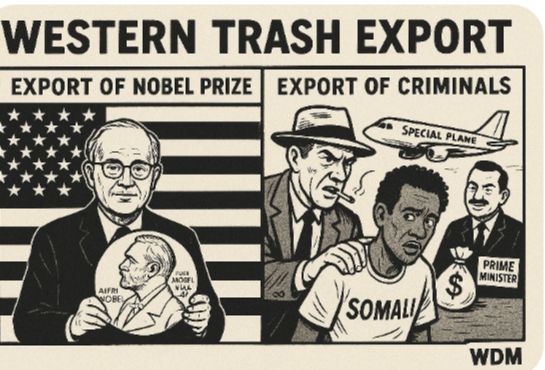
WESTERN TRASH EXPORT – THE NEW HUMAN TRAFFICKING

  October 4, 2025 

WDM SATIRE

The West has perfected a new export commodity: its own criminals.

When once upon a time Europe exported philosophy, democracy, and industrial technology, today it exports convicted felons – all nicely packaged with “Somali-Swedish” or “African-American immigrant” labels. The United States, under policies promoted by the Trump administration, is now a leader in this field, actively negotiating deals with African nations to accept “third-country” deportees . Sweden, the so-called land of Nobel Prizes and neutrality, has become the Nobel laureate of deportation hypocrisy.

Instead of investing in rehabilitation or bearing the full cost of incarceration for its own societal dregs, the West now treats Africa like a dumping ground for toxic waste. Except this time the waste breathes, steals, and kills. The rhetoric is flowery – “third-country deportation,” “security cooperation,” and removing “uniquely barbaric monsters” from American soil . But peel the diplomatic wrapping paper, and you find something uglier: a form of human trafficking in reverse, a practice that echoes the dynamics of “waste neocolonialism,” where environmental burdens are shifted onto the Global South .

Poverty as Landfill

Why Somalia? Why Eswatini? Because poverty and political vulnerability make it easy. Fragile states and desperate leaderships are presented with a “carrot and stick” approach by Western powers . As one analyst noted, some African governments agree to receive convicted deportees as a “goodwill gesture, aiming to improve US ties and be in Trump’s good books” . Western governments engage in “robust high-level engagements,” and then load a “Special Plane” with hardened criminals for delivery. Somalia and Eswatini get more instability and more gang wars, while Washington and Stockholm get cleaner streets, lower prison bills, and applause from their far-right echo chambers.

This practice is not accidental; it is a systemic feature. It mirrors the “hypocrisy of the Western aid regime,” where governments that officially promote human rights simultaneously support and engage in policies that undermine the sovereignty and safety of African nations . The very countries expressing outrage at regional security collaborations are the ones offloading their security problems onto the same region .

Nordic Hypocrisy Meets African Complicity

What we are watching is not just deportation. It is a joint-venture between Western hypocrisy and African complicity. It is a marriage of convenience between smug bureaucrats in Washington and officials in Mogadishu or Mbabane. The U.S. waves the flag of the “rule of law,” claiming deportees “received due process and had a final order of removal from an immigration judge” , while critics argue the receiving nations are betraying their citizens’ right to security. In Eswatini, opposition leaders have denounced the move as making their country a “criminal dumpsite” and an abuse of national sovereignty .

A Grim Satire of “Aid”

Aid used to be (in theory) for schools, clinics, and roads. Today, it can include budget lines for dumping criminals. Development cooperation is being reduced to crime outsourcing. While the U.S. insists it offers no financial reward for accepting deportees , the broader system of aid and engagement creates powerful incentives. Somalia gets killers and a broken social order, while Eswatini, with its prisons already operating at over 170% capacity, is forced to house foreign criminals . Meanwhile, officials fly to Geneva to lecture about “partnerships for peace.”

WDM Final Word

When citizens of Somalia or Eswatini are forced to live with foreign-trained, Western-naturalized gangsters disguised as “returnees” or “third-country nationals,” one must ask: what kind of sovereignty is this? What kind of leadership trades its people’s safety for geopolitical goodwill?

This is not merely deportation. It is neo-colonial waste management, a direct parallel to the export of hazardous electronic and plastic waste to the developing world . And the garbage, tragically, is human.