
By Ismail H Warsame, MSc, PhD Candidate, Author of Talking Truth to Power in Undemocratic Tribal Conttext.
Warsame Digital Media (WDM). September 30, 2025
Keywords: criminal justice, wealth inequality, bail, pretrial detention, public defense, prosecutorial discretion, legal aid, social control.
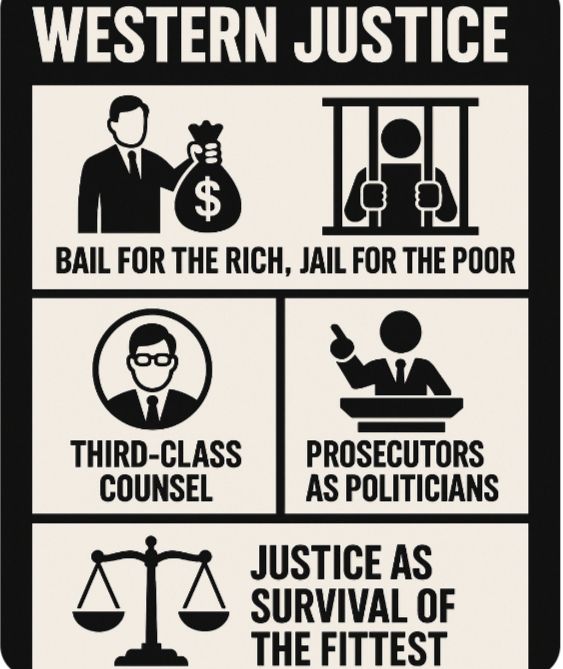
Abstract: The Western world proudly proclaims itself the cradle of democracy, human rights, and the rule of law. Its courtrooms are stages for a noble performance of impartial justice. Yet, behind this veneer of order and due process lies a system deeply compromised by a fundamental bias: not of ideology, but of income. The machinery of justice, while coded in the language of fairness, often functions as an instrument of social control that systematically disadvantages the poor and marginalizes communities of color. This paper argues that the foundational principles of Western justice are subverted by a wealth-based tiering of the system, evident in the practices of pretrial detention, the crisis of legal aid, and the perverse incentives of prosecutorial conduct, ultimately transforming the ideal of justice from a fundamental right into a purchasable commodity.
Wealth-Based Detention: The Presumption of Innocence at a Price
The cornerstone legal principle of “innocent until proven guilty” is critically undermined at the juncture of the bail hearing. In theory, bail ensures a defendant’s return to court; in practice, it has become a mechanism for the detention of the indigent. As legal scholar John Pfaff argues, the rapid expansion of pretrial detention is a primary driver of mass incarceration in the United States. For the affluent, bail is a procedural formality; freedom is purchased, allowing them to await trial at home, maintain employment, and collaborate intensively on their defense. For the poor, however, pretrial detention is the default. Unable to afford even modest sums, they remain in jail for months or even years. The consequences are catastrophic: jobs are lost, homes are forfeited, and families are fractured—all before a verdict is reached. This dynamic creates a coercive pressure to plead guilty, regardless of actual guilt, simply to escape jail time. This is not a punishment for a proven crime, but a severe penalty for poverty, effectively creating a two-track system where liberty is contingent on wealth.
The Illusion of Defense: The Systemic Failure of Legal Aid
The Sixth Amendment right to counsel is guaranteed, but the quality and efficacy of that counsel are not. The institution of legal aid and public defense, intended to level the adversarial playing field, is in a state of chronic crisis. Public defenders are often heroic in their efforts but are hopelessly overburdened, carrying caseloads that far exceed professional standards and make vigorous representation a mathematical impossibility. This systemic underfunding creates an inherent conflict. As organizations like the Brennan Center for Justice have documented, defenders are institutionally enmeshed within the very state apparatus they are meant to challenge, leading to a “meet ’em and plead ’em” culture in many jurisdictions. The accused is not represented by a gladiatorial advocate but by a case manager operating under triage conditions. This profound resource disparity means that from the outset, the defense is outmatched by a prosecution armed with the full investigative and financial power of the state, rendering the constitutional right to counsel a hollow formality for many.
The Incentive for Conviction: Prosecutorial Discretion and the Pursuit of Victory
The prosecutor’s ethical duty is to seek justice, not merely to convict. However, the institutional and professional incentives within the prosecutorial system often prioritize conviction rates. As legal scholar Angela J. Davis demonstrates, prosecutors wield immense discretionary power with minimal accountability, and their decisions are frequently influenced by political and career ambitions. Each conviction becomes a quantifiable “win,” a credential for election campaigns or a stepping stone to a judgeship. This transforms the courtroom from a search for truth into an adversarial arena where the primary goal is victory. The pressure to secure plea bargains and high-profile convictions can eclipse the ethical duty to disclose exculpatory evidence or pursue dismissals in weak cases.The casualties of this careerist competition are, predictably, those who lack the social and economic capital to mount a formidable defense: the poor, minorities, and other marginalized groups. This dynamic reinforces the system’s discriminatory outcomes and undermines its legitimacy.
Conclusion: The Corrosion of a Democratic Ideal
The evidence from these three critical areas—pretrial detention, public defense, and prosecutorial incentives—reveals a justice system that is not merely malfunctioning but is fundamentally flawed in its design. A system that promises equal protection under the law while delivering outcomes predicated on financial capacity is a monument to systemic hypocrisy. It perpetuates cycles of poverty and incarceration, erodes public trust, and betrays the core democratic principle that the law should be a shield for the vulnerable. The commodification of justice ensures that the system remains self-perpetuating, processing the marginalized to feed the prison-industrial complex. Meaningful reform—such as the abolition of cash bail, the radical reinvestment in public defense, and the creation of robust prosecutorial oversight—is necessary to begin restoring integrity. Until there is a collective will to dismantle these profit-driven and punitive structures, Western courts will remain sophisticated engines of inequality, betraying the very ideals they were established to uphold.
——
Bibliography
Davis, Angela J. Arbitrary Justice: The Power of the American Prosecutor. New York: Oxford University Press, 2007.
Gideon v. Wainwright, 372 U.S. 335 (1963).
Gottschalk, Marie. Caught: The Prison State and the Lockdown of American Politics. Princeton: Princeton University Press, 2015.
Pfaff, John F. Locked In: The True Causes of Mass Incarceration and How to Achieve Real Reform. New York: Basic Books, 2017.
Rabbit, Leah, and Emily Zubrovsky. “The Causes and Consequences of Overworked Public Defenders.” Brennan Center for Justice, August 10, 2022.
Subramanian, Ram, et al. Incarceration’s Front Door: The Misuse of Jails in America. New York: Vera Institute of Justice, 2015.
Alexander, Michelle. The New Jim Crow: Mass Incarceration in the Age of Colorblindness. New York: The New Press, 2010.
 Warsame Policy & Media Network (WAPMEN)