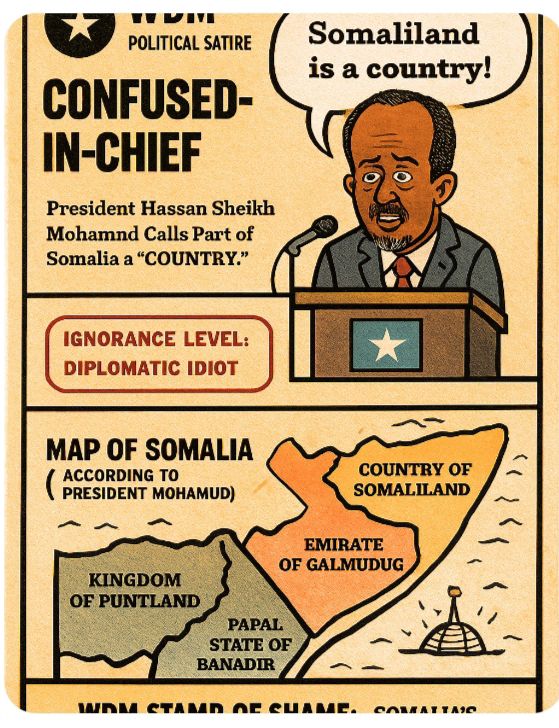
WDM POLITICAL SATIRE: THE “COUNTRY” THAT WASN’T

https://x.com/GuledWiliq/status/1971305480988541296/video/1

So, ladies and gentlemen, we finally got it. The head of state of the Federal Somali Republic—yes, the man supposedly tasked with defending its sovereignty—steps up to a press podium and calls Somaliland a country. You heard it right. Not a “region,” not a “self-declared administration,” not even the diplomatic cliché of “Somaliland authorities.” Nope. Straight from the Villa Somalia dictionary of political blunders: country.

Is Hassan Sheikh Mohamud stupid, ignorant, or just auditioning for a UN press officer role in Hargeisa?

A President Who Can’t Read His Own Constitution

The same constitution he swore to uphold clearly spells out that Somalia is one, indivisible, sovereign state. Yet here he is, in front of flashing cameras, doing public relations for a secessionist project. If this isn’t political malpractice, then Somalia must have invented a new category: treason by microphone.

Somaliland Leaders Must Be Laughing

Imagine the scene in Hargeisa. Ministers sipping tea, watching Hassan on flat-screen TVs, bursting into applause. “He finally said it! We don’t need recognition from Washington, Brussels, or the African Union anymore—Mogadishu’s very own president just gave it to us live on air!” Congratulations, Mr. President. You just became Somaliland’s unpaid foreign minister.

Somalia’s Unity: Outsourced and Auctioned

This is the tragicomic state of affairs: while Ethiopian soldiers are “peacekeeping” in Beledweyne, Al-Shabaab is planting IEDs, Puntland is bleeding in CalMiskaad mountains, and youth are fleeing across deserts to die in dinghies—our president is busy redefining geopolitics at a press conference, handing out sovereignty like it’s a charity project.

The WDM Verdict

Somalia doesn’t need enemies. Not when its president is on the payroll of stupidity. Not when the man trusted with holding the Somali flag can’t distinguish between “state,” “federal member state,” and “country.” Hassan Sheikh Mohamud has just graduated summa cum laude in Diplomatic Idiocy.

And if the Somali public doesn’t shout back, loud and clear, then tomorrow he’ll be calling Puntland a kingdom, Galmudug an emirate, and Banadir a papal state.

WDM Stamp of Shame: Hassan Sheikh Mohamud – Somalia’s accidental secessionist-in-chief.
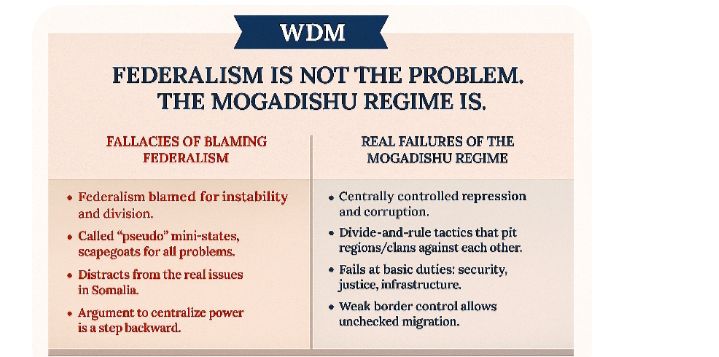
The Scapegoat and the Saboteur: How the Mogadishu Regime Undermines Somali Federalism

Introduction: The Misplaced Blame
A persistent narrative within certain Somali political circles claims federalism is the root cause of the nation’s instability,insecurity, and fragmentation. This centralist critique, often tinged with nostalgia, conveniently identifies the federal member states—Puntland, Jubbaland —as the primary obstacles to unity. This essay argues that this diagnosis is not merely incorrect; it is a dangerous diversion. The true engine of Somalia’s dysfunction is not the federal model itself, but the Mogadishu regime, which has systematically sabotaged the federal compact while expertly scapegoating it for its own catastrophic failures.

The Organic Origins of Federalism: A Shield, Not a Weapon
To blame federalism for Somalia’s collapse is to fundamentally misread history.Federalism was not an imported ideology imposed upon a functioning state. It was an organic, necessary response to the total vacuum left by the collapse of the centralist dictatorship in 1991. For decades, the Mogadishu-centric state was built on repression, clan favoritism, and rampant corruption, leading to its inevitable implosion. In the ensuing chaos, local communities were left to fend for themselves, forging regional administrations to provide security, justice, and basic services that Mogadishu could not. Therefore, federalism is not the cause of disintegration but a pragmatic framework to manage diversity and rebuild a fractured nation from the bottom up. It is a shield against the very tyranny that shattered the country.

The Mogadishu Regime: A Cartel of Division
The so-called Federal Government of Somalia(FGS) often operates less as a national unifier and more as a rent-seeking cartel, sustained by international donor funds and foreign security proxies. Rather than nurturing the federal project as envisioned in the Provisional Constitution, it has waged a relentless campaign of political and financial attrition against the member states. The regime in Mogadishu has perfected a cynical strategy of divide-and-rule, manipulating clan tensions and pitting regional administrations against one another to prevent a united front that could demand accountability.

This sabotage is not merely rhetorical; it is operational. Critical national functions like border control, immigration, and customs—the very levers of sovereignty—are concentrated in Mogadishu. The unchecked demographic shifts and security threats often blamed on the federal states are, in reality, enabled by a central regime that treats entry permits and border policy as political currency. While member states are accused of separatism, it is Mogadishu that fails to provide equitable infrastructure, economic opportunity, or even a reliable share of national resources, thereby creating the very conditions of neglect it then decries.

The Centralist Mirage: A Return to Failure
The argument that recentralizing power would”save” Somalia is a recipe for repeating the catastrophes of the past. The hyper-centralized state is the failed model that led to civil war. Dismantling federalism would not restore unity; it would strip communities of their hard-won autonomy and reignite the very conflicts that the federal structure seeks to manage. While the current federal system is imperfect and its implementation often contentious, it remains the only viable mechanism for balancing power and ensuring that all Somali communities have a stake in the national project. To weaken it is to empower the same centralizing impulses that destroyed the nation.

Conclusion: Accountability Over Allegory
The problem is not federalism.The problem is a Mogadishu regime that refuses to be a government for all Somalis, thrives on manufactured crises, and evades accountability by blaming the federal architecture. Somalia’s path forward does not lie in dismantling the federal system but in strengthening it. This requires building genuine partnership between the center and the states, adhering to the constitution, and, most importantly, holding the Mogadishu regime responsible for its role as a saboteur rather than a savior. True patriotism demands that we identify the real culprit, not its convenient scapegoat.