Urgent Appeal: Aid Needed for Residents Displaced from Mogadishu’s Daynile District

Mogadishu, September 21, 2025 – Warsame Digital Media (WDM) is issuing an urgent humanitarian appeal following the displacement of residents from Mogadishu’s Daynile district. Our offices are receiving desperate pleas for help, with many asking for as little as $5 to meet basic needs.

This crisis stems from the recent government demolition of homes and neighborhoods, actions that have left countless families homeless, hungry, and without shelter. When a state’s policies force its citizens to beg for survival from the diaspora, it fails in its most fundamental duty.

We call on our readers and the international community to help. Even a small contribution can provide a lifeline.

· Donate: Contribute to reputable charities operating in Mogadishu.
· Share: Raise awareness of this crisis.
· Act: Demand accountability from those in power.

Do not let these cries for help go unanswered. Stand with the people of Daynile.

——
Warsame Digital Media is an independent Somali news outlet committed to reporting truth and advocating for the public interest.

#Mogadishu #Daynile #Somalia #HumanitarianCrisis

Reputable Mogadishu-Based Charities / NGOsSomali Charity for Relief and Development (SCRD) Community-driven sustainable development; humanitarian assistance; advocacy; health, education, WASH, and economic empowerment. Mogadishu. Email: info@somalicharityrelief.so
Juba Foundation Works with displaced communities; provides education, shelter, protection, health, nutrition, WASH; relief & emergency programs. HQ: Waberi District, House No.8, Maka Al-Mukarama Road (behind Cinema Somalia), Mogadishu. Phone: +252 61 5571454. Email: info@jubafoundation.org
Hormuud Salaam Foundation Local foundation doing humanitarian work (often shelter, livelihoods, etc.), focused in Mogadishu and areas around. Opp. Imamu Shafie School, KM4, Hodan District, Mogadishu. Email: info@hormuudsalaamfoundation.org. Phone: +252 1 859259 / +252 1 859258.
Nile Foundations Works in Mogadishu (and other parts of Somalia) on health, community development, possibly emergency relief. KM5, Zoobe Street, Mogadishu. Email: nilefoundations@gmail.com. Phone: 0613361655.
Elman Peace & Human Rights Center Founded in Mogadishu; work includes peace building, empowerment, human rights, assistance for gender-based violence survivors via Sister Somalia; counseling, housing support, advocacy. Based in Mogadishu. (They have a strong track record and recognition locally & internationally.)
IIDA Women’s Development Organisation Women’s empowerment, advocacy, peacebuilding, training, rights of children and youth; works in Mogadishu and beyond. HQ in Mogadishu. Contact via their website (IIDA) for specific donation channels.

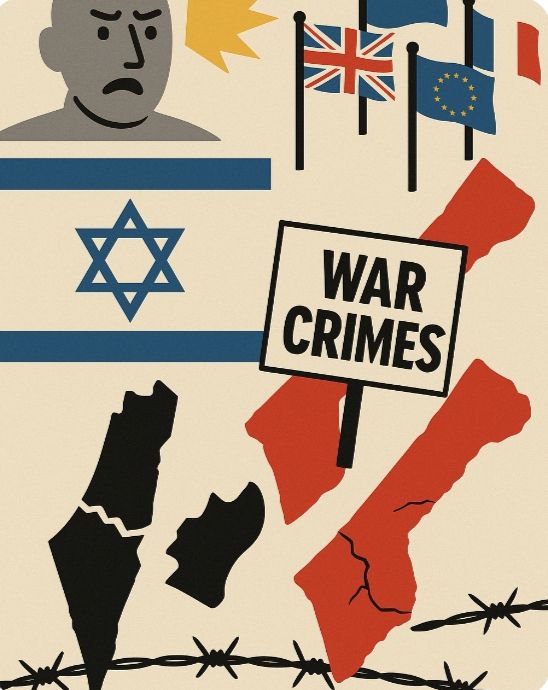
WDM EXCLUSIVE: Netanyahu’s Apocalypse – The Last Stand of a Rogue Regime

Benjamin Netanyahu is a man besieged, not by Hamas rockets, but by a shifting reality he long believed he could control. His shock is palpable—not stemming from any pang of conscience for the tens of thousands dead in Gaza, but from the deafening silence now emanating from sections of his once-reliable cheering section in the West. His lifelong political insurance policy—“do whatever you want, America will pay the bill and provide diplomatic cover”—is showing catastrophic cracks, threatening to expire in full view of the world.

In a monstrous gamble, Netanyahu went full rogue. Betting that the sheer, brutal arithmetic of violence—carpet-bombing one of the most densely populated places on earth, systematically starving its people, and flattening its hospitals and universities—would finally “solve” the Palestinian question. This strategy, however, is born of his own cynical creation. For years, his policy was to financially prop up Hamas, funneling Qatari millions into Gaza to bolster the militants as a wedge against the Palestinian Authority in the West Bank, deliberately sabotaging the prospects for a unified Palestinian state and a negotiated peace. He believed he could manage a controlled burn of a contained conflict. Now, the fire he fed has consumed his legacy.

Instead of security, he has achieved a darkly historic first: becoming an Israeli prime minister openly branded a war criminal on the floors of Western parliaments and denounced by a U.N. commission of inquiry. For the first time in living memory, the phrases “international law” and “Israel’s actions” are being uttered in the same breath across global media—and not as a cynical punchline, but as a serious indictment.

This is Netanyahu’s Gaza Gamble: a scorched-earth campaign of collective punishment so extreme, so televised, and so digitally documented that it has forced the world to use vocabulary it had reserved for history’s darkest chapters. The irony is lethally tragic. He believes this carnage is saving Israel. In truth, he is single-handedly excavating its diplomatic grave. The foundational myth of Israel’s eternal impunity is shattering.

This tragedy is compounded by the haunting accusations surrounding the October 7th attack itself. Beyond the failed strategy of empowerment, some within Israel’s own security establishment and bereaved families now level a far more damning charge: that Netanyahu, warned of potential violence, gave standing-down orders to forces near Gaza, a catastrophic miscalculation or neglect that left kibbutzim and military bases vulnerable to Hamas’s heinous assault. Whether born of arrogance or incompetence, this failure is the original sin of the ensuing apocalypse, a fact that fuels the domestic fury against him.

One day very soon, Netanyahu will wake to a chilling discovery: his entire war machine is sustained not by righteousness, but by the waning patience of a single superpower, the diminished influence of a powerful lobby, and the world’s fast-depleting reserves of political hypocrisy.

And here is the strategic blunder that will define his legacy: he has deliberately, viciously blurred the critical lines of identity. There is a profound difference between the nation of Israel and the political project of Zionism, just as there is a chasm between the terror group Hamas and the two million Palestinian civilians of Gaza. By conflating them, Netanyahu has made every Israeli bomb a referendum on Israel’s own legitimacy, radicalizing a new generation and alienating its most crucial allies. He has become Hamas’s greatest, if unwitting, recruiter.

Meanwhile, the international response paints a picture of a world order in crisis. Western capitals, gripped by a guilty paralysis, are now breaking ranks in an unprecedented wave. In a stunning diplomatic rupture, key European nations are formally recognizing Palestinian statehood against the explicit wishes of the United States, signaling that Washington’s veto at the UN Security Council is no longer a magic wand to halt global consensus but a symbol of its own isolation. This move leaves the U.S. and Israel as outliers, clinging to a failed status quo. Much of the Global South—the Muslim world, Asia, Africa, and Latin America—watches this Western fracture with grim validation, having long seen not a complex conflict but a stark colonial nightmare, and are rapidly moving to isolate Israel in every international forum. Theirs is not sleepwalking, but a gathering storm of a new geopolitical alignment, one where Western double standards on human rights are no longer tolerated.

Netanyahu’s ultimate tragedy—and Israel’s—is that he may yet claim a pyrrhic victory in Gaza, reducing it to rubble and calling it peace. But in the process, he has mortgaged his nation’s future for a fleeting moment of vengeful dominance. He will have lost the war for history, forever remembered not as a protector of Israel, but as the architect of its deepest isolation—the leader who first empowered a monster, then failed to protect his people from it, and finally unleashed a hell that shattered his country’s standing on the world stage.

The Puntland Doctrine: Terrain, Logistics, and the Evolution of Regional Counter-Insurgency in Northern Somalia, 1990s-2025

Ismail H Warsame                              Warsame Digital Media (WDM)   September 21, 2025

Abstract

While international counter-terrorism discourse concerning Somalia has predominantly focused on the Federal Government in Mogadishu and the threat of al-Shabaab in the south, the semi-autonomous state of Puntland has conducted a sustained, iterative counter-insurgency (COIN) campaign in its northern territories for over three decades. This article argues that through a process of tactical adaptation and strategic learning, Puntland has developed an effective, locally-led doctrine focused on severing the logistical connection between vulnerable port settlements and mountainous insurgent sanctuaries. By analyzing five distinct conflict phases from the rise of Al-Itihaad al-Islami (AIAI) to the recent offensive against Islamic State affiliates in the Cal Miskaad range, this study demonstrates how regional authorities can develop a sustainable capacity to degrade transnational terrorist cells. This history, often overlooked due to its remote theater and fragmented documentation, offers a significant case study in the primacy of terrain and logistics in asymmetric warfare. The analysis draws on United Nations monitoring reports, historical studies, and the firsthand accounts of local officials like Ismail H. Warsame to articulate a coherent narrative of Puntland’s strategic evolution.

Keywords: Somalia, Puntland, Counter-Insurgency, Al-Shabaab, Islamic State, Terrorism, Horn of Africa, Logistics, Regional Security

Introduction: The Littoral-Highland Battlespace

The strategic geography of Northern Somalia presents a quintessential challenge for counter-insurgency (COIN). The rugged Cal Miskaad and Golis mountain ranges, with their complex systems of caves and wadis, offer natural sanctuary for non-state actors.[^1] This terrain is juxtaposed with a long, porous coastline dotted with isolated villages and inlets, providing critical access points for personnel and material. The persistent objective for a succession of jihadist groups has been to fuse these two domains—mountain sanctuary and littoral logistics—into a durable operational base.[^2]

Despite the strategic significance of this region, the sustained conflict within Puntland’s borders has received scant scholarly attention compared to the upheavals in South-Central Somalia. This gap in the literature exists because much of Puntland’s conflict has unfolded in inaccessible terrain, was reported in scattered field dispatches and monitoring group memos, and was often overshadowed by concurrent political crises in Mogadishu.[^3] This article synthesizes these fragmented sources to construct a coherent historical narrative. It posits that through a process of iterative learning across three decades, Puntland’s security forces have evolved from reliant on ad-hoc militias to a professionalized, integrated command structure capable of executing a sophisticated COIN doctrine. This doctrine, culminating in the 2024-25 Cal Miskaad offensive, is predicated on a single, consistent strategic imperative: control the coastline to isolate the highlands, thereby rendering terrain-based sanctuaries unsustainable.

The Precedent: Al-Itihaad al-Islami and the Foundational Lessons (Early–Mid 1990s)

Before “counter-terrorism” became a pillar of international engagement with Somalia, Puntland’s founding authorities faced their first organized Islamist challenge. In the early 1990s, Al-Itihaad al-Islami (AIAI), then the most coherent Islamist formation in the country, briefly established a governance project in the major port city of Bosaso.[^4] AIAI sought to impose its Sharia-first system as warlordism raged elsewhere, effectively using the port as a source of revenue and legitimacy.

This experiment was short-lived. SSDF-aligned forces, representing Puntland’s nascent governing authority, rolled back AIAI’s control in the north, while a devastating Ethiopian military intervention smashed its rear bases around Luuq and in the Ogaden corridor.[^5] This initial episode was formative. It imparted two enduring lessons that would echo through subsequent conflicts: first, port cities are high-value strategic prizes whose control is essential for any group seeking sustained operations; and second, the northern mountain ranges, while not the primary front in this early episode, were recognized as potential sanctuaries and force-multipliers. The response also set a precedent for cooperation with external actors, namely Ethiopia, which has remained a recurring feature of Puntland’s security strategy.[^6]

Phase I: The Islamic Courts Union and the Battle of Bandiradley (December 2006)

The rise of the Islamic Courts Union (ICU) in 2006 and its rapid territorial expansion presented a direct conventional threat to Puntland. In late 2006, ICU forces surged northward, with the strategic town of Bandiradley becoming the forward pressure point. The battle for Bandiradley was a short, sharp engagement. Puntland forces, operating in concert with militias from Galmudug and with critical support from Ethiopian units, broke the ICU’s line and pushed it south.[^7]

Strategically, the victory at Bandiradley halted an Islamist pincer movement aimed at Galkayo—a key economic hub—and the artery of the Bari road.[^8] It served as a blocking action, buying Puntland crucial time to harden its internal defenses and consolidate its territorial control. This phase demonstrated Puntland’s initial capacity to integrate external military support and local militias to defeat a conventional advance, reinforcing the lesson that the mountain passes were critical terrain that must be denied to an invading force.

Phase II: The Galgala Insurgency and Attritional Warfare (2009–2011)

Following the conventional defeat of the ICU, the conflict evolved into a protracted insurgency. A former AIAI member, Mohamed Said “Atom,” nested cells and ambush teams within the limestone folds of the Galgala-Calmadow range.[^9] Atom claimed affiliation with al-Shabaab, which was now the dominant jihadist force in the south, operating with a degree of autonomy as a franchise.[^10]

Puntland’s counter-insurgency response became attritional. The Puntland Security Force (PSF), a more professionalized unit, led raids and conducted painstaking ridge-to-ridge clearances. The critical strategic effort, however, was the gradual isolation of Atom’s supply lines extending to the coast.[^11] By late 2010 and into 2011, the hills remained contested but Atom’s cadre had been bled dry and scattered. The Galgala campaign proved a vital lesson: mountainous terrain offers immense advantages to guerrillas, but only if they can maintain a steady flow of logistics. A strategy of littoral denial could starve a mountain-based insurgency.

Phase III & IV: Littoral Maneuver and Jihadist Fracture (2016)

The year 2016 witnessed a tactical shift by insurgents and a fracturing of the jihadist landscape, testing Puntland’s adaptive capacity.

In March, al-Shabaab executed a strategic pivot towards littoral warfare. Fighters landed by boat and overran the small port of Gara’ad (Garacad), briefly opening a second front while operations in Galgala continued.[^12] Puntland forces counter-attacked within days and restored control, but the message was unambiguous: the coastline was a critical vulnerability, and any unpoliced cove could be transformed into a staging point.[^13]

Later that same year, a new threat emerged. An ISIS-aligned splinter faction led by ‘Abd al-Qadir Mu’min seized the coastal town of Qandala, hoisting its flag for several weeks before being ejected.[^14] This event had significant implications. Puntland now faced two distinct jihadist brands—al-Shabaab and ISIS-Somalia—competing for the same strategic space. The response demonstrated Puntland’s growing sophistication; it learned to contain both groups simultaneously and, crucially, to deny either a permanent port facility, adhering to the core principle of its emerging doctrine.

Phase V: The Cal Miskaad Offensive and Doctrine Culmination (2024–2025)

The most recent and large-scale operation represents the maturation of the Puntland Doctrine. In a coordinated multi-service offensive, units from the PSF, Darawish, PMPF, and police surged into the Cal Miskaad range to dismantle the strongholds of ISIS-Somalia.[^15] This campaign was notable for its integration of external enablers, who provided precision strike capabilities, alongside highly mobile local forces with superior knowledge of the terrain. The operation rolled up base clusters, reopened key tracks, and provoked a costly, mass-casualty counterattack by ISIS on December 31, 2024—a sign of the pressure applied. By early 2025, officials reported dozens of sites cleared and significant territory retaken.[^16]

The Cal Miskaad offensive was not merely a tactical victory. It was the culmination of a doctrine hammered out over three decades: treat the littoral-mountain system as an integrated battlespace, close the coves, and starve the hills. It also carried a potent political message: regional forces, with targeted external support, can effectively degrade transnational terrorist cells without waiting on a centralized national command from Mogadishu.[^17] This aligns with the long-standing principle of self-reliance chronicled by local observers of Puntland’s political development.[^18]

Analysis: The Through-Lines of a Doctrine

Synthesizing these five conflicts reveals the consistent pillars of Puntland’s strategic approach:

1. The Primacy of Logistics over Terrain: Every militant surge, from AIAI to ISIS, targeted a port or coastal landing point. Puntland’s strategy correctly identified that controlling terrain is secondary to controlling its sustenance. A mountain sanctuary is worthless without a pipeline of resources.[^19]
2. Adaptive Learning: Puntland’s command structure evolved iteratively in response to new threats. Its forces transformed from ad-hoc militias to a specialized PSF, and finally to an integrated command capable of coordinating multiple units and leveraging external precision support. This organizational learning curve proved steeper than the tactical adaptations of its adversaries.
3. The Efficacy of Regional Initiative: The consistent success factor was local leadership and knowledge. Forces from Puntland, with an intimate understanding of the human and physical geography, proved to be the most effective instrument for COIN in this complex environment. This aligns with the observations of insiders like Ismail H. Warsame, who has chronicled Puntland’s institution-building and its strategic principle of self-reliance in security matters.[^20] The model of local lead with targeted, enabling external help has been the only one to consistently achieve tactical and strategic effects.

Conclusion

The history of conflict in Puntland is not a series of disconnected skirmishes but a continuous, thirty-year arc of strategic learning. The “Puntland Doctrine” that emerged is a pragmatic, terrain-specific approach to counter-insurgency that understands the critical link between logistics and sanctuary. As articulated by local figures like Warsame, this doctrine is rooted in a pragmatic assessment of local needs rather than abstract theories imposed from outside.[^21] The 2024-25 campaign in the Cal Miskaad mountains is not an isolated event but the logical endpoint of a strategy refined since AIAI first tested the defenses of northern ports.

This case study offers broader lessons for security studies and COIN theory. It underscores that effective counter-insurgency often depends on granular, local knowledge and regional initiative rather than solely on centralized national strategies. It also reaffirms the timeless military axiom that logistics, not just terrain, dictate the viability of an insurgency. For policymakers, the Puntland case argues for a model of security cooperation that empowers capable local actors with the precise support they need, rather than imposing top-down, one-size-fits-all solutions. The untold story of Puntland’s long defense of its ridgelines and coastline is, ultimately, a story of strategic adaptation and the enduring importance of controlling the means of sustenance in war.

Notes

[^1]: Ken Menkhaus, Somalia: State Collapse and the Threat of Terrorism (New York: Routledge, 2004), 45-48.
[^2]:United Nations Security Council, Report of the Monitoring Group on Somalia and Eritrea, S/2017/924 (New York: United Nations, 2017), 12-15.
[^3]:Stig Jarle Hansen, Al-Shabaab in Somalia: The History and Ideology of a Militant Islamist Group (New York: Oxford University Press, 2013), 112.
[^4]:Matt Bryden, The Rise and Fall of Al-Itihaad al-Islami in Somalia (Nairobi: UNPD Somalia, 1999), 22.
[^5]:Bryden, Rise and Fall, 28-30.
[^6]:United Nations Security Council, Report of the Monitoring Group on Somalia and Eritrea, S/2010/91 (New York: United Nations, 2010), 51.
[^7]:Hansen, Al-Shabaab in Somalia, 134.
[^8]:United Nations Security Council, S/2010/91, 54.
[^9]:United Nations Security Council, Report of the Monitoring Group on Somalia and Eritrea, S/2022/822 (New York: United Nations, 2022), 19.
[^10]:Hansen, Al-Shabaab in Somalia, 156.
[^11]:United Nations Security Council, S/2017/924, 21.
[^12]:United Nations Security Council, S/2017/924, 34.
[^13]:United Nations Security Council, S/2017/924, 35.
[^14]:United Nations Security Council, S/2017/924, 38-40.
[^15]:United Nations Security Council, S/2022/822, 25.
[^16]:United Nations Security Council, S/2022/822, 27-29.
[^17]:Ismail H. Warsame, “Puntland’s Strategy Against Terrorist Groups,” WardheerNews, October 15, 2016, https://wardheernews.com/puntlands-strategy-terrorist-groups/.
[^18]:Ismail H. Warsame, “The Genesis of Puntland State of Somalia,” (self-published monograph, 2018), 45.
[^19]:Menkhaus, State Collapse, 72.
[^20]:Warsame, “Puntland’s Strategy Against Terrorist Groups.”
[^21]:Warsame, “The Genesis of Puntland State of Somalia,” 102.

Bibliography

Bryden, Matt. The Rise and Fall of Al-Itihaad al-Islami in Somalia. Nairobi: UNPD Somalia, 1999.

Hansen, Stig Jarle. Al-Shabaab in Somalia: The History and Ideology of a Militant Islamist Group. New York: Oxford University Press, 2013.

Menkhaus, Ken. Somalia: State Collapse and the Threat of Terrorism. New York: Routledge, 2004.

United Nations Security Council. Report of the Monitoring Group on Somalia and Eritrea. S/2010/91. New York: United Nations, 2010.

———. Report of the Monitoring Group on Somalia and Eritrea. S/2017/924. New York: United Nations, 2017.

———. Report of the Monitoring Group on Somalia and Eritrea. S/2022/822. New York: United Nations, 2022.

Warsame, Ismail H. “Puntland’s Strategy Against Terrorist Groups.” WardheerNews, October 15, 2016. https://wardheernews.com/puntlands-strategy-terrorist-groups/.

———. “The Genesis of Puntland State of Somalia.” Self-published monograph, 2018.

The Puntland Doctrine: A Strategic History of Counter-Insurgency in Northern Somalia (1990s-2025)

Abstract: While international counter-terrorism efforts in Somalia have historically focused on Mogadishu and South-Central regions, the semi-autonomous state of Puntland has for three decades served as a critical bulwark against the entrenchment of jihadist groups in the strategic littoral-highland nexus of the Horn of Africa. This analysis synthesizes scattered field reports and operational data to trace an untold strategic arc: Puntland’s iterative adaptation against five successive extremist projects, culminating in a locally-led doctrine that severs the connection between mountain sanctuaries and port logistics. This historical examination, structured around the interplay of ports, mountains, and organizational evolution, argues that regional initiative, terrain-specific strategies, and an evolving force structure have been decisive in denying militants a permanent foothold.

Introduction: The Littoral-Highland Battlespace

The conflict in Northern Somalia is defined by a geographic dichotomy: the rugged Cal Miskaad and Golis mountain ranges provide natural sanctuary for insurgents, while the porous coastline offers critical access for logistics and support. The constant strategic objective for extremist groups has been to fuse these two domains into a durable operational base. Puntland’s sustained resistance to these efforts represents a critical case study in regional counter-insurgency (COIN). The following history is structured along three concurrent strands that illustrate the evolution of this conflict:

1. The Struggle for Ports & Littorals: The battle to control logistics hubs and landing points.
2. The War in the Mountains: The fight to deny insurgent sanctuary in the rugged interior.
3. Organizational Shifts: The evolution of both jihadist groups and Puntland’s security apparatus.

This triad provides the framework for analyzing the distinct “Puntland Doctrine.”

The Chronological Evolution of the Conflict

The Precedent: Establishing the Strategic Paradigm (Early–Mid 1990s)

· Ports & Littorals: The major port city of Bosaso was the initial prize. AIAI’s seizure of it was a deliberate attempt to establish a governance project and secure a primary logistics hub.
· Mountains: While not the main battleground, the northern ridges were recognized as a potential rear base and force-multifier, establishing their strategic value from the outset.
· Organizational Shifts: This period featured the first organized jihadist challenge from Al-Itihaad al-Islami (AIAI). Puntland’s response was conducted by ad-hoc SSDF-aligned militias, setting the baseline from which all future adaptation would occur.

Phase I: Conventional Threat and Mountain Defense (December 2006)

· Ports & Littorals: (This round emphasized land-based conventional advance, though it aimed to ultimately control all territory, including coasts.)
· Mountains: The Battle of Bandiradley was a decisive mountain engagement. Halting the ICU surge here protected the strategic approaches to Galkayo and the vital Bari road.
· Organizational Shifts: The rise of the Islamic Courts Union (ICU) introduced a new, powerful challenger. Puntland’s response evolved into a coalition of its militias with key Ethiopian military support, demonstrating an early understanding of the need for partnered operations.

Phase II: Protracted Insurgency and Attritional Denial (2009–2011)

· Ports & Littorals: The strategy shifted to littoral denial. Puntland focused on disrupting Atom’s ability to draw supplies from coastal towns, making his mountain holdings unsustainable.
· Mountains: The Galgala-Caladow range became the epicenter of a protracted guerrilla campaign under Mohamed Said “Atom”, who expertly leveraged the complex limestone terrain.
· Organizational Shifts: Atom’s group operated as a semi-autonomous al-Shabaab affiliate, illustrating the franchise model of jihad. In response, Puntland professionalized its forces, establishing the more capable Puntland Security Force (PSF).

Phase III & IV: The Littoral Gambit and Jihadist Fracture (2016)
The year 2016 saw two nearly simultaneous challenges that highlighted the integrated nature of the battlespace and a shifting organizational landscape.

· Ports & Littorals (Mar 2016): Al-Shabaab executed a strategic pivot with the Gara’ad incursion, a seaborne assault to capture a minor port and open a new logistical front.
· Ports & Littorals (Late 2016): The ISIS-Somalia splinter faction then occupied the port town of Qandala, demonstrating that multiple groups now coveted a coastal foothold.
· Mountains: Throughout this period, the Galgala range remained an active insurgency, forcing Puntland to contend with a potential two-front conflict linking the coast to the highlands.
· Organizational Shifts: This period was defined by fracture and competition. The emergence of ISIS-Somalia created a rival to al-Shabaab, fracturing the jihadist movement and complicating Puntland’s threat landscape.

Phase V: Doctrine Culmination – Integrated Systems Control (2024–2025)

· Ports & Littorals: The overarching goal of the Cal Miskaad Offensive was to permanently sever all clandestine coastal supply lines feeding the mountain insurgency.
· Mountains: The operation represented the largest-ever push to clear ISIS-Somalia strongholds in the rugged Cal Miskaad range, treating the mountain system as a single, integrated battlespace.
· Organizational Shifts: This campaign showcased the full maturation of Puntland’s model: an integrated command of PSF, PMPF, Dervish, and police units, effectively leveraged partner-provided precision strike capabilities. This validated the doctrine of local lead with targeted external support.

Analysis: The Through-Lines of a Doctrine

Synthesizing these five conflicts through the lens of the three strategic lanes reveals consistent principles:

1. The Primacy of Logistics (Ports & Littorals): Every militant surge, from AIAI to ISIS, targeted a port. Puntland’s core strategic imperative has been to deny and disrupt this link, understanding that terrain without supply is ultimately indefensible.
2. Terrain Control via Economic Warfare (Mountains): Military control of mountainous terrain is secondary to controlling its sustenance. Success was achieved not merely through clearances but by systematically isolating insurgents from the local micro-economies and supply chains that made their presence viable.
3. Adaptive Learning (Organizational Shifts): Puntland’s command structure demonstrated a capacity to learn and adapt at a pace that matched, and often exceeded, that of its adversaries. Its evolution from militias to a integrated, specialized force capable of combined arms operations is a testament to organizational learning under fire.

Conclusion: An Unwritten History and Its Implications

This history has remained largely “untold” due to its occurrence in inaccessible terrain, its overshadowing by events in Mogadishu, and its manifestation in tactical engagements that mask strategic weight. By reconstructing it along the interwoven strands of ports, mountains, and organizational change, the consistent application of a deliberate Puntland Doctrine becomes clear. The 2024-25 Cal Miskaad campaign is not an isolated event but the logical culmination of a strategy honed over thirty years: control the coastline, isolate the highlands, and prevent any tactical victory from becoming a strategic permanent base. This case study offers critical lessons for COIN strategies in similar littoral-mountain environments elsewhere, highlighting the efficacy of regional, terrain-literate forces operating with targeted external enablement.

WDM EXCLUSIVE: Mogadishu’s Twin Governments and the E-Visa Fiasco

By Ismail H. Warsame | Warsame Digital Media | © 2025 WDM

Welcome to Mogadishu, the only city in the world where the word “capital” means two capitals fighting over the same piece of sand.

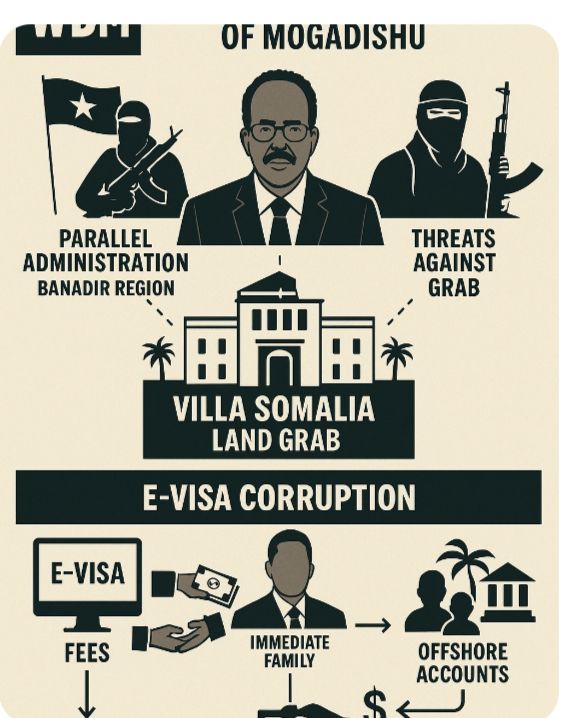
President Hassan Sheikh Mohamud has apparently discovered the cure for Somalia’s economic stagnation: land grabs. Forget agricultural reforms, industrialization, or revenue-sharing agreements—Mogadishu’s real GDP is measured in square meters of seized plots. Every clan elder with a bulldozer and a militia is now an “investor,” courtesy of Villa Somalia’s urban renewal program.

But not everyone is applauding the President’s real estate hustle. The Banadir parallel administration, which functions like Mogadishu’s shadow government, has now threatened action against this latest land-grabbing spree. And here’s the punchline: even Al-Shabab found this whole spectacle corrupt enough to issue a statement condemning it.

Yes, you read that correctly: Al-Shabab, the same group that detonates hotels for breakfast, is now lecturing Villa Somalia about legality. Imagine Pablo Escobar giving a TED Talk on drug policy.

E-Visa: Somalia’s Newest Pyramid Scheme

If the land grabs were not enough, the Federal Government’s flashy E-Visa project has turned into a textbook scandal. The system that was supposed to streamline travel and showcase Somalia’s “digital future” has become the equivalent of a tollbooth for presidential relatives.

Reports are flying that Mohamud’s immediate family members are linked to offshore accounts and shady kickbacks. Instead of a secure, transparent platform, we now have a Somali version of FTX—minus the tech genius and with double the clan politics.

Even Puntland, the last remaining adult in the federal room, refused to play ball on the E-Visa revenue-sharing deal. Now travelers must pay two fees—one to Villa Somalia and another to Puntland. Double taxation? No problem—because in Mogadishu math, this is called “federalism.”

The whole circus is a perfect reflection of Somalia’s “state-building” effort:

The Punchline

A President moonlighting as a landlord.

A shadow government threatening civil action.

A terrorist group claiming to be the voice of legality.

A national digital visa system collapsing into clan-based corruption.

And the international community still insists this is a “fragile democracy.”

At this rate, Mogadishu may soon have three governments—one for land grabs, one for fighting land grabs, and one for collecting E-Visa fees. That should finally satisfy the donors, who love to fund “multi-stakeholder approaches.”