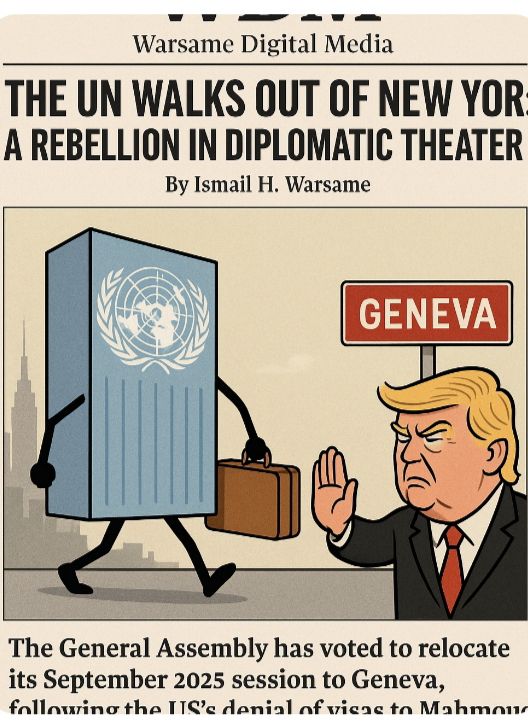
The UN Walks Out of New York: A Rebellion in Diplomatic Theater

Copyright ©️ 2025 WDM

By Ismail H. Warsame
Warsame Digital Media (WDM)

The circus has finally left New York. After nearly eight decades of American visa tantrums, security paranoia, and weaponized airport interrogations, the United Nations General Assembly has voted to pack up its September 2025 session and stage the show in Geneva. The trigger? Washington’s refusal to grant Palestinian President Mahmoud Abbas and some 80 senior officials visas, in blatant violation of the 1947 UN Headquarters Agreement. The Americans, who love to lecture the world about “rules-based international order,” suddenly forgot the first rule of hosting: you open the door to your guests, even the ones you hate.

154 nations said enough. Only the United States and Israel stood together like two stubborn drunks refusing to leave the bar at closing time. Britain, true to its declining empire’s tradition, abstained—too timid to clap, too cowardly to resist.

A Historic Slap in the Face

This isn’t just a relocation. It’s a global slap to Washington’s face. The memory of 1988, when the US denied Yasser Arafat a visa, has come back to haunt them. Back then, the world convened in Geneva for a one-off meeting. Now, in 2025, the General Assembly is formally walking out of the American house party. Geneva, land of chocolate and neutrality, will host the 80th session, while New York sulks like a jilted landlord.

Make no mistake: this is the UN’s revenge. For decades, America used the UN as a stage prop—preaching democracy while vetoing justice, hosting cocktail receptions while starving Palestinians, and turning Turtle Bay into a diplomatic Disneyland with FBI surveillance on the side. Now, the tenants are saying, “If the landlord can’t honor the lease, we’ll take our rent elsewhere.”

Washington: From Host to Outcast

The irony is thicker than Manhattan traffic. The United States still calls itself the “indispensable nation,” but in the eyes of 154 member states, it has become the indecent nation. What good is a host who locks the door on half the guests? What credibility remains when the so-called champion of democracy sabotages the very forum of global diplomacy?

In truth, the US always liked the UN only when it could boss it around. When the votes went their way, it was “the voice of humanity.” When they lost—as in this 154–2 humiliation—it suddenly becomes “irrelevant.” Washington wants the UN to be a cheerleading squad, not an assembly of sovereign nations. Geneva’s relocation proves the world is done playing along.

The Collapse of the American Monologue

This is not about Mahmoud Abbas alone. It is about the principle: if Palestine cannot enter the hall, then the hall itself will move. This moment signals a deeper crack in America’s control of the international stage. The UNGA has essentially told Washington: “You are not the bouncer of global diplomacy.”

For years, the US bullied others with visas—denying entry to Iranian diplomats, restricting Russians, and humiliating Africans at JFK airport. But this time, the world has acted collectively. The empire’s monologue has been interrupted by a global chorus saying: “Pack your arrogance, we are moving.”

What Geneva Means

Geneva is more than a change of venue. It is symbolic exile. The September 9, 2025 opening session will not just be a routine debate; it will be the inauguration of a post-American UN stage. Diplomats will sip Swiss coffee instead of New York bagels. Delegates will stroll along Lake Geneva instead of dodging NYPD barricades. And the United States will learn the bitter lesson that even empires can be boycotted.

The fact that only Israel joined Washington in opposition speaks volumes. When your only friend at the table is the very state accused of war crimes in Gaza, you are not a leader—you are an accomplice.

The End of UN in New York?

This move could be the beginning of the end for the UN’s American address. If Geneva succeeds—and it likely will—why should the world return to a host that treats the UN as its doormat? America’s veto in the Security Council may still function, but morally and symbolically, Washington has been evicted.

The United Nations was meant to embody universality. If universality cannot live in New York, it will find a home elsewhere. Geneva, Vienna, Nairobi—anywhere but the shrinking empire that refuses to share its stage.

Conclusion: A Warning Shot

The relocation of the 80th UNGA is a warning shot to Washington: your monopoly on global diplomacy is over. The rest of the world has finally realized that the UN does not need the US, but the US desperately needs the UN to pretend it still matters.

In 1947, the world handed America the keys to the UN. In 2025, the world has begun taking them back. For the first time in decades, the empire must sit in the corner and watch as the show goes on—without its permission, without its control, and without its arrogance.

Welcome to Geneva, Nairobi, Cairo, Addis Ababa or elsewhere, the new capitals of world diplomacy.

Somalia’s Future: An Unforgiving Forecast of Collapse and Intervention

Copyright ©️ 2025 WDM

By Ismail H. Warsame Warsame Digital Media (WDM) September 8, 2025

To predict Somalia’s future is to navigate a labyrinth of perpetual crisis. This is a nation where reality consistently outpaces even the most pessimistic speculation, where each new “worst-case scenario” is rapidly rendered obsolete by the grim lived experiences of its citizens. While forecasting is perilous, existing trends paint a picture that is not only dark but alarmingly coherent. The trajectory, if unaltered by a miraculous national awakening, points toward a catastrophic climax.

The Illusion of a Capital: Mogadishu’s Slow Strangulation

The notion of Mogadishu as a sovereign capital is becoming a fiction. The city exists in a state of virtual siege, not by a traditional army at its gates, but by an insidious and adaptive extremist insurgency. Al-Shabab, a Taliban-like force perfected through years of resilience, operates with a lethal synthesis of rigid ideology and pragmatic opportunism. It systematically extorts businesses, infiltrates institutions, and governs shadow districts with brutal efficiency, all while tightening a noose around the city’s economic and supply lines.

The response from the Federal Government of Somalia (FGS) has been a masterclass in political theater. Grandly announced “offensives” consistently devolve into fleeting photo-opportunities for officials, yielding no lasting territorial gain or strategic advantage. The Somali National Army (SNA), hamstrung by clan loyalties, corruption, and inadequate support, remains a fragmented and ineffective force. The tragic, undeniable reality is that there are no coherent, unified, or meaningful efforts underway to reverse the tide. Mogadishu is not a bastion of statehood but a precarious island, slowly eroding.

The Architecture of Failure: Political Paralysis and International Divestment

Somalia’s political class has perfected a system of self-sabotage. The foundational model of governance—4.5 power-sharing—has devolved from a necessary compromise into a permanent cage. It incentivizes clan competition over national interest, turning the Federal Parliament into a marketplace for quota disputes rather than a chamber for legislation and oversight. This dysfunction is acutely felt by those outside the center of power. There is a pervasive and damaging perception that non-Hawiye members of the federal Parliament, particularly those hailing from the assertive Federal Member States of Puntland and Jubaland, are treated as poor guests rather than equal partners in governance. This political othering—whether real or perceived—fuels profound resentment and ensures that crucial legislation and national strategies are bogged down in petty disputes and boycotts, rather than being debated on their merit.

The incessant power struggles between the Federal Government and the Federal Member States (FMS) have created a vacuum where no central authority can effectively govern. This political paralysis is met with growing and unmistakable fatigue from the international community. Donors who have poured billions into state-building now see diminishing returns on their investment. The patience of regional allies like Ethiopia, Kenya, and the Gulf States is wearing thin, replaced by a cold, pragmatic calculus. Somalia is rapidly becoming the “permanent project” that the world is no longer willing to fund indefinitely, especially when its leaders appear unwilling to forge a unified path forward.

The Inevitable Conclusion: Two Grim Scenarios

Given this unchecked decay, the endgame is now coming into focus, and it offers two horrifying choices.

1. The Militant Takeover: Left unchecked, Al-Shabab’s methodical campaign will continue. They will not necessarily storm Mogadishu in a dramatic battle; instead, they will suffocate it, gradually rendering the government irrelevant until it collapses under its own weight. South-Central Somalia would fall under a harsh, theocratic rule, reminiscent of the pre-2012 Islamic Courts Union era, but far more entrenched and internationally connected.

However, unlike the Taliban’s takeover of Afghanistan, the world—and more importantly, regional powers—will not stand idly by. This leads to the second, and perhaps more likely, scenario.

2. The Re-Occupation and Regionalization of the Conflict: The strategic waters of the Red Sea and the Gulf of Aden are simply too vital to global commerce and military strategy. No international power—not the United States, Turkey, Egypt, or the Gulf Coalition—will tolerate a hostile force like Al-Shabab (potentially in alliance with or mimicking the Houthis of Yemen) controlling such a critical chokepoint.

The result will not be a UN-sanctioned peacekeeping mission like ATMIS, but a forced, violent re-occupation. This could take the form of a regional coalition or unilateral interventions under the banner of “stabilization,” but it will be driven by hard national security interests, not altruism. The outcome will not be peace. It will be a new chapter of brutal warfare, foreign forces against a guerrilla insurgency, with Somali civilians caught in the crossfire. Sovereignty would become a distant memory, replaced by the reality of a nation partitioned into spheres of influence by foreign powers.

A Choice That Must Be Made

This is the unvarnished future that awaits: either collapse into militant rule or a devastating foreign intervention that sacrifices sovereignty for a brutal, imposed “order.” Neither option offers dignity, prosperity, or self-determination.

The profound tragedy is that this fate is not yet sealed. The power to avert it rests almost entirely with Somalia’s political elites and clan elders. It requires a radical, immediate self-correction: a genuine political truce, the prioritization of national army building over partisan militias, and a unified front against extremism. The Somali people have repeatedly demonstrated breathtaking resilience, but their leaders have consistently squandered it. The clock is not ticking; it is flashing red. The time for slogans is over; the time for action is now, if it is not already too late.