From Begging Bowl to Breadbasket: A Skills-First Path for Somalia’s Economy September 2025
Executive Summary
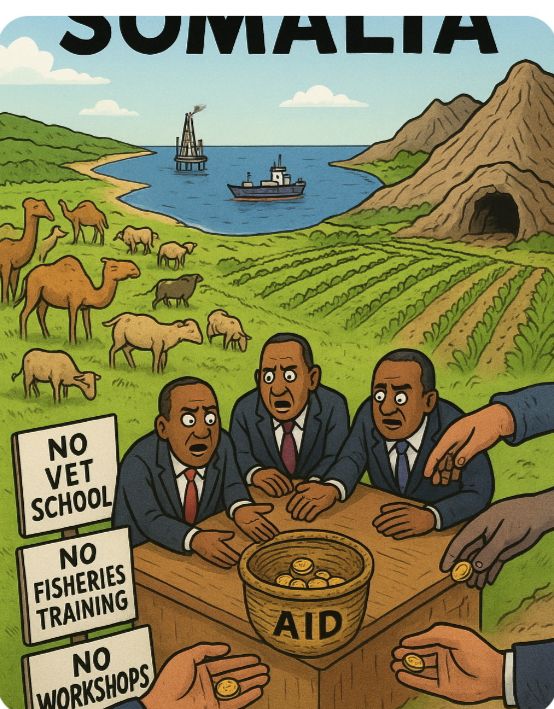
Somalia is a nation rich in resources but poor in applied skills. With Africa’s largest livestock herd, the continent’s longest coastline, significant mineral potential, fertile land, and emerging hydrocarbons, Somalia should be a regional breadbasket. Instead, it relies heavily on aid and remittances, with limited productive skills to leverage its wealth.
This brief outlines a five-year skills-first agenda targeting livestock, fisheries, construction, and extractives services. By prioritizing vocational training, employer-led standards, and outcome-based financing, Somalia can transition from aid dependence to a skills-driven economy.
The Challenge: A Wealthy Nation Behaving Poor
Livestock: ~7 million camels, 5 million cattle, 30 million goats, 14 million sheep—Somalia’s greatest export asset.
Fisheries: A 3,330 km coastline with underexploited tuna and pelagic stocks.
Minerals & Hydrocarbons: Uranium, iron ore, gypsum, and offshore oil exploration agreements underway.
Land: 70% classified as agricultural/pastoral land.
Yet Somalia imports food, suffers recurring famines, and remains donor-dependent. Vocational and technical education is almost absent:
Few accredited veterinary para-professional programs.
Little structured fisheries or marine training.
Construction trades lack certification, lowering safety and productivity.
Young people overwhelmingly seek NGO or office jobs instead of skilled work.
Bottom line: Somalia is rich in natural assets, but lacks the workforce to turn them into wealth.
Aid, Remittances, and the “Office Economy”
Remittances (20–25% of GDP) sustain families but reinforce consumption.
Foreign aid dominates the fiscal framework, but donor fatigue and cuts threaten stability.
NGO employment absorbs educated youth but distorts skills away from productive sectors.
Without vocational pathways, the economy orients toward aid-funded clerical jobs rather than livestock markets, fishery exports, or construction trades.
A Five-Year Skills-First Agenda (2026–2030)
1. Build a Skills Governance System
Establish a Somalia Skills Commission with employer-led sector skills councils.
Create a National Qualifications Framework (NQF) for trades and certifications.
2. Invest in Livestock Competitiveness
Train thousands of veterinary para-professionals, abattoir technicians, and cold-chain workers.
Modernize quarantine stations and introduce animal ID systems.
Promote HACCP/ISO standards in meat exports to Gulf markets.
3. Develop Fisheries Training Hubs
Establish 3 coastal training hubs (Bosaso, Mogadishu, Kismayo).
Train skippers, marine engineers, refrigeration technicians, and HACCP specialists.
Upgrade landing sites with ice, water, and hygiene facilities.
4. Professionalize Construction Trades
Require apprenticeships on all donor-funded and public works.
Certify masons, electricians, plumbers, HVAC technicians, and surveyors.
Enforce safety standards to lower accidents.
5. Prepare for Hydrocarbons & Minerals Responsibly
Focus first on transferable skills: HSE officers, welders, environmental technicians, logistics.
Publish contracts and data to ensure transparency and avoid “boom-bust” training.
Financing the Transition
Domestic revenue growth: allocate a fixed share to vocational training and labs.
Donor alignment: shift funding from clerical/NGO-heavy projects to TVET and applied skills.
Remittance leverage: offer matching schemes for apprentices to buy toolkits and equipment.
Results-based financing: pay training providers only for certifications, job placements, and retention.
Risks and Mitigation
Aid volatility: modular programs allow scaling up/down with available funds.
Security & climate shocks: mobile training units and drought-resilient fodder systems.
Elite capture: employer councils oversee standards and outcomes, not politicians.
Hype in extractives: skills focused on services useful across sectors.
Headline Targets by 2030
50,000 new certified workers in livestock, fisheries, construction, and maintenance.
30% increase in export livestock meeting international standards.
Tripled fish landings through Somali-managed vessels and certified landing sites.
25,000 apprentices trained in construction trades, reducing site accidents.
Conclusion
Somalia’s paradox is clear: immense wealth in resources, yet chronic dependence on aid. The answer is not more conferences or more clerks, but practical skills, vocational pathways, and employer-led standards.
A five-year, skills-first agenda—anchored in livestock, fisheries, construction, and extractives services—can turn Somalia’s begging bowl into a breadbasket.
Somalia must shift from “aid-fed” to “skills-led.”
Somalia is richly endowed—with one of Africa’s largest livestock herds, the longest mainland coastline on the continent, under-explored hydrocarbons and minerals, and significant agricultural potential. Yet the country’s growth model remains heavily tilted toward aid, remittances, and low-productivity services. This white paper diagnoses the structural reasons behind the paradox—particularly the chronic shortage of vocational, technical, and applied tertiary skills—and proposes a 5-year, skills-first transformation agenda focused on livestock value chains, fisheries, construction, and light manufacturing. The recommendations emphasize practical training, standards and certification, enabling regulation, targeted public investment, and results-based financing tied to jobs.
1) Context and Problem Statement
Somalia’s economy has grown on the back of agriculture and services, but remains exposed to climate shocks and volatile aid flows. In 2024 real GDP growth reached ~4.0%, supported by agriculture and livestock, yet the outlook is clouded by cuts to foreign aid. Remittances remain a critical lifeline (about a quarter of GDP in recent years), cushioning domestic demand but reinforcing a consumption-heavy, import-dependent structure. Domestic revenue mobilization is still among the lowest globally, limiting the state’s capacity to invest in productive skills and infrastructure.
At the same time, the education and training system undersupplies technicians, veterinary professionals, fisheries officers, master builders, machinists, welders, and maintenance technicians. While universities and some faculties exist, provision is fragmented and thin relative to need. Technical and vocational education and training (TVET) remains underdeveloped and weakly connected to employers, standards, and certification systems.
2) Somalia’s Resource Endowments (What’s on the Table)
2.1. Livestock
Livestock is Somalia’s largest economic asset, with recent estimates placing the national herd at ~7.1 million camels, 5.3 million cattle, 30.9 million goats, and 13.6 million sheep—driving exports and rural incomes when sanitary and trade conditions allow. In arid zones, camel production is especially important.
2.2. Fisheries and the Ocean Economy
Somalia has Africa’s longest mainland coastline—≈3,330 km—bordering rich upwelling systems that support tuna and other pelagics. FAO and IOTC documentation highlight considerable, still-underexploited potential within the EEZ, long constrained by governance, security, and limited domestic capacity for monitoring, control, and surveillance (MCS), as well as processing and cold-chain gaps.
2.3. Hydrocarbons
Somalia has moved to re-open offshore exploration. In March 2024, Somalia and Türkiye signed an inter-governmental cooperation agreement covering exploration and, upon discovery, development and production; Turkish Petroleum’s seismic vessel Oruç Reis was slated to conduct extensive 3D surveys. Earlier licensing initiatives and block delineation by national authorities also point to renewed investor interest. While commerciality remains unproven, upstream activity could be catalytic if transparently governed.
2.4. Minerals
Legacy geological work and UN/IAEA briefs list uranium, iron ore, tin, gypsum, bauxite, copper, salts, limestone and industrial minerals as prospective but largely unexploited, reflecting the long hiatus in systematic exploration and infrastructure deficits. Modern re-mapping and responsible, transparent licensing would be prerequisites to any development.
2.5. Arable and Pastoral Land
While only ~1.7–2% of land is classified as arable, agricultural land (including rangelands) covers roughly 70% of the territory, underscoring the centrality of climate-smart pastoralism, fodder systems, and water management rather than rain-fed cropping alone.
3) The Binding Constraint: A Missing Skills Ecosystem
The complaint that “everyone trains to be an office clerk or NGO staffer” exaggerates—but flags a real distortion. Somalia’s TVET system is fragmented; employer linkages, quality assurance, and competency standards are embryonic; and training finance rarely rewards job placement or productivity gains. Even where sector-specific faculties exist (e.g., veterinary medicine at Somali National University, Benadir University, Mogadishu University), scale and applied training infrastructure (clinics, demonstration farms, abattoir QA labs, mobile vet services) are insufficient for the national herd, export ambitions, and disease surveillance needs.
In fisheries, the bottlenecks are similar: few accredited programs in skipper training, marine engineering, cold-chain logistics, HACCP/ISO 22000, stock assessment, and MCS operations; weak paths for artisanal fishers to formalize and upskill; and limited processing skills for value addition (filleting, canning, fishmeal and fish oil, by-product utilization).
Construction—one of the largest urban employers—faces shortages of certified foremen, masons, electricians, plumbers, HVAC techs, survey technicians, and materials testers, keeping productivity and safety low and raising costs. Global TVET evidence underscores that competency-based standards and employer-designed curricula are essential to close such gaps.
4) Political Economy of Aid, Remittances, and “Office Economy”
Debt relief under HIPC and successive IMF reviews have improved macro-stability, but also spotlighted the risk of aid retrenchment. World Bank and IMF assessments warn that foreign-aid cuts are already dampening the growth outlook, while domestic revenues remain low by international standards. Remittances—estimated around 20–25% of GDP in recent years—sustain consumption but can crowd skilled labor into distribution and services rather than traded sectors if productive opportunities are scarce. NGO ecosystems deliver lifesaving aid, yet studies note capacity gaps and donor-driven priorities that may not align with building productive skills at scale. The net effect: a relatively large share of educated youth gravitates to donor projects and clerical services instead of technical trades.
5) What Success Could Look Like: Four Priority Value Chains
5.1. Livestock Health, Quality, and Market Access
Goal: Lift export earnings and pastoral incomes by upgrading animal health, fodder, finishing, and cold-chain. Critical skills: field epidemiology; veterinary paraprofessionals; HACCP/ISO 22000; abattoir QA; feed formulation; cold-chain maintenance; live-animal logistics. Rationale: Somalia’s herd scale offers comparative advantage, particularly in Gulf markets; camels and small ruminants command premium prices with reliable certification and handling.
5.2. Artisanal and Semi-Industrial Fisheries
Goal: Multiply domestic landings captured by Somali vessels and increase value-added processing. Critical skills: skipper and marine-engine training; MCS operators; HACCP; refrigeration and ice-plant technicians; by-product processing; SME management for landing sites.
5.3. Urban Construction and Materials
Goal: Raise productivity, safety, and standards in booming cities (Mogadishu, Hargeisa, Garowe, Kismayo, Bosaso). Critical skills: certified foremen; masonry/electrical/plumbing/HVAC; surveying; concrete/materials testing; prefab assembly; site safety; maintenance.
5.4. Hydrocarbon & Mineral Services (Foundational Stage)
Goal: Build domestic technical services to support exploration: environmental baseline, logistics, fabrication, and HSE—before any production decision. Critical skills: HSE officers; welders/rig mechanics; geotech and environmental technicians; lab techs; GIS; procurement; port logistics.
1. Create a Somalia Skills Commission (SSC) and National Qualifications Framework (NQF). Mandate sector skills councils (livestock, fisheries, construction, energy/minerals) to co-design competency standards, apprenticeship norms, and assessments tied to employer demand.
2. Scale “dual” TVET via Results-Based Financing (RBF). Public funds pay providers for verified outcomes: certifications earned, apprenticeships completed, and 6-/12-month job retention—differentially weighted toward priority trades and underserved regions. Global TVET reviews support outcome-linked finance to improve relevance and accountability.
3. Rebuild Veterinary and Fisheries Training Infrastructure.
Equip SNU/Benadir/MU vet faculties with field clinics, mobile vaccination units, abattoir QA labs, and disease surveillance linkages; certify veterinary paraprofessionals for last-mile services.
Establish three coastal Fisheries Training Hubs (e.g., Bosaso, Kismayo, Mogadishu) for skipper/engineer training, MCS, cold-chain maintenance, HACCP, and entrepreneurship.
4. National Apprenticeship Compact with Industry. Co-finance 25,000 apprenticeships in construction trades and maintenance over five years; require firms on public works to take apprentices and certify supervisors; embed site-safety standards.
5. Livestock Export Competitiveness Program. Modernize quarantine stations; introduce electronic animal ID and movement tracking in export corridors; expand fodder/finishing pilots; mainstream HACCP and animal-welfare standards in export abattoirs.
6. Fisheries MCS and Landing-Site Upgrades. Fund VMS/AIS integration, patrol capacity, and landing-site utilities (ice, water, electricity, hygiene); introduce transparent licensing/royalties; support co-management with fishing communities.
7. Transparency for Extractives (Pre-Production). Adopt open data for licensing, contracts, and seismic results; require local-content plans focused on transferable technical skills (HSE, welding, fabrication, logistics) rather than short-term clerical hires.
8. Align Public Finance with Skills. Protect training budgets against aid volatility by earmarking a share of growing domestic revenues; gradually shift from general budget support reliance toward domestic resource mobilization.
7) Financing and Governance
Macrofiscal space: Debt relief milestones widen access to concessional resources, but aid cuts require prioritization. Channel IDA and AfDB windows into skills infrastructure with RBF contracts and rigorous procurement.
Domestic revenues: Intensify tax digitalization and customs reforms that recently lifted collections; ring-fence a portion for TVET and sector labs.
Diaspora and remittances: Offer matched savings for toolkits, certification fees, and SME equipment for returning apprentices; leverage remittance corridors for skills finance.
Aid volatility: Design programs with tranche-based RBF and modular procurement so scaling can match cash flow.
Security and climate shocks: Prioritize mobile training delivery, drought-resilient fodder systems, and contingency apprenticeships linked to public works.
Capture and credential inflation: Keep employers in the driver’s seat via sector skills councils; publish pass rates and job outcomes by provider.
Extractives hype: Sequence skills toward horizontal services (HSE, maintenance, logistics) valuable beyond oil and minerals to avoid “boom-bust training.”
50,000 new nationally certified workers across veterinary para-professionals, fisheries, construction, and maintenance; 70% placed or self-employed at 12 months.
+30% increase in value-added livestock exports meeting HACCP/animal-welfare standards; >80% vaccination coverage in targeted corridors.
Tripled domestic fish landings handled through upgraded landing sites with HACCP certification; zero major MCS compliance gaps in pilot zones.
25,000 apprentices trained on public and donor-funded construction sites; measurable reductions in site accidents.
10) Conclusion
Somalia is not “poor” in assets; it is underserved in capabilities. A skills-first strategy—rooted in the country’s natural endowments and executed through employer-led standards, outcome-based financing, and transparent governance—can flip the economy from aid-reliant consumption to export-driven production. The agenda above is pragmatic, sequenced, and measurable. With consistent execution, Somalia can replace the “begging bowl” narrative with one of earned income, certification, and competitiveness.


 Warsame Policy & Media Network (WAPMEN)
You must be logged in to post a comment.