
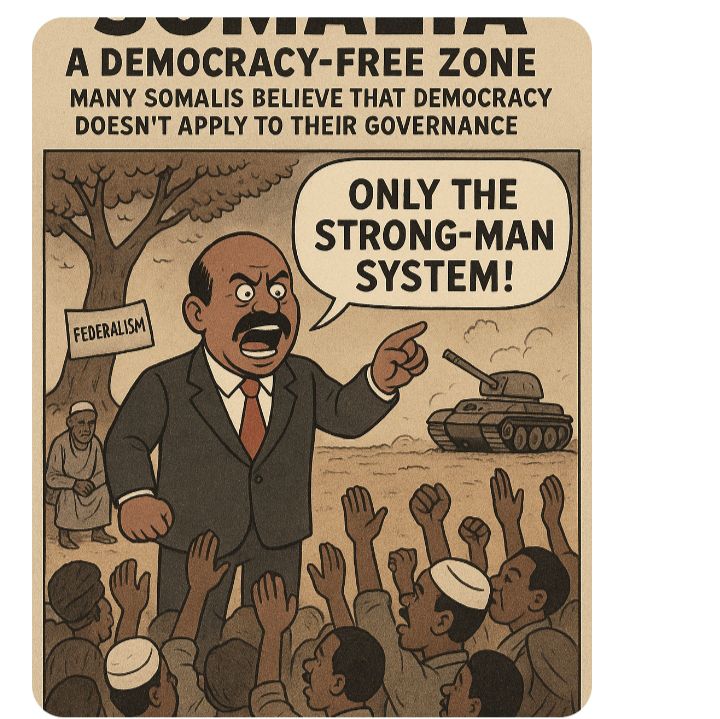
Democracy, we are told, is about choice, accountability, and the consent of the governed. In Somalia, however, democracy is considered an imported disease—like coronavirus—something that only afflicts foreigners with passports and embassies in Mogadishu. The Somali cure? Clan conferences under an acacia tree, where warlords sip camel milk and agree that the only vote worth casting is for the man with the largest militia, loudest insults, or deepest pocket lined with qat leaves.
Federalism was meant to be the antidote, a fragile attempt to distribute power and stop the endless parade of strongmen with delusions of being Somali Gaddafis. Yet, in the Somali imagination, federalism is not about checks and balances—it is about checks from donors and balances in offshore accounts. Federalism exists only on PowerPoint slides in foreign-funded workshops where “leaders” nod politely, collect per diems, and then return home to declare: “There is only one leader, me.”
And here’s the real absurdity: When was the last time, SOMALIS—government, opposition, civil activists, intellectuals—sat around a table or even under a tree, inside their own country, and engaged in civil, constructive dialogue to deal with the critical issues facing their motherland? The answer is brutal: never. Instead, the Somali political class packs its bags for Djibouti, Nairobi, Embagathi, Addis Ababa—anywhere but Mogadishu. There, in five-star hotels, enemies and opportunists of Somalia line up to offer “mediation,” a euphemism for divide-and-rule. The irony is thicker than Mogadishu dust: Somalis must fly abroad to learn how to quarrel politely, while foreign waiters serve them cappuccinos.
So the question remains: Are Somalis hardwired to kneel before a strongman? Judging by history, the answer is depressingly clear. The national pastime has never been football—it has been applauding the tyrant until the tyrant’s helicopter takes off in flames. Then, as tradition dictates, the people quickly recalibrate to praise the next man with a big voice, a bigger stomach, and the promise of “rebuilding Somalia.” The cycle continues: clap, collapse, repeat.
Ask any Somali elder about democracy, and you’ll hear a sermon about how it cannot work in a country where every man believes himself a president-in-waiting. The ballot box is mistrusted, not because it is foreign, but because it cannot be stuffed with clan loyalty. Better a dictator who “keeps the peace” than a parliament of a thousand egos arguing over which camel track constitutes a border.
The irony? Those same Somalis will fly to America, Europe, or even Nairobi and enjoy democracy like a five-star hotel buffet. They will cast votes, demand their rights, sue the government, and send long Facebook rants about human rights violations back home. Yet when it comes to Somalia, democracy is suddenly “un-Islamic, un-Somali, and unworkable.”
What this reveals is not an allergy to democracy but an addiction to the theater of power. The Somali psyche respects the man who can shout the loudest, imprison rivals, and distribute patronage like wedding sweets. Federalism, in their eyes, is weakness; consensus is cowardice; compromise is betrayal. The Somali strongman is celebrated not despite his tyranny, but because of it. He embodies order in a society terrified of its own chaos.
So let’s be honest: Somalia is not a democracy-in-waiting. It is a democracy-refusing experiment where ballots are replaced by bullets, parliaments by palaces, and constitutions by clan constitutions. Federalism is not respected because it threatens the only thing Somalis still worship: power without responsibility.
Maybe, just maybe, Somalia is not “behind” on the road to democracy. Maybe Somalia is on a different road entirely—the eternal highway of Strongman Rule, where the destination is always the same: ruins, regret, and another strongman promising salvation.
 Warsame Policy & Media Network (WAPMEN)