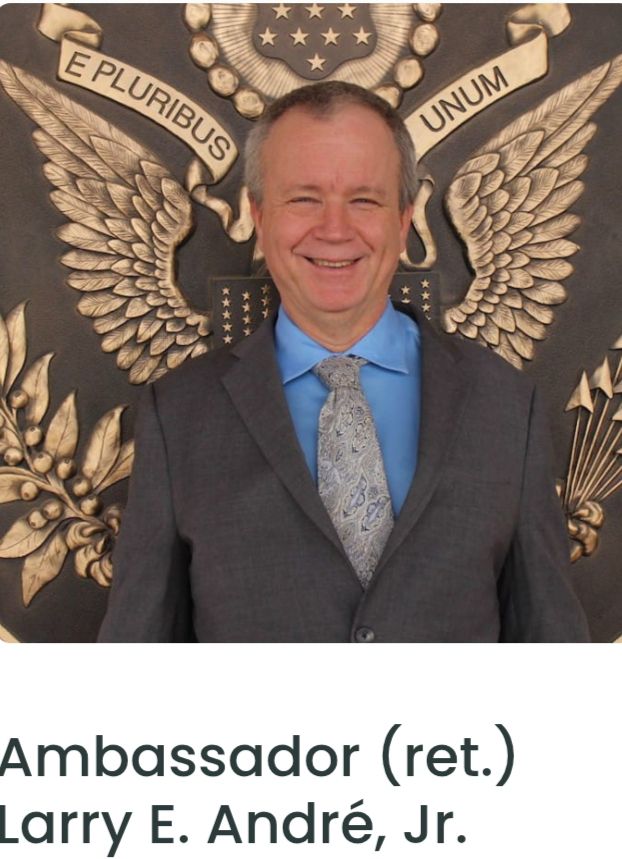
Review of Somaliland Status Policy on “Review by Ambassador (ret.) Larry André”

Ambassador Larry André’s piece is a thoughtful, sober, and experience-driven analysis of one of the Horn of Africa’s most contentious political issues: the status of Somaliland. Drawing on decades of diplomatic engagement in Somalia, Djibouti, and the wider region, André calls for a measured and fact-based U.S. policy review at a time when advocacy for Somaliland recognition is growing louder in Washington.

Here is the link to the piece:

https://open.substack.com/pub/larryandre61/p/somaliland-status-policy-review?utm_campaign=post&utm_medium=web

Strengths of the Article

1. Pragmatism Over Idealism
André avoids simplistic solutions. He carefully outlines three U.S. policy options—status quo, liaison office in Hargeisa, or full recognition of Somaliland—and persuasively argues for the middle ground of opening a U.S. office in Hargeisa under Mogadishu’s embassy framework. This cautious approach reflects both regional realities and U.S. strategic interests.

2. Deep Regional Context
Unlike many Western commentaries on Somaliland, André situates the issue within the complex clan dynamics of the Somali people, emphasizing that clan loyalties often outweigh national ones. His acknowledgment that the Isaaq overwhelmingly drive Somaliland independence while other clans (Dir, Darod) remain ambivalent is particularly important—and often overlooked.

3. Balanced Consideration of Facts
The article highlights uncomfortable truths on both sides. For example, André notes Somaliland’s stronger governance and stability compared to southern Somalia, but also its intolerance of pro-unionist voices, illustrated by President Bihi’s blunt admission about jailing “traitors.” Similarly, he dismisses unproven allegations about Somaliland collusion with al-Shabaab, while recognizing that Somaliland’s security partly benefits from international efforts in southern Somalia.

4. Comparative Insights
The discussion of federalism models (Canada–Quebec, UK–Scotland, Tanzania–Zanzibar) adds intellectual weight, suggesting creative constitutional arrangements as alternatives to either secession or forced unity.

Weaknesses of the Article

1. Limited Somali Voices
While André emphasizes consultation, the essay still largely reflects a diplomat’s top-down perspective. More engagement with grassroots Somali perspectives beyond political elites and business leader would have enriched the analysis.

2. Underplaying External Geopolitics
Although he briefly mentions Turkey, the UAE, and rival powers, the piece could have more fully assessed how great-power competition (China, Gulf states, Western powers) intersects with Somaliland’s recognition question, especially regarding Berbera port and Red Sea security.

3. Ambiguity on U.S. Interests
André stresses “do no harm” and regional stability, but is less clear on what concrete U.S. interests—counterterrorism, maritime security, great-power competition—would ultimately drive Washington’s decision.

Overall Assessment

This is an enlightening, cautious, and authoritative contribution to the Somaliland debate. Its greatest strength lies in tempering passionate advocacy with historical perspective, lived diplomatic experience, and a clear warning against reckless unilateralism. By urging a process rooted in consultation, facts, and creative federalist thinking, André positions himself as a voice of prudence in a debate often dominated by emotion and lobby-driven arguments.

The article does not settle the Somaliland question—but it is not meant to. Instead, it provides a framework for responsible deliberation, reminding U.S. policymakers that decisions made in Washington can carry unintended, and possibly explosive, consequences in Hargeisa, Mogadishu, and beyond.

Verdict: A must-read for anyone serious about Somali politics, U.S. Africa policy, or the geopolitics of the Horn.
What Is “Weaponized Interdependence”?

Coined by political scientists Henry Farrell and Abraham L. Newman, the term refers to the strategic leveraging of global economic networks—like finance, supply chains, and communication systems—to exert coercive pressure on other states. This isn’t traditional military force, but control via chokepoints or surveillance-like power in the global economic architecture .

Chokepoint effect — Dominant players can restrict or penalize access to critical network hubs.

Panopticon effect — They can monitor and observe others’ activities through embedded informational structures .

U.S. Economic Power as a Weapon

Financial Coercion

The United States has weaponized its dominance in global finance—primarily through:

The U.S. dollar’s centrality in foreign exchange and global reserves.

Influence over SWIFT and financial messaging systems.

Its role in global debt issuance .

These tools enable economically punitive measures—like sanctions—without firing a weapon .

Trade and Manufacturing Limitations

However, the U.S.’s coercive capacity in trade is more limited:

China dominates manufacturing and critical materials, granting it leverage in areas like rare earths, lithium, cobalt, and semiconductors .

U.S. export restrictions—e.g., on chipmaking technologies—have prompted retaliatory supply controls from China, highlighting mutual vulnerabilities .

China’s Strategic Countermeasures

Unlike the U.S., whose sanctions tend to have legal justification, China employs more opaque, politically motivated coercion. This includes:

Trade restrictions or boycotts following political slights—e.g., countries meeting with the Dalai Lama.

Private sector compliance or self-censorship (companies removing content or apologizing to avoid Chinese backlash).

Tourism bans, restrictive trade practices, and market access limits .

This strategy shapes behavior by creating a mental environment of deference—discouraging criticism of China due to fear of economic repercussions .

Global Impacts and Responses

Risk of Fragmentation

Continuous economic coercion risks destabilizing the global economic order.

Sanctions can backfire: countries may seek alternatives, fragmenting global systems.

Scholars note resemblances to the interwar era—sanctions undermining cooperation and security .

Regulatory vs. Abolitionist Approaches

Regulatory Mode: Proposes legal/ethical frameworks to minimize humanitarian harm from economic coercion (akin to laws of armed conflict).

Abolitionist Mode: Rejects economic coercion outright, especially unilateral measures that undermine sovereignty .

Multilateral and Collective Resilience

Solid strategies to resist coercion include:

Diversifying trade partners and supply chains.

Strengthening legal/regulatory frameworks (e.g., the EU’s ACI).

Coordinated responses through institutions like the G7, WTO, OECD, or ad-hoc coalitions .

Key Takeaways

1. Global economic networks now serve as instruments of power, beyond just trade and finance—encompassing communication technology, supply chains, and messaging systems.

2. Both the U.S. and China weaponize interdependence—but in different ways:

The U.S. uses transparent, legally justified leverage via finance and sanctions.

China uses less transparent coercion tied to political objectives and market control.

3. Overusing coercive economic tools risks fragmenting globalization, reducing system resilience and multiplied vulnerability.

4. The path forward should blend regulation and cooperation, leveraging alliances, legal safeguards, trade diversification, and institutional reform to restore stability and limit coercion’s destructive capacity.

Trump’s Cheap Bargain at the White House

By WDM Political Desk

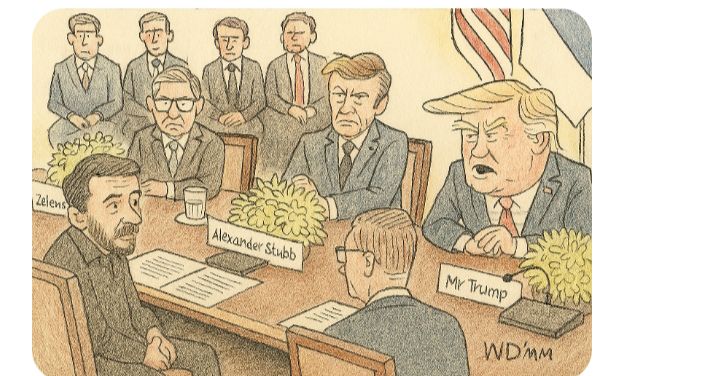
Donald Trump, once again, summoned European leaders to the White House as if he were a circus master calling his performers to line up for the evening show. This time the star attraction was President Volodymyr Zelensky of Ukraine, reluctantly standing beside Trump in what looked like a family portrait of a very dysfunctional household.

Trump, notorious for turning high-stakes geopolitics into cheap reality TV, avoided repeating last February’s debacle with Zelensky—not out of wisdom, but out of sheer self-interest. Two reasons drove him this time:

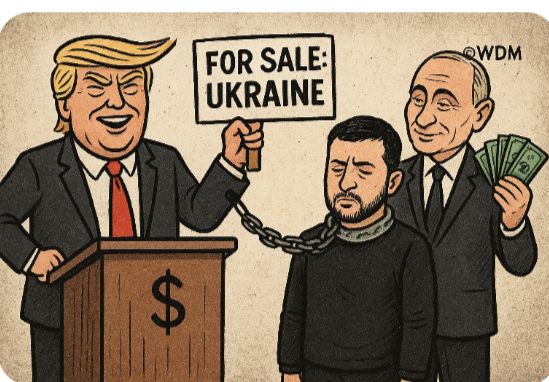
First, Trump needed to show Vladimir Putin that he has “control” over Zelensky. To Trump, Ukraine is not a sovereign nation, not a battlefield of survival, not a bleeding edge of European security—it is just a bargaining chip, a poker card to trade away slices of Ukrainian territory in exchange for Russian favors. He dreams of calling Putin on live television and boasting: “Look Vlad, I made your boy sit down quietly. Where’s my deal?”

Second, Trump’s everlasting obsession: the Nobel Peace Prize. Obama got one for breathing air in the Oval Office, and that burns Trump’s ego daily like acid. He wants the same, even if it means auctioning Ukraine’s sovereignty on the Nobel Committee’s altar. “Nobel Prize! Nobel Prize!” is Trump’s mantra—he craves it like a toddler screaming for candy in a supermarket.

But Europe is not fooled. Macron, Scholz, Rutte, Meloni, and the rest flew in not to humor Trump but to chain themselves around Zelensky. They know the game: if Ukraine falls, Russia won’t stop at Kyiv—it will march to Warsaw, Berlin, Paris, and maybe even Brussels. Trump may play diplomat, but Europeans know he is dangling Ukraine as bait while sharpening the knife under the table.

The tragicomic scene at the White House was clear:

Trump puffing his chest, grinning like a salesman desperate to close a deal.

Zelensky, trapped in a photo-op he didn’t want, surrounded by allies who looked more like bodyguards shielding him from Trump than partners in peace.

European leaders, smiling stiffly for cameras while whispering in each other’s ears: “God save us if this maniac sells Ukraine to Moscow.”

History will remember this summit not as diplomacy but as a pawn shop negotiation where Trump tried to trade Ukrainian land for personal glory. Europe left Washington more worried than when they arrived—because the real threat is not only Russia’s tanks, but also Trump’s hunger for applause, prizes, and Putin’s approval.

Trump wants to be crowned peacemaker. Instead, he looks like a desperate broker selling Europe’s security for a Nobel medal.