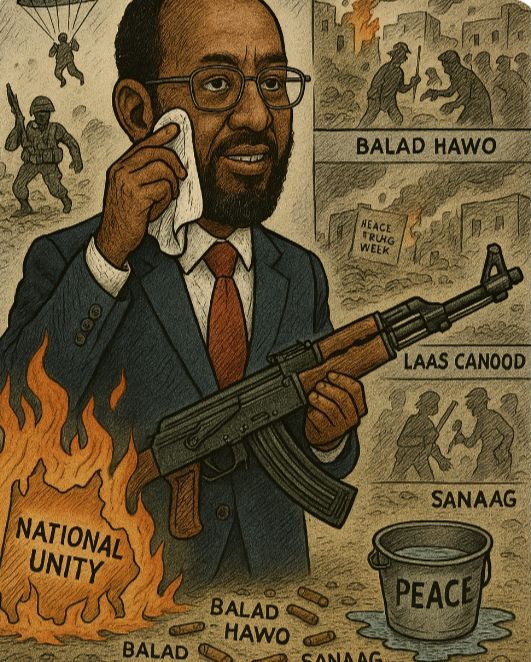
President Hassan Sheikh Mohamud — the self-styled “Peacemaker-in-Chief” who manages to ignite more fires than a pyromaniac at a petrol station, and then shows up with a thimble of water for the cameras.
This is the man who airlifted federal troops to Ras Camboni — not to defend against foreign threats, mind you, but to attack the very Jubaland Administration he is constitutionally meant to work with. He then airlifted another batch of soldiers to Balad Hawo in Gedo Region, pouring petrol into the already raging inferno of clan rivalry. And just in case the fire didn’t spread fast enough, he’s been busy meddling in Puntland, planting a rival administration in Laas Caanood, and dispatching political arsonists to Sanaag.
But wait, there’s more! While the nation suffers under the grip of poverty and insecurity, Villa Somalia has been caught in red-handed trafficking arms (MV Sea World )— a government moonlighting as a gun-runner, like some bizarre Netflix crime drama where the villain also happens to be the “President.”
And now, after his meddling and machinations left Balad Hawo soaked in blood, Mohamud dons his trademark pained expression, moistens his eyes for the camera crew, and starts preaching “peace” for Gedo. Peace? From the same hands that loaded the gun, aimed it, and pulled the trigger?
These aren’t tears — they’re political saline solutions, squeezed out for international optics, while the real agenda is as ruthless as ever. The tragedy isn’t that Hassan Sheikh Mohamud has no shame. The tragedy is that he wears his shamelessness as a political crown and still expects applause.
In the theatre of Somali politics, he’s both the playwright and the arsonist — penning scripts of peace while burning down the stage.
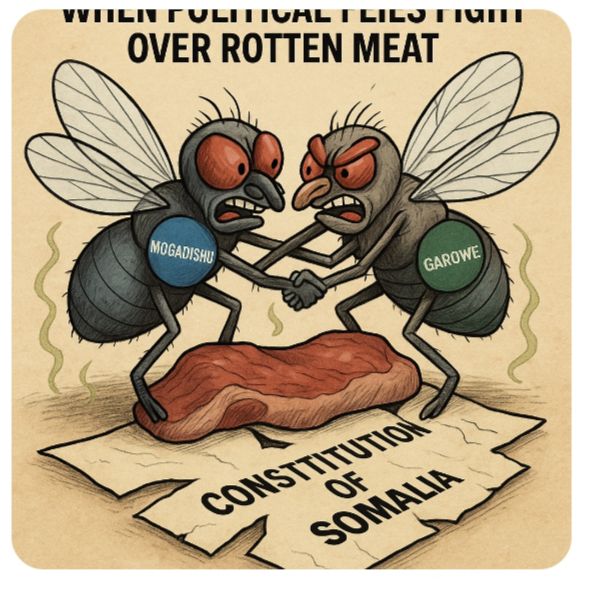
The other day, at a busy internet Cafe shop in Garowe, Puntland, I had the misfortune — or perhaps the blessing — of overhearing a heated debate between two young “activists.” I use the word loosely, because in Somalia “activism” has devolved into the fine art of online propaganda for hire.
One lad, chest puffed out like a seasoned politician, accused the other of being an official of Hassan Sheikh Mohamud’s CBB — Cayayaanka Baraha Bulshada — the buzzing, tweeting, and trolling insects employed to defend the Mogadishu regime. His opponent, not to be outdone, fired back that the accuser was nothing more than a Garowe mouthpiece, the type who would print a press release from the Puntland presidency and call it investigative journalism.
They went back and forth like this — federalist fly versus regionalist roach — each pretending to be a principled patriot while in reality fighting over which corrupt master’s leftovers they preferred to gnaw on.
What struck me was not the intensity of their insults, but the absence of any real political vision. These were not debates over policy, governance, or the future of the Somali people. No — this was just another episode in the tragic sitcom called “Clan-Driven Politics, Season Infinity.”
One was proud to “stand for the unity of Somalia” as long as unity meant unquestioned obedience to Mogadishu. The other was equally proud to “protect Puntland’s autonomy” as long as autonomy meant immunity for Garowe’s failings. Neither cared that the constitution they claim to defend is being torn to shreds daily by the very people they serve.
The truth is, whether you buzz for Villa Somalia or chirp for Garowe, you are still an insect in someone else’s political jar — and the jar is getting smaller by the day.
WDM says: Until Somali youth stop renting out their voices to the highest bidder, our politics will remain nothing more than a noisy swarm circling a rotten carcass.
In the lexicon of Somalia’s turbulent politics, the term warlord usually points to armed, self-appointed commanders who rely on force—not law or democratic legitimacy—to enforce their will. By this definition, Mohamed Abdullahi “Farmajo” has emerged as Somalia’s most unexpected warlord, not through military uprising, but via political manipulation.
Rise to Power: 2016’s Contested Election
Farmajo ascended to power in 2016 through a highly controversial parliamentary vote. Accusations of procedural fraud and manipulation shadowed his victory, infusing his presidency with an aura of illegitimacy from its inception. This pattern echoes the modus operandi of traditional warlords—those who operate above law by claiming divine or exclusive authority.
Tools of Control: Patronage, Militias, and Foreign Support
Farmajo’s grip on power is buttressed by a multifaceted network:
Unaccountable financial backing, sometimes referred to as “Qatari dinars,” hint at clandestine patronage systems.
AMISOM protection, which shields him militarily.
External alliances with Turkey and Ethiopia, offering political and strategic cover.
Dependence on clan-based militias from southern-central Somalia, reinforcing his dominance through armed loyalty rather than democratic consensus.
These pillars create an image of a leader untouchable by constitutional norms or public opinion.
Defiance of Norms: Electoral Impasse & Political Standoff
Since the end of his term, Farmajo has resisted public and international pressure to step down. The resulting electoral deadlock and political standoffs have stalled progress and undermined fragile state institutions—exactly what warlords historically do when their authority is threatened.
Why This Matters: Beyond Political Labeling
Labeling Farmajo as a “warlord” is not mere sensationalism—it reframes how we understand governance in Somalia:
Erodes constitutional legitimacy: When power is upheld by arms, not law, democratic growth stalls.
Reduces public trust: Citizens grow disillusioned with a system that values coercion over consensus.
Perpetuates instability: Political deadlocks and factionalism invite further unrest.
A Path Forward: Rebuilding Institutional Governance
To escape the cycle of warlordism:
1. Revitalize electoral processes — ensure they are open, transparent, and credible.
2. Reassert institutional authority — strengthen parliamentary, judicial, and civil society checks on executive power.
3. Decentralize security — integrate militias like the Maawisley into formal security structures under federal oversight. Their origins as community defense groups could be leveraged positively.
4. Promote inclusive dialogue — address demands from clan factions and political actors through negotiation, not force.
In Summary
Mohamed Abdullahi Farmajo’s tenure bears the hallmarks of warlordism—coercive authority, unaccountable networks, and systemic impunity. Acknowledging this reality is essential for resetting Somalia’s political trajectory toward true institutional legitimacy and stability.
Somalia’s deeply entrenched institutional dysfunction is often summarized through terms like corruption, Al-Shabab, absenteeism, or foreign interference. Yet these are surface-level symptoms. At its core, the existential challenge is modern warlordism cloaked in pseudo-federalism, a system that perpetuates personalistic governance as opposed to state-building.
2. Historical Context: Institutional Capture of Warlordism
Somalia’s federal architecture, proclaimed the Provisional Charter in 2004 and the Provisional Constitution in 2012, intended to distribute authority across federal and regional tiers to prevent authoritarian collapse and fragmentation . However, regional administrations—such as Puntland—have failed to democratize or devolve governance as prescribed, reflecting institutional erosion and personalized control .
3. Characteristics of Modern Warlordism
3.1 Constitutional Ambiguity and Personal Rule
Federalism in Somalia suffers from constitutional vagueness, undefined boundaries, and contested legitimacy—features that enable political actors to sidestep democratic norms and entrench authority .
3.2 Clan-Based Territorial Governance
Federal member states often align along clan lines and correspond to localized power bases, reinforcing clan loyalties over civic identity. This dynamic entrenches sectionalism at the expense of national cohesion .
3.3 Structural Dysfunction Across Government Tiers
Research documents how both the Federal Government and Federal Member States repeatedly overstep their jurisdictions and neglect the institutional mechanisms—such as constitutional courts and intergovernmental forums—intended to resolve disputes and enforce norms .
4. Why Modern Warlordism Is More Durable Than Overt Violence
Unlike the open warlordism of the 1990s, which existed in a vacuum of legitimacy, today’s warlord-politicians benefit from formal titles, recognition, and donor support, thereby entrenching them in power while preserving the illusion of state authority.
5. Societal Impacts
Political stagnation—policymaking is hampered by chronic conflict over authority.
Loss of trust—citizens view governance as self-serving and nepotistic.
Elite capture of resources—administrative positions and revenue streams become patronage outlets.
Undermined reconciliation—clan-based politics fracture national unity.
6. Reform Strategy: Dismantling the Warlord Class
To restore state legitimacy, Somalia must:
1. Uphold Term Limits and Enforce Transition—no indefinite rule.
2. Operationalize Constitutional Structures—activate institutions like the constitutional court and national reconciliation councils .
3. Promote Civic Federalism Over Clanism—federal units must reflect governance structures, not kinship networks .
4. Entrench Meritocracy in appointments and policymaking.
5. Transparency in Foreign Engagement—eliminate patronage dynamics.
6. Invest in Civic Education—promote legal literacy and citizenship awareness.
7. Conclusion
Modern warlordism in Somalia is not a historical relic but a presently operative system disguised as federalism. Unless Somalis confront this political class—and its international enablers—the cycle of dysfunction will persist. The starting point is systemic renewal: discard the warlord model and rebuild governance abiding by constitutional norms.
————
Bibliography & Suggested Further Reading
Dahir, Abdinor & Sheikh Ali, Ali Yassin (2021). Federalism in post-conflict Somalia: A critical review of its reception and governance challenges. Regional & Federal Studies, 34(1), 1–20.
Ahmed, Dayib Sh. (2025). Somalia’s Crisis Isn’t Federalism, It’s a Failure of Leadership. WardheerNews.
Somalia is Trapped by Clan Warlordism, Crippling Federalism and Paralyzing Foreign Diktat. WardheerNews.
Kimenyi, Mwangi S. (2010). Fractionalized, Armed and Lethal: Why Somalia Matters. Brookings Institution.




 Warsame Policy & Media Network (WAPMEN)
You must be logged in to post a comment.