
By Ismail H. Warsame
Warsame Digital Media (WDM)
August 11, 2025
Abstract
This study explores how the Somali collective psyche has transitioned from a historically grounded nomadic identity—anchored in land, clan, and survival—to a modern condition marked by dislocation, diluted national attachment, and entrenched political instability. Utilizing comparative frameworks involving Palestinians and Kurds, the paper argues that Somalia’s enduring struggle to forge a unified state reflects an erosion of traditional territorial values that once defined nomadic life.
1. Introduction
For centuries, Somali pastoral nomads maintained an intimate, survival-driven bond with land—grazing territories and seasonal routes defined livelihoods, security, and prestige. Territorial boundaries were fiercely protected through clan-based mechanisms rather than centralized authority. Yet contemporary Somalis often struggle to embrace the more abstract notion of territoriality inherent in modern statehood.
2. Nomadic Territorial Values
In Somali society, territorial loyalty was intensely local and clan-centered. Each clan maintained a historically rooted mosaic of grazing lands rather than a single unified national territory, reinforcing micro-level loyalties but not fostering a broader national identity. Mobility—essential in arid ecosystems—reinforced adaptability and undermined the cultural affinity toward fixed borders and centralized governance .
3. The Urban Transition and the Displacement of Values
Colonial rule, post-independence modernization, and conflict-induced displacement propelled Somalis toward cities. This shift eroded the traditional land-based identity: although clan identities persisted, they were detached from their historical territorial roots. Urbanized Somalis became more mobile in a different sense—not as seasonal pastoralists, but as economic migrants, refugees, and members of a far-flung diaspora.
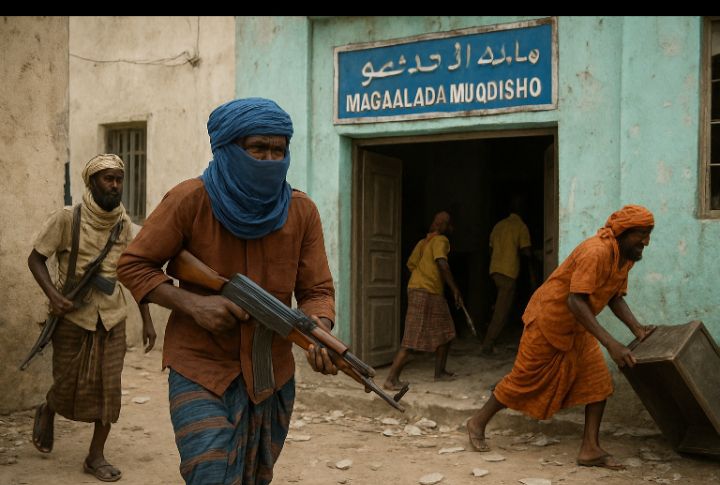
The collapse of the Somali central government in 1991 marked a pivotal moment in this transformation. Many nomads—who formed the backbone of the United Somali Congress (USC)—swiftly began seizing both private and public lands amid the lawlessness that ensued after state collapse. This phenomenon reflected deeply ingrained nomadic raiding traditions, but in the urban context, it mutated into predatory land grabs and opportunistic economic activity .During this period of anarchy, urban upheaval in Mogadishu manifested as widespread looting and banditry. Insurgent groups, including the USC, contributed to the chaos—they didn’t so much control the uproar—they facilitated it. Crowds and militias targeted public offices, state-owned businesses, and banks, turning what began as nominal resistance into destructive appropriation .
During this period of anarchy, urban upheaval in Mogadishu manifested as widespread looting and banditry. Insurgent groups, including the USC, contributed to the chaos—they didn’t so much control the uproar—they facilitated it. Crowds and militias targeted public offices, state-owned businesses, and banks, turning what began as nominal resistance into destructive appropriation .
4. Comparative Lessons: The Palestinians and the Kurds
The Palestinian experience—marked by statelessness, fragmented territory, and continuing diasporic identity—illustrates how national consciousness can persist even without direct control over territory. Similarly, Kurds, divided across multiple nation-states, have cultivated robust diasporic nationalism that often transcends legal citizenship or territorial sovereignty.
Somalis, in contrast, possess a recognized territorial state—yet they have struggled to value it collectively. This paradox suggests that possession without shared stewardship can be as destructive as dispossession itself. Without internalized national loyalty, sovereignty becomes hollow.
5. The Crisis of Somali Nationalism
Mid-20th-century Somali nationalism initially held promise in unifying Somali-inhabited territories. However, its collapse amid authoritarian rule, civil war, and foreign interference fractured this identity into competing clan loyalties. The nomadic instinct to defend one’s localized “turf” re-emerged—this time, micro-territorial instincts eclipsed national unity.
6. Conclusion: Relearning the Value of a Homeland
Beyond rebuilding institutions, Somalia must reforge a shared sense of territorial belonging. Cultural, educational, and civic innovations should frame the state not as an abstract construct, but as a tangible legacy—akin to the pastoral fields once zealously defended. Without such reorientation, Somalia risks drifting into a fragmented global identity devoid of territorial anchoring.
 Warsame Policy & Media Network (WAPMEN)
You must be logged in to post a comment.