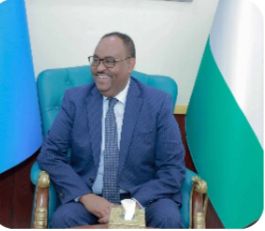
Will President Deni stand firm on the Sea World seizure amid pressure from Turkey, Egypt, and Mogadishu?

Said Deni

Context: What exactly happened with Sea World?

On July, 2025, Puntland’s Maritime Police Force (PMPF), under President Said Abdullahi Deni’s administration, intercepted the MV Sea World, a Comoros‑flagged vessel, off Bareeda’s coast   of Puntland State.

The ship was reportedly laden with Turkish-marked armored vehicles, anti‑aircraft guns, ammunition, and MRAPs—apparently en route to Mogadishu for non-state actors.

Puntland claims the ship entered territorial waters without distress signals, violating UNCLOS and posing regional security threats.

Parts of the cargo were off‑loaded, with some weapons reportedly found in civilian hands outside Bosaso Port, prompting an internal probe.

Diverse reactions: Federal Government and external actors respond

The Federal Government of Somalia has condemned Puntland’s actions as “hijacking,” invoking the provisional constitution and UNCLOS to demand immediate release.

Somalia’s defense ministry asserts cargo was legal military equipment under bilateral agreements with Turkey.

Regional analysts have voiced concerns:

A Turkish analyst accused Deni of acting as a proxy for the UAE, claiming the PMPF was UAE-funded and that UAE backed the seizure.

Turkey has a growing defense footprint in Somalia, highlighted by delivery of helicopters and advisory missions.

Egypt too has increased arms shipments to Mogadishu under defense pacts—adding further complexity.

Will President Deni relent under pressure?

Political and Strategic Stakes at Play

1. Puntland’s Legal and Sovereign Position

The administration emphasizes strict adherence to Somalia’s constitution and maritime law sovereignty.

Releasing the ship under federal pressure may be seen as undermining Puntland’s autonomy and authority.

2. Federal Pressure via Diplomatic Channels

Mogadishu is expected to escalate through federal legal routes and international maritime norms to force a release.

Political pressure may ensue via intergovernmental forums and possible UN monitoring teams already engaged in arms embargo enforcement.

3. Regional Backing and Strategic Alliances

UAE support for PMPF and Puntland’s regional security capabilities—possibly emboldening Deni.

Turkey and Egypt may lobby via diplomatic means but face the risk of confrontation with Puntland’s stance.

4. Domestic Pressure from Puntland Citizens

The public in Puntland demands accountability on illegal weapons flows and expects their leadership to act firmly.

Any sign of backing down risks political fallout at home.


Analysis: Likely outcomes for President Deni

Scenario Likelihood Implications

1.Stand firm, keep the ship detained.  Reinforces regional autonomy, asserts Puntland’s maritime sovereignty, but sharpens tensions with Mogadishu and external actors.
2. Negotiate conditional release. Release only after transparent joint federal-regional investigation, potentially preserving unity but risking domestic backlash.
3. Immediate release. Politically costly locally; may ease federal relations but embolden Mogadishu to challenge regional autonomy again.

Conclusion: What’s next?

The Sea World standoff highlights the complex tug‑of‑war between Puntland’s self-governance and Somalia’s federal authority—complicated further by Turkey’s defense involvement, Egypt’s arms deliveries, and UAE’s backing of regional security forces.

President Deni is expected to proceed cautiously, prioritizing Puntland’s constitutional rights and public sentiment. A forced release seems unlikely, but a negotiated compromise—perhaps through joint investigations or international mediation—could emerge if diplomatic costs escalate for Puntland.

What People of Puntland Are Saying

Local citizens express deep concern, saying they “need clarity and accountability—illegal arms must be stopped.”

Analysts warn: “How Deni handles this will define Puntland’s autonomy and its role in Somali federal dynamics.”

Final Thoughts

The world is watching. Whether by legal pressure, diplomatic outreach, or regional alliances, Turkey, Egypt, and Mogadishu will seek to reclaim the Sea World and its cargo. Yet Deni’s political calculus—balancing regional pride, domestic sentiment, and external actors—suggests he’s unlikely to capitulate outright. What happens next could redefine federal-state relations in Somalia and influence Horn‑region security ties.

Stay tuned as investigation results emerge, and diplomatic signals shift.

Britain’s Somaliland Policy: A Calculated Delay Rooted in Self-Interest, Not Principle

By Ismail Warsame

For over three decades, Somaliland has claimed independence from the rest of Somalia, and yet Britain—its former colonial ruler and one of its strongest foreign patrons—continues to withhold official recognition. This deliberate non-recognition has often been misread by pan-Somali unionists as a moral stance in support of Somali unity, or as Britain’s respect for African Union protocols and international law.

But nothing could be further from the truth.

Britain’s refusal to formally recognize Somaliland’s statehood is not a gesture of goodwill toward Somalia’s unity, nor is it based on any principled commitment to continental or global legal frameworks. Rather, it is a well-orchestrated policy of self-interest, anchored in a desire to preserve influence over the entire Somali geography—fragmented, unstable, and exploitable.

A Strategic Hedge: Playing Both Sides of Somali Politics

Unlike other former colonial powers, the UK has adopted a dual-track approach to Somalia. It engages both the Federal Government in Mogadishu and the administration in Hargeisa. This enables Britain to retain maximum leverage while avoiding formal legal commitments to either side.

By withholding recognition of Somaliland, Britain maintains:

Access to Mogadishu, where UN and African Union missions are based.

Soft power in Hargeisa, where UK-funded NGOs, education programs, and security firms operate freely.

Flexibility in oil and port negotiations, especially concerning Berbera, where UK-friendly interests (like DP World) operate.

This ambiguity is not accidental. It is strategic.

Not About African Unity – Just Global Hypocrisy

Britain frequently cites the African Union’s official stance on Somali territorial integrity to justify its hesitation on recognizing Somaliland. But this argument collapses under global scrutiny.

Britain supported the creation of South Sudan, recognized Kosovo’s independence, and has repeatedly intervened in state fragmentation when it aligns with its own interests. So why is Somaliland different?

Because Somalia—fragmented, weakened, and aid-dependent—is easier to manage, influence, and benefit from.

The moment Britain recognizes Somaliland, it risks:

Losing diplomatic access in Mogadishu.

Triggering regional chain reactions in Puntland and Jubaland.

Empowering nationalists who might resist UK economic and military influence.

So, the status quo—keeping Somaliland in limbo—serves British interests best.

Oil, Ports, and Quiet Power

Much of Britain’s hesitation is economic. Somaliland offers key strategic assets—especially its untapped oil reserves and the Berbera Port, a deep-water port with commercial and military potential.

British companies like Genel Energy have oil exploration interests in Somaliland. However, formal recognition might:

Trigger diplomatic or legal disputes with Mogadishu.

Invite regulatory scrutiny from a more empowered Somali federal government.

Endanger regional power balances that favor Western firms.

Moreover, maintaining soft control over strategic infrastructure without recognition allows the UK to:

Avoid responsibility.

Escape international legal constraints.

Play a long game of influence over multiple Somali actors.

As discussed in the article “The Invisible Hand: How Britain’s Shadow Governance Network Controls Modern Somalia and Seeks its Partition” (wordpress.com/ismailwarsame), the UK’s influence is exerted through a complex network of:

Development NGOs

Security contractors

Political mentorship programs

Education and aid channels

This network allows Britain to play an outsized role in Somali politics without direct intervention. A formal recognition of Somaliland would force London to take sides—thereby disrupting this delicate architecture of indirect influence.

Who Truly Loses in This Game?

The primary victim of Britain’s non-recognition policy is the Somali people—both in Somaliland and in southern Somalia. This ambiguity:

Encourages fragmentation and elite corruption.

Delays genuine reconciliation or reintegration efforts.

Undermines national institutions in favor of parallel structures.

Fuels regional tension and proxy rivalries (e.g., UAE vs. Qatar, Turkey vs. Egypt).

Britain’s calculated silence not only perpetuates division but sabotages the chance for a long-term Somali-led solution—be it reunification, federation, or legal separation.

Conclusion: This Is Not About Unity—It’s About Control

Britain’s refusal to recognize Somaliland is not a principled defense of Somali unity. It is a self-serving strategy to prolong access, leverage influence, and avoid legal entanglements in a volatile yet resource-rich region.

It is time for Somali intellectuals, youth, leaders, and regional allies to confront this duplicity. The future of Somalia—and Somaliland—should not be held hostage to outdated colonial calculations and foreign self-interest masquerading as diplomacy.

Whether one supports recognition or unity, the truth must be clear: Britain’s policy is not based on legality or loyalty—but on pure geopolitical calculus.

Further Reading

“The Invisible Hand: How Britain’s Shadow Governance Network Controls Modern Somalia and Seeks its Partition”

Read here: https://ismailwarsame.blog/2025/07/21/the-invisible-hand-how-britains-shadow-governance-network-controls-modern-somalia-and-seeks-its-partition/