
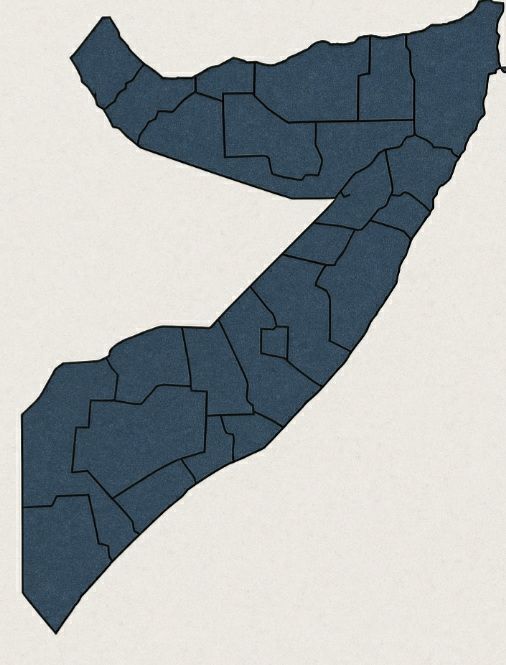
Once a proud land of nomadic warriors and pastoral wisdom, Somalia today lies fractured, besieged, and preyed upon by regional and global actors who treat it as a chessboard for influence and resource extraction. The struggle for Somalia’s future is no longer an internal matter; it has become a scramble — a ruthless, self-interested competition between foreign powers, aided and abetted by opportunistic local elites who barter national sovereignty for clan leverage and personal gain.
Historical Pride, Present Humiliation
Somalia’s collapse began with internal fissures — dictatorship, warlordism, and endless transitional governments. But now the decay is fed and prolonged by a wider geopolitical contest involving countries such as Turkey, UAE, Qatar, Egypt, Ethiopia, and even Israel — each maneuvering for a slice of Somalia’s land, coast, ports, influence, and strategic location on the Red Sea, Gulf of Aden, and Indian Ocean.
This new scramble for Somalia eerily mirrors the Berlin Conference of 1884-85, where European colonial powers carved Africa into spheres of influence. Today, this is happening again — not with maps and rulers, but with military bases, corrupt deals, infrastructure projects, drone bases, arms shipments, political endorsements, and proxy leaders.
Turkey: Imperial Revivalism Draped in Islamic Brotherhood
Among the most aggressive actors is Turkey, which disguises its neo-Ottoman ambitions under the rhetoric of Islamic solidarity. Ankara has established its largest overseas military base in Mogadishu, trained thousands of Somali troops, and embedded itself in government operations under the banner of development and security. But behind this veneer lies a deeper agenda: domination through dependency.
Turkish companies now manage Mogadishu Port and Airport, while Turkish-trained soldiers form the inner circle of elite military units answerable to Villa Somalia. These are not acts of brotherhood — they are steps toward colonial-style leverage, with Somalia providing cheap loyalty and strategic access in exchange for superficial development.
Case in Point: Hassan Sheikh Mohamud.
President Hassan Sheikh, hailed as a democrat in some Western circles, is widely viewed within Somalia as a divisive figure whose loyalty lies more with Turkish interests and his own personal gain than with national unity. Hassan Sheikh has:
1. Alienated the Darood clans by strategically supporting clan fragmentation in Jubaland, Puntland.
2. Undermined federalism while falsely claiming to champion reconciliation.
3. Used Turkish support to entrench a military apparatus loyal to him, not to the Somali state.
This is not leadership — this is the weaponization of foreign alliances to crush domestic dissent and suppress rival clans.
UAE: Commercial Empire by Proxy
If Turkey brings guns wrapped in religious language, the United Arab Emirates (UAE) comes with cash, ports, and backroom deals. Using financial leverage and political manipulation, the UAE has positioned itself as a commercial hegemon in northern Somalia, particularly through its deep involvement in Berbera Port (Somaliland) and Bosaso Port (Puntland).
The UAE’s strategy is clear:
Exploit federal fragmentation by signing independent port and military agreements with regional states, bypassing the federal government.
Support leaders such as Said Deni in Puntland or figures in Somaliland who will toe the Emirati line in return for funds, equipment, or political endorsement.
Control Red Sea trade routes, undermining Somalia’s chance to ever centralize maritime revenue.
In many ways, the UAE has replicated colonial divide-and-rule tactics, using cash and contracts instead of rifles.
Qatar, Egypt, and the Broader Proxy War
Qatar, a close Turkish ally, has often been accused of financing Islamist networks in Somalia and influencing media and politics through shadow channels. Its rivalry with UAE spills onto Somali soil, turning the country into a battlefield of Gulf enmities.
Egypt, obsessed with Ethiopia’s Nile dam project, sees Somalia as a possible southern flank to pressure Addis Ababa. Egyptian intelligence involvement in Mogadishu is rising, sometimes in competition with Ethiopia and sometimes coordinated with UAE-backed figures.
Meanwhile, Israel’s low-profile involvement through security intelligence and partnerships with Ethiopia and UAE, adds another layer of complexity.
Ethiopia: Historical Hostility in Strategic Garb
Ethiopia — with dreams of sea access — has long played a destabilizing role in Somalia, from invading in 2006 to meddling in regional states. Under Prime Minister Abiy Ahmed, Ethiopia has pivoted to a port diplomacy strategy, pushing for naval access through Somalia, Djibouti, or Eritrea. This has resurrected fears of territorial ambition masked as economic need.
The Ethiopian-Somaliland Memorandum of Understanding (MoU) over sea access — supported by some UAE channels — directly threatens Somalia’s territorial integrity. Yet Villa Somalia’s response under Hassan Sheikh has been weak, reactive, and uncoordinated, showing a leadership vacuum in Mogadishu.
Internal Betrayal: Local Elites as Gatekeepers to Foreign Control
None of this foreign interference could happen without local collaborators. Somalia’s elites — especially in Mogadishu — have traded national interest for clan supremacy or financial gain. President Hassan Sheikh’s government has become emblematic of this betrayal, presiding over:
1. The politicization of the military and security forces.
2. The weakening of federalism through manipulative appointments and budgetary blackmail.
3. Tactical alliances with foreign actors who prefer a fragmented Somalia — easier to manipulate and less likely to stand up for itself.
On the other hand, regional leaders like Said Deni in Puntland have played the UAE card for their own survival, equally compromising Somalia’s cohesion in the process.
The Cost: Somalia as a Puppet Theater
The result of this multilayered scramble is clear:
1. National institutions are hollow.
2. Foreign actors pull the strings of key politicians.
3. Somalia’s future is determined in Ankara, Abu Dhabi, Doha, and Addis Ababa — not in Mogadishu or Garowe.
Rather than forging unity, Somali leaders have become intermediaries of foreign interests, deepening the crisis of statehood.
A Path Forward: Resisting the Scramble
The tragedy is not irreversible. But it requires:
1. A genuine national dialogue across clans and regions — without foreign meddling — to agree on a new political contract.
2. Reclaiming sovereignty over key institutions, including ports, airports, and the military.
3. Ending the proxy games, by banning foreign bases and mercenary training programs that answer to foreign capitals.
4. New leadership from within the Somali people, especially among the younger generation, who see beyond clanism and are weary of being pawns in foreign conflicts.
Conclusion
Somalia’s greatest danger today is not just poverty or terrorism. It is the death of national will — the loss of collective identity amid a sea of foreign agendas and internal betrayals. The scramble for Somalia is real, but it can be resisted. Pride, history, and the legacy of those who once united the Somali nation must guide the next generation.
To reclaim Somalia, Somalis must first reclaim Somalia from themselves — and from those who have sold it piece by piece.
The WDM: The Voices of the People. The Mirror of the Nation.
 Warsame Policy & Media Network (WAPMEN)
You must be logged in to post a comment.