
By: WDM
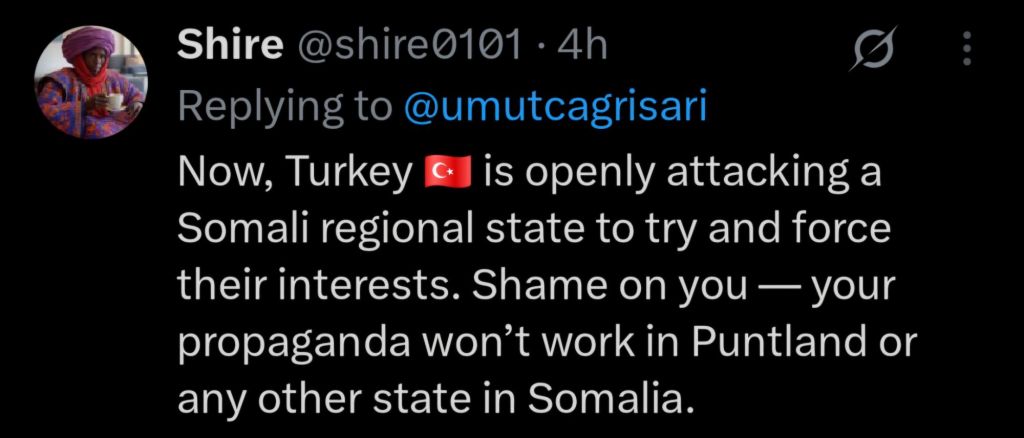
In a disturbing display of neocolonial arrogance, Turkey has escalated a media and diplomatic campaign targeting Puntland State — one of Somalia’s most stable and functional federal member states. The target of Ankara’s ire? A legal, transparent, and well-documented partnership between Puntland and the United Arab Emirates focused on trade, security, and infrastructure. This campaign is not only baseless; it is dangerous and exposes Turkey’s increasingly aggressive posture in the Horn of Africa.
Let us be unequivocal: Puntland is not a sovereign actor conducting rogue foreign policy. It is a constitutionally recognized federal state within Somalia, operating well within the bounds of its decentralized governance powers. Its cooperation with the UAE — dating back over decades — has helped combat piracy, ISIS, build ports, and inject real economic value into a region long neglected by Mogadishu.
Contrast this with Turkey’s own role in Somalia. Ankara’s deepening ties with the Somali federal government have increasingly taken the form of secretive deals, including a murky hydrocarbon agreement signed without parliamentary scrutiny, stakeholder consultation, or environmental assessment. These opaque arrangements suggest that Turkey’s growing presence is not about development or partnership — but extraction, control, and influence.
Turkey’s latest provocation — using pundits and proxies to vilify Puntland — is an unacceptable interference in Somalia’s fragile federal system. It is a brazen attempt to intimidate a peaceful region into submission, to punish Puntland for choosing practical partnerships over political allegiance, and to delegitimize any actor that does not tow Ankara’s preferred line.
This campaign also undermines the very stability that Turkey claims to support. Puntland is not a rebel territory or a breakaway enclave; it is a functioning federal member state with its own institutions, security forces, and governance structures. By attacking Puntland’s legitimacy, Turkey is not just meddling — it is fueling division and weakening Somalia’s already fragile federalism.
For a country that presents itself as a benevolent partner in Africa, Turkey is increasingly behaving like a 21st-century empire-builder — silencing dissent, pressuring local authorities, and cutting deals behind closed doors. This is not development. This is not diplomacy. It is coercion.
The international community must not stand by while a foreign power bullies a peaceful region for engaging in legal, beneficial partnerships. Turkey must be held to account for its destabilizing rhetoric and backroom dealings. Somalia needs genuine allies — not overlords.
If Turkey wants to be a partner in Somalia’s future, it must start by respecting the country’s federal structure, ceasing its propaganda against Puntland, and submitting its own dealings to the same transparency it demands of others. Until then, its influence in Somalia will be viewed not as a partnership but as provocation.
 Warsame Policy & Media Network (WAPMEN)