JUST IN CASE YOU WANT TO KNOW

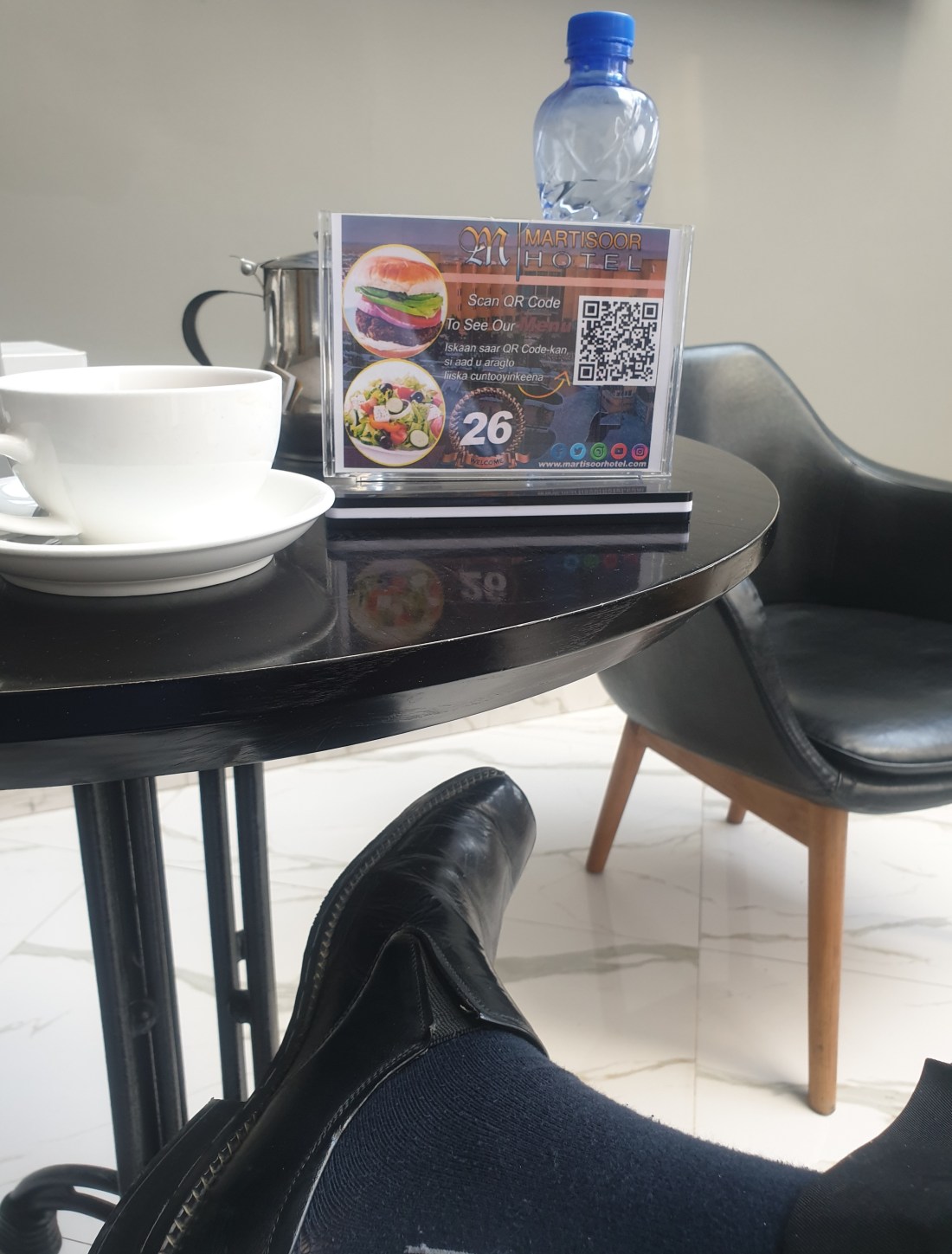
http://martisoorhotel.com/restaurant/menu.html

Garowe, Puntland, Somalia.

DARSI LA BARTAY

Watch “History of the Somali People – A Tale of Warriors, Herders and Seafarers.” on YouTube

WDM BREAKING NEWS

Bosaso standoff coming to an end.

AN OPEN LETTER TO PUNTLAND PRESIDENT SAID ABDULLAHI DENI

Mr. President,

Perhaps you had had heard that I was one of the key people, if not the key Puntland official then, who had created PIS/PSF as anti-terrorist units against foreign cells in major urban centres of Puntland. They were not established for local use.There were a number of foreign intelligence agencies’ proposals like UK, USA and others to recruit, fund and equip our units. These units came under the Presidency since they were specialized forces and didn’t fit into other security forces. We also did this command structure to prevent manipulations by foreign intelligence services.

President Bush’s War on Terror finally got our acceptance. These units were highly effective and useful in their operations against Al-Qaeda cells in Bosaso and Galkayo.

Now, to diffuse the standoff in Bosaso between PSF and other forces, I would suggest that you appoint PSF Commander, and under him, two Deputy-commanders, one of them being drawn from PSF units to release the tension and give them face-saving.

Mr. President,

Avoid accident, premature action and miscalculations. Puntland Government is a shared entity based on clan consensus. Its President, until now, isn’t popularly elected and his powers are limited if major tribal conflicts break out, despite the provisions of Puntland Constitution.

Moreover, Farmajo and his Co. are undermining Pl Government and determined to exploit the situation. Besides, any major escalation of hostilities in Puntland now could damage your political capital both locally and nationally.

Finally, the commanders of PSF must understand that they can’t exist outside the laws and control of Puntland Government. If they try to ignore Puntland leadership, they risk being decommissioned and disbanded all together.

Ismail Warsame

ON THE ETHIOPIAN SITUATION

DON’T JUDGE A BOOK BY ITS COVER. HAVE A NICE FLIGHT!

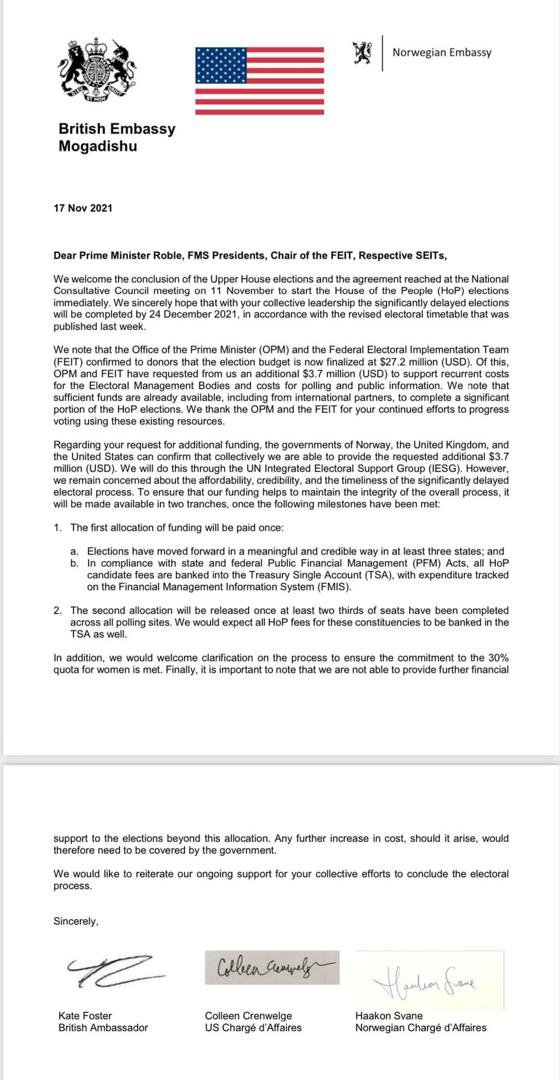
SOMALIA: ON FOREIGN ELECTORAL FUNDING

The Rise of “Peaceocracy” in Africa


The Rise of “Peaceocracy” in Africa

  • Gabrielle Lynch
  • Published online: 28 August 2019

Summary

The term “peaceocracy” refers to a situation in which an emphasis on peace is used to prioritize stability and order to the detriment of democracy. As such, the term can be used to refer to a short-lived or longer-term strategy whereby an emphasis on peace by an incumbent elite is used to close the political space through the delegitimization and suppression of activity that could arguably foster division or conflict. At the heart of peaceocracy lies an insistence that certain actions—including those that are generally regarded as constituting important political and civil rights, such as freedom of speech and association, freedom of the press, and freedom to engage in peaceful protest and strike action—can spill over into violence and foster division and must therefore be avoided to guard against disorder. Recent history suggests that incumbents can effectively establish a peaceocracy in contexts where many believe that widespread violence is an ever-present possibility; incumbents have, or are widely believed to have, helped to establish an existing peace; and the level of democracy is already low. In such contexts, a fragile peace helps to justify a prioritization of peace; the idea that incumbents have “brought peace” strengthens their self-portrait as the unrivaled guardians of the same; and semi-authoritarianism provides a context in which incumbents are motivated to use every means available to maintain power and are well placed—given, for example, their control over the media and civil society—to manipulate an emphasis on peace to suppress opposition activities. Key characteristics of peaceocracy include: an incumbent’s effective portrait of an existing peace as fragile and themselves as the unrivaled guardians of order and stability; a normative notion of citizenship that requires “good citizens” to actively protect peace and avoid activities that might foster division and conflict; and the use of these narratives of guardianship and disciplined citizenship to justify a range of repressive laws and actions. Peaceocracy is thus a strategy, rather than a discreet regime type, which incumbents can use in hybrid regimes as part of their “menu of manipulation,” and which can be said to be “successful” when counter-narratives are in fact marginalized and the political space is effectively squeezed.

Keywords

SOME SOMALI HISTORY EXPLANTIONS AND FACTS

Questions:

  1. Why did Abdullahi Yusuf Ahmed, the late president of the Transitional Federal Government, propose to the late president of Somaliland, Mohamed Ibrahim Egal, to seek the post of Somalia’s president, given the fact Mr. Yusuf had been struggling all his life to become the President?
  2. Why did friends-officers, Col. Abdullahi Yusuf and General Mohamed Farah Aydid couldn’t agree to unite USC–SNA and SSDF to form a united national government?
  3. How history would treat the leaders of Somali National Movement ((SNM)? These and more will be exposed in this short story.

It is generally agreed Abdullahi Yusuf was extremely ambitious to become one day Somali president and that he had been working hard towards that goal in all his adult life. Becoming a rebel SSDF leader in exile in Ethiopia after a failed coup is part of his struggle to attain the goal. When the Somali Republic had failed, he saw diminishing returns for that dream of ever becoming a Somali president. Here re-instating the failed state of Somalia became his top priority, using any means to realize the foundation of the 2nd Somali Republic.

Establishment of Puntland State is a major part of that political vision. Abdullahi Yusuf saw the territorial disputes on Sool and Sanaag between Puntland and Somaliland as an obstacle to Somali unity and persistent factor for security instability in Northern Somalia (Puntland and Somaliland). He approached Late Mohamed Ibrahim Egal for peaceful resolution of the issue, including encouraging the latter to seek post of Somalia’s president. Despite Egal’s known bold past decision-making, he couldn’t dare to confront Somaliland public, who in delusional way, bought into the idea of “gooni Isutaag (secession from Somalia). At the time the Head of the BBC Somali Language Section, Patrick Gilkes, told the author of this article that Mr Egal couldn’t stay President of Somaliland one day more, were he to return to the issue of Somaliweyn politics.

General Aideed of USC and Abdirahman Tuur of SNM had conspired with Mengistu Haile-Mariam of Ethiopia to overthrow the already dying regime of Siyad Barre, and split the spoils of Somali State among their factions in Mogadishu and Hargeisa. It was agreed that in post-Siyad Barre, power would be shared between Hawiye and Isaak. Darood would be marginalized in this power grab. This is how and why Abdullahi Yussuf and Aideed couldn’t strike a deal.

When talking about the issue of “Somaliland”, in reality, people don’t appreciate the difference between Isaak clans and the rest of other clan system of Harti (Mainly Dhulbahante and Warsangeli), Issa, Samaroon (Gadabursi) that technically constituted the former British Protectorate of Somaliland. By the way, Dhulbahante clan wasn’t a party to that Protectorate arrangement as they were conquered by the British Military Administration with the help of Isaaks’ British conscripts and help.

Now, the leaders of rebel SNM, expressing real and perceived grievances against the politicians and officials of former Italian Protectorate, represented only the interests of Isaak. Somaliland is now nothing more than an Isaak identity. Many of SNM leaders were former officials of Somali Republic, who had contributed to its progress, turning up against it in the end. How history would treat them is to be seen.

Somalia: Vote to Renew Sanctions Measures

Security Council Report

What’s In Blue

Posted Sun 14 Nov 2021

Tomorrow afternoon (15 November), the Security Council is expected to vote on a draft resolution on the 751 Somalia sanctions regime, renewing for one year the partial lifting of the arms embargo on Somali security forces, the authorisation for maritime interdiction to enforce the embargo on illicit arms imports and charcoal exports, and humanitarian exemptions to the regime. The draft resolution also renews the mandate of the Somalia Panel of Experts until 15 December 2022.

As has been the case in the past several years, the sanctions measures themselves were not a matter of controversy during the negotiations. However, divergences persisted on other parts of the resolution that do not have direct impact on the implementation of the sanctions regime, such as references to the ongoing dispute between Djibouti and Eritrea.

It seems that the UK, the penholder on Somalia, sought to maintain the core measures of the sanctions regime and to extend the mandate of the Panel of Experts without changes—an approach apparently supported by Council members. The draft text in blue renews for one year, until 15 November 2022, the main elements of the sanctions regime—including the partial lifting of the arms embargo and the humanitarian exemptions—which were most recently outlined in resolution 2551 of 12 November 2020.

The UK convened one round of virtual negotiations on an initial draft text on 8 November. It then circulated a revised version for comment until 11 November. Several Council members submitted comments and a second revised version was then placed under silence until Friday (12 November) morning. Silence was broken on the text, and subsequently the vote on the draft resolution, which was initially scheduled for Friday (12 November), was postponed to Monday (15 November) to allow for further deliberations. The draft resolution was then put in blue on Friday (12 November) afternoon.

The penholder reorganised the draft resolution in blue under new concise headings, adding new sections which reflect a focus on countering the threat posed by the militant group Al-Shabaab and on supporting state- and peace-building in Somalia. In this regard, the draft text in blue notes in its preambular part that the objective of the resolution is to “support state- and peace-building in Somalia including by reducing the threat to peace and security posed by Al-Shabaab and by reducing the destabilising impact of Al-Shabaab’s activities”. New language is included in the operative section of the draft in blue emphasising the need to “target Al-Shabaab’s finances, improve maritime domain awareness, prevent illicit revenue generation, including from the sale of charcoal, and reduce the threat posed by IEDs [improvised explosive devices]”. Regarding Somali institution-building, the draft text in blue underscores the importance of improving weapons and ammunition management and of increasing the capabilities of Somali security forces, with the aim of bolstering the Somali authorities’ resilience and their ability to address the threat posed by Al-Shabaab.

It seems that, as in previous years, the most divisive topic of discussion during the negotiations was references to the relationship between Djibouti and Eritrea. The penholder proposed language in an earlier iteration of the draft resolution underscoring the importance of confidence-building measures between Eritrea and Djibouti and “encouraging the Secretary-General and African Union to use their good offices…in this regard”, as well as requesting the Secretary-General to report on improvements of their bilateral relations “as deemed necessary”. This proposal was apparently unacceptable to some Council members and was not retained in the draft text in blue.

The relationship between Djibouti and Eritrea has been addressed in Somalia-related sanctions resolutions since the adoption of resolution 1907 of 23 December 2009, which linked Djibouti-Eritrean relations to the peace process in Somalia. The reference has been divisive, causing abstentions by China and Russia on several past Somalia-related resolutions.

In resolution 2444 of 14 November 2018, the Council lifted sanctions on Eritrea, terminated the mandate of the Somalia and Eritrea Monitoring Group (SEMG), and established a Panel of Experts focused solely on Somalia. The Council’s decision in 2018 to lift the sanctions imposed on Eritrea was based on the recognition that for five consecutive reporting cycles, the SEMG had not found conclusive evidence that Eritrea supported Al-Shabaab. The decision was also informed by the positive political developments after Ethiopian Prime Minister Abiy Ahmed and Eritrean President Isaias Afwerki signed a peace agreement in Asmara on 9 July 2018.

Difficult regional dynamics have persisted since 2018, however, and relations between Djibouti and Eritrea remain strained because of their unresolved border dispute. Therefore, several Council members, including France, apparently believe that it is important for the Council to continue monitoring confidence-building measures between the two countries. It seems that these members maintain that the Somalia sanctions resolutions are a means for the Council to address Djibouti-Eritrea relations.

Other Council members, including China and Russia, opposed having a reference to Djibouti-Eritrea relations, arguing that the focus of the resolution should be assisting Somalia. These members apparently maintain that it is unusual for a country-specific resolution to refer to relations between other countries. It seems that China and Russia also argue that Djibouti-Eritrea tensions are strictly a bilateral matter, which is not a threat to international peace and security. In light of these positions, China and Russia broke silence over references to Djibouti-Eritrea relations during the negotiations.

It seems that several Council members, including the “A3 plus one” (Kenya, Niger, Tunisia, and Saint Vincent and the Grenadines) held discussions with Djibouti and Eritrea about the reference in the resolution in order to find language that would be agreeable to all parties involved. However, Council members were not able to agree on compromise language on the matter. As a result, the penholder retained in the draft text in blue existing language from resolution 2551, which reaffirms the Council’s intention to follow developments towards the normalisation of relations between Eritrea and Djibouti and, as in previous Somalia sanctions resolutions, requests the Secretary-General to submit a report on the matter, in this case no later than 31 July 2022.

It seems that discussions on cross-cutting issues were also contentious during the negotiations. In the first draft of the resolution, the penholder, following a recommendation by the Panel of Experts, added a reference highlighting the potential for Al-Shabaab to exploit the effects of climate change. This reference was not retained in the draft text in blue, apparently due to objections from China and Russia. In addition, it seems that Mexico wanted additional language requesting the Panel of Experts to include gender issues in its investigations and reporting. Although this request faced opposition from some Council members, it was ultimately retained in the draft text in blue.

Copyright © 2021 Security Council Report

SOMALILAND FAKE DEMOCRACY AND PEACEOCRACY

Somaliland’s authoritarian turn:
oligarchic–corporate power and
the political economy of de facto states
CLAIRE ELDER*
International Affairs 97: 6 (2021) 1749–1765; doi: 10.1093/ia/iiab174
© The Author(s) 2021. Published by Oxford University Press on behalf of The Royal Institute of International Affairs. This is
an Open Access article distributed under the terms of the Creative Commons Attribution License (http://creativecommons.org/
licenses/by/4.0/), which permits unrestricted reuse, distribution, and reproduction in any medium, provided the original work
is properly cited.
The prevailing narrative of Somaliland’s democratic successes has to date stressed
the pre-eminent role of bottom-up statebuilding, the strength of social institutions
and the absence of foreign aid.1 This research identifies Somaliland as one of the
most effective entities in the Horn of Africa, even when compared to its neighbours—
de jure recognized states such as Somalia, Ethiopia and Djibouti.2 This
depiction of Somaliland as a safe haven of security and stability—as opposed to
the warlord- and terrorist-ridden Somalia—has, however, for decades downplayed
internal political dynamics and complex crises.3 A political economy perspective
provides new insights that challenge certain underlying assumptions and dominant
discourses about Somaliland’s processes of democratization and development.
While democracy has been demanded and fought for from below since it declared
independence in 1991, original findings unveil how cross-border oligarchic–corporate
networks, linked also to the Djiboutian patron state, as well as dependence on
trade and security rents, have restricted democratization, leading to the formation
of an ‘oligopolistic state’ and a ‘peaceocracy’. In putting forward this argument,
this article focuses attention on the distinct challenges de facto states face in balancing
political control and financial hardship, and the unique and uneven development
trajectories, including creative governance structures, that are not captured
by Weberian state models and path-dependent understandings of democratization.
While the study of de facto states has gained increasing prominence in International
Relations, political economy research is notably absent from these discussions.
4 This is partly because these jurisdictions are not researched in terms of

  • Funding for this article was facilitated by the Cyril Foster Peace Fund at Oxford University (2018) and the
    Economic and Social Research Council (ESRC), project ES/P008038/1, ‘CPAID: Centre for Public Authority
    and International Development’ at the London School of Economics and Political Science from 2019 to 2021.
    1 Yaniv Voller, ‘Contested sovereignty as an opportunity: understanding democratic transitions in unrecognised
    states’, Democratisation 22: 4, 2013, pp. 610–30; Sarah G. Phillips, ‘When less was more: external assistance
    and the political settlement in Somaliland’, International Affairs 92: 3, 2016, pp. 629–45.
    2 Mark Bradbury, Becoming Somaliland (Oxford: James Currey, 2008).
    3 Roland Marchal, ‘Warlordism and terrorism: how to obscure an already confusing crisis? The case of Somalia’,
    International Affairs 83: 6, 2007, pp. 1091–106.
    4 James Harvey and Gareth Stansfield, ‘Theorizing unrecognized states: sovereignty, secessionism and political
    economy’, in Nina Caspersen and Gareth Stansfield, eds, Unrecognised states in the international system (Abingdon:
    Routledge, 2011), pp. 1–26. Magdalena Dembinska and Aurélie Campana, ‘Frozen conflicts and internal
    dynamics of de facto states: perspectives and directions for research’, International Studies Review 19: 2, 2017,
    pp. 254–78.
    Downloaded from https://academic.oup.com/ia/article/97/6/1749/6412453 by guest on 01 November 2021
    Claire Elder
    1750
    International Affairs 97: 6, 2021
    expectations of effective developmental performance. Instead, homogenizing,
    singular and linear narratives of de facto statehood see these entities as deviations
    from western institutional frameworks and as hot-spots of terrorism, criminality
    and corruption.5 I set out here to fill this gap, examining at close range how crossborder
    oligarchic–corporate interests brought stability but also limited democratization.
    This perspective includes assessing the canny political manoeuvrings of
    Somaliland officials and oligarchic–corporate structures in creating a ‘paper leviathan’
    or hollow state, 6 and how western donors and the politics of foreign aid, by
    means including the securitization of aid, have empowered dominant clientelistic
    networks and hindered democratization efforts for decades. This article also details
    how the ‘oligopolistic state’ in Somaliland was rooted in a revolutionary ideology
    of privatized governance that motivated Somalia National Movement (SNM)
    in the 1980s to resist Siad Barre’s socialist and predatory military regime. After
    independence, this revolutionary system sought to overturn colonial hierarchies
    of power and protect market-led development. It brought elements of stability for
    a time, but also lessened the bargaining power of the state vis-à-vis domestic firms
    and hindered the formation of a professional bureaucracy and legitimate central
    authority, and weakened popular mobilization. This system was tolerated (even
    encouraged) internationally in line with commitments to depoliticized economic
    development models until the formation of a crony capitalist system under President
    Mohamed Mohamoud ‘Silanyo’ that threatened Somaliland’s premier role in
    the fight against global terrorism.
    Following his election in 2010, President Silanyo sought to accelerate state
    capture of the political economy—implementing a model of Djiboutian-style
    presidentialism—and he rewarded loyal business associates with new opportunities
    in Islamic finance and business. Yet, Silanyo was never able to rebalance the
    bargaining power of the state vis-à-vis domestic firms nor limit the opposition’s
    access to political finance. What was described as a ‘decentralized kleptocratic
    system’, of affiliated oligarchs and ‘deniable authoritarianism’,7 rather exposed the
    depths of collusion between business and government officials, and the nature of
    the corrupt and exclusive statebuilding enterprise also aided by foreign aid and
    security rents that empowered oligarchic–corporate structures.
    While Somaliland has always received less aid than Somalia,8 the 2013 special
    arrangement, awarded as part of the New Deal Compact with the federal government
    of Somalia, provided access to funding from the EU and other donors
    earmarked for security, trade and resilience. Important was that minimal aid
    was directed for ‘state effectiveness’ due to political sensitivities and the region’s
    5 See Laurence Broers, ‘Resourcing de facto jurisdictions: a theoretical perspective on cases in the south Caucasus’,
    Caucasus Survey 3: 3, 2015, pp. 269–90; Scott Pegg, ‘Twenty years of de facto state studies: progress,
    problems, and prospects’, Oxford research encyclopedia of politics (Oxford: Oxford University Press, 2017).
    6 Daron Acemoglu and James A. Robinson, The narrow corridor: states, societies, and the fate of liberty (New York:
    Penguin Publishers, 2019).
    7 These concepts, although not in the public discourse on Somaliland, were repeated in interviews and focus
    group discussions conducted from 2015 until 2020.
    8 Federal Government of Somalia, Ministry of Planning, Investment and Economic Development, Aid flows in
    Somalia (Mogadishu, May 2019).
    Downloaded from https://academic.oup.com/ia/article/97/6/1749/6412453 by guest on 01 November 2021
    Somaliland’s authoritarian turn
    1751
    International Affairs 97: 6, 2021
    ambiguous status within the 2012 provisional federal constitution. This had
    deleterious implications. Democratization has always been a subordinate issue
    for donors who paid lip service to bottom-up statebuilding activities but made
    few attempts to support or maintain these systems. Like elsewhere in Africa, and
    indeed globally, the securitization of aid has entrenched illiberal and authoritarian
    states by promoting the state as donors’ preferred ‘partner’ in development,9
    creating aid flows no longer accountable to citizens and providing states with the
    machinery to repress opponents and democracy.10 In Somaliland the securitization
    of aid and access to new resources propped up the state’s security apparatus and
    a military–logistics complex that reinforced the power of oligarchic–corporate
    structures rather than a national, democratic state.
    In 2017, the international community and population widely endorsed Musa
    Bihi Abdi not as a supporter of democracy but as an antidote to corruption and
    political instability. He used his military credentials to re-confirm commitments
    to security, but he failed to assert political control over the economy. Kulmiye
    Party’s tenure in power (2010–21) came to symbolize the fierce power struggle over
    how to balance financial hardship and ‘supranational’ corporate interests (that had
    fought for and singlehandedly financed the liberation movement and independence
    project) with political control and the nation-state agenda. By examining
    Somaliland’s political economy and its effects on internal politics, this study
    provides new insights for understanding governance structures and outcomes
    within de facto states. It offers strong evidence of how collusive cross-border elites,
    regional patron states and western donors have limited democratization in Somaliland
    through the creation of a ‘peaceocracy’ and ‘oligopolistic state’.11 This study
    also raises important questions about how new donors in the Gulf and in Asia,
    and opportunities for recognition through Islamic finance and business, affect de
    facto states’ relationship with the international system, including commitments to
    democratization.12 It argues that the prevailing democratic-success narrative, as it
    has been constructed and reproduced, has not served the interests of Somalilanders
    but those of elites and donors keen to maintain the status quo.
    Analysing the political economies of de facto states raises a number of methodological
    and political challenges, including poor availability of data. This study
    draws on a number of robust sources, including 110 interviews with politicians,
    former liberation fighters, business actors, senior government officials and international
    organizations, and archival work conducted in Somaliland from 2015 to
    2021.13 Original data gathered from the chamber of commerce, business accounts
    9 Jonathan Fisher and David Anderson, ‘Authoritarianism and the securitization of development in Africa’,
    International Affairs 91: 1, 2015, pp. 131–51; Will Jones, Ricardo Soares de Oliveira and Harry Verhoeven,
    Africa’s illiberal state-builders, working paper no. 89 (Refugee Studies Centre, University of Oxford, 2013).
    10 Tobias Hagmann and Filip Reyntjens, eds, Aid and authoritarianism in Africa: development without democracy
    (London: Zed, 2016).
    11 Rita Abrahamsen, ‘Africa and international relations: assembling Africa, studying the world’, African Affairs
    116: 462, 2017, pp. 125–39.
    12 Davinia Hoggarth, ‘The rise of Islamic finance: post-colonial market-building in central Asia and Russia’,
    International Affairs 92: 1, 2016, pp. 115–36; Lena Rethel, ‘Whose legitimacy? Islamic finance and the global
    financial order’, Review of International Political Economy 18: 1, 2011, pp. 75–98 at p. 94.
    13 Many interviewees (particularly senior government officials and those working for international organiza-
    Downloaded from https://academic.oup.com/ia/article/97/6/1749/6412453 by guest on 01 November 2021
    Claire Elder
    1752
    International Affairs 97: 6, 2021
    and intelligence reports, as well as interviews with business actors, enables an
    analysis of hitherto hidden corporate ownership (including around Islamic finance
    and banking institutions). Additional data is drawn from government and media
    archives (including leaders’ published and unpublished statements, speeches and
    policy agendas) and donor surveys. Participant and non-participant observation of
    public debates on leadership and economic development plans also provides invaluable
    insights on how de facto states balance the challenges of financial hardship,
    political control and democratization. Together, these data sources provide a rich
    account of Somaliland’s development since independence, and particularly of the
    transformations that unfolded after 2010.
    The next section first outlines the analytical and conceptual framework
    surrounding the concepts of ‘oligopolistic states’ and ‘peaceocracy’. The following
    section then examines how the oligopolistic state emerged out of a revolutionary
    liberation agenda committed from the outset to business autonomy, market-led
    development and self-sufficiency in the shadow of Siad Barre’s predatory regime,
    and to overturning power structures inherited from the colonial state. The
    remaining sections then examine how attempts by President Silanyo to rebrand
    Somaliland as a player in the global political economy and to capture control of
    the economy presented new security concerns, a rupture in the political settlement,
    and laid the foundations for the rise of a populist authoritarian. The ruling
    Kulmiye Party, under President Musa Bihi Abdi after 2017, tried to implement
    stringent ‘monopolistic’ control over the country’s political economy and its territorial
    boundaries—efforts that continued to reveal the weak bargaining power of
    the state vis-à-vis domestic firms.
    Somaliland’s ‘oligopolistic state’ and ‘peaceocracy’
    Somaliland constitutes what we can call an ‘oligopolistic state’, referring to the
    small number of firms and elites which, after independence—and through discreet
    cross-border business networks and unaccounted financial flows—colluded,
    either explicitly or tacitly, to limit competition and restrict the authority of
    the state in order to achieve above-normal market returns and protections.14 In
    particular, the deep entanglements of Somaliland’s finance and politics with
    neighbouring Djibouti, and the polity’s dependence on trade and security rents,
    have since underlain poor elite commitment to democratization as well as the
    enduring legacy of the SNM over politics. Where other de facto states may be
    either subsistence economies (relying on local forms of production and taxation)
    or rentier states (dependent on natural resources or a primary patron for formal
    loans),15 Somaliland has limited potential for industry, little agriculture and is
    tions) requested anonymity, given the nature of the sensitive issues discussed.
    14 On how such oligopolies emerge in conflict-affected contexts, see Antonio Giustozzi, The resilient oligopoly:
    a political-economy of northern Afghanistan 2001 and onwards (Kabul: Afghanistan Research and Evaluation Unit,
    Dec. 2012), pp. 4–5.
    15 Broers, ‘Resourcing de facto jurisdictions’, p. 273. See also Michael Ross, ’Does oil hinder democracy?’, World
    Politics 53: 3, 2001, pp. 325–61.
    Downloaded from https://academic.oup.com/ia/article/97/6/1749/6412453 by guest on 01 November 2021
    Somaliland’s authoritarian turn
    1753
    International Affairs 97: 6, 2021
    heavily reliant on import–export industries and the expansion of financial and
    business services (and to a lesser extent remittances).16 Pritchett et al. emphasize
    the ‘bad politics’ that emerge when such powerbroker industries dominate, as they
    fuel corruption and business-government collusion.17 Others have highlighted the
    risks of ‘small states’ relying on financial and business services as supporting the
    formation of undemocratic, offshore tax havens.18
    By exerting excessive influence over policy-making and politics as the region’s
    major lenders, employers and taxpayers—using in-kind loans to support political
    campaigns—Djiboutian oligarchs and sectoral-specific rent relationships
    have limited forms of economic liberalization and democratization that would
    challenge structures of accumulation and power. In these oligopolistic systems,
    elites are not entirely autonomous and independent of society, as in rentier
    states,19 but they are not compelled to structure their relationship with society
    in such a way as to construct common projects around productive and inclusive
    development. While these states may exercise the functions of a state, and can
    create stable environments and mimic compliance with regulatory and governance
    structures, they also come into confrontation with the political–bureaucratic
    machinery of the nation-state and thrive in conditions of state regulatory failure,
    porous borders and the privatization of redistributive institutions. States of this
    type, such as Somaliland, lurch between the solidification of public–private ties
    and a more opaque rentierism, that create uneven development and governance
    and complicate external assessments of governance and political outcomes. For
    instance, corporate taxation is notoriously low (even lower than in Somalia) as
    successive governments have feared the risk of business flight to other regions (as
    businesses frequently threaten).20
    The oligopolistic state, in turn, also created a ‘peaceocracy’ that was necessary
    for business and external legitimacy. Holding frequent, peaceful elections adheres
    to certain minimal requirements for international legitimacy but also inherently
    restricts core tenets of democratization linked to freedoms and civil liberties.21
    The concept of peaceocracy has been used in other post-conflict contexts to
    refer to the formation of limited electoral democracies and access orders,22 where
    peaceful elections are secured through the use of ‘peace-at-all-costs’ narratives,
    16 ‘Somaliland’s private sector at a crossroads: political economy and policy choices for prosperity and job creation’
    (Washington DC: International Bank for Reconstruction and Development, The World Bank, 2016).
    17 Lant Pritchett, Kunal Sen and Eric Werker, Deals and development: the political dynamics of growth episodes (Oxford:
    Oxford University Press).
    18 See Ronen Palan, The offshore world: sovereign markets, virtual places, and nomad millionaires (Ithaca, NY: Cornell
    University Press, 2005); Ricardo Soares de Oliveira, Researching Africa and the offshore world, working paper
    (Oxford: Oxford Martin Programme on African Governance, 10 June 2021).
    19 Peter Evans, ‘Predatory, developmental, and other apparatuses: a comparative political economy perspective
    on the Third World state’, Sociological Forum, vol. 4, 1989, pp. 561–87.
    20 World Bank, Somalia economic update: edition no. 2, mobilizing domestic revenue for Somalia’s economic reconstruction
    (Washington DC, 2015), p. 35, fig. 1.13. Author interviews with more than 30 business actors, Hargeisa, Nov.
    2017 and April 2018.
    21 See Gabrielle Lynch, Nic Cheeseman and Justin Willis, ‘From peace campaigns to peaceocracy: elections,
    order and authority in Africa’, African Affairs 118: 473, 2019, pp. 603–27.
    22 For definition of ‘limited access orders’, see Douglass C. North, John Joseph Wallis, Steven B. Webb and Barry
    R. Weingast, Limited access orders in the developing world: a new approach to the problems of development, policy research
    working paper no. 4359 (Washington DC: World Bank, 2007).
    Downloaded from https://academic.oup.com/ia/article/97/6/1749/6412453 by guest on 01 November 2021
    Claire Elder
    1754
    International Affairs 97: 6, 2021
    the stifling and criminalizing of dissenting views and open political debate, and a
    heavy security presence, but are nonetheless greeted internationally as legitimate
    and secure favourable aid relations.23 Somaliland’s peaceocracy, which has been in
    existence since its transition to multiparty democracy in 2002, has recorded some
    of the highest rates of election turnout on the continent (80 per cent of registered
    voters turned out for the presidential elections of 2016).24 Yet every election
    since 2002 has also seen high rates of state interference, intimidation, rigging,
    and the stifling of opposition activity and media freedom, which often go underreported
    where public criticism of corrupt officials and authorities is also criminalized.
    25 Elites have for decades used the restrictive three-party system (effectively
    frozen since 2002),26 along with constitutional provisions and electoral laws, to
    stay in power and prevent any genuine oppositional pole from emerging. The
    recent municipal and parliamentary elections of 2021 were no exception: at least
    seven candidates were detained to pre-empt any challenge to the ruling Kulmiye
    party.27 These heavy-handed tactics just proved less effective this time around.
    As such, rather than serving the population as a whole, Somaliland’s peaceocracy
    has protected the interests of a select group of financial and political elites
    for decades. These interests have deliberately kept civil society organizations and
    formal offices and ministries weak,28 and repeatedly postponed important parliamentary
    elections,29 in turn restricting the space for alternative political projects
    to emerge.30
    For decades, high rates of electoral participation, relative peace and stability, and
    economic self-sufficiency have been mistakenly construed as markers of democratization.
    A political economy perspective, by contrast, reveals weak elite commitments
    to democratization and the technologies of power that have been used to
    undermine genuine democratic reform and weaken popular mobilization. The
    following section examines the origins of Somaliland’s oligopolistic state within
    23 Somaliland has frequently been characterized as a ‘hostage to peace’: see Human Rights Watch, Hostages to peace:
    threats to human rights and democracy in Somaliland (New York, 2009), https://www.hrw.org/report/2009/07/13/
    hostages-peace/threats-human-rights-and-democracy-somaliland. (Unless otherwise noted at point of citation,
    all URLs cited in this article were accessible on 26 Sept. 2021.)
    24 Michael Walls, Conrad Heine, Andrea Klingel, Carrie Goggin and Ahmed Farag, The limits of consensus? Report
    on the Somaliland presidential election (London: University College London International Election Observation
    Mission, 13 Nov. 2017).
    25 ICG, Somaliland, p. 20; International Crisis Group (ICG), Somaliland: the strains of success, Africa Briefing no.
    113 (Brussels, 2015), pp. 14–15.
    26 Author in-person interview, former member of Somaliland parliament (1997–2005), Hargeisa, Sept. 2016.
    Oisin Tansey calls the three-party system one of the most problematic aspects of Somaliland’s political transition:
    ‘Does democracy need sovereignty?’, Review of International Studies 37: 4, 2011, pp. 1515–36.
    27 See Human Rights Centre, A quarterly report April 2021 (Hargeisa), http://hrcsomaliland.org/hrc-quarterlyreport-
    april-2021/; author phone interview, former member of SNM, Ali Guray, Hargeisa, June 2021.
    28 Sarah G. Phillips argues the weakness of formal institutions in When there was no aid: war and peace in Somaliland
    (Ithaca, NY, and London: Cornell University Press, 2020). Interviews and non-participant observation of
    bureaucracy reveal that this is a deliberate strategy pursued to exercise social and political control.
    29 Prior to the 2021 elections, the parliament elected in 2005 for five years had served 15 years; the Guurti or
    House of Elders has not faced elections since 1997. See Centre for Policy Analysis, Somaliland: the extensionbased
    democracy (Hargeisa, 2019), https://somalilandelection.com/reports/somaliland-the-extension-baseddemocracy/.
    30 Author interviews and focus group discussions, 2015 and 2018, and with local activists and party officials,
    Hargeisa, Nov. 2016.
    Downloaded from https://academic.oup.com/ia/article/97/6/1749/6412453 by guest on 01 November 2021
    Somaliland’s authoritarian turn
    1755
    International Affairs 97: 6, 2021
    the liberation movement as these structures of power and ideologies of privatized
    governance continue to shape contemporary politics and power struggles.
    The revolutionary origins of Somaliland’s oligopolistic state
    Under colonial rule, and in contrast with the more interventionist policies of
    Italian colonizers in Somalia, Somaliland’s business community appreciated
    considerable autonomy from the ‘state’, developing a stronger orientation towards
    the Gulf countries.31 However, during Somaliland’s long union with Somalia
    (1960–91), and particularly under Siad Barre’s scientific socialism after 1969,
    Somaliland traders faced heavy restrictions as the government violently seized
    northern assets. The experience of political and economic marginalization,32 as
    a consequence of southern domination, generated two movements within the
    Somaliland region: religious nationalism, including the rise of organizations such
    as ‘Waxda’ (Unity of Muslim Youth); and capitalist mobilization against socialism,
    which was bad for business.33 Not well understood in the study of Somaliland
    is how capitalists during this time viewed their longer-term interests as aligned
    with a nationalist struggle against broader waves of socialism in the region (under
    leaders including Haile Selassie in Ethiopia and Al Nasir Muhammed in Yemen),
    and how this resulted in mutual commitments to Islamic ideals of self-sufficiency,
    market-led development and entrepreneurship as the foundations of the national
    project.34 These capitalists, represented initially by the Saudi group, dominated
    the more liberal ideas of the London group and the local grassroots Uffo group in
    the founding of the SNM, 35 and these hierarchical structures of power continued
    to influence political developments post-independence. Capitalists along with the
    military fighters decisively pushed for independence when it was evident that
    southern groups would continue to dominate the politics and economy of any
    newly liberated Somali state, and equally quickly moved against attempts by the
    SNM executive committee to establish a central army and government.36
    By independence, the SNM was deeply divided among different factions with
    fundamental disagreements over the nature of state power, the role of Islam, and
    how to balance the distribution of resources between clans—this would in turn
    spark a civil war. The single most important driver of the civil war was the fact
    that, at independence, the SNM was under the command of Abdirahman Ahmed
    Ali Tuur, who was to lead the two-year transitional government until a civilian
    government could take over. Yet Tuur represented the Garhajis clan, who were
    widely seen as beneficiaries of British indirect rule, landowners and more populous
    than other groups, having also commanded more fronts than other clans in the
    31 Roland Marchal, Final report on the post-civil war Somali business class (Paris: Sciences Po, 1996), p. 15.
    32 Hussein A. Bulhan, Politics of Cain: one hundred years of crises in Somali politics and society (Bethesda, MD: Tayosan,
    2008).
    33 Author in-person interviews with members of the Saudi group, Hargeisa, Nov. 2018 and Nov. 2019.
    34 Author interviews with members of the Saudi group, Hargeisa, Nov. 2018 and Nov. 2019.
    35 On the dominant authority of the Saudi group within the SNM, see Marleen Renders, Consider Somaliland:
    state-building with traditional leaders and institutions (Leiden: Brill, 2012).
    36 Author interviews with ex-SNM officials and intellectuals, Hargeisa, May and June 2020.
    Downloaded from https://academic.oup.com/ia/article/97/6/1749/6412453 by guest on 01 November 2021
    Claire Elder
    1756
    International Affairs 97: 6, 2021
    liberation fight. There was widespread concern among factions within the SNM
    that the Garhajis would dominate the post-independent state.37 At the 1991 Burco
    conference, Ahmed Silanyo and Saleban Gaal (two key actors within this faction
    of the SNM) even worked actively against recognition, ‘calling for the international
    community not to recognise Somaliland and [not to give it] any aid …
    saying that Somaliland was in conflict amongst its people’.38 What emerged was a
    ‘second liberation’ of Somaliland—an internal civil war (1992–4)—through which
    a new coalition of capitalist and non-dominant clan interests would seek to redistribute
    assets from the former colonial beneficiaries but also cement a new political
    order with strong commitments to market-led development as a preferred alternative
    to hegemonic state power.39 These synergies between corporate and national
    interests, backed also by an anti-colonial and anti-socialist ideology, would not
    easily bring to power a national, democratic government.
    Corporate sponsorship of the statebuilding project after independence in 1991
    has featured prominently in the study of Somaliland. Scholars have, for instance,
    documented how a group of ten or so Djibouti-based traders from the Isaaq clan,
    known as the ‘exclusive club’,40 gave the young Somaliland credit and financed the
    peace,41 leading to what Alex de Waal called ‘a profit-sharing arrangement amongst
    livestock traders’.42 Yet no scholarship has looked at the deep entanglements of the
    Djiboutian patron state, affiliated oligarchs and Somaliland officials (as far back
    as the SNM), and how these cross-border networks of ‘business–state–clan relations’
    together overturned the inherited colonial state,43 became stakeholders in the
    civil war of 1992–4 and created an oligopolistic state opposed to democratization.
    Immediately after independence, these cross-border networks seized control of
    strategic outposts, trade corridors, ports and imports, sidelining groups previously
    aligned with the statebuilding enterprise (in particular the Garhajis, who had previously
    dominated livestock, import/exports and the aviation sector).44 Djiboutian
    oligarchs and affiliated banks used credit to the Somaliland polity to secure free
    economic rein (without taxation). Somaliland also committed itself to security and
    intelligence-sharing with Djibouti. In this collusive and coercive relationship, it
    would be frequently reported that ‘Djibouti de facto owned Somaliland’ and could
    cut off the polity from internet and financial services at any point.45
    From this perspective, the development of President Mohamed Haji Ibrahim
    Egal’s ‘shrewd, authoritarian politics’ and one-party state (from 1993 to 2002) was
    37 Author interviews with ex-SNM officials and intellectuals, Hargeisa, May and June 2020.
    38 Author interview with former member of the Uffo group and local activist, Hargeisa, 25 Oct. 2017.
    39 Author interview with former member of the Uffo group and local activist, Hargeisa, 25 Oct. 2017.
    40 Marchal, Final report, p. 28.
    41 Dominik Balthasar, ‘Somaliland’s best kept secret: shrewd politics and war projects as means of state-making’,
    Journal of Eastern African Studies 7: 2, 2013, pp. 218–38.
    42 Alex de Waal, ‘The wrong lessons: the vanishing legacy of Operation Restore Hope’, Boston Review, Jan. 2004,
    https://bostonreview.net/world/alex-de-waal-wrong-lessons; Phillips, When there was no aid.
    43 This conceptualization was used in an author interview with an ex-parliament member, June 2020.
    44 Claire Elder and Annette Hoffman, ‘Somalia’s business elites: political power and economic stakes across
    the Somali territories and in four key economic sectors’, Clingendael CRU report for World Bank and IFC
    (internal) (The Hague, 17 Feb. 2017). See also Balthasar, ‘Somaliland’s best kept secret’, p. 220, on the sidelining
    of the Garhajis from statebuilding.
    45 Author interviews with businessmen and local activists, Nov. 2018 and Nov. 2019.
    Downloaded from https://academic.oup.com/ia/article/97/6/1749/6412453 by guest on 01 November 2021
    Somaliland’s authoritarian turn
    1757
    International Affairs 97: 6, 2021
    less a reflection of the strength of a single charismatic leader or unitary state, as has
    frequently been reported, but more an indication of the growing power of new
    oligarchic–corporate structures tied to the ‘rainbow coalition’ or jeegan.46 More
    than his successors, and understanding the implications for economic and political
    sovereignty, Egal would resist Djibouti’s oversized influence. This expansion of
    power was further halted for a time following the sudden death of Egal; this
    unexpectedly brought Dahir Riyale, who was closely aligned with the Garhajis,
    to power, and the rainbow coalition moved into the opposition pole. However,
    the election of President Silanyo in 2010 solidified the control of the rainbow
    coalition and its cross-border networks; he then set about defying the post-Burco
    political settlement, committing to only very marginal power-sharing and distribution
    of economic assets.
    Silanyo’s decentralized kleptocracy
    Once elected in 2010, President Silanyo championed national transformation
    through the rapid expansion of military bases, critical infrastructure, and Islamic
    financing and banking, with the aim of positioning Somaliland as a key player in
    the global political economy of logistics and trade.47 Silanyo rebranded himself
    as a reformed SNM hero, wooing donors as ‘a diaspora leader more pragmatic
    than his predecessors’.48 In courting new private financiers in the Gulf and Asia
    he also hardened the moral boundaries around a self-sufficient, stable Somaliland
    in contrast to the aid-dependent and chaotic south. He made highly symbolic
    appeals to his progress towards achieving inclusive development, as represented
    by projects including the 400-kilometre Burao–Erigavo road. In an escalated bid
    for recognition by way of economic development, he expanded opportunities in
    Islamic finance and banking. In 2012 he signed the Islamic Banking Bill, allowing
    privately owned banks—including the Mogadishu-based Premier Bank and Amal
    Bank—to open and expand business in Somaliland, and also attracted the Islamic
    Development Bank. WorldRemit, led by the Somaliland–UK diaspora figure
    Ismail Ahmed, also opened up operations in Hargeisa in 2010, and would become
    a leading global player in fintech.49 Similarly, Silanyo’s patronage would aid the
    rapid expansion of Dahabshiil, which would become one of the largest remittance
    transfer companies in the world—operating in 126 countries and expanding
    domestically, with interests in telecommunications and utilities, as well as housing
    and construction—through rapid privatization efforts supported by the government.
    Other large businesses groups—including GSK Group, Deero Group,
    46 The Isaaq consist of eight sub-clans; five of them have formed an alliance under the banner of the Habar
    Jeclo (Tol Je’lo, Muuse, Sanbuur Ibraan) and Habar Awal (Sacad Muse and Isse Muse) in order to balance the
    Garhajis dominance (Idigale and Habar Yonis). Jeegan is a pejorative term used in political discourse to refer to
    the rainbow coalition.
    47 Andres Schipani, ‘Somaliland gears up for “healthy” battle of ports’, Financial Times, Sept. 2021, https://www.
    ft.com/content/f928ecda-2c96-4957-ae3c-94be56385fcf.
    48 Author interviews with UK and EU representatives in Hargeisa, Oct. and Nov. 2016.
    49 Nabila Ahmed and Crystal Tse, ‘WorldRemit adds Spotify CFO Vogel to board as it mulls 2021 IPO’, Bloomberg,
    23 Nov. 2020.
    Downloaded from https://academic.oup.com/ia/article/97/6/1749/6412453 by guest on 01 November 2021
    Claire Elder
    1758
    International Affairs 97: 6, 2021
    OMINCO Group and MSG Group (all Isaaq-owned)—would expand power
    while paying minimal taxes that could be converted into public services or local
    development.50
    In his sights, he had the model of President Ismail Omar Guelleh’s Djibouti.
    Guelleh, known as Africa’s ‘most friendly little dictator’, had been able to establish a
    ‘commercial state–city’ while deflecting any international criticism or sanctions.51
    To this end, Silanyo expanded the influence of key Djiboutian oligarchs—for
    instance, Mohamed Aw Saed’s SomCable secured an exclusive 30-year agreement
    granting it control of fibre optic cables throughout Somaliland in return for financial
    support to Silanyo’s campaign.52 SomCable would be accused of repeatedly
    shutting down websites, intimidating competitors, paying off parliamentarians
    and falsely claiming to have made philanthropic contributions.53 More than any
    of his predecessors, Silanyo had set out to directly challenge the economic domain
    of the Garhajis by courting foreign capital, and by disseminating public contracts
    and licenses for natural resources to loyal jeegan business associates.54 His moves
    to privatize the state were revealed most clearly by how he absorbed Dahabshiil’s
    core management into his government. The ministries of foreign affairs, the presidency,
    telecommunications and energy were all headed by former managers in
    Dahabshiil’s international corporate empire.55 The expansion of the kleptocratic
    system included the involvement of Silanyo’s close family. For instance, Silanyo’s
    son-in-law Bashe Awil Omar (then Ambassador to the UAE) brokered large infrastructure
    projects and the privatization of public assets (including electricity grids,
    cement production, the port and livestock quarantine).56 Widespread corruption
    allegations would engulf Silanyo’s administration and the provision of licences
    and contracts around the DP World deal and oil exploration.57
    Silanyo had also virulently used narratives of self-sufficiency and economic
    development to disparage democratization.58 While his rebranding around
    50 Elder and Hoffman, ‘Somalia’s business elites’, p. 43.
    51 President Guelleh would go on to win his sixth term in office in May 2021 with 99 per cent of the vote: see
    Aly Verjee, ‘A friendly little dictatorship in the Horn of Africa: why the world doesn’t care about Djibouti’s
    autocracy’, Foreign Policy, 8 April 2011, https://foreignpolicy.com/2011/04/08/a-friendly-little-dictatorshipin-
    the-horn-of-africa-2/; Daher Ahmed Farah, ‘In Djibouti, a dictator clings to power and extends suffering’,
    Vanguard Africa, 19 April 2021, http://www.vanguardafrica.com/africawatch/2021/4/19/in-djibouti-a-dictator-
    clings-to-power-and-extends-suffering.
    52 Elder and Hoffman, ‘Somalia’s business elites’, p. 41.
    53 Aly Verjee, Adan Abokor, Haroon Yusuf, Amina Warsame, Muhammad Farah and Mohamed Hersi, The
    economics of elections in Somaliland: the financing of political parties and candidates (Nairobi: Rift Valley Institute,
    2015), https://riftvalley.net/publication/economics-elections-somaliland.
    54 Elder and Hoffman, ‘Somalia’s business elites’, p. 35.
    55 Author in-person interviews with businessmen and government officials, Hargeisa, June and Nov. 2017 and
    Nov. 2019.
    56 Emma Lochery, ‘Generating power: electricity provision and state formation in Somaliland’, DPhil, University
    of Oxford, 2015. See also Mohamoud Hashi, former minister and chief Kulmiye strategist, confessing
    Kulmiye’s blatant use of state power in a press conference: https://youtu.be/DmcwT51R-FQ.
    57 In May 2016, DP World signed a 30-year US$442 million agreement with the government of Somaliland to
    develop and operate a regional trade and logistics hub at the Port of Berbera. Contracts were also allocated for
    the Berbera Oil Terminal. See Bashir Ali, ‘How an unrecognised state’s port deal could shift dynamics across
    the Horn’, African Arguments, 1 May 2018, https://africanarguments.org/2018/05/how-an-unrecognised-statesport-
    deal-could-shift-dynamics-across-the-horn-berbera-port-dpworld-somaliland/.
    58 Author in-person interviews with ex-SNM officials and intellectuals, Hargeisa, May and June 2020.
    Downloaded from https://academic.oup.com/ia/article/97/6/1749/6412453 by guest on 01 November 2021
    Somaliland’s authoritarian turn
    1759
    International Affairs 97: 6, 2021
    economic development certainly attracted donors who elsewhere in Africa have
    supported ambitious developmental state models over democratization,59 the red
    line was any perceived threat to security. Western donors refrained from making
    any negative statements about the quality of governance in Somaliland until after
    2015, when there was an uptick in security events and Silanyo simply stopped
    ‘showing up to aid meetings’.60 Unbeknownst to Silanyo at the time, the expansion
    of economic opportunities through Islamic banking and finance had also
    empowered opposition and political liberalization against his administration.61 As
    he began to lose control over his kleptocratic system, Silanyo jailed journalists and
    deployed paramilitary forces against political opponents and groups,62 while also
    ‘resuscitating’ the militant SNM legacy through the reconstruction of monuments
    and the excavation of mass graves attributed to Barre-era war atrocities. He also
    sought to re-establish political control by using internationally sponsored ‘talks
    with Somalia’ to reinforce the dominant ‘national’ framing narrative of external
    threats and internal unity.63
    Consistent with Silanyo’s lukewarm engagement with western donors, corporate
    actors also started to promulgate a narrative of ‘philanthrocapitalism’ as an alternative
    development model to aid.64 Through philanthrocapitalism, the private sector
    would assume some responsibility for filling the gaps in state provision of public
    services through corporate charity and donations, in exchange for low taxation.
    This form of governance has been widely criticized by Linsey McGoey and others
    for entrenching powerful financial elites and eliminating the social welfare state.
    During Silanyo’s tenure, this model constituted minor financial commitments in
    exchange for large tax breaks, where ‘community-led projects’ and support for
    conflict mediation largely aided business expansion plans in the region rather than
    leading to national transformation or poverty reduction.65 There are also reports
    of companies falsifying reports of philanthropic activities altogether, leading to
    erroneous notions of business contributions to development.66 This model has
    continued to gain prominence, expressed most recently by Ismail Ahmed, the
    founder of World Remit, who—having been a ‘whistleblower’ in a large corruption
    case against the UN—denounced the model of aid dependency and outlined
    59 Thomas Carothers and Diane de Gramont, Development aid confronts politics: the almost revolution (Washington
    DC: Carnegie Endowment for International Peace, 2013), p. 3.
    60 Author in-person interviews with UK and EU representatives in Hargeisa, Oct. and Nov. 2016.
    61 Author in-person interviews with business actors, Hargeisa and London, Jan. 2017 and Nov. 2018.
    62 ICG, Somaliland, pp. 20–22.
    63 See Silanyo’s speech at a ceremony to lay the foundation stone for a monument to honour SNM struggle at
    Balligubadle (in Somali): https://youtu.be/aM-9KqaOtQw, accessed on 8 June 2021.
    64 Linsey McGoey, Darren Thiel and Robin West, ‘Philanthrocapitalism and crimes of the powerful’, In Politix
    121: 1, 2018, pp. 29–54.
    65 For instance, while Sompower, a Dahabshiil majority-owned entity, supplies lights and electricity to police
    stations free of charge, the cost of this provision does not equal the profits they received from tax cuts and
    rapid expansion: J. Meester, A. Uzelac and C. Elder, Transnational capital in Somalia: blue desert strategy, CRU
    report (The Hague: Clingendael Institute, 2019); author in-person interview with Somaliland government
    officials, Hargeisa, Feb. 2019.
    66 ‘False advertising—Somcable chairman lies about his philanthropic activities in Somaliland’, Somaliland
    Chronicle, 8 Nov. 2019, https://somalilandchronicle.com/2019/11/08/false-advertising-somcable-chairmanlies-
    about-his-philanthropic-activities-in-somaliland/.
    Downloaded from https://academic.oup.com/ia/article/97/6/1749/6412453 by guest on 01 November 2021
    Claire Elder
    1760
    International Affairs 97: 6, 2021
    a ten-year plan for Somaliland through the Sahamiye Foundation, pledging $500
    million (£365 million) for health and education.67
    This is important, as the rise of philanthrocapitalism was born in the absence of
    aid and through the revolutionary ideologies of privatized governance. It symbolized
    a creative governance structure not born out of state weakness but also not
    consistent with national, democratic government. It also became a convenient
    narrative through which oligarchic–corporate structures could disguise the ‘true
    agenda’ of elites in power—demanding the protection of business autonomy while
    restricting legitimized central authority and democratization. President Musa
    Bihi’s overt hostility towards domestic capitalists voiced an emerging popular
    opinion about oligarchs as corrupt agents who exploited the population at large.
    This would, however, also raise questions about the foundations of the national
    project. The election of Musa Bihi represented more generally the paradoxical
    ways in which the expanding power of global financial elites confront the violent
    resuscitation of the nation-state.68
    Bihi’s ‘populist’ authoritarianism
    Musa Bihi emerged within Kulmiye as the antidote to Silanyo’s poor leadership
    and economic mismanagement. He was ultimately able to win the presidential
    elections thanks to support from western intelligence and security personnel for
    his anti-terrorist stance, and ‘his accessibility, efficiency, and commitments to
    stability’,69 as well as to popular support for his military capital (having been a
    former liberation fighter) and appeals to order and stability, and for his undeniable
    loyalty to the cause of Somaliland statehood. Musa Bihi cultivated the image
    of a populist authoritarian leader (a man ‘of the people’ because of the role he had
    played as a liberation fighter, and because he was not from the diaspora). His access
    to state and corporate coffers certainly also helped. The main opposition party,
    Waddani, which represented the Garhajis, also faced many challenges including
    poor leadership and lack of originality. Kulmiye had previously pioneered a
    revolutionary narrative of progress and transformation, captivating the diaspora,
    and Waddani struggled to compete with this and also to shake off an image of
    being ‘from the establishment’ and even pro-union.70 Waddani denounced the
    incumbent Kulmiye as the ‘engineers of corruption’ and called for the ‘removal
    of SNM entrenched power’ and the exposure of the ‘deep state’.71 Waddani’s
    chief strategist, Ismail Bubba (also one of the founding fathers of the SNM),
    denounced what he called Somaliland’s ‘democratic militancy’, recharacterizing
    67 Sarah Johnson, ‘Aid agencies can be harmful, says Somaliland tycoon’, Guardian, 9 April 2021, https://www.
    theguardian.com/global-development/2021/apr/09/aid-agencies-can-be-harmful-says-somaliland-tycoon.
    68 Philip G. Cerny and Alex Prichard, ‘The new anarchy: globalisation and fragmentation in world politics’,
    Journal of International Political Theory 13: 3, 2017, pp. 378–94.
    69 Author in-person interview with FCDO official, Hargeisa, Nov. 2017.
    70 Author in-person interviews and participant observation of 2016 election process, Hargeisa, Nov. 2016.
    71 Author in-person interviews with opposition leaders from Waddani and civil society, Hargeisa, 16 and 17 Oct.
    2016.
    Downloaded from https://academic.oup.com/ia/article/97/6/1749/6412453 by guest on 01 November 2021
    Somaliland’s authoritarian turn
    1761
    International Affairs 97: 6, 2021
    the quality of Somaliland’s widely acclaimed democracy since independence. As
    he explained:
    For decades being democratic has meant being tied to SNM-type leadership that is based
    on clan imbalance and is militaristic and stagnant. We need to move beyond that, close
    that chapter: Hargeisa is still armed (gun culture is still with us)—we need to establish
    a political leadership that is non-militaristic and progressive. SNM is continuing the old
    war. We cannot have peace with ourselves and progress with that liberation mentality.72
    Waddani’s new national agenda and alternative political project tied to Somaliland
    lawada leeyahay—a charter based on inclusion, social justice, and equitable
    distribution of resources and power—would gain further momentum after the
    2017 elections.73 Yet no one was under the illusion that he would be a democratic
    leader. He was selected in the interests of security and nationalism—both of
    which had come into disarray under Silanyo. Musa Bihi’s ‘imperial presidency’, as
    some have called it, would quickly reconfirm commitments to Somaliland’s role
    as a security protectorate and was even less tolerant of public criticism.
    In a clear display of his vision of state power, at the October 2020 party congress,
    Bihi—flanked by army leaders—refused to relinquish his role as chairman of the
    Kulmiye Party (a position he has held since 2010).74 This also extended to the
    international community, escalating the tone and rhetoric around Somaliland’s
    territorial sovereignty and independence. His numerous press releases and public
    appeals demanded recognition no longer on the basis of injustices, self-determination
    and human rights, nor on progress towards democratization, but now on
    Somaliland’s geostrategic value (its indispensability as an ally in the Red Sea and
    counterterrorism).75 In October 2020, Musa Bihi suspended Somaliland’s relations
    with the United Nations ‘until further notice’ demanding the UN deal with
    Somaliland on its own terms.76 In an unprecedented move he also announced
    that no external funds were to be used to conduct the upcoming municipal and
    parliamentary elections in 2022: the whole amount, he said, was coming from the
    national budget.77
    Like his predecessors, he actively sought external resources, including by
    sending a high-level trade delegation to Malaysia to discuss trade and development
    cooperation, and engaging the Islamic Bank of Thailand and the Islamic Development
    Bank (IsDB). Unlike his predecessor, he was hostile to domestic capitalists.
    72 Author in-person interview with Ismail Bubba, former SNM official and strategist for Waddani, Oct. 2016.
    73 Author phone interviews with the originator of the motto Somaliland lawada leeyahay, Abdikarim Mooge,
    Hargeisa, June 2020; and with Abdirashid Jeeni, one of the authors and signatories of the Baaq-shacab or
    ‘People’s Declaration’, https://youtu.be/AY0UZiHpt6Q, Dec. 2020.
    74 Author interviews and participant observation, Hargeisa and Mogadishu, Dec. 2020.
    75 Tom Wilson, ‘Somaliland steps up push for international recognition’, Financial Times, 1 November 2018,
    https://www.ft.com/content/331521ba-dc24-11e8-9f04-38d397e6661c.
    76 The UN was last expunged from Somaliland last in 1993; this occurs under the calculation that the UN will
    continue with its projects. Robert Kluijver, ‘Somaliland suspends relations with the United Nations amidst
    rising tensions’, Democracy in Africa, 20 November 2020.
    77 ‘President Bihi reveals government was bankrolling twin election bill’, MENAFN, 8 Feb. 2021, https://
    menafn.com/1101567786/Somaliland-President-Bihi-Reveals-Government-Was-Bankrolling-Twin-Election-
    Bill.
    Downloaded from https://academic.oup.com/ia/article/97/6/1749/6412453 by guest on 01 November 2021
    Claire Elder
    1762
    International Affairs 97: 6, 2021
    Musa Bihi quickly sought to nationalize public assets under a campaign of state-led
    development, launching a war against the private sector which he saw ‘as having
    worked across borders for decades’, interpreting their unwillingness to pay taxes
    as proof of disloyalty to the Somaliland project.78 He cancelled previous contracts
    awarded under Silanyo, including a 20-year contract concerning ownership of
    the Berbera Oil Terminal (favouring Trafigura) that had allowed six domestic
    companies to import oil jointly.79 Bihi also cancelled Somaliland’s contracts
    with low-cost carriers between Dubai and Hargeisa (Fly Dubai and Air Arabia)
    which were owned and managed by opposition groups.80 One way in which he
    sought to maintain control was by demanding majority shares for himself and his
    associates in companies doing business in the country, including in Dahabshiil’s
    fibre optic initiative.81 Yet many of these initiatives, particularly those perceived
    as overt concessions to the Djiboutian state, were unsuccessful. As the rainbow
    coalition began to fracture, Musa Bihi began to rely even more on external legitimacy,
    most importantly from Djibouti. For instance, Bihi tried (but failed) to
    expand the Djibouti-based conventional bank La Banque pour le Commerce et
    l’Industrie—Mer Rouge (also known as BCIMR, a company in which he holds
    a stake) to challenge the authority of Islamic finance.82 He also ultimately failed
    to extradite from Somaliland to Djibouti one of the most powerful businessmen,
    Ahmed Geele of GSK holdings, whom Djibouti accused of escaping with loans
    and money from BCIMR.83
    The rallying of popular support to protect business autonomy from state intervention
    raises a number of interesting issues about Somaliland’s democratization
    processes and future development trajectories. First, these developments clearly
    demonstrate the fallibility of Musa Bihi’s image of strength and monopolistic
    control over the state, security and territorial boundaries, and the challenges of
    any leader ever mounting an authoritarian project in Somaliland. But they also
    equally strongly emphasize the state’s poor bargaining power vis-à-vis domestic
    firms. Musa Bihi had alienated business interests within his coalition. Second, these
    events also highlight the extent to which questions about the role of the private
    sector and market-led development are deeply embedded in questions about the
    viability of the national project, the authentic legacy of the liberation movement
    and relations with the international system.
    78 Author in-person interviews with officials in Ministry of Finance and Chamber of Commerce, Hargeisa, Nov.
    2019.
    79 See also ‘Trafigura to invest in improving Berbera Oil Terminal to become a regional supply hub with the
    support of the Government of Somaliland’, press release, 7 Sept. 2020 https://www.trafigura.com/pressreleases/
    trafigura-to-invest-in-improving-berbera-oil-terminal-to-become-a-regional-supply-hub-with-thesupport-
    of-the-government-of-somaliland.
    80 ‘See Somaliland: politicians accuse President Bihi of sacrificing sound leadership for personal, familial interest’,
    MENAFN, 15 Oct. 2020, https://menafn.com/1100965266/Somaliland-Politicians-Accuse-President-Bihi-of-
    Sacrificing-Sound-Leadership-for-Personal-Familial-Interest.
    81 Author phone interviews with The Justice and Welfare Party (Somali: Ururka Caddaalada iyo Daryeelka,
    UCID) party official, May 2021; with Dahabshiil officer, June 2021.
    82 Author phone interview with local activists and ministerial officials, May 2021.
    83 Author phone interviews with businessmen and ministerial officials, June 2020.
    Downloaded from https://academic.oup.com/ia/article/97/6/1749/6412453 by guest on 01 November 2021
    Somaliland’s authoritarian turn
    1763
    International Affairs 97: 6, 2021
    What next for Somaliland?
    The watershed win for the opposition in the June 2021 parliamentary and municipal
    elections was widely revered as a win for democracy—an image reinforced by
    the fact that Somalia is still unable to hold popular elections—and even more so by
    the fact that Bihi had tried, but failed, to orchestrate election results in his favour.84
    The opposition win in the 2021 election marked a protest vote against incumbency
    and a repudiation of Musa Bihi’s vision of state-led development, and marked a
    renewal of long-stagnant institutions, namely parliament and local councils. Yet,
    the opposition win was also emboldened by the fracturing of the former coalition
    and the realignment of core business interests with the opposition. Bihi (and
    his imperial presidency) had evoked Siad Barre-style militant socialism that had
    been bad for business.85 Waddani’s new national agenda and alternative political
    project tied to Somaliland lawada leeyahay does offer promise.86 But enduring issues
    remain a closed political space (dominated by old SNM-era elites) and key dimensions
    of the oligopolistic state—including the dominance of powerbroker sectors,
    the securitization of aid and the political economy of quasi-recognition. Both
    continue to hinder democratization.
    New partnerships with Taiwan, now Somaliland’s most outspoken critic in
    terms of governance and corruption, could encourage much-needed fiscal and
    political reforms and provide opportunities for building development cooperation
    treaties and mutual defence and banking agreements.87 Yet in the immediate term
    aggressive politicking by Somalia of non-Isaaq communities at the peripheries
    of Somaliland’s statebuilding enterprise, along with Great Power rivalries over
    military bases, hydropolitics and economic free trade zones in the Red Sea and the
    Gulf of Aden, have generated a multitude of issues for Somaliland’s democratization
    process.88 The passing of the free trade zone law in January 2021 by Musa
    Bihi solidified Somaliland’s commitment to becoming a ‘market-dominant small
    jurisdiction’ based on ‘chokepoint’ sovereignty,89 in a bid for independence with
    non-western allies.90 This route does not follow the ‘developmental state’ models
    84 See Human Rights Centre, A quarterly report, April 2021, p. 3.
    85 Author phone interviews with Dahabshiil Bank officers, June 2021. Opposition victories included a mayoral
    seat won by the originator of Somaliland lawada leeyahay, Abdikarim Mooge. See ‘Somaliland elections: opposition
    parties win majority of seats’, Al Jazeera, 6 June 2021, https://www.aljazeera.com/news/2021/6/6/
    somaliland-opposition-wins-first-parliamentary-polls-since.
    86 Author phone interviews with the originator of the motto Somaliland lawada leeyahay, Abdikarim Mooge,
    Hargeisa, June 2020; with Abdirashid Jeeni, one of the authors and signatories of the Baaq-shacab or ‘People’s
    Declaration’, Dec. 2020, https://youtu.be/AY0UZiHpt6Q,
    87 Taiwan is also a leading player in the region in Islamic finance. See ‘Taiwan and Somaliland risk China’s
    ire with bilateral ties’, Financial Times, 1 July 2020, https://www.ft.com/content/a85c82f7-ed5a-4c78-b494-
    620addc03fd8.
    88 Zach Vertin, ‘Red Sea rivalries: the Gulf states are playing a dangerous game in the Horn of Africa’, Foreign
    Affairs, 15 Jan. 2019, https://www.foreignaffairs.com/articles/east-africa/2019-01-15/red-sea-rivalries.
    89 Jatin Dua, ‘Chokepoints and corridors: ordering maritime space in the Western Indian Ocean’, Rift Valley
    Institute Report (Nairobi: Rift Valley Institute and X-Border Local Research Network), 2021.
    90 ‘Somaliland passes law paving way for launch of free trade zone’, Horn Diplomat, 8 Jan. 2021, https://www.
    horndiplomat.com/2021/01/08/somaliland-passes-law-paving-way-for-launch-of-free-trade-zone/. Christopher
    M. Bruner, Re-imagining offshore finance: market-dominant small jurisdictions in a globalizing financial world
    (New York: Oxford University Press, 2017).
    Downloaded from https://academic.oup.com/ia/article/97/6/1749/6412453 by guest on 01 November 2021
    Claire Elder
    1764
    International Affairs 97: 6, 2021
    of Ethiopia and Rwanda,91 nor the route of the east Asian tigers of the 1970s and
    1980s, which relied on a smooth transition to more open and inclusive—and hence
    legitimate and stable—political systems. Seminal research has looked at how ‘small
    states’ in Africa and beyond have become some of the best and worst-performing
    democracies. In terms of the latter, many have become attractive tax havens for
    unscrupulous businesses and corporations where the lack of international recognition
    has not eliminated these options for de facto states. While challenges exist
    as Somaliland remains outside the formal financial economy, it offers the added
    advantage of stability, openness and proximity to Gulf allies, compared to other
    de facto tax havens in the region (including Djibouti and Somalia).
    With this perspective, it is not yet clear whether Islamic finance and banking
    will serve as Somaliland’s ticket out of peripheralization, even if it has in the shortterm
    aided political liberalization. What is clear is that Somaliland’s renewal of
    democratization will rely on local momentum as donor concerns remain directed
    elsewhere. This will require larger structural transformation to reduce the power
    of oligarchic–corporate structures—economic diversification (investing in labourintensive
    industries), the regulation of business and campaign finance, and state
    commitments to the provision of public services.
    Conclusion
    This study of Somaliland’s political economy since independence challenges core
    arguments about the country’s democratic successes. Using theories of ‘oligopolistic
    state’ and ‘peaceocracy’, it presents key arguments about how structures of
    oligarchic–corporate power have limited democratization. The holding of routine
    elections without extending broader rights and public services has not generated a
    thriving democracy in the absence of progressive leadership. Rather, an oligopolistic
    state has formed around an exclusive statebuilding agenda that serves the
    interests of a select group of financial and political elites who represent the Isaaq
    clan. A critical political economy lens emphasizes the key challenges faced by
    Somaliland, along with other de facto states, in balancing financial hardship and
    political control and in designing development models. These financial troubles
    may place these states at the mercy of patron states and oligarchic–corporate structures
    in ways that affect political development and have been under-researched to
    date. As such, this article establishes an important comparative research agenda
    for examining de facto states’ political economies as they affect elite strategy and
    uneven and uncertain development trajectories, and makes a number of contributions
    to the study of Somaliland. First, it provides an account of how business–
    state relationships may develop in contexts of financial hardship and de facto
    statehood. It demonstrates how oligarchic–corporate systems and ideologies of
    privatized governance may emerge as forms of post-colonial market-building.
    Second, this article shows how quasi-recognition (special relationships and the
    91 Stephen Brown and Jonathan Fisher, ‘Aid donors, democracy and the developmental state in Ethiopia’, Democratization
    27: 2, 2020, pp. 185–203.
    Downloaded from https://academic.oup.com/ia/article/97/6/1749/6412453 by guest on 01 November 2021
    Somaliland’s authoritarian turn
    1765
    International Affairs 97: 6, 2021
    securitization of aid without necessary contributions to institution-building) can
    empower oligopolistic state systems and erode national, democratic government.
    This occurs by empowering the security apparatus and oligarchic–corporate structures
    that benefit from these rents. Third, it details how conflicts play out between
    traditional forces and global financial elites around the hollowing out of the state
    by privatization and around the viability of the nation-state.
    Somalilanders’ ambitions for democratization have for decades greatly suffered
    under the oligopolistic state and peaceocracy—a reality that has not been
    adequately captured by prevailing discourses and narratives on Somaliland to date.
    This oversight is due at least in part to a culture of silence that has pervaded the
    study of Somaliland—produced both by donors keen to justify and protect their
    security and strategic interests, and by the Somaliland state itself rallying behind a
    duty of collective national interests to protecting prospects for recognition. This
    article has sought to start the process of unveiling some of the dynamics that have
    safeguarded private sector actors and public authorities and created a culture of
    impunity, undermining democratization. It has also highlighted the importance
    of developing more flexible tools and frameworks in which to understand the
    uneven and uncertain development paths of de facto states. The challenge for
    Somaliland’s viability now is how to reconcile foundational elements that include
    business autonomy and market development with democratic principles.
    Downloaded from https://academic.oup.com/ia/article/97/6/1749/6412453 by guest on 01 November 2021

Can Ethiopia Survive?

What Might Happen If Abiy Ahmed Falls
By Nic Cheeseman and Yohannes Woldemariam
November 5, 2021

Marching in Addis Ababa, October 2021
Tiksa Negeri / Reuters

In October, Ethiopian Prime Minister Abiy Ahmed ordered an offensive against the Tigrayan rebel forces that control much of the country’s northern Tigray region and part of the neighboring Amhara and Afar regions. His aim was to force the insurgents into a final stand on their home turf, ultimately concluding a yearlong war that has claimed thousands of lives and uprooted more than 1.7 million people. Instead, the gambit appears to have backfired. Not only have Ethiopian troops failed to advance but they have suffered a series of defeats that have left the capital, Addis Ababa, open to attack—forcing Abiy to declare a state of emergency this week and to call on residents to take up arms to defend the city.
Even if Abiy’s military offensive had succeeded, he would have faced a major challenge in reintegrating Tigray and restoring a sense of national identity. Now that he appears on the brink of failure, however, the prime minister has called into question his own capacity to govern and, potentially, the very existence of the Ethiopian state in its current form.
The political geographer Richard Hartshorne famously argued that the viability of any state depends on whether its centripetal (unifying) forces outweigh its centrifugal (dividing) ones. The former includes government efforts to build infrastructure, provide services, and strengthen borders, as well as efforts to persuade citizens to buy into the idea of the state—whether by promoting a shared national culture, language, economy, or other unifying visions. The latter includes large or unwieldy territory, weak infrastructure, lack of resources, and entrenched ethnic or social divisions.
Abiy’s fundamental challenge is that the centrifugal forces in Ethiopia have grown stronger than the centripetal ones. In addition to Tigray, a number of other long-running insurgencies and cycles of interethnic violence have persisted and, in some cases, intensified. Ethnic and regional tensions have been further inflamed by the deployment of propaganda by all sides and by social media platforms such as Facebook and Twitter that have facilitated the spread of hate speech and helped fuel atrocities.

Ethiopia has become a source of instability rather than a bulwark against it.
Of Ethiopia’s festering conflicts, the one in Tigray has been the most destabilizing because it has torn apart the governing alliance that has ruled Ethiopia since 1991. The war pits Abiy’s government against the Tigrayan People’s Liberation Front (TPLF), which once dominated Ethiopia’s government but has raised a formidable rebel army and now seeks to conduct a referendum to determine the future of Tigray and to secure greater autonomy. Both sides have at times framed the conflict in ethnic terms, raising the risk of widespread ethnic violence, and each regards the other’s vision for how to govern Ethiopia as fundamentally incompatible with its own. The conflict has also sucked in a range of foreign powers—including China, Egypt, Eritrea, Somalia, Sudan, Turkey, the United Arab Emirates, and the United States—which in turn has prompted each side to accuse the other of selling out Ethiopia’s sovereignty and has raised the risk that Ethiopia will fall victim to proxy wars between rival regional and world powers.
As East Africa’s largest nation and arguably its most powerful one, Ethiopia has long been held up by its allies as a force for stability in an otherwise volatile region. It has been a close counterterrorism partner of the United States, and its military has played a leading role in the fight against al Shabab extremists in neighboring Somalia. Yet even before the recent crisis, critics pointed out that Ethiopian intervention in Somalia often did more harm than good. And as the conflict in Tigray has intensified, it has become increasingly clear that the country has become a source of instability rather than a bulwark against it.
Even if the fighting can be halted, fierce disagreements about who should govern Ethiopia and how will persist. Without a compelling and widely shared vision for the Ethiopian state, neither Abiy nor any potential successor will be able to prevent the centrifugal forces from overwhelming the centripetal ones. “The state must have a reason for existing,” Hartshorne wrote. If Ethiopia is to survive in its current form, it will need to come up with one.
UPHILL BATTLE
The war in Tigray erupted in November 2020, after months of simmering tensions between Abiy’s government and the TPLF, which refused to join his new Prosperity Party. Initially, Abiy portrayed the conflict as a quick “policing operation” necessary to root out what he claimed were corrupt and recalcitrant members of the TPLF elite. Ethiopian government forces, backed by troops from neighboring Eritrea, rapidly took control of key Tigrayan towns and the city of Mekelle. But Abiy underestimated how hard it would be to hold this territory. Having fought a successful guerrilla war against the Marxist-Leninist Derg regime from 1974 to 1991, the TPLF fell back, fanned out, and launched an insurgency to retake control. The conflict soon became a thorn in Abiy’s side, with military setbacks going hand in hand with evidence of widespread human rights abuses that tarnished his carefully cultivated image as a reformer.
Abiy should have anticipated how hard it would be to surgically eliminate the leadership of the TPLF. After all, he was an intelligence chief in the previous government, known as the Ethiopian People’s Revolutionary Democratic Front (EPRDF), which ruled Ethiopia for almost three decades before he became prime minister in 2018. The TPLF dominated this government, and its leaders enjoyed plum military postings and controlled much of the economy. They were never going to simply step aside. Yet Abiy failed to appreciate how ferociously the TPLF would resist any attempt to invade Tigray or to hold its territory by force. He sought to establish an interim administration, even handpicking new officials who were ethnic Tigrayans. But these administrators were either incapable of winning back hearts and minds or actively working with the TPLF.

Abiy campaigning in Jimma, Ethiopia, November 2021
Tiksa Negeri / Reuters
Despite the government’s repeated claims that it was winning the war, the Tigrayan forces fought an effective rear-guard action and were ultimately able to wrestle back control of most of the region in June, forcing Ethiopian troops to make an embarrassing withdrawal from Tigray. Worse still for Abiy, the Tigrayan forces went further, invading parts of the neighboring Amhara and Afar regions in an attempt to force the regional government there to relinquish control of a disputed area now commonly referred to as Western Tigray.
Abiy’s latest offensive was designed to push the Tigrayan forces out of the Amhara and Afar regions and cut off their supply lines so that they could no longer provide for the Tigrayan people. Instead, Ethiopian troops not only failed to win back territory but lost control of the cities of Dessie and Kombolcha in Amhara, likely giving the rebels access to an airport and thwarting Abiy’s efforts to block access to the region. Even more troubling for Abiy’s government, Tigrayan forces have begun coordinating with the Oromo Liberation Army (OLA), which has intensified a long-running insurgency and is closing in on the capital from the southwest. Recent press reports suggest that both rebel movements may join together with other opposition groups to forge an anti-Abiy alliance under the banner of the United Front of Ethiopian Federalist Forces.
At this point, it is possible to envision four outcomes to the conflict, all of which could ultimately threaten the survival of the Ethiopian state. The first is a joint Tigrayan and Oromo rebel victory over the Ethiopian army, which is rumored to be collapsing. Such an outcome would resolve the conflict with Abiy’s government but require the TPLF and the OLA to find a way to jointly govern the country, large parts of which are hostile to them. Having to share power would also likely bring long-standing tensions between the two groups to the fore, increasing the risk of further political instability.
The second possible outcome would involve some kind of negotiated settlement. Recognizing that a military victory could land them in the same impossible position as Abiy—trying to hold a large territory against an inevitable insurgency—the TPLF could decide not to march on Addis Ababa but instead to sue for peace on favorable terms. Among other things, Tigrayan leaders could demand a referendum on greater autonomy and protections for Tigray. But such an arrangement would likely heighten tensions with the OLA, which claims the capital as the heart of Oromia. It would also leave the underlying drivers of the conflict unresolved, raising questions about the durability of such a solution.
Abiy could join the growing list of recently deposed African leaders.
A third possible scenario would see Abiy removed from his position, likely by his own military officers. Once feted as a peacemaker and a reformer, the prime minister increasingly looks like a liability, and it is not impossible to imagine that he will join the growing list of recently deposed African leaders that includes Guinea’s Alpha Condé and Mali’s Bah Ndaw. But a coup would not necessarily bring the conflict any closer to resolution, since Ethiopia’s military appears internally divided and unable to defeat the TPLF and the OLA through force alone.
A final possible outcome would be a prolonged stalemate. Ethiopian troops could hold on to the capital and to the train line that connects Addis Ababa to Djibouti but fail to win back any of the territory now controlled by Tigrayan and Oromo forces. Should this happen, Abiy would come under even greater pressure to pursue a negotiated settlement. But although there have been backroom discussions between representatives of both sides in the Kenyan capital of Nairobi, there has been little progress, in part because both teams include hard-liners who see compromise as betrayal. In other words, whichever way the current conflict plays out, the stability and, ultimately, the survival of the Ethiopian state will require the country’s leaders to devise a new vision for the country—one they currently seem incapable of delivering.

THE FORCES OF DIVISION
The crisis in Tigray has underscored the severity of the risk of national fragmentation, but the seeds of Ethiopian instability were not sown in 2020 or even 2012, when longtime EPRDF leader Meles Zenawi passed away. Rather, they have been lying just beneath the surface all along. At no point in history have Ethiopians agreed on who their legitimate leaders are or how they should share power between different ethnic groups. Take the founder of modern Ethiopia, Emperor Menelik II. The Amhara generally revere him as a national hero, but many Oromo, Somalis, and Tigrayans see him as an imperialist slave owner and land grabber.
The same is true of Haile Selassie, emperor of Ethiopia from 1930 to 1974, who spent much of his tenure attempting to put down insurgencies. In fact, Abiy, who recently ordered controversial airstrikes on Mekelle, is not the first Ethiopian leader to attempt to bomb Tigray into submission. Haile Selassie did the same after returning from exile during World War II, calling in the British Royal Air Force to try to snuff out a Tigrayan campaign for autonomy.
Indeed, Ethiopia has rarely known internal peace. The era of the Derg, which lasted from 1974 to 1991, was also characterized by intense war, instability, and famine. After ousting Haile Selassie in a military coup, Colonel Mengistu Haile Mariam sought to impose his vision of socialism on the country. But disagreements about how to govern Ethiopia and to accommodate its different ethnic communities persisted. Between 1977 and 1979, Mengistu attempted to strengthen his hold on power through a series of purges known as the Red Terror that killed thousands of people. In 1977, Somalia invaded the Ogaden region of Ethiopia, causing internal conflicts to blend with external ones. So great was the political fragmentation during this period that it set in motion Eritrea’s independence from Ethiopia and the ascendance of TPLF and EPRDF insurgencies, which went on to take power by force in 1991.
By comparison, the period of EPRDF rule was relatively stable. But many of the tensions and disagreements that had animated the Haile Selassie and Mengistu eras were papered over rather than resolved. Meanwhile, the EPRDF’s mode of governance gave rise to fresh quarrels. Many Tigrayans regard this as a golden era, marked by rapid development, poverty reduction, and strong international support. Yet many more non-Tigrayans remember the rampant repression of these years and the rigged elections that maintained EPRDF dominance over the country and Tigrayan dominance of the EPRDF. This viewpoint has hardened since Abiy came to power, and especially since the war began in Tigray, with the prime minister’s supporters using it to deflect criticism of the government’s human rights record. Foreigners have no right to criticize Abiy, they argue, because they were silent when the EPRDF intimidated, tortured, and imprisoned its rivals.
At no point in history have Ethiopians agreed on who their legitimate leaders are or how different ethnic groups should share power.
It is easy to see these divisions as an inevitable outgrowth of the country’s immense size and diversity: Ethiopia is the 27th-largest country in the world by landmass and home to more than 80 different ethnic groups. But neither geography nor demography is destiny. Successive Ethiopian leaders have fueled ethnic and regional tensions, each one ruling in a way that has given at least one community a reason to feel aggrieved.
The current Tigray crisis is a case in point. Abiy’s government has been careful to claim that it is fighting a battle against the TPLF, not the people of Tigray. But its actions, including removing many Tigrayans from government positions, have undermined this contention. Ethiopian and Eritrean forces have committed atrocities, including against civilians, and Abiy’s government has blocked humanitarian aid, creating near famine conditions in Tigray. Deacon Daniel Kibret, a close ally of Abiy’s, has called for the total elimination of the TPLF, and the prime minister himself previously celebrated the idea that the “the weed is being removed from our country.” Coupled with reports of ordinary Tigrayans being detained and beaten in non-Tigrayan regions, this kind of rhetoric has fanned fears of genocide and strengthened the bond between the TPLF and the people of Tigray, who feel that their community is under attack and that they would not be safe or well treated under a regional government loyal to Abiy. At the same time, the Tigrayan forces have been accused of committing human rights abuses of their own, including during the recent fighting in Amhara. These reports, in turn, have stoked fears among other communities about what a Tigrayan and Oromo rebel invasion of Addis Ababa could bring.
Over the past two years, Ethiopia’s divisions have been hardened by the spread of hate speech on social media. The Ethiopian government has built a powerful propaganda machine that disseminates pro-Abiy material on satellite networks and on Facebook, Twitter, and WhatsApp, while censoring dissent. At the same time, rebel groups and their supporters are pushing their own narratives on social media and through outlets such as the Tigray Media House—often with the help of incendiary falsehoods. Last March, the Ethiopian parliament introduced a measure requiring social media companies to remove hate speech within 24 hours but failed to explain exactly how this should happen or what consequences would befall companies that failed to comply. Similar ambiguities undercut other laws governing hate speech on social media.
Even if Ethiopia had a clear regulatory framework, it would be difficult to stop the spread of dangerous misinformation online. Identifying and removing such content requires understanding both the language and the context. During the COVID-19 pandemic, however, Facebook sent many of its human content moderators home, relying instead on algorithms that are not as good at detecting hate speech that involves local idioms or is written in languages not spoken globally. In Ethiopia, Facebook has not even made its community standards available in Amharic, one of the country’s most widely spoken languages. The result has been a proliferation of hate speech, some of which has turned deadly. As the Facebook whistleblower Frances Haugen told U.S. senators in a hearing in October, “Dangerous online talk has led to actual violence that harms and even kills people.” She cited the case of Ethiopia specifically, acknowledging that the social media giant has contributed to the fragmentation of the state.

Airstrikes in the capital of Tigray, Ethiopia, October 2021
Reuters
Ethnic and regional grievances, supercharged by social media, have been further aggravated by deep inequalities. As the development economist Frances Stewart has argued, when economic inequalities break down along ethnic or religious lines and thereby reinforce subnational identities, the risks of intercommunal conflict increase significantly. Overall income inequality is relatively low in Ethiopia, but unemployment stands at 27 percent and the benefits of economic growth have mainly been enjoyed by the urban elite. Inequalities, or perceived inequalities, between regions and ethnicities have added to the problem. During the years it was in power, the TPLF was accused of funneling a disproportionate share of government resources to Tigray. Now, Abiy, who hails from the region of Oromia, is seen by some as favoring his own group and by others as not doing enough to aid the impoverished Oromo youth who enabled his political rise. Competition between these groups, often over land or resources, tears at the fabric of the Ethiopian state and claims hundreds of lives each year in Afar, Amhara, Oromia, the Somali region, and elsewhere.
Economic inequalities can sometimes be managed during times of prosperity, when most citizens feel optimistic and that their lot is improving. But Ethiopia is in the midst of a painful economic downturn. Disruptions caused by the war in Tigray have pushed up food prices dramatically, and the government has been forced to devalue the Ethiopian currency, the birr. At the same time, large government deficits and weak fiscal and monetary policies have accelerated the downward economic spiral. Graft within state enterprises, the expansion of the black market, and considerable spending on the 2021 general elections have all aggravated the situation. Against this backdrop, the name Abiy selected for his new political vehicle, the Prosperity Party, is a constant reminder of his failure to meet the expectations of the Ethiopian people.
At least 13 different ethnic groups are currently demanding either greater autonomy or regional status. Resolving these tensions has proved to be particularly challenging not only because the central government has in practice refused to allow communities to exercise their right to secession, which the constitution gives them in theory, but also because some of their claims are contradictory. For example, regions such as Tigray and Amhara claim parts of each other’s territory and have been locked in long-running border disputes. Other disputes are even more complicated: the Sidama and Wolayita ethnic groups wish to break away from the country’s Southern region, which lumps together 56 different ethnic groups, some of which oppose letting the Sidama and Wolayita go—in part because the region’s capital, Hawassa, is also the capital of the Sidama region and therefore has economic and symbolic importance. Partly as a result, this area has become a hotbed of protests and clashes that often occur along ethnic lines. Such examples underscore the immense difficulty of managing Ethiopia’s complex ethnic mosaic and the urgent need for a unifying vision if the country is to remain intact.
“A REASON FOR EXISTING”
In Ethiopia as elsewhere, civil war has destroyed much-needed infrastructure, such as roads, factories, and telecommunications equipment, and has also eroded the fabric of national identity. To prevent the disintegration of the state, Ethiopia’s leaders must find a way to put the country back together again, both physically and symbolically. Doing so will require three things, none of which will be easy: securing a lasting peace, reconstructing Tigray and the other parts of the country affected by the war, and forging a consensus on the idea of Ethiopia.
None of these issues can be resolved by military conquest alone. When Abiy’s forces have captured territory, they have struggled to hold it. The same would be true for Tigrayan and Oromo fighters, should they succeed in toppling Abiy’s government. And if the winning side commits more atrocities or human rights abuses on its road to victory, it will only intensify the distrust and animosity on the other side of the conflict.
The problems presented by outright military conquest will be even worse if that victory is enabled by foreign powers. According to Tigrayan leaders and some Western officials, Ethiopian troops have used armed drones supplied by China, Turkey, and the United Arab Emirates to conduct controversial airstrikes on Tigrayan towns. It is also clear that despite Abiy’s denials, Eritrean forces fought alongside Ethiopian troops in the early days of the conflict. Eritrean troops are reportedly now stationed near the border with Sudan, likely in an effort to prevent Tigrayan forces from accessing a sanctuary in Sudan. This collaboration with Ethiopia’s erstwhile enemy has opened Abiy up to accusations of selling out his country and doing the bidding of Eritrean President Isaias Afwerki. As long as this apparent alliance endures, Abiy will be handing the TPLF a propaganda victory and complicating the task of restoring national unity. Yet Ethiopia’s military is unlikely to be able to hold out without foreign military support.
The only solution is to pursue a negotiated settlement that secures at least some buy-in from the leaders of the TPLF and the OLA. It is unclear exactly what terms the TPLF would accept, especially now that it has gained the upper hand. At a minimum, its leaders would hope to press their current military advantage and demand reinstatement as the regional government, greater autonomy for the region, funds to rebuild after the war, and a guaranteed safe route in and out of the region. If the TPLF ends up joining forces with the OLF and other rebel and opposition groups, their demands are also likely to include the removal of Abiy himself and the formation of a transitional government. At present, however, Abiy appears unwilling to make even the more modest of these concessions, even though doing so may be the only way to preserve the integrity of the country.
Ethiopia’s leaders must find a way to put the country back together again, both physically and symbolically.
Once the parties reach a settlement, the process of national reconstruction must begin. Whether Abiy or some other leader is in power, the most effective way to approach this would be to rebuild the nation’s infrastructure and its national identity at the same time. Research on countries with politicized ethnic cleavages such as Kenya and Sri Lanka has shown that investment in public goods that benefit all citizens equally makes it easier to build an inclusive national identity. Similarly, investment in a common language and national symbols can create a stronger and more resilient sense of national identity. Former Tanzanian President Julius Nyerere’s decision to promote Swahili as a lingua franca and to emphasize national unity in civic education has often been credited with fostering that country’s political stability.
Doing something similar in Ethiopia will not be easy, however. Historically, the country’s deep linguistic fragmentation has prevented the emergence of a single national language. And far from building unity, efforts to promote Amharic by successive rulers since Menelik II, who reigned from 1889 to 1913, have been seen as ethnic favoritism, in part because they have gone hand in hand with the neglect and in some cases suppression of other languages. In theory, the powerful Orthodox Church should be a unifying force, given its deep roots in Amhara and Tigray, but in practice, it is riven by deep divisions. Achieving national unity may therefore require new symbols to be found and promoted—ones that all communities will be able to buy into.
But that will be possible only if agreement can be reached on the most difficult task of all: forging a shared vision for the Ethiopian state. The country has tried two very different formulations, but both have been discredited. Under the EPRDF, the main legitimizing principle of the state was ethnic federalism, which promised each community the right to self-determination in theory, if not always in practice. The failure of this arrangement to treat all groups equally spurred protests by groups such as the Oromo and the Amhara—and ultimately led the EPRDF to choose Abiy, a self-proclaimed reformer born to an ethnic Oromo father and Amhara mother, as the country’s new prime minister following Hailemariam Desalegn’s resignation in 2018. Yet Abiy’s attempt to replace ethnic federalism with a more centralized model has also failed. His decision to supplant the EPRDF with his own party strained relations with the TPLF and contributed to the outbreak of the fighting in Tigray, while doing little to ease tensions among other ethnic groups.
Abiy has characterized his approach to government as medemer, or synergy, even writing a book with that title and promoting it across the country. Medemer can be understood in two ways: first, as synthesizing all previous attempts to build the Ethiopian nation; and second, as better integrating the country’s ethnic groups into a common identity. The practical implications of this philosophy are unclear, but some have interpreted it as meaning that Abiy wished to transform a “mosaic into a melting pot,” pursuing a strategy similar to Nyerere’s attempt to build a coherent core identity out of the country’s fragmented regional governments.

Ethiopian refugees queuing for food, Al-Qadarif, Sudan, November 2020
Mohamed Nureldin Abdallah / Reuters
This view of medemer is no longer credible given events in Tigray. And even if a future government were to follow Abiy’s strategy for forging a collective national identity, there are reasons to think it would fail, at least in the short term. The first and most obvious is that the prime minister has not unified Ethiopia but further polarized it. Although the war in Tigray empowered Abiy to unite many Ethiopians against the TPLF, it has exacerbated a dangerous ethnopolitical cleavage and made the disintegration of the country more likely. And although Ethiopian state media spun Abiy’s landslide election victory in June as evidence that he has the backing of the vast majority of Ethiopians, critics pointed out that by “winning” 410 out of the 436 available seats in the federal parliament in elections that were neither free nor fair, Abiy was simply using the same strategy—and repeating the same mistakes—as the EPRDF.
The second problem is that while the model of ethnic federalism promoted by the EPRDF has been discredited, few communities are willing to give up the group-based representation and self-determination that it promised. As a result, anyone seeking to build a more coherent state and national identity will be starting from a very different place than Nyerere did: whereas the Tanzanian leader governed a society made up of a large number of small ethnic groups recently united by the struggle against colonial rule, Ethiopian leaders preside over a smaller number of large ethnoregional groups whose identity has long been enshrined in the country’s political system. Persuading these groups to give up their aspirations and trust the federal government may prove just as challenging in the rest of the country as it has been in Tigray.
Finally, the kinds of policies the government would need to implement in order to craft a successful melting-pot strategy would also make it harder to achieve a lasting peace in Tigray. Before they agree to lay down their guns, the TPLF will almost certainly want more regional autonomy, not less. And the same is likely to be true for the OLA. The problem Abiy faces, therefore, is that his favored approach to nation building seems destined to exacerbate the country’s most pressing political crisis.
THE BEGINNING OF THE END?
In the absence of a unifying vision for how to rebuild the country, Ethiopia’s future is perilously uncertain. Both ethnic federalism and political centralization have been tried and found wanting. This has fueled speculation that Ethiopia’s only path to survival runs opposite to the one Abiy has charted: toward a loose confederation of largely self-governing regions. The name of the mooted alliance of opposition and rebel forces, the United Front of Ethiopian Federalist Forces, certainly points in this direction.
Such a path might help end the conflict with the TPLF, but there are good reasons to think that it would further entrench ethnoregional identities and so exacerbate the centrifugal forces pulling the country apart. If a rebel coalition is formed, any autonomy offered to Tigray would have to be extended to the country’s other larger communities. In the absence of any agreement on ideology or how to share resources, such a confederation would risk simply creating stronger regions that would be better placed to defy the central government if they feel they are not receiving their due. A move toward a looser federation may be inevitable, then, but it could also invite more attempts at secession and thereby the end of the country as Ethiopians know it.
Abiy would almost certainly reject such a plan, which would be a personal humiliation and see him go down in history as the man who broke Ethiopia. This may explain why he seems increasingly determined to find a military solution to a political problem. As the resilience of the Tigrayan insurgency has shown, however, force alone will not subdue a country so large and diverse, with so many armed groups that know how to sustain insurgencies. For this reason, it would be foolish to think that a military victory for either side will lead to greater political stability. Abiy is not the first leader to have tried and failed to resolve Ethiopia’s internal contradictions. Every government for the last hundred years has sought to build a viable state and a unifying national identity. So far, none have found a formula that has worked for more than a couple of decades.