HOW DID SOMALIA COME TO THIS POLITICAL QUAGMIRE?

https://ismailwarsame.blog/2021/04/16/how-did-somalia-came-to-this-political-quagmire/

HOW DID SOMALIA COME TO THIS POLITICAL QUAGMIRE?

By Ismail Warsame; ismail@ismailwarsame.blog; @ismailwarsame

Understanding the issues at heart of this stalemate and political paralysis is essential to get Somalia out of the deep hole in regards to democratization, conducting all-inclusive and fair electoral process. How to achieve that?

We must first find out how the country, emerging from most vicious civil war in its entire history came to a standstill with regards to its governance?

The answer to this question lies in deceptive populism of former President Farmajo, his inclination to return the government to tyranny by trying to dismantle Federal Member States (FMSs), thus throwing the country’s constitution out to the window. The Upper House of the Federal Parliament, representing FMSs had been marginalized and sidelined altogether. This was first attempt to undermine the constitution by Farmajo government. To consolidate power and seize total control of the Central Authority (FGS), a few crucial policies were implemented:

  1. Remove or replace Heads of the FMSs with loyalists. This Farmajo policy had succeeded in the weak FMSs of Galmudugh, Hirshabelle and Southwest State.
  2. Break and prevent unofficial ties of some FMSs like Puntland and Jubaland had had with Ethiopia, UAE and Kenya. This couldn’t succeed with regards to Jubaland as far as Kenya is concerned due to the presence of Kenya’s AMISOM portion stationed in Jubaland and Puntland with Emirates’ commercial relations.
  3. Exert maximum political pressure on Puntland and Jubaland for centrally approved domestic policies compliance.
  4. Qatar and Turkey persuaded to deal only with the Centre ( FGS).
  5. To take advantage of the weak institutions, the tasks required to complete Provisional Constitution were forfeited.

Under these tense circumstances and relationships between Farmajo and some heads of the FMSs administrations, Farmajo has been announcing that he was in favour of an election on the basis one-person-one-vote (1P1V). Farmajo never wanted free and fair elections. I had exposed this in several of my past articles. However, for the sake of chronicles of this story, I will try to narrate the sequences of events leading to the illegal extension of his mandate. Many saw Farmajo’s 1P1V as impractical and unrealistic. It was a sinister ploy on his part to extract concessions for an extension of his mandate. Nevertheless, Farmaajo and Heads of FMSs came together in a number of meetings in Dusamareb and Mogadishu, and through hard bargaining, Farmajo abandoned his demand for 1P1V. He had immediately and unilaterally instituted, though, FGS electoral commission packed up with supporters and government officials. This was unacceptable to Puntland and Jubaland administrations. Finally, a consensus had emerged in Mogadishu Meeting of September 17, 2020. What was left to attend was how to implement it. A deadlock ensued afterwards. A meeting to resolve this latest impasse collapsed in DusaMareb-4, Galmudugh, as Farmajo simply walked away from the meeting, while he was aware of the fact that his four-year mandate would end in just a few days.

Under intense pressure from Somalia”s International Partners, Joint Technical Committee from FGS and FMSs had reached a compromise consensus towards resolving the contentious election issues in Baidoa following Dusamareb Fiasco. This required from the political leaders to come together for a signing ceremony and to work out protocols for the implementation of these agreements. Some issues on the security of the meeting venue in Mogadishu were raised by the administrations of Puntland and Jubaland. Farmajo insisted hosting the meeting in Villa Somalia. That was non-starter for Puntland and Jubaland Heads of administrations as mistrust between them and Farmajo had reached at new heights. While awaiting for that meeting to take place, and before heads of Jubaland and Puntland arrive in Mogadishu, the Council of Presidential Candidates had staged public demonstrations in the Capital Mogadishu. Armed clashes between FGS security forces and opposition followed and two former presidents’ hotel residence in town, Hassan sheikh Mohamud and Sheikh Sharif Sheikh Ahmed, was fired at by FGS security forces. Things got tense in Mogadishu.

Finally presidents Deni of Puntland and Madobe of Jubaland had arrived in Mogadishu under the promise of security protection by AMISOM and other International Partners. They were housed at Airport Hotel, Decale. After much juggling and much delays due to the absence of some heads of other FMSs, the meeting finally kick-started between Farmajo and FMSs. They couldn’t agree on the agenda, given what had transpired in Mogadishu since September 17 Agreement. Puntland and Jubaland demanded accountability for Farmajo’s actions. Just before that happened, a new forum, the Somali Salvation Council composed of CDC, Somaliland Group led the Speaker of the Upper House of Federal Parliament, Abdi Hashi, Puntland and Jubaland was inaugurated in Mogadishu. This had put unbearable political pressure on Farmajo. This had further complicated issues at hand.

Like he did in Dusamareb Meeting, Farmajo had walked away from the Mogadishu Airport Meeting, claiming the meeting had collapsed through his Spokesman, Information Minister, Dube. People in the know said that Dube’s announcement on the collapse of meeting was pre-recorded, confirming the notion that Farmajo didn’t want the meeting to succeed in the first place, as he was planning to extend his mandate through only one lower chamber of Federal Parliament, an unconstitutional move. Both chambers have to concur on such legislation, and neither of them is in good standing now as their four-year term or mandate had expired in December of last year.

On April 12, 2021, the Lower House of Parliament (People’s House) had made unprecedented and unconstitutional move by MPs whose legislative terms had expired, to extend the mandate of both House of parliament and President for two more years, effectively closing all doors to negotiated settlement of the outstanding governance issues. The act sent shockwaves nationally and worldwide. It was hard to believe the news. As expected, the move has sparked off national and international condemnations. It looks sanctions against Somali individuals in the Farmajo Government leading to this unconstitutional decision, would follow. In the meantime, the modest gains of the people of Somalia during the course of a decade in re-building their country are at stake. Somalis now desperately need help more than ever before in preventing tyranny to take hold in the country again. There is a potential as well for the country to backslide into chaos, anarchy and violence.

The solution now lies in imposing effective and comprehensive international sanctions against the perpetrators of the unconstitutional extension of FGS mandates and compell them to return to the negotiation national table in order to deliberate on holding free and fair elections in 2021.

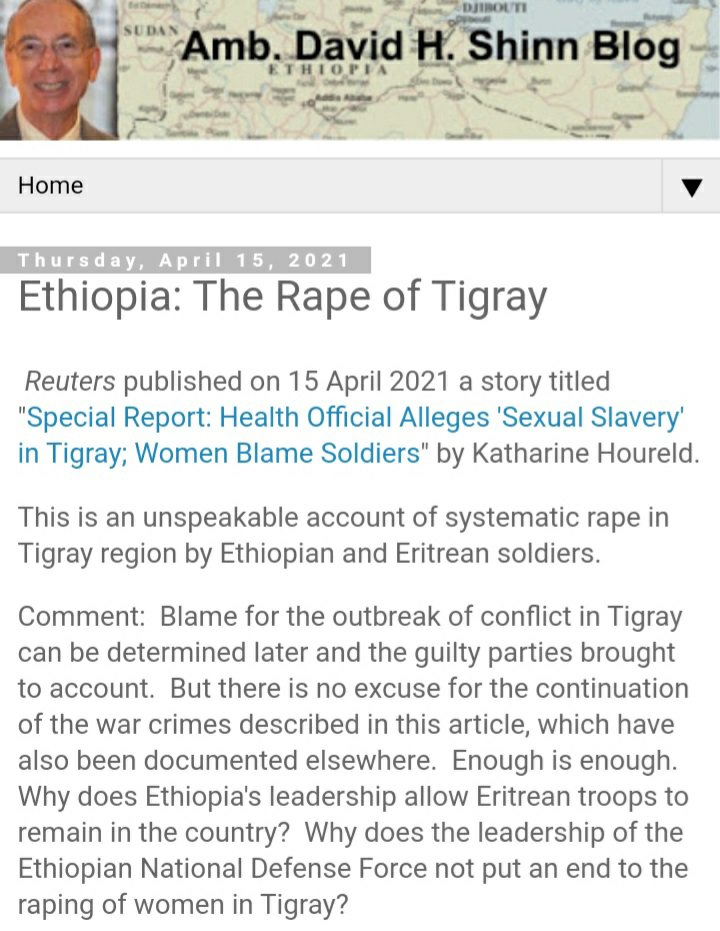
THE MILITARY RAPE OF TIGRAY

WDM SOMALIA MONITOR CONTACT INFO

[Name] WDM SOMALIA MONITOR [Work info] Media Services, WDM, [Mobile] +252 907 034 081 [Mobile] +252 906 794 548 [Home] ismail@ismailwarsame.blog

FROM THE SOCIAL MEDIA CIRCULATIONS

‪Hence all these in advertently contribute to the extension crisis that befall Somalia. Here are few updates and Also check your sources:

  1. The situation is going from bad to worse. Opposition groups are taking positions on different parts of the city. The likelihood of all out war is increasing.
  2. Somalia foreign minister and his deputy are touring in Arab capitals. They are seeking funds to replace the suspended funds from the west. I was told they got a cold shoulder from Saudis. They are now in Oman. There is touchable financial constraints which making running the business of the gov difficult
  3. No one so far endorsed the extention
  4. There is growing likelihood for PM to resign.

SOMALIA ADIOS

By Ahmed Khalif

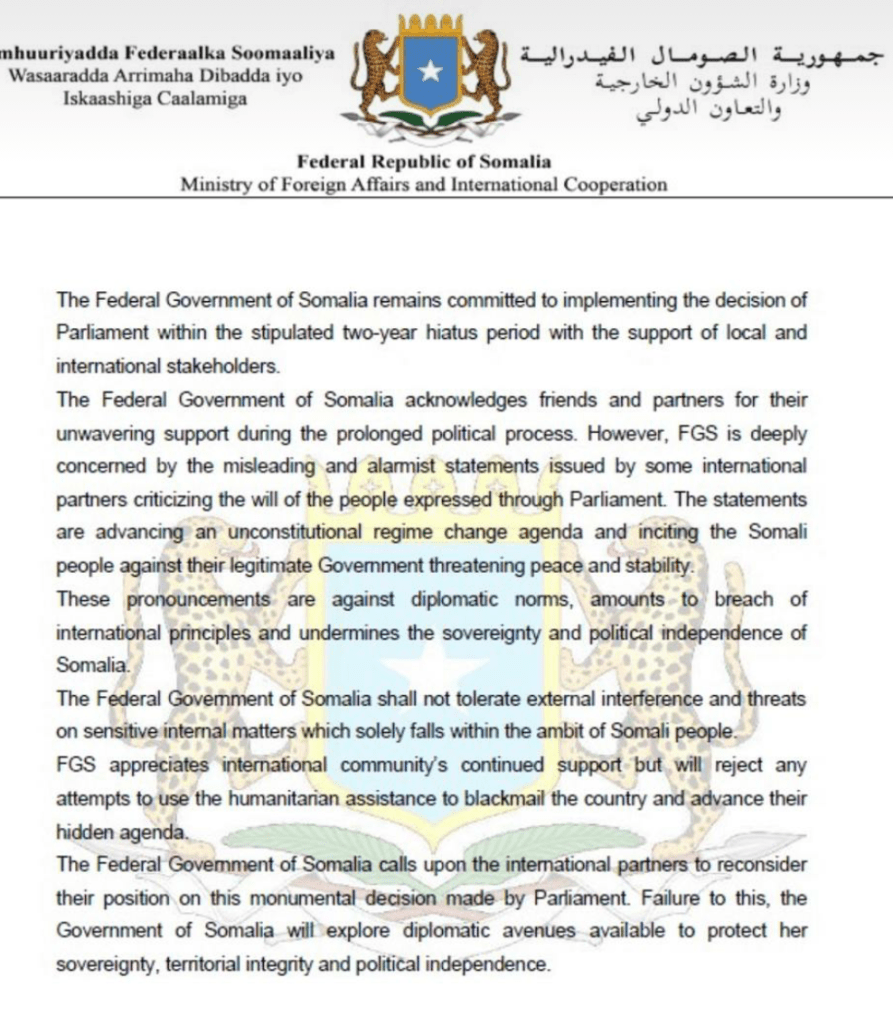
THIS IS HOW SOMALI FOREIGN AFFAIRS DEPARTMENT OPERATES

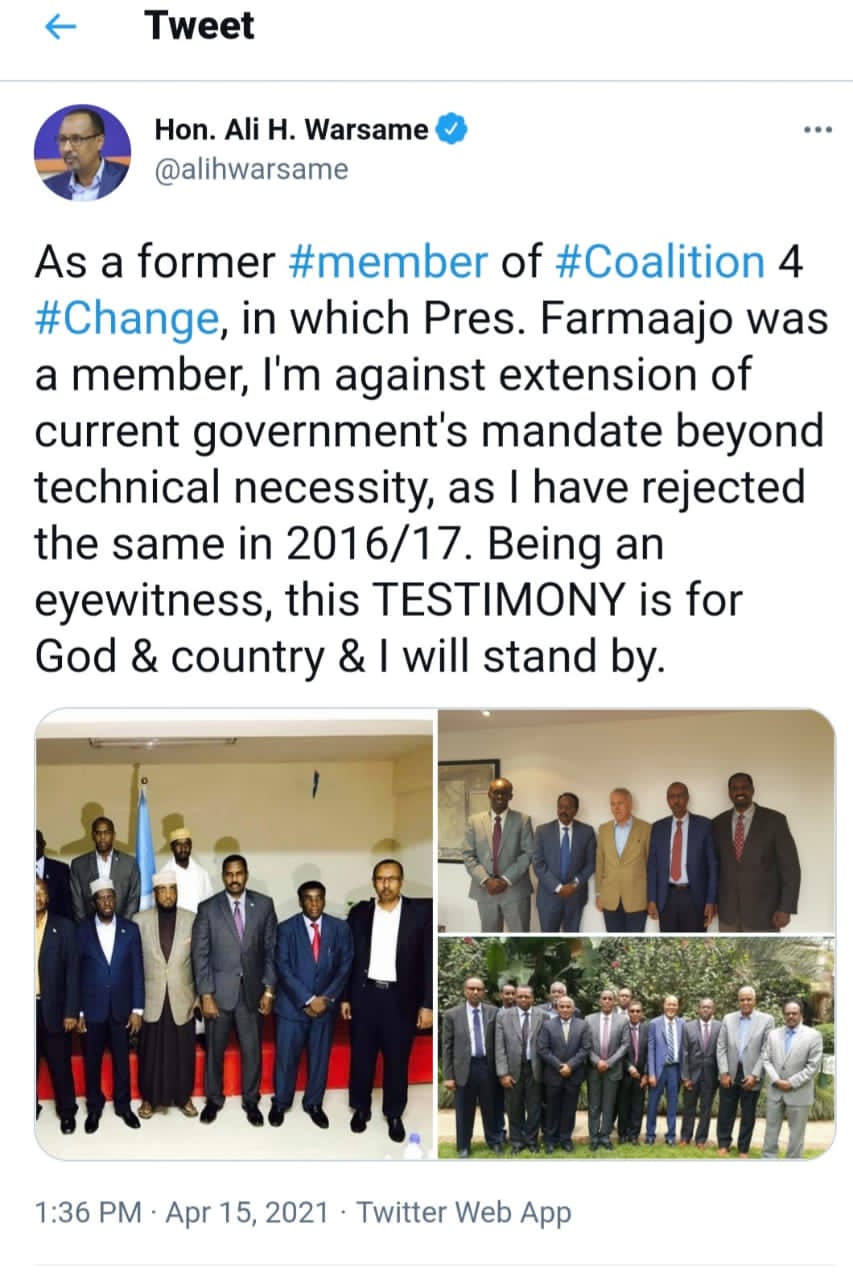
A FORMER MEMBER OF FARMAJO’S COALITION FOR CHANGE AS CANDIDATE FOR SOMALIA’S PRESIDENCY IS NOW AGAINST MANDATE EXTENSION

Ali Haji Warsame, who now rejects Farmajo’s manadate extension, was a member of the Coalition for Change.

CONSENSUS OF CONDEMNATION AGAINST FARMAJO IS BUILDING UP ACROSS SOMALI SPECTRUM

Take a listen to Somali-American Prof Samater:

https://m.facebook.com/story.php?story_fbid=905528293574050&id=100023506641901t

https:/twitter.com/ismailwarsame

http://youtube.com/ismailwarsame

Go back

Your message has been sent

Warning
Warning
Warning
Warning
Warning
Warning.

WDM EDITORIAL: SECURITY/MILITARY/LEGISLATIVE COUP D’ETAT IN MOGADISHU

A coup d’etat involving security/military/legislative took place in Mogadishu in early days of April 2021. It was seizing of all powers of the Central Government (FGS) by its own president, MAM Farmajo.

From now onwards, it will not be business as usual with unpredictable security situation in the Capital City and elsewhere in the country.

All Somali patriotics should resist this coup d’etat in order to saveguard the modest gains of people of Somalia, following the Civil War.

WDM YEARLY SUBSCRIPTION

Annual fee

$37.00

UNPREDICTABLE AND PRECARIOUS SECURITY SITUATION IN MOGADISHU

ARE THINGS GETTING OUT OF HAND IN MOGADISHU?

DOMINO REACTIONS TO FARMAAJO COUP D’ETAT IN MOGADISHU CONTINUES WORLDWIDE

NO LOVE LOST BETWEEN MESSRS GAAS AND FARMAAJO

Go back

Your message has been sent

Warning
Warning
Warning
Warning
Warning
Warning.

But, in this instance, GAAS is right

THIS IS HOW TO TRY TO MISLEAD BOTH SOMALI READERS AND WORLD COMMUNITY, COVERING UP COUP D’ETAT

If it is authentic, sn’t it an insult added to an jury after the fact of a daylight security/military/legislative coup d’etat? Is there any credibility left for Mogadishu Junta to tell the world? It is either someone with the FGS or a staunch supporter of it drafted this letter. Have your say.

HOW WOULD YOU RECOMMEND TO THE INTERNATIONAL COMMUNITY ABOUT WHAT TO DO WITH FARMAJO, MURSAL, FAHAD YASSIN AND DUBE, AMONG OTHER SPOILERS OF SOMALIA’S GOVERNANCE?

The international community should take due diligence not to help rolling back the modest gains of the people of Somalia, emerging from the legacy of civil war. Recognition of the Federal Government of Somalia is one of the critical achievements Somalia had gained – withdrawing it would harm Somalia beyond post-Farmajo. Defunding AMISOM would mean throwing Somalia to the wolves. It would be not only policy mistake, but also a dangerous proposition for all concerned. Relocating embassies and offices of international organizations would create a precarious power vacuum in Mogadishu. Curtailing humanitarian interventions would lead to humanity disasters. Confronting Farmajo’s regime by the International Community must be smartly handled to avoid hurting ordinary Somalis and their hope for the future.

Farmajo’s regime should be dealt with targeted and effective individual sanctions to remove obstacles towards democratic movement. In fact, IC requires doubling down on aid effectiveness and monitoring the activities of those, who are known to impede progress in Somalia.

Compelling Farmajo regime to return to the negotiating table on the basis of 17 September Agreement is the only reasonable course of action – no backing down on this principle. Resolutions and bills by a dissolved one House of Parliament alone without any consideration to the Upper House of the same legal status is a flagrant violation of the law of the land. This couldn’t stand.

Go back

Your message has been sent

Warning
Warning
Warning
Warning
Warning
Warning.

Somalia : Statement by the High Representative Josep Borrell on the current political situation

Brussels, 13/04/2021 – 17:01, UNIQUE ID: 210413_4Statements by the HR/VP

Yesterday, the Lower House of the Somali Parliament voted to a de-facto extension of the mandate of the President and the Federal government by two years following the impasse on the electoral process which should have been finalised by 8 February 2021. This action undermines the longstanding effort, supported by the EU and the international community, to rebuild Somalia through consensus.

The international community, including the EU, have repeatedly and publicly expressed that we could under no circumstances accept an extension of the government mandate, or any partial or parallel process related to the elections, without the agreement of the parties to the 17 September electoral agreement. The European Union believes that the passage and signing of this resolution will divide Somalia, impose additional delays and constitute a grave threat to the peace and stability of Somalia and its neighbours. It certainly does not serve the interests of the people of Somalia.

We call for an immediate return to talks on the holding of elections without delay based on the September 17 agreement. Failing this, the EU will consider further concrete measures.

WDM YEARLY SUBSCRIPTION

Annual fee

$37.00

ACTION SPEAKS LOUDER THAN WORDS


There are three kinds of people who get messages either visually, abstructively or by feeling. It seems to me that Mr.Farmajo understands stuff visually – he obviously neither understands communication through reason nor by feeling when others get hurt by his illegal actions and unilateral decision-making methods with regards to complex issues of national importance. In his approach to governance, he had done irreversible damages to Somalia’s national interests, and could do more, if he isn’t restrained and contained immediately. This task is not easy, if not impossible, to be handled by existing legal and traditional systems in Somalia. The traditional system of 4.5 clan power-sharing mechanism isn’t designed for conflict resolution of this nature. Balance of power between the executive, legislative and judiciary doesn’t exist in Farmajo’s world or in any other Somali rule in any part of the country. They are all tin-pot dictators.

Farmajo is different from others in the sense he had grabbed illegally total power from all branches of the national government. He is now Somalia’s Head of State and Head of government at the same time with no constitutional basis whatsoever. By the constitution, he was the Head of State, not Head of Government, until February 8, 2021.

In a move to seize total power, he had deposed the Head of government, Hassan Ali Khayre, where he started the process of security/military/legislative coup d’etat against the people of Somalia, their fledgling Federal institutions and Federal Member States. That illegal power grabbing process is now almost complete, with some works left to be done on Puntland and Jubaland still pending.

The so-called international community and Somali International Partners have been voicing concerns about abnormal developments and political shenanigans in Somalia, while appeasing the tin-pot dictator, Farmajo, in the hope that he may eventually heed to their empty rhetoric and change his ways. In vain, the IC and IP are now sucking up the embarrassment they so deservedly earned from their pathetic lack of action. It is now time for action, impose sanctions and chase out another warlord in town.

Go back

Your message has been sent

Warning
Warning
Warning
Warning
Warning
Warning.

THE STORY OF SOMALIA’S TRAGEDY CONTINUES

They say that those who don’t remember their past mistakes are condemned to repeat them. In Somalia, no lessons learnt from decades of mayhem ending up in state failure and hundreds of thousands of citizens perished. And now, with decimating Coronavirus, severe drought, and today’s state coup through already dissolved and illegitimate parlianent, the little hope people of Somalia had had in consolidating the modest gains of the last decade is slipping away before their eyes. Tin-pot dictator, Farmajo, has also been able to squander the generous help from the world community in reviving the failed State. It is a tragedy that continues unabated and risks existential threat this time around. This is a fragile country infested with tribal divisions. That is why Somali State had failed in 1991 because of one dictator. Somalia could disappear this time around because of one man dictator-to-be. Could it be saved this time around? Have your say.

Radio Daljir quoting ….

BREAKING NEWS: NO ILLEGAL SESSION OF LOWER HOUSE OF PARLIAMENT

Take a listen to Banadir Police Commander, General Sadiq Omar

This is a developing story. Stay tuned.

PS: The Commander of Federal Police, General Hijar, a Farmajo loyalist, has summarily dismissed General Sadiq Omar (Sadiq John).

To understand, in principle, what is going on in Mogadishu right now, please read this article: https://ismailwarsame.blog/2021/03/27/fgs-beginning-of-the-end-of-farmajo-regime/

SOMALIA: AN EXISTENTIAL THREAT TO BE

Go back

Your message has been sent

Warning
Warning
Warning
Warning
Warning
Warning.

PREVENT DICTATORSHIP RE-APPEARING IN SOMALIA

SOMALIA: A NEW WARLORD IN TOWN

https://ismailwarsame.blog/2021/03/31/somalia-a-new-warlord-in-town/

STRONG LANGUAGE FROM FORMER UNITED STATES AMERICA AMBASSADOR TO SOMALIA

https://ismailwarsame.blog/2021/04/11/strong-language-from-former-united-states-america-ambassador-to-somalia/

STRONG LANGUAGE FROM FORMER UNITED STATES AMERICA AMBASSADOR TO SOMALIA

Take a look.

ON GARA’AD PORT ON THE INDIAN OCEAN

Take a watch

WDM EDITORIAL ON SOMALIA’S ELECTORAL IMPASSE

At least, beggers have limited choices in the sense that Somalis can’t have both ways: full sovereignty and barely surviving on the security protection and handouts from the International Community. The Federal Government of Somalia could lose presence and relevance in Mogadishu within hours if it weren’t for the security protection of AMISOM. AMISOM itself is bankrolled by the big donors of IC. No doubt Somalia has the potential to remain a free and sovereign country, only if she puts her house in order by uniting her citizens and resolving the outstanding issues at heart of the current political paralysis and electoral impasse. To move Somalia forward, it requires the country to be in peace with itself – a nation reconciled after vicious civil war and recognizing that strength lies in unity of its people and purpose.
The call in a united voice by the international community in a strong communique this morning is also a clarion call for Somali Federal Institutions to heed this collective warning. It would turn out ugly, if Somali leaders don’t get the message, for the status quo isn’t only unsustainable, but also illegal and unconstitutional.

WDM YEARLY SUBSCRIPTION

Annual fee

$37.00

JOINT COMMUNIQUE OF IC ON SOMALIA SITUATION

A MESS AT PUNTLAND MINISTRY OF PUBLIC WORKS AUTO-TAXATION OFFICES

https://ismailwarsame.blog/2021/04/10/a-mess-at-puntland-ministry-of-public-works-auto-taxation-offices/

HUMAN RIGHTS ABUSES IN SOMALIA

In SOMALIA Members of the federal and state security forces committed numerous abuses.

Significant human rights issues included: unlawful or arbitrary killings, including extrajudicial killings, by government forces; torture and cruel, inhuman, or degrading treatment by the government; arbitrary arrest or detention; political prisoners or detainees; serious problems with the independence of the judiciary; serious abuses in an internal conflict, including killing of civilians, enforced disappearances or abductions, torture and physical abuses or punishment, unlawful recruitment or use of child soldiers, and other conflict-related abuses; serious restrictions on free expression, the press, and the internet, including violence, threats of violence, or unjustified arrests or prosecutions against journalists, and criminal libel laws; inability of citizens to change their government peacefully through free and fair elections; restrictions on political participation; pervasive acts of corruption; lack of investigation of and accountability for violence against women;

https://www.state.gov/reports/2020-country-reports-on-human-rights-practices/somalia/

A MESS AT PUNTLAND MINISTRY OF PUBLIC WORKS AUTO-TAXATION OFFICES

https://wp.me/p32mpX-2Yq

A MESS AT PUNTLAND MINISTRY OF PUBLIC WORKS AUTO-TAXATION OFFICES

Take a watch.

This is happening at the Ministry of Public Works after more than two decades of self-government in Puntland. There is still no concept of line-up to access services in public places, no face masks and no social distancing in the Era of Coronavirus. No single employee or guard was in hand, managing these unruly throngs of people gathering in one spot. It looked like a flock of scavengers fighting for a piece of animal corp. I went there today to get a quarterly sticker for my vehicle and got stuck in this dystopian chaos. Finally, I had had enough of it and decided to drive away. It was a wild dream for all the vehicles in the Ministry campound blocked one another with no outlet to drive through. Vehicles were packed up and parked in the same disorderly way people inside the taxation offices were pushing and roughing up upon one another. Finally, when I got a small opening to drive through, I was stopped at gate for I didn’t have that elusive sticker. I had to negotiate for my way out with the gatekeeper and luckily got let out.This Ministry badly needs cleaning up. It is engaged in unacceptable ways of delivering public services for real hard-earned people’s money.

This kind of hazel and inconvenience had turned motorists off to avoid coming to that ministry to pay off their dues. This situation of non-compliance compels the ministry to order erecting checkpoints at busy intersections of highways, creating unbearable traffic jams in Puntland towns. This state of affairs has been there for many years without anyone thinking of how to improve the system. Online payment option and establishing auto-kiosk centres could go far more better to increase government revenue and make life easier for Puntland motorists and personnel at ministry.

CURRENCY CRISIS IN SOMALIA

https://ismailwarsame.blog/2020/12/27/currency-crisis-in-somalia/

WRONG-HEADED RECOMMENDATIONS

Somali saying has it, “Ka dar oo dibi dhal” ( doing more harm). It is doubtful that this recommendation or decision would make any difference in the monetary crisis in Puntland. The Distinguished Committee’s recommendations will exacerbate the problem by adding to the inflation while they won’t address the crisis. It was necessary to study the problem from the perspective of why Puntland alone experiences this crisis -how Somaliland does handle monetary and exchange rates and issues. Why doesn’t the problem exist in other parts of Somalia?

Instead of sanctioning an amount “less than $1” to pay for goods and services in So. Sh., they would have recommended less than $10. This would have made sense in three ways:

1. It would have curtailed inflation. Under the Committee’s recommendations, the $1 would jump up to a minimum unit to pay for goods and services in Puntland.

2. It would have prevented the repeat of previous Puntland Government’s mishandling of the issue.

3. This would have encouraged and promoted the use and circulation of Somali Shilling in the marketplace.

There are a lot of services happening under $1, including city public transportation, charity to the poor, shoe polishing etc. – goods and services without which cities in Puntland can’t operate.

Finally, the Committee would have recommended for the establishment of organized and officially registered money exchange centres throughout the State.

(Above picture text in Somali: public notification from Golis Communications).

PS: Eyewitnesses reports from Garowe said public transit was in standstill this morning as a result of this wrong-headed decision.

SPA COMMENTARY ON THE SOMALI ELECTORAL MODEL

Somalia’s Electoral Conundrum: An Alternative to the Mogadishu Model

This commentary explains the current impasse around elections in Somalia and proposes a potential alternative to the indirect elections of the September 17 ‘Mogadishu Model’ (which now appears unworkable). This alternative involves the extension of the Somali Parliament’s mandate for 2 years and the election of new speakers. These speakers would organize a parliamentary election of a President for a 2-year mandate. The president would then put together an inclusive government of national unity. This government would be tasked with organizing direct elections in Somalia after 2 years, in which the president elected by the Parliament would not be able to stand as a candidate. This is an unusual and innovative model which – inevitably – has its own limitations. Nevertheless, this commentary argues that the current electoral stalemate and extraordinary political circumstances require the consideration of such options.

Somalia is at an uncertain crossroads. It was expected that indirect elections would be held in 2021. Although one-person-one-vote elections were originally envisaged, it became clear by early 2020 that the preparations and political will for these were not adequate. This led to the exploration of alternative model(s). After several Federal Government of Somalia (FGS) and regional Federal Member State (FMS) presidential meetings in Dhusamareb and Mogadishu, an indirect election –  similar to the 2016 electoral process – was agreed in Mogadishu on 17 September 2020. The agreement (also known as ‘The Mogadishu Model’) was approved by the two chambers of parliament on September 26. This was followed by an agreement on the technical details of the election on October 2.

However, after more than six months since the indirect elections agreement was signed, it seems that the agreed model is not working. Its implementation initially faced several challenges. The three main challenges that the 17 September Agreement (the Mogadishu Model) faced before February 8 (when the constitutional mandate of President Mohamed Abdullahi Farmaajo ended) related to (a) the civil servants and members of the security forces appointed as members of the federal and state-level election implementation teams; (b) the Gedo region and the federal forces operating there; and (c) the appointment of the commission managing the election of Somaliland representatives.

The challenges and dynamics surrounding the Mogadishu Model have evolved and new obstacles emerged in February 2021. These have further worsened the already fragile trust among the political elites in Somalia.

The Trust Deficit and the Impracticality of the Mogadishu Model

Although the Mogadishu Model was agreed on 17 September last year, in the 5 months before the end of President Farmaajo’s term, Somali leaders failed to address the above three contentious issues and thus avert a constitutional crisis in early February. The best chance appeared to be the fourth Dhusamareb meeting in early February 2021 between the National Consultative Council members (the NCC is comprised of FGS president and presidents of five FMSs and the governor of Benadir region). President Farmaajo left the meeting on February 6, two days before his mandate ended, although at that point most of the contentious issues had been agreed upon. However, the constitutional mandate of the president ended on February 8 (the mandate of the parliament had ended on December 27, 2020), and without a new plan for elections in place, the current government faces a crisis of legitimacy. The FGS stated that they are legitimate until a new government is elected although the president himself has not spoken to the public since February 8.

The contentious issues were later further agreed upon by a technical committee appointed by the Prime Minister on 16 February 2021 in Baidoa, ten days after the president left the Dhusamareb meeting. However, the agreement needs an endorsement by the NCC, which has proved a challenge as the Puntland and Jubaland presidents have both questioned the convening mandate of President Farmaajo.

Events since February 8th have further deteriorated the already fragile trust among Somalia’s political elites and have added more challenges on top of the three previously outstanding issues of contention.

Firstly, the Council of Presidential Candidates’ Union (formed in November 2020 by a group of 14 presidential candidates including two former presidents and a former prime minister)  planned a demonstration in Mogadishu’s Daljirka Daahsoon, and the FGS used security forces to stop this rally. The opposition had also deployed technical and security forces, and General Indha Adde seemed to have triggered the armed clash.  There was heavy gunfire on the night of 19 February near the hotel housing the two former presidents and other politicians. Subsequent firing on demonstrators led by politicians (including the former prime minister) near the airport also occurred. These events have worsened the already fragile trust. It has added another complication to the 17 September agreement as actors raised questions relating to election security and the role of President Farmaajo in the electoral process.

Prime Minister Mohamed Hussein Rooble started talks with the opposition a few days after the 19 February incidents and the FGS agreed with the opposition to secure the Daljirka Daahsoon area and the demonstrators. However, another subsequent demonstration planned for 26 February did not happen. The Council of Presidential Candidates’ Union stated that the government had closed all roads and that they were thus postponing the demonstration.

Secondly, Puntland and Jubaland presidents have questioned President Farmaajo’s authority to convene the NCC meeting. Although they set conditions for coming to Mogadishu and meeting with the FGS (since the constitutional mandate of the FGS ended) to address the contentious issues of the 17 September agreement, they later came to Mogadishu (in March 2021) with the invitation of the international community. After more than a week of their stay in Mogadishu, the much-expected meeting was announced by President Farmaajo on March 20 soon after the US Secretary of State Antony Blinken issued a press statement asking Somalia leaders to hold elections immediately. Since Puntland and Jubaland presidents publicly stated that the mandate of the President ended, and he should not convene the NCC meeting as well as disagreed with the leaked NCC meeting agenda, a partial meeting between President Farmaajo, Prime Minister Mohamed Hussein Rooble, presidents of South West, Galmudg and Hirshabelle, and the governor of Benadir region chaired by President Farmaajo started in Mogadishu’s Afisyoni hall (the exact hall the February 2017 presidential elections happened) on 22 March. The UN called it a pre-meeting with partial FMS representationand highlighted the need for further informal consultations to ensure full participation.

At the same time, a rival camp emerged with the Council of Presidential Candidates’ Union, Puntland and Jubaland’s regional state presidents, and the Somaliland Political Council (Somaliland politicians linked to Senator Abdi Hashi) forming the Somali National Salvation Forum. Chaired by Abdi Hashi, the Upper House chair, the Forum was established (according to a press release) with the mission to ensure free and fair elections; safeguard national unity, and maintaining political stability and national security. The formation of this forum shows how electoral politics is now split between two camps.

Thirdly, there is significant pressure from the international community, which has reiterated that they will not support parallel or partial elections and extension of prior mandates. This has led to a critical response from the FGS to other countries intervening in Somalia’s internal affairs. The FGS Minister of Information said: “That is a red line that must never be crossed.” This response illustrates the FGS’ dissatisfaction with how the international community is approaching Somalia’s election impasse.

Fourth, the House of the People of the bicameral Somali parliament has started efforts to extend its mandate and the mandate of the president for two years. Although the initial agenda shared related to Covid-19 deliberations, the parliamentary meeting on 27 March ended without opening the session because some MPs obstructed the meeting. The speaker of the House of the People subsequently issued a letter sanctioning 15 MPs to attend the upcoming five sessions for obstructing Saturday’s planned session. On 31 March, the House of the People held a session again. Although all roads to the parliament building were closed and the 15 MPs were blocked to enter the parliament hall, an extension was not discussed.    

A unilateral mandate extension by the House of the People could further complicate the election impasse and could lead Somalia into uncharted territory. Is there an alternative solution to the 17 September agreement?

A Way Out: Extending the Parliament’s Mandate and Electing new Leaders

It seems that the Mogadishu Model is not workable. Amendment to the key components of the model, as well as restoring lost trust (including concerns of the security of the election) will require high-level all-inclusive discussion among key stakeholders. These are not evident at the present moment. To avoid a vacuum that could trigger instability and confrontations in Somalia, one option that could be explored is extending the mandate of the two chambers of Parliament and electing new speakers (six of them, three speakers of the House of the people and three of the Upper House) and a president for a new two years mandate.

This is an option that can become a solution for the current election impasse. First, the bicameral parliament – after consultations and with the acceptance of all actors – including the FMS leaders, the National Salvation Forum, and the international community – could be given a two-year mandate by the National Consultative Council with the condition that they will elect new speakers and the president. Like the September 17 Agreement, the new deal will be endorsed by the two chambers of parliament in a joint session.

Second, the parliament elects a president with a two-year mandate. A condition for the presidential candidates will be that they will not be eligible for re-election in the next election. This president (elected by Parliament)  will, however, be eligible for election after the next election, when the term of his successor ends. This should be part of the signed agreement.

With this model, the election of the speakers of parliament and the president can be arranged in just three to four weeks after an all-inclusive agreement is reached. Each chamber of the parliament elects its oldest person as an interim chair, and they will select commissions that organize the election of the speakers of the parliament. When speakers of the House of the People and the Upper House are elected, they will form a joint parliamentary committee that leads the presidential election.

Third, after the election of the president by parliament, a Government of National Unity that includes all key actors will be formed. Members of the parliament should not be included in that government. This will contribute to the separation of powers of the legislators and the executive and would advance accountability and checks and balances.

Fourth, a roadmap and key priority issues will be assigned for the new Government of National Unity. The government will be asked to focus on reconciliation and trust-building, security, completion of the constitutional review, federalization, and direct elections (or an enhanced participation (in)direct election) in two years. There should be a work plan for the two years that is reviewed every 6 months for the new government by the parliament.

This arrangement has several benefits. First, it will address the election impasse that resulted from the end of the constitutional mandate of federal institutions as well as potential election-related violence. Second, the aspiration to conduct direct elections will be revived, and there will be the opportunity to organize direct elections after two years. Third, a Government of a National Unity with key targets to achieve will be formed. Finally, this will most likely bring some change to the leadership of the parliament and the president.

However, it will face several challenges. First, it will not likely get the buy-in of President Farmaajo who probably has less chance for re-election given his complicated relationship with the MPs in the last four years, as well as with the leadership of the House of the People, Puntland, Jubaland, and the opposition politicians in Mogadishu. Second, this option will not give much leverage to the FMSs who would be able to manipulate seats if an indirect election along the lines of the Mogadishu Model is actually conducted. Therefore, some FMS presidents may refuse to support it. Third, a Government of National Unity may not be able to achieve direct elections in two years. Finally and perhaps more worryingly, this could set a precedent for the parliament mandate to be extended, and MPs could seek another extension after the end of the two years.

Notwithstanding these limitations, it seems that this is a potentially viable option that could be considered for the best interests of Somalia, given the current political stalemate.

Election Series: This commentary is the eleventh paper of our election series. SPA welcomes and very much appreciates comments, feedback, and ideas relating to Somalia’s anticipated federal and state level elections.

YOU DON’T PRAY AT UAE SHEIKH’S ROYAL COURTS

https://ismailwarsame.blog/2019/05/31/ramadan-coming-to-a-close/

BLEAK STATUS OF POOR READERSHIP IN PUNTLAND STATE

There is a single flyer-tabloid in the entire State of Puntland, the KAAHA BARI, issued by Mr. Khalif Mohamed Barre in Bosaso. Kaaha Bari is a newsletter of several A4 color pages in Somali. This is also an advertising medium for some local businesses.

The existence of Kaaha Bari in the State as the single print media is the best indicator of how residents of Puntland are fairing in literacy. It is a shocking state of affairs in Puntland education. Think of intellectual development and future of people, who don’t reader!

STOLEN INTELLECTUAL AND TEADEMARKS PROPERTIES OF PUNTLAND

These trademarks and intellectual properties were stolen by Farmajo and his Facebook fans from PUNTLAND STATE. We, the people of PUNTLAND, demand for the discontinuation of the use of these properties illegally. We also demand apologies for the illegal acquisition of these properties.

FARMAAJO’S PLANS ARE BOUND TO FAIL

By Staff Writer

Mr Farmajo’s options for automatic extension and consequently rigging Somali elections are narrowing as he is desperately trying to frustrate the International Community and participants in the “Consultative Meeting ” in Afsiyone Xalane camp.

In the weeks that the IC and other Somali stakeholders were doing everything they could to bring FGS and FMSs leaders together, Farmajo has been taking several steps to force President Deni and Ahmed to leave the talks:

  1. Engineered and exaggerated protestors in Puntland State
  2. Staged defection of Jubland’s former Security minister Janan
  3. Facilitated Interior Minister’s meeting with Jubbaland “Elders”.
  4. Released previously recorded statement falsely claiming that talks had collapsed. These actions were deliberately engineered and meant to force presidents Ahmed and Deni to leave talks. Fortunately, both leaders understood Farmajo’s incredulous behaviour. The fact that both leaders remained in talks, despite the relentless provocations, is indicative of their realisation of how serious Somalia’s political situation is.

Puntland & Jubbaland are what stands between Somalia going back to civil war and/or a new dictatorial regime to take hold. It is, therefore, imperative that these leaders get all the necessary support they so deserve.

WDM YEARLY SUBSCRIPTION

Annual fee

$37.00