WDM: THE RIGHT APPROACH TO SOMALIA’S ISSUES IN POLITICS

“Get Used to Free Press”

Get your copies of these best seller books at https://amazon.com/author/ismailwarsame

Watch “‘I told you so’: Trump’s former attorney says he warned Giuliani” on YouTube

POWER HUNGRY FARMAJO TAKES HIS COUNTRY TO THE BRINK

WDM YEARLY SUBSCRIPTION

Annual fee

$37.00

Get your copies of these best seller books at https://amazon.com/author/ismailwarsame

Check it out

BRIEFING ON THE POLITICO/SECURITY SITUATION IN MOGADISHU

There is calm before the storm. What is happening in Mogadishu now is re-orentation of forces and weighing of strategic/political options by Farmajo, on one side, and the Hawiye opposition forces, on the other.

Farmajo is planning his next step. He had started with bringing more troops to Mogadishu, mainly from Gedo in Jubaland and Galgadud (DusaMareb) in Galmudugh. He had sought alternative sources of funding for his regime, mainly from Gulf States of Saudi Arabia, Qatar, Oman, and Turkey, among others, as Western aid to Somalia is about to dry up. He is engaged in counter-balancing his Hawiye opposition through divisions in their rank and file in seeking help from some former politicians like Hussein Aidid, Ali Mohamed Gedi, Mohamed Sheikh Gacmadheere and bunch of others. He is weighing his opinions to use the Lower House of Parliament for further political intrigues, but Somalis and world community expect them to rescind their recent controversial and unlawful act of April 12, 2021, extending Farmajo’s mandate to two more years. Farmajo sees power is slipping out of his grip. His so-called Somali National Army, SNA, is fragmenting alone sub-clan lines. Now, it is just a matter of time before he is pushed aside.

On the opposition side, there are mobilization campaigns of Hawiye political and armed militia to depose Farmajo under the pretext of holding elections. A series of meetings between Prime Minister Roble and Council of Presidential Candidates, CPC, are continually taking place in Mogadishu to seek consensus on how to handle Farmajo. They seem to have persuaded Hawiye leaders of Galmudugh and Hirshabelle, Qoor Qoor and Guudlaawe, respectively, to the side of the opposition, though reluctantly. Prime Minister Roble is using his Hawiye clan card to challenge Farmajo and to demonstrate that he is a relevant figure in Mogadishu political power plays that couldn’t be easily deposed by the Parliament like they did with former Prime Minister Hassan Ali Khaire. The opposition is also monitoring the activities of Farmajo’s henchmen, such as commanders of military, police and security forces.

Meanwhile, in their meetings, Hawiye opposition leaders were not talking about the two elephants in the room – Puntland and Jubaland.

Things are moving in Mogadishu in a fast pace. Stay tuned.

Get your copies of these best seller books at https://amazon.com/author/ismailwarsame

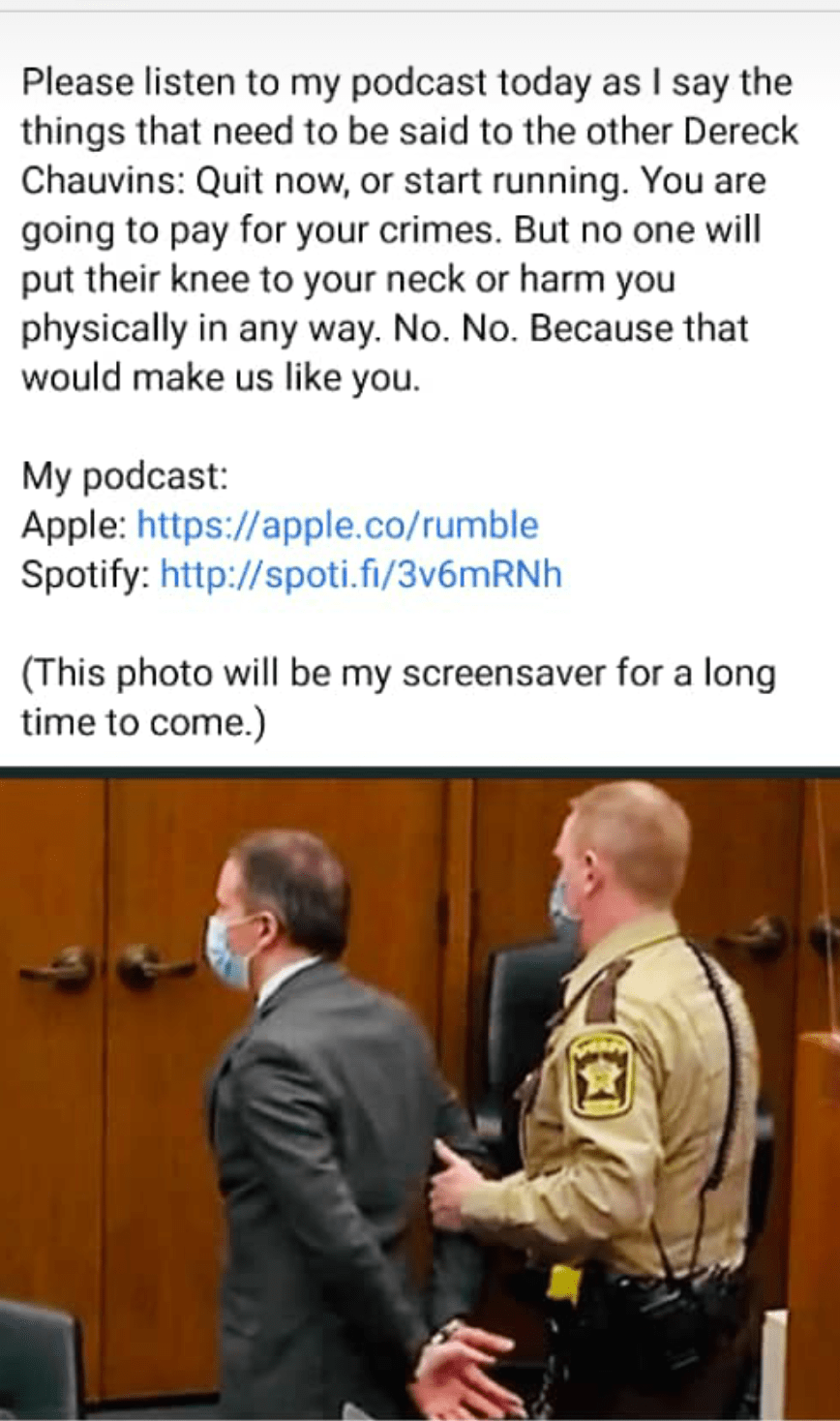
JUSTICE MATTERS, BLACK LIVES MATTER

ON THE LATEST DEVELOPMENTS FROM SOMALIA’S FRONT

https://ismailwarsame.blog/2021/04/24/on-the-latest-developments-from-somalias-front/

Watch “Video for Berbera Corridor | Allow yaa Wadan oo dhan Sidan ka Dhiga|” on YouTube

SOMALIA: LEADERSHIP VETTING A MUST

IT IS TIME TO LOOK AT AND RECORD THE BIOGRAPHIES AND BACKGROUNDS OF CURRENT SOMALI LEADERS.

DO WE KNOW WHERE THEY ARE COMING FROM AND WHAT THEY STAND FOR? HOW COME DO WE IGNORE THESE IMPORTANT FACTORS IN SOMALI POLITICS? HOW DO WE EXPECT TO FIND SOLUTIONS TO OUR POOR LEADERSHIP PROBLEMS AND NOT REPEAT THE SAME WRONGS OF YESTERDAY?

HAVE YOUR SAY.

SOMALIA: Chronology of Events

December 1992-June 1994 Publisher Canada: Immigration and Refugee Board of Canada Author Research Directorate, Immigration and Refugee Board, Canada Publication Date 1 November 1994 Cite as Canada: Immigration and Refugee Board of Canada, Chronology of Events: December 1992-June 1994, 1 November 1994, available at: https://www.refworld.org/docid/3ae6a80610.html [accessed 29 April 2021] Disclaimer This is not a UNHCR publication. UNHCR is not responsible for, nor does it necessarily endorse, its content. Any views expressed are solely those of the author or publisher and do not necessarily reflect those of UNHCR, the United Nations or its Member States.   CHRONOLOGY 1992 8 December At Kismayo, a port city in the South, supporters of Colonel Jess begin a series of massacres which leave over 100 members of the Harti clan dead over the coming days (UPI 29 Dec. 1992). 9 December Within the framework of operation “Restore Hope”, US Marines land on a Somali beach (Keesing’s Dec. 1992, 39225). 11 December The two warlords of the capital, Mogadishu, General Mohamed Farah Aidid and acting President Ali Mahdi, undertake to stop their war through negotiations (Keesing’s Dec. 1992, 39225). 15 December A woman leaving a French Army jeep is accused of prostitution by the crowd and beaten in the streets of Mogadishu (The New York Times 16 Dec. 1992). 23 December US and French troops take control of the town of Baidoa (Afrique contemporaine 2nd quarter 1993, 96). 26 December General Mohamed Farah Aidid and acting President Ali Mahdi Mohamed sign an agreement covering the peaceful resolution of longstanding conflicts, the creation of a political committee responsible for resolving political differences and an end to hostilities throughout the country (AFP 27 Dec. 1992). 28 December In Mogadishu, the two warlords Aidid and Mahdi appear together in public to mark the dismantling of the “green line” separating their respective territories (The Washington Post 28 Dec. 1992; Le Devoir 29 Dec. 1992). 29 December US and Canadian soldiers enter the town of Belet Huen (Le Devoir 29 Dec. 1992). 31 December US President George Bush begins a two-day visit to Mogadishu and Baidoa (Keesing’s Jan. 1993, 39255). North of Mogadishu, artillery, mortar and heavy machine gun fighting between the Mursades and the Habar Gedirs, two sub-clans of the Hawiyes, leaves at least 17 people dead and 25 injured. The dispute between the two sub-clans is territorial (The Washington Post 2 Jan. 1993). 1993 2 January A British UNICEF employee in Kismayo is shot to death. According to one source, he had made statements on the massacres in Kismayo on 8 December 1992 (Reuters 3 Jan. 1993). 3 January During his visit to Mogadishu, UN Secretary-General Boutros Boutros-Ghali is prevented from visiting the UN office by hundreds of demonstrators supporting General Aidid (The Los Angeles Times 4 Jan. 1993). 4 January A preparatory meeting of Somali armed factions, including those of General Aidid, Colonel Omar Jess and “acting President” Ali Mahdi, opens in Addis Ababa under the chairmanship of the UN Secretary-General (Libération 5 Jan. 1993). 7 January While discussions continue in Addis Ababa in preparation for a possible conference of reconciliation, heavy machine gun fire between rival factions resounds in the Somali capital, probably between rival members of the Mursade clan (Le Devoir 7 Jan. 1993). Fighting between US troops and Somali factions apparently kills at least one American and 30 Somalis (AFP 7 Jan. 1993). 8 January For the second time in a month, fighting breaks out between Somali Salvation Democratic Front (SSDF) militia and General Aidid’s forces in and around the town of Galcaio, in the centre of the country (AFP 12 Jan. 1993). In Hargeisa, Somaliland, there are reports that five women were stoned for adultery (AI 1994, 307). 11 January In Addis Ababa, the leading warlords agree to call an immediate ceasefire and begin disarmament (Reuters 11 Jan. 1993). The agreement is signed on 15 January (AFP 15 Jan. 1993). According to a spokesman for General Aidid, a committee of seven is charged with studying criteria for taking part in a conference of national reconciliation planned for mid-March in Addis Ababa, as well as the agenda for the conference. There are differences of opinion between Aidid’s National Alliance and other factions as to criteria for participation (ibid.). 22 January The meeting of the seven-member committee responsible for drawing up the agenda for the conference of reconciliation scheduled for mid-March breaks up at Addis Ababa after General Aidid’s representatives accuse the other factions of violating the ceasefire agreement signed on 15 January (AFP 22 Jan. 1993). 23 January Two Somalis are killed by Belgian forces deployed at Kismayo (AFP 24 Jan. 1993). 29 January General Aidid releases 25 officers and 362 soldiers of deposed President Siad Barre’s army whom he had detained at Mogadishu (AFP 29 Jan. 1993; The New York Times 30 Jan. 1993). 3 February Fighting between two opposing Somali clans claims dozens of victims in the region of Kismayo (Libération 4 Feb. 1993). 4 February The UN embarks on the disarmament process (Afrique contemporaine 2nd quarter 1993, 97). 22 February At least 7 are dead and 21 injured following armed clashes in Kismayo between supporters of General Mohamed Said Hersi “Morgan”, former President Siad Barre’s son-in-law, who is seeking to recapture the city, and supporters of Colonel Omar Jess (Reuters 22 Feb. 1993; Libération 23 Feb. 1993). Also, at Afgoye, bandits are reported to have killed an Irish woman working for the non-governmental organization (NGO) Concern (Libération 23 Feb. 1993; Le Devoir 23 Feb. 1993). 15 March A new Somali peace conference opens in Addis Ababa. In addition to the various factions engaged in the conflict, reports indicate that it includes representatives of women, intellectuals and traditional chiefs. The goal of the conference is [translation] “national reconciliation” and the “restoration of a State” (Libération 16 Mar. 1993; Le Devoir 16 Mar. 1993; AFP 12 Mar. 1993). 17 March General Mohamed Farah Aidid and his allies suspend their participation in the Addis Ababa conference in protest against the attack by General Morgan’s troops on their partisans at Kismayo. Five hundred US soldiers are sent to restore order in Kismayo (Le Devoir 18 Mar. 1993; BBC Summary 19 Mar. 1993). 19 March The conference of reconciliation resumes work with the participation of General Aidid (Afrique contemporaine 3rd quarter 1993, 99). 27 March The Addis Ababa peace conference ends and faction leaders agree to set up a “National Transitional Council” consisting of 74 members and to implement general disarmament (The Washington Post 28 Mar. 1993). A peace agreement is signed the following day (Africa contemporaire 3rd quarter 1993, 99). 1 April A Canadian Army spokesman announces that four members of the Canadian military have been arrested for the murder of a Somali at Belet Huen, Somalia (La Presse 2 Apr. 1993). 2 April Because of the [translation] “growing insecurity”, the International Committee of the Red Cross leaves the Somali port of Kismayo (Afrique contemporaine 3rd quarter 1993, 99). 8 April The United Nations High Commissioner for Refugees (UNHCR) announces that following the peace agreement signed on 28 March, 5,000 Somali refugees have been repatriated, with their consent, from the Kenyan camps where they had been staying (AFP 8 Apr. 1993; BBC Summary 15 Apr. 1993). 1st week of May US soldiers leave Somalia and operation “Restore Hope” is replaced by UNSOM II, United Nations Operation in Somalia, whose goal is to enforce the peace (Le Devoir 4 May 1993; ibid. 5 May 1993; Afrique contemporaine 3rd quarter 1993, 99). 5 May At Borama, a vote by the Council of Elders chooses as President of Somaliland, Mohamed Ibrahim Egal, Prime Minister of Somalia from 1967 to 1969 (AFP 8 May 1993). 7 May Fighting between Belgian UN troops and warlord Omar Jess’ militia in Kismayo kills 13. Jess accuses the peacekeepers of favouring his rival, General Mohamed Said Hersi (AFP 7 May 1993). 5 June At least 22 Pakistani peacekeepers are killed and over 50 others are wounded in an attack by partisans of General Aidid. The next day, the UN Security Council passes Resolution 837 condemning this aggression and demanding that those responsible be arrested, tried and punished (Keesing’s June 1993, 39499; AFP 7 June 1993). 6 June US helicopters attack three of General Aidid’s arms depots (Keesing’s June 1993, 39499; La Presse 7 June 1993). 13 June Pakistani peacekeepers, shooting at Somali demonstrators, kill at least 14, including women and children, and wound about 50 more (Keesing’s June 1993, 39499; The Los Angeles Times 14 June 1993). UN forces launch air attacks on several objectives thought to be General Aidid’s arms depots (UPI 13 June 1993;The Los Angeles Times 13 June 1993). The death toll is 28 Somalis and five peacekeepers (Libération 20 June 1993). 17 June The UN Security Council issues a warrant for General Aidid’s arrest (Keesing’s June 1993, 39499). 19 June Five thousand Somalis demonstrate in the streets of Mogadishu to denounce attacks by UN forces (La Presse 20 June 1993). 2 July Three Italian peacekeepers are killed and over 20 more are injured by Aidid’s militia (The Los Angeles Times 3 July 1993; Keesing’s July 1993, 39456). 10 July The UN promises US$25,000 to anyone who captures or provides information leading to the capture of General Aidid (Afrique contemporaine 4th quarter 1993, 266; Jeune Afrique 28 July 1993). 12 July UN forces launch an attack on the suspected headquarters of General Aidid’s Somali National Alliance (SNA) in southern Mogadishu. Following this attack, an angry crowd kills three foreign journalists (The Ottawa Citizen 12 July 1993). 13 July The Red Cross reports at least 54 dead and 174 injured in the previous day’s attack. The UNSOM reports 13 dead. General Aidid’s Somali National Alliance (SNA) reports 73 Somalis dead (La Presse 14 July 1993). Following the attack, the Italian Government protests and demands a halt to fighting, and the Organization for African Unity (OAU) calls on the UN to [translation] “reconsider its operation and intensify dialogue” (Libération 14 July 1993; Afrique contemporaine 4th quarter 1993, 266). 30 July The human rights group Africa Rights issues a report denouncing what they call the unjustified killings of civilians in Mogadishu, the assassinations of unarmed civilians, the acts of brutality, thefts and destruction of weapons and ammunition in conditions hazardous to the population by UNSOM forces. In the report, Africa Rights is especially critical of Belgian peacekeepers based in Kismayo, who they claim have earned the hatred of the population by a series of murders, tortures, wrongful detentions and expulsions. UN Secretary-General Boutros Boutros-Ghali states in a press release that measures would be taken if these accusations proved founded. He adds that the accusations are [translation] “false or based on hearsay” (La Presse 31 July 1993; AFP 31 July 1993; The Ottawa Citizen 30 July 1993). 8 August Four US soldiers are killed south of Mogadishu when a mine explodes, blowing up their vehicle. US President Bill Clinton promises to retaliate (Libération 9 Aug. 1993; Keesing’s Aug. 1993, 39586). 9 August Because of the previous day’s incident, UN forces decide to [translation] “confine non-essential land missions” to Mogadishu (Afrique contemporaine 4th quarter 1993, 266). 11 August Peacekeepers kill seven Somalis, presumed to be supporters of Aidid, who fired on a surveillance helicopter (Keesing’s Aug. 1993, 39586). 13 August In deep disagreement with the strategy used by the UN to fight Aidid, Italy decides to withdraw its troops from Mogadishu (Afrique contemporaine 4th quarter 1993, 266; The Washington Post 14 Aug. 1993). 18 August The UN Secretary-General asks for 3,000 more soldiers to strengthen the UN operation in Somalia (UNSOM) (Afrique contemporaine 4th quarter 1993, 266). 24 August The USA decides to send 400 more soldiers to Mogadishu to quell the [translation] “unacceptable” violence and “restore security” (Libération 25 Aug. 1993; Afrique contemporaine 4th quarter 1993, 286). 25 August An investigation by an independent expert into the murder on 5 June 1993 of 24 Pakistani soldiers finds General Aidid responsible. Henceforth he [translation] “and his chief colleagues are liable to prosecution” (AFP 25 Aug. 1993). 30 August UN forces storm and capture the headquarters of two humanitarian organizations, one of which is Action internationale contre la faim (AICF). They take eight prisoners, all employees of the United Nations Development Program (UNDP) (Libération 12 Sept. 1993; Afrique contemporaine 4th quarter 1993, 266). 5 September During an ambush in a neighbourhood of the capital inhabited by supporters of General Aidid, seven Nigerian peacekeepers are killed, at least six more are wounded and another disappears (AFP 5 Sept. 1993; The Los Angeles Times 6 Sept. 1993). According to witnesses, at least two Somalis are killed in this clash (AFP 5 Sept. 1993). With the loss of these Nigerian soldiers, the death toll since the start of UNSOM II reaches 47 (AFP 5 Sept. 1993; The Los Angeles Times 6 Sept. 1993). 9 September In Mogadishu, a US helicopter fires on a crowd and kills “about 200 Somalis, most of them women and children”. The crowd is said to have opposed UN forces when they were fighting militia (Keesing’s Sept. 1993, 39627). 10 September Fighting occurs between the Habar Gedir and Hawadle clans in the south of the capital, Mogadishu (AFP 10 Sept. 1993). The Italian Minister of Defence condemns the UN actions in Somalia. He denounces the destruction of Mogadishu and states that [translation] “firing on the crowd is the very antithesis of the humanitarian mission” (La Presse 11 Sept. 1993; The Independent 11 Sept. 1993). 14 September UN forces arrest two colonels in General Aidid’s militia (Afrique contemporaine 4th quarter 1993, 267). 21 September US soldiers capture four Somalis in Mogadishu, including Osman Hassan Ali (“Osman Ato”), General Aidid’s chief financier. Osman Ato is suspected of having orchestrated the massacre of 24 Pakistani peacekeepers on 5 June and is held in administrative detention under UN Security Council resolution 837 authorizing soldiers “to use force to capture those involved in the massacre of 5 June” (AFP 21 Sept. 1993; Keesing’s Sept. 1993, 39627). 22 September The UN Security Council unanimously passes Resolution 865 “stressing the importance of ending [UNSOM] peacekeeping operations in Somalia by March 1995” (Keesing’s Sept. 1993, 39627) and asking the Secretary-General to [translation] “advance the process of national reconciliation and political rule” and take the necessary steps toward the restoration of the police, judicial and penal systems (La Presse 23 Sept. 1993; Keesing’s Sept. 1993, 39627). 27 September The French humanitarian organization Médecins sans frontières leaves Somalia, criticizing the UN for favouring military action at the expense of humanitarian work (La Presse 28 Sept. 1993; Afrique contemporaine 1st quarter 1994, 82). 28 September The human rights organization Africa Rights issues a report denouncing the high level of violations suffered by Somali refugees in Kenya, especially women, [translation] “thousands of whom have been raped”. Africa Rights accuses “the Kenyan Government up to the highest level of being responsible for the violations” and also condemns the attitude of the UNHCR (AFP 28 Sept. 1993). 3 October In fighting between peacekeepers and Somali militias, at least 15 US soldiers are killed (The Washington Post 11 Oct. 1993). In the space of a few days, 357 Somalis are killed (Afrique contemporaine 1st quarter 1994, 82), and the Red Cross estimates that [translation] “over 750 Somali civilians suffered bullet wounds” during the weekend (Libération 6 Oct. 1993). 9 October General Aidid, pursued by the UN since June, unilaterally declares a ceasefire (Keesing’s Oct. 1993, 39675). 14 October General Aidid releases a US soldier detained by his supporters since 3 October. Another Nigerian peacekeeper is also released (Keesing’s Oct. 1993, 39675; Le Devoir 15 Oct. 1993). Leaders of the Arab League, the OAU and the Organization of the Islamic Conference (OIC) call for UN mediation in co-operation with regional organizations to draw up a peace agreement for Somalia (Keesing’s Oct. 1993, 39675). 19 October In order to encourage negotiations, UN forces release Mohamed Nur Gutale, a close collaborator of General Aidid (La Presse 21 Oct. 1993; Afrique contemporaine 1st quarter 1994, 82). 22 October UN Secretary-General Boutros Boutros-Ghali goes to Baidoa, southwest of Mogadishu. This visit sparks incidents between rival groups in the city. He also stops for two hours at Mogadishu airport, provoking demonstrations by Aidid’s supporters (AFP 22 Oct. 1993). 25-26 October In Mogadishu on 25 and 26 October, fighting between supporters of General Aidid and those of his rival, acting President Ali Mahdi, leave about ten dead and about 50 wounded (Libération 26 Oct. 1993; Reuters 26 Oct. 1993). 3 November A grenade is thrown by unknown persons in the Hargeisa market, leaving one person dead and at least 15 injured (BBC Summary 15 Nov. 1993). 16 November Robert Oakley, the US President’s special envoy, arrives in Mogadishu. His task is to [translation] “restart peace talks with General Aidid” (Le Devoir 17 Nov. 1993). To encourage political negotiations, the UN Security Council decides to suspend its warrant for General Aidid’s arrest (Le Devoir 17 Nov. 1993; Afrique contemporaine 1st quarter 1994, 84). 18 November Through adoption of Resolution 886, the UN Security Council extends the UNSOM mandate until 31 May 1994 (Keesing’s Nov. 1993, 39721). 29 November The UN conference on the co-ordination of humanitarian aid to Somalia opens in Addis Ababa in the absence of the two chief actors in the Somali crisis – General Aidid and his rival Ali Mahdi Mohamed (Le Devoir 26 Nov. 1993; Afrique contemporaine 1st quarter 1994, 82). 1 December Ali Mahdi Mohamed arrives in Addis Ababa (Le Devoir 3 Dec. 1993). 2 December General Aidid also arrives in Addis Ababa (Le Devoir 3 Dec. 1993). 3 December Ali Mahdi Mohamed and General Aidid meet separately with representatives of the Ethiopian Government which hopes to organize discussions between the two Somalis (The Independent 4 Dec. 1993). 8 December According to an article in the New York Times, between 5 June and 3 October, fighting between the various Somali factions and between those factions and UN forces in Somalia have left between 6,000 and 10,000 Somalis dead or injured (Afrique contemporaine 1st quarter 1994, 83). 12 December The negotiations led by Ethiopian President Meles Zenawi between the various Somali factions break down. General Aidid and the alliance of 12 factions headed by the acting President refuse to take responsibility (Le Devoir 13 Dec. 1993; Afrique contemporaine 1st quarter 1994, 83). According to the UN, this failure is liable to plunge the country once again [translation] “into the quagmire of famine and civil war” (Libération 14 Dec. 1993). 1994 5 January General Aidid is re-elected – in absentia – President of the United Somali Congress (USC), part of the Somali National Alliance (SNA), of which he is also re-elected head (AFP 5 Jan. 1994; Indian Ocean Newsletter 21 Jan. 1994). 6 January Passing through Nairobi, Mohamed Egal, the President of the self-declared Republic of Somaliland, calls on the international community to recognize his republic and grant financial aid for the reconstruction of his country and the demobilization of militias (Le Devoir 7 Jan. 1994). 16 January Following a three-day conference, under the direction of clan leader Imam MaMahammod Imam Omar, the clans to which General Aidid and acting President Ali Mahdi belong, sign a peace accord. Neither General Aidid nor acting President Ali Mahdi attended the conference (The New York Times 17 Jan. 1994). 18 January The UN releases eight prisoners, including Osman Hassan Ali (“Osman Ato”), a member of General Aidid’s SNA. After their release, three of them strongly criticize the [translation] “inhuman conditions” in which they were detained, but they still call for [translation] “peace and reconciliation” (Le Devoir 21 Jan. 1994; The Washington Post 19 Jan. 1994). 26 January At least 13 people are killed and several more injured in clan clashes between two sub-clans of the Hawiyes (the Abgaals and the Hawadles) at Buurfale, north of Jowhar (AFP 27 Jan. 1994). 31 January At least five Somalis are killed and about 15 more are wounded when shots are exchanged between US soldiers and Somalis in the south of Mogadishu (Le Devoir 1 Feb. 1994). Early February The UN Security Council reduces the objectives of its operation in Somalia; the political process will be emphasized rather than disarming the various factions. It also [translation] “approves gradual reductions in UNSOM II strength down to a maximum of 22,000 men” (Le Devoir 16 Feb. 1994). 6 February An attempted bomb attack takes place in Mogadishu on the premises of the humanitarian organization, World Concern (AFP 7 Feb. 1994). 9 February Two British MPs and an employee of the British NGO Action Aid are abducted by a band of kidnappers from the Habar Yunis clan near Erigavo (between the village of Mait and Hargeisa) in the self-proclaimed Republic of Somaliland (AFP 10 Feb. 1994). 10 February The three British subjects abducted the previous day are released without being ransomed after negotiations conducted by elders of the Habar Yunis representing Mohamed Egal, President of Somaliland (AFP 10 Feb. 1994). The UN special representative, US Admiral Jonathan Howe, returns to the USA (Libération 11 Feb. 1994). 12 February At Belet Huen, in the west of the country, a grenade attack on the premises of the NGO International Medical Corps (IMC) causes no injuries but prompts the NGOs IMC, OXFAM and the German Red Cross to leave the town (AFP 12 Feb. 1994). 13 February In the past three days, violent fighting in the port city of Kismayo between supporters of Mohamed Said Hersi “Morgan” and the militia of Omar Jess has killed between nine and 60 people and injured many; over 5,000 supporters of Omar Jess are forced to leave the city (AFP 13 Feb. 1994a; Le Devoir 14 Feb. 1994). Two Italians are kidnapped near the town of Jowhar, bringing to five the number of foreigners working for the international aid agencies, Consorzio Europeo di Formazione Agaria (CEFA) and SOS International, who have been abducted during the preceding week (AFP 13 Feb. 1994b; Le Devoir 14 Feb. 1994). An Egyptian soldier is killed in an ambush (AFP 13 Feb. 1994b). 16 February About 50 foreigners, including 13 British employees of the mine sweeping company, Rimfire, are prevented from leaving Hargeisa by a group of armed Somalis. Police are unable to control the situation (AFP 17 Feb. 1994; Reuters 17 Feb. 1994). 27 February Ali Mahdi announces his intention of taking part in negotiations organized by Egyptian President Hosni Mubarak, but General Aidid refuses to take part (Le Devoir 28 Feb. 1994). 12 March A Kenyan and a New Zealander, on the staff of an Australian company providing services to the UN, are kidnapped in Mogadishu by six armed men (AFP 12 Mar. 1994; Reuters 14 Mar. 1994). 15 March Nine Somalis are killed and five more are injured by Indian soldiers responsible for protecting a convoy transporting provisions to Baidoa (AFP 15 Mar. 1994; Reuters 15 Mar. 1994). The incidence of cholera in Somalia continues to increase. In Mogadishu alone, 58 new cases are added to the already long list of 407 (Le Monde 18 Mar. 1994). 18 March Two Italian journalists are killed by bandits in the north of Mogadishu (AFP 20 Mar. 1994). 22 March A battle pitting the Sheegal and Ogadeni clans against the Gaelgal clan leaves six dead and seven injured at Jilib, north of Kismayo (AFP 23 Mar. 1994). Two Cambodians, members of the staff of Morris Catering, an Australian company providing services to the UN, are killed by “bandits” near Afgoye about 50 kilometres from Mogadishu (AFP 23 Mar. 1994). 24 March Peace talks between leaders of rival Somali factions lead to an agreement signed by General Aidid and President Ali Mahdi Mohamed. It provides for [translation] “a ceasefire and voluntary disarmament throughout the country” (Le Monde 25 Mar. 1994; AFP 24 Mar. 1994). 27 March In a demonstration organized by the Somali National Alliance in south Mogadishu, a thousand people show their approval of the peace agreement signed in Nairobi on 24 March by the various factions (AFP 27 Mar. 1994). 28 March In Kismayo, Somali gunmen shoot down two Indian peacekeepers while they were escorting two UNICEF employees to a food distribution centre (AFP 28 Mar. 1994). 4 April Clan fighting between the Habar Gedirs and the Mursades, two sub-clans of the Hawiyes, kills at least three in southern Mogadishu (Reuters 5 Apr. 1994). 18 April A UNHCR staff member is killed by bandits firing on his plane in southwestern Somalia (AFP 18 Apr. 1994). 19 April Sudan’s ambassador to Somalia is abducted by members of the Hawadle clan militia who demand a US$10,000 ransom (AFP 20 Apr. 1994; Reuters 27 Apr. 1994). 27 April Sudan’s ambassador to Somalia is released following the intervention of Somali religious dignitaries (ibid.). 16 May In combat between General Aidid’s Habar Gedir sub-clan and the Hawadle sub-clan, five UN soldiers from Nepal who were trying to intervene are killed (Reuters 16 May 1994). Another Nepalese peacekeeper is wounded in fighting and later abducted from his hospital bed by unidentified persons (Reuters 17 May 1994; AFP 17 May 1994). 26 May The self-proclaimed Republic of Somaliland announces that it is prepared to temporarily receive Somali refugees living in Yemen (BBC Summary 27 May 1994). 29 May The Nepalese peacekeeper abducted from hospital on 16 May is released (AFP 29 May 1994; Reuters 29 May 1994). 1 June The President of the Republic of Somaliland, Mohamed Ibrahim Egal, accuses the UN special envoy of partiality in his efforts to reconcile the various Somali factions (AFP 1 June 1994). REFERENCES Afrique contemporaine [Paris]. 1st quarter 1994. No 169. “Chronologie: Somalie.” Afrique contemporaine [Paris]. 4th quarter 1993. Special No. “Chronologie: Somalie.” Afrique contemporaine [Paris]. 3rd quarter 1993. No 167. “Chronologie: Somalie.” Afrique contemporaine [Paris]. 2nd quarter 1993. No 166. “Chronologie: Somalie.” Agence France Presse (AFP). 1 June 1994. “Somaliland Warns UN over its ‘Independence’ from Somalia.” (NEXIS) Agence France Presse (AFP). 29 May 1994. “Libération du Casque bleu népalais enlevé le 16 mai à Mogadiscio.” (NEXIS) Agence France Presse (AFP). 17 May 1994. “Un casque bleu népalais enlevé sur son lit d’hôpital à Mogadiscio.” (NEXIS) Agence France Presse (AFP). 20 April 1994. “Sudan Envoy Kidnapped in Mogadishu.” (NEXIS) Agence France Presse (AFP). 18 April 1994. “Un chef d’opérations du HCR à la frontière tué en Somalie.” (NEXIS) Agence France Presse (AFP). 28 March 1994. “Somali Gunmen Kill Two Indian Peace Keepers.” (NEXIS) Agence France Presse (AFP). 27 March 1994. “Manifestation pour la ‘paix’ dans le sud de Mogadiscio.” (NEXIS) Agence France Presse (AFP). 24 March 1994. “Somali Leaders Sign Reconciliation Accord.” (NEXIS) Agence France Presse (AFP). 23 March 1994. “Six morts dans une bataille entre clans somaliens.” (NEXIS) Agence France Presse (AFP). 20 March 1994. “Two Italian Journalists Killed in Mogadishu.” (NEXIS) Agence France Presse (AFP). 15 March 1994. Jean-Claude Chauvière. “Neuf ‘bandits somaliens’ tués et cinq blessés par des soldats.” (NEXIS) Agence France Presse (AFP). 12 March 1994. Serge Arnold. “Un Néo-zélandais et un Kényan enlevés à Mogadiscio.” (NEXIS) Agence France Presse (AFP). 17 February 1994. Claude Casteran. “Treize Britanniques retenus dans le nord-ouest de la Somalie par des hommes armés.” (NEXIS) Agence France Presse (AFP). 13 February 1994a. “Thousands Flee Fighting in Southern Somalia.” (NEXIS) Agence France Presse (AFP). 13 February 1994b. Jonathan Ewing. “Egyptian Killed, Two Italians Kidnapped in Somalia.” (NEXIS) Agence France Presse (AFP). 12 February 1994. “Grenade Attack Drives Relief Agencies from Somali Town.” (NEXIS) Agence France Presse (AFP). 10 February 1994. “Kidnapped British MPs Released in Somalia.” (NEXIS) Agence France Presse (AFP). 7 February 1994. Christian Millet. “Attentat à la bombe contre une association internationale d’aide humanitaire à Mogadiscio.” (NEXIS) Agence France Presse (AFP). 27 January 1994. “Affrontements entre Somaliens: au moins 13 personnes tuées selon l’ONUSOM.” (NEXIS) Agence France Presse (AFP). 5 January 1994. “Aidid Re-elected President of the United Somali Congress.” (NEXIS) Agence France Presse (AFP). 22 October 1993. “Boutros-Ghali Visit Sparks Protests in Mogadishu.” (NEXIS) Agence France Presse (AFP). 28 September 1993. Francis Curta. “Viols massifs de réfugiées somaliennes au Kenya, selon African Rights.” (NEXIS) Agence France Presse (AFP). 21 September 1993. Catherine Côté. “Trois Casques bleus pakistanais tués à Mogadiscio, selon un nouveau bilan.” (NEXIS) Agence France Presse (AFP). 10 September 1993. Ruzica Gavralovic. “Violents combats entre clans dans le sud de Mogadiscio.” (NEXIS) Agence France Presse (AFP). 5 September 1993. Marie-Thérèse Delboulbes. “Somalie: attaque.” (NEXIS) Agence France Presse (AFP). 25 August 1993. “L’enquête sur la mort de 24 soldats pakistanais démontre la responsabilité d’Aïdid, selon l’ONU.” (NEXIS) Agence France Presse (AFP). 31 July 1993. “African Rights Accuses UN Forces in Somalia of Violations.” (NEXIS) Agence France Presse (AFP). 7 June 1993. Jean-Claude Chapon. “Nouveau bilan de la tuerie de samedi à Mogadiscio: 23 casques bleus tués.” (NEXIS) Agence France Presse (AFP). 8 May 1993. “Mohamed Ibrahim Igal Elected President of Somaliland.” (NEXIS) Agence France Presse (AFP). 7 May 1993. “Thirteen Reported Dead in a Clash in Somalia.” (NEXIS) Agence France Presse (AFP). 8 April 1993. “Over 5,000 Somali Refugees Returning Home: UNHCR.” (NEXIS) Agence France Presse (AFP). 12 March 1993. Pierre-Antoine Donnet. “Les Somaliens doivent démontrer leur volonté de paix, selon les pays donateurs.” (NEXIS) Agence France Presse (AFP). 29 January 1993. “Le général Aïdid libère les soldats de Siad Barre détenus à Mogadiscio.” (NEXIS) Agence France Presse (AFP). 24 January 1993. “Belgian Troops Kill Two Somalis as MSF Evacuates Kismayo.” (NEXIS) Agence France Presse (AFP). 22 January 1993. “Ceasefire Row Stalls Meeting of Somalia Clans.” (NEXIS) Agence France Presse (AFP). 15 January 1993. Christian Chaise. “La réunion des clans somaliens doit prendre fin avec la signature d’un accord de cessez-le-feu.” Agence France Presse (AFP). 12 January 1993. Frédéric Castel. “Des combats vendredi dans le centre de la Somalie.” (NEXIS) Agence France Presse (AFP). 7 January 1993. “Combats jeudi à l’aube au nord de Mogadishu.” (NEXIS) Agence France Presse (AFP). 27 December 1992. “Le texte de l’accord entre les deux chefs de guerre somaliens.” (NEXIS) Amnesty International (AI). 1994. Amnesty International Report 1994. London: Amnesty International Publications. BBC Summary of World Broadcasts. 27 May 1994. “Somaliland Offers to Take In Somali Refugees in Yemen.” (NEXIS) BBC Summary of World Broadcasts. 15 November 1993. “Somaliland: Grenade Attack Reported at Hargeisa Market.” (NEXIS) BBC Summary of World Broadcasts. 15 April 1993. “Kenya: Repatriation of Somali Refugees.” (NEXIS) BBC Summary of World Broadcasts. 19 March 1993. “Somalia: Addis-Ababa Peace Talks Adjourned Following Morgan’s Invasion of Kismayo.” (NEXIS) Le Devoir. 28 February 1994. “Somalie: Moubarack tente une médiation entre factions.” Le Devoir. 16 February 1994. “Le chaos guette la Somalie.” Le Devoir. 14 February 1994. “Sanglants combats en Somalie.” Le Devoir. 1 February 1994. “Fusillade à Mogadiscio: 5 morts.” Le Devoir. 21 January 1994. “Appel à la paix en Somalie.” Le Devoir. 7 January 1994. “Le Somaliland veut être reconnu par le monde.” Le Devoir. 13 December 1993. “Les Somaliens toujours divisés.” Le Devoir. 3 December 1993. “Aïdid se rend à Addis-Abeba.” Le Devoir. 26 November 1993. “Somalie: Aïdid et Mahdi ne vont pas à Addis-Abeba.” Le Devoir. 17 November 1993. “C’est la joie chez Aïdid.” Le Devoir. 15 October 1993. “Somalie: magnanime, Aïdid libère Durant.” Le Devoir. 5 May 1993. “Le demi-départ des Américains.” Le Devoir. 4 May 1993. “Somalie: les Nations unies vont désarmer.” Le Devoir. 18 March 1993. “Les combats interrompent les pourparlers.” Le Devoir. 16 March 1993. “Dernière chance en Somalie.” Le Devoir. 23 February 1993. “Somalie: les factions renouent avec le feu.” Le Devoir. 7 January 1993. “Lueur d’accord entre les chefs de clans somaliens.” Le Devoir. 29 December 1992. “Les deux chefs de guerre se réconcilient en Somalie.” (NEXIS) The Independent [London]. 4 December 1993. Buchizya Mseteka. “Hopes Grow for Somali Peace Talks.” (NEXIS) The Independent [London]. 11 September 1993. Richard Dowden and Rupert Cornwell. “Clans and UN Fights in Somali Capital; Men Women and Children Build Barricades in Mogadishu’s Streets as US Troops Fire at Gunmen – Bonn Opposition at Odds on UN Policy.” (NEXIS) The Indian Ocean Newsletter {Paris]. 21 January 1994. “Mohamed Farah Aideed (Somalia).” Jeune Afrique [Paris]. 28 July 1993. Paul-Marie de la Gorce. “Entre la farce et la tragédie.” Keesing’s Record of World Events [Cambridge]. November 1993. Vol. 39, No. 10. “Somalia: Reversal of UN Policy.” Keesing’s Record of World Events [Cambridge]. October 1993. Vol. 39, No. 10. “Somalia: Shift in UN Policy – Reorientation of US Policy.” Keesing’s Record of World Events [Cambridge]. September 1993. Vol. 39, No. 9. “Somalia: UN Attack On.” Keesing’s Record of World Events [Cambridge]. August 1993. Vol. 39, Nos. 7-8. “Somalia: Abortive Raid.” Keesing’s Record of World Events [Cambridge]. July 1993. Vol. 39, Nos. 7-8. “Somalia: Conflict over Peacekeeping.” Keesing’s Record of World Events [Cambridge]. June 1993. Vol. 39, No. 6. “Somalia: UN Operations Against Aydid.” Keesing’s Record of World Events [Cambridge]. January 1993. Vol. 39, No. 1. “Somalia: Difficulties of Peace Enforcement.” Keesing’s Record of World Events [Cambridge]. December 1992. Vol. 38, No. 12. “Somalia: US-Led Military Intervention.” Libération [Paris]. 11 February 1994. Stephen Smith. “Somalie: le représentant spécial de l’ONU quitte Mogadiscio.” Libération [Paris]. 14 December 1993. Stephen Smith. “Somalie: l’échec d’Addis-Abeba fait peur à Mogadiscio.” Libération [Paris]. 26 October 1993. “Violents combats entre factions somaliennes à Mogadiscio.” (NEXIS) Libération [Paris]. 6 October 1993. Stephen Smith. “Somalie: Mogadiscio, les rumeurs et les otages.” Libération [Paris]. 12 September 1993. Stephen Smith. “Somalie: Guerre humanitaire à Mogadiscio.” Libération [Paris]. 25 August 1993. “Somalie: Washington envoie des renforts à Mogadiscio.” Libération [Paris]. 9 August 1993. Stephen Smith. “Somalie: Mogadiscio, les premiers morts américains.” Libération [Paris]. 14 July 1993. “Somalie: Contre Aïdid, Washington maintient la ligne dur.” Libération [Paris]. 20 June 1993. “Somalie: l’ONU compte ses morts à Mogadiscio.” Libération [Paris]. 16 March 1993. Stephen Smith. “Nouvelle conférence de paix somalienne.” Libération [Paris]. 23 February 1993. “Les factions somaliennes s’affrontent à Kismayo.” Libération [Paris]. 4 February 1993. “Somalie: des combats ayant fait des dizaines de victimes opposent deux clans somaliens.” Libération [Paris]. 5 January 1993. Stephen Smith. “Somalie: les Somaliens se penchent sur leur avenir.” (NEXIS) The Los Angeles Times. 6 September 1993. Keith B. Richburg. “Somali Ambush Kills 7 Nigerian UN Soldiers.” (NEXIS) The Los Angeles Times. 3 July 1993. Art Pine. “3 U.N. Peacekeepers Killed in Somalia Ambush.” The Los Angeles Times. 14 June 1993. Art Pine and Todd Shields. “Pakistanis Fire on Somali Civilians.” (NEXIS) The Los Angeles Times. 13 June 1993. Art Pine. “U.N. Launches 2nd Aerial Attack on Somali Warlord.” The Los Angeles Times. 4 January 1993. Daniel Williams and Stanley Meisler. “Protests Bar U.N. Chief from Office in Somalia.” (NEXIS) Le Monde [Paris]. 25 March 1994. Jean Hélène. “Somalie: signature d’un accord entre les principaux chefs de factions.” (NEXIS) Le Monde [Paris]. 18 March 1994. “Somalie: une épidémie de choléra a déjà fait plus de cent morts.” (NEXIS) The New York Times. 17 January 1994. “Two Main Mogadishu Clans Reach Accord.” (NEXIS) The New York Times. 30 January 1993. Diana Jean Schemo. “Somali to Release Prisoners of War.” (NEXIS) The New York Times. 16 December 1992. “Somali, Attacked by a Mob, is Charged with Prostitution.” (NEXIS) The Ottawa Citizen. 30 July 1993. Richard Dowden. “Mission to Somalia; Watchdog Details UN Atrocities.” (NEXIS) The Ottawa Citizen. 12 July 1993. “Angry Somali Mob Kills Reporter after UN Attack.” (NEXIS) La Presse [Montreal]. 21 October 1993. “Les Nations unies libèrent un proche du général Aïdid.” La Presse [Montreal]. 28 September 1993. “Médecins sans frontières quitte la Somalie en critiquant le rôle de l’ONU.” La Presse [Montreal]. 23 September 1993. “Le Conseil de sécurité donne 18 mois à l’ONUSOM II pour réussir.” La Presse [Montreal]. 11 September 1993. “L’Italie dénonce la destruction de Mogadiscio.” La Presse [Montreal]. 31 July 1993. “L’ONU réagit aux accusations d’African Rights.” La Presse [Montreal]. 14 July 1993. “Mogadiscio: l’ONU sur la sellette.” La Presse [Montreal]. 20 June 1993. “Des milliers de Somaliens manifestent contre Clinton.” (NEXIS) La Presse [Montreal]. 7 June 1993. “L’ONU évacue son personnel de Mogadiscio.” La Presse [Montreal]. 2 April 1993. Marie-Claude Lortie. “Meurtre d’un Somalien: quatre militaires canadiens arrêtés.” Reuters. 29 May 1994. BC Cycle . “Somalis Free Kidnapped Nepalese Soldier.” (NEXIS) Reuters. 17 May 1994. BC Cycle. Julian Bedford. “Wounded Nepalese Soldier Kidnapped in Somalia.” (NEXIS) Reuters. 16 May 1994. BC Cycle. “Somali Gunmen Kill Five Nepalese U.N. Soldiers.” (NEXIS) Reuters. 27 April 1994. BC Cycle. “Kidnapped Sudanese Envoy Freed Unharmed.” (NEXIS) Reuters. 5 April 1994. BC Cycle. “Three Gunmen Killed in Militia Clash in Mogadishu.” (NEXIS) Reuters. 15 March 1994. BC Cycle. “Nine Somali Bandits Killed in Surge of Lawlessness.” (NEXIS) Reuters. 14 March 1994. BC Cycle. Aidan Hartley. “Freedom Sought for Foreigners Seized in Somalia.” (NEXIS) Reuters. 17 February 1994. BC Cycle. Peter Smerdon. “UN Reports Militia Standoff in Northwest Somalia.” (NEXIS) Reuters. 26 October 1993. BC Cycle. Jim Adams. “Clan Fighting Spreads in Mogadishu.” (NEXIS) Reuters. 22 February 1993. “Seven Somalis Killed, 21 Wounded in Battles.” (NEXIS) Reuters. 11 January 1993. Tsegaye Tadesse. “Somalia Factions Agree on Immediate Ceasefire.” (NEXIS) Reuters. 3 January 1993. Paul Holmes. “UNICEF Pulls Foreign Staff From Somalia Town after Killing.” (NEXIS) United Press International (UPI). 13 June 1993. “Rioting Breaks Out in Mogadishu.” (NEXIS) United Press International (UPI). 29 December 1992. “Massacres Reported in Somalia City.” (NEXIS) The Washington Post. 19 January 1994. “U.N. Releases Eight Somalis Loyal to Militia Leader; Move Was an Attempt to Aid Peace Efforts.” (NEXIS) The Washington Post. 11 October 1993. Keith B. Richburg. “Somalia’s Cease-Fire Takes Hold; Aideed’s Guns Silent as US Envoy Arrives in Mogadishu.” (NEXIS) The Washington Post. 14 August 1993. Keith B. Richburg. “Italy in Rebuke to UN, to Pull Troops Out of Mogadishu; General Refuses to ‘Use Same Means That Guerrillas Use’.” (NEXIS) The Washington Post. 28 March 1993. Jennifer Parmelee. “Somalis Reach Peace Accord; Plan for Interim Rule Set at U.N. Talks.” (NEXIS) The Washington Post. 2 January 1993. Keith B. Richburg. “Somali Factions Fight Near Capital.” (NEXIS) The Washington Post. 28 December 1992. Jennifer Parmelee. “Somalia’s Fearless Free Press.” (NEXIS) Copyright notice: This document is published with the permission of the copyright holder and producer Immigration and Refugee Board of Canada (IRB). The original version of this document may be found on the offical website of the IRB at http://www.irb-cisr.gc.ca/en/. Documents earlier than 2003 may be found only on Refworld. Search Refworld by keyword and / or country All countries Clear Search Advanced Search | Search Tips Countries Somalia © UNHCR 2021 Partners Help Contact Site Map About Accessibility Disclaimer Privacy

WITNESSES REPORT A SOMALI MASSACRE BEFORE U.S. ARRIVAL

By Jane Perlez

  • Dec. 29, 1992
Credit…The New York Times Archives

See the article in its original context from
December 29, 1992, Section A,  Reprints New York Times, enjoy full access to Times Machine—view over 150 years of New York Times journalism, as it originally appeared. This is a digitized version of an article from The Times’s print archive, before the start of online publication in 1996. To preserve these articles as they originally appeared, The Times does not alter, edit or update them. Occasionally the digitization process introduces transcription errors or other problems; we are continuing to work to improve these archived versions.

More than 100 religious leaders and business executives, a doctor and other prominent residents of this port city were hunted door to door and killed in three nights of terror that began on the eve of the American landing in Mogadishu, Somali witnesses and United States diplomats say.

The killings were directed by the clan leader who controls Kismayu in a move to eliminate educated Somalis who might support the Americans, United States officials in Somalia said in interviews over the past two days. All the victims were Harti, who have deep roots here and say they regard other clans as occupiers.

The clan leader was identified as Col. Omar Jess, a member of the Ogadeni clan, who seized control of the city in May. Recent public statements by him seem to support the assessment of the United States officials, who are directing more than 20,000 troops in securing relief supplies for this famine- and war-wracked country. The Night the Trucks Rolled

The night the killings began, trucks roared through town and wild gunshots could be heard as Harti were pulled from their homes and killed on the edge of the town, Somali witnesses said.

The killing is continuing, but sporadically, Somalis say, adding that the timing and the circumstances of the massacre show the treacherous terrain of clan politics that the Americans are stepping into in Somalia.

Colonel Jess, who has tried to ingratiate himself with the Americans, apparently used their impending arrival as an excuse to wipe out rivals, one associate said. On Dec. 19, 11 days after the first killings, Colonel Jess warmly welcomed President Bush’s special envoy to Somalia, Robert B. Oakley. The next day American troops arrived in Kismayu. A Roundup at 3 A.M.

The colonel also has a strong ally in Gen. Mohammed Farah Aidid, one of the two clan leaders who control Mogadishu and who have been the focus of Western diplomatic efforts.

[ General Aidid and his rival, Mohammed Ali Mahdi, embraced publicly in Mogadishu, renewing promises to end hostilities. Page A6. ]

Grim details of what happened in the killing spree were pieced together from Somalis who escaped or who hid Harti, and from Western relief workers whose agencies have tried to protect Harti employees.

Many Somalis interviewed in the last two days said they wanted the story to get out but, fearful of retribution, they insisted on anonymity.

One survivor, a man in his 20’s, said he was blindfolded with five others after loyalists to Colonel Jess broke into his house at 3 A.M. on Dec. 9. He said the women in the house were beaten with guns and the men were driven in a “technical” — a souped-up jeep with weapons mounted on it — to the beach.

The four Harti in the group were lined up and shot without questions, the survivor said in an interview here. The survivor and another man pleaded with the gunmen that they were not Hartis, and the killers took them to a Jess encampment until morning, then released them. A Surgeon Is Shot

One of the five Somali doctors at the Kismayu hospital, Mohammed Musa Sugule, a Harti, was shot in front of his wife and children, according to several Somalis and to an account given to Reginald Moreels, the president of the medical agency Doctors Without Borders.

Dr. Moreels, who arrived in Kismayu on Dec. 12, said he was told by a doctor at the hospital that Dr. Sugule, a well-known surgeon, left work one evening and joined his family in a place where there was “quarreling” with Jess fighters. Dr. Sugule was shot in the head, Dr. Moreels said.

“In the whole week after my arrival, there was a lot of clannic cleaning,” Dr. Moreels said in an interview from Brussels. “I was struck by the hate among the people. A lot of people were shot to be killed — they were shot in the head, the thorax, the abdomen. In war there are two types of injuries: to the limbs to handicap or, as in this case, to kill.” A Confusion of U.S. Goals

The American-led military intervention in Somalia has been repeatedly described by Washington as limited to securing routes for the delivery of aid.

But in the nearly three weeks since the troops landed, it has become clear that because so many of the hungry died before the foreign forces arrived, emergency food is perhaps a less critical issue than was originally outlined. Just as important now, say Western diplomats, aid workers and Somalis, is the need for political reconciliation, to allow Somalia some semblance of normality.

In the late afternoon before the Americans landed on the beach of Mogadishu, Colonel Jess called a rally in Kismayu and said the town had to be “cleared” of people who would cause problems, a member of his central committee said in an interview. The committee is a 74-member Ogadeni group, the Somali Patrotic Movement.

This was the go-ahead for the killings, the committee member said, adding that it was “obvious” that Colonel Jess’s main ally, General Aidid, was in collusion. General Aidid visited Kismayu briefly on Dec. 6, two days before the start of the killings. A Warning From the U.S.

Mr. Oakley, the Presidential envoy, said in an interview Saturday that he believed “over 100” people were killed in the clan purge. Mr. Oakley said he had told the Colonel that “we knew exactly what went on and we won’t forget it.”

The envoy, who visited each Somali town ahead of the troops to explain their role to local leaders, suggested that Washington’s possible response to the killings was limited. He said the Security Council resolution authorizing military intervention in Somalia made no provisions for trying suspects charged with war crimes.

“The legal situation is very clear,” Mr. Oakley said. “We are not an occupying power. We have no power of arrest. There is nothing in the Security Council resolution about war crimes, as there is with Bosnia.”

A Western diplomat acknowledged that by dealing with local leaders like Colonel Jess, the foreign forces ran the risk of giving them legitimacy. “Kismayu is a political problem, not a humanitarian problem,” the diplomat said. An Attempt at Isolation

Instead of taking direct action against Colonel Jess, Mr. Oakley said, attempts would be made to isolate him by encouraging traditional leaders to take part in new town committees. The American troops, joined by Belgians here, made their first moves against Colonel Jess today by surrounding a compound where he keeps a number of armed vehicles, with the apparent intention of confiscating them.

Kismayu, which has a reputation in Somalia as a particularly vicious and volatile town, has been battered by waves of occupying armies over the past two years of Somalia’s civil war. But the killings in early December were the most systematic and brutal, Somalis witnesses said.

Dr. Moreels, of Doctors Without Borders, who stayed in Kismayu until Dec. 22, said he worked on “hundreds of war wounded” in the time he was there.

On his arrival, Dr. Moreels said, he went to see Colonel Jess to seek a guarantee that all the people, no matter what clan, would have access to the hospital. Many Harti, he said, were afraid to come to the hospital and Harti staff members were too scared to leave the hospital grounds, he said. ‘Just a Little Problem’

“Jess said it was just a little problem one night and things would go better,” Dr. Moreels said. “It was a complete lie because all the nights there were clannic cleanings.”

One of the most prominent people killed was Ali Warabe, a Harti elder, several Somalis said. His body, stripped of his expensive sarong, was found with nine others at Gobuen, 10 miles north of the city, according to a Somali friend. Among others in the group, all blindfolded, were Mohammed Abdi Hersi and Gura Hadji, two senior members of the clan.

Aid workers said they knew of one Harti man who had lost 17 members of his family in the purge.

For the Harti who escaped, daily life became a torment of fear.

A young educated Harti who supervises a center for an international aid agency in Kismayu said he was grabbed on Dec. 14 at the center and surrounded by five armed Ogadeni men who said they wanted to kill him.

“They shouted at me: ‘How can a Harti man work in a place occupied by the Somali National Alliance, especially in such a post,’ ” the young man recalled, a references to the group formed by Colonel Jess and General Aidid.

He was saved, the young man said, by sympathetic workers at the center who outmaneuvered the attackers. A Smooth Character

The killings in Kismayu did not seem out of character for Colonel Jess, both Americans and Somalis said. He is described as showing a smooth veneer and being practiced at a vocabulary that he thinks will impress Westerners; his public speech to Mr. Oakley on Dec. 19 was full of references to the emerging democracy in Somalia.

But, above all, he is known as a ruthless military man.

He was also a close colleague of Gen. Mohammed Said Hersi Morgan, the son-in-law of the ousted President, Mohammed Siad Barre, when General Morgan masterminded a war in 1988 against the Isaak clan in the northeastern city of Hargeisa.

Colonel Jess attended medical school in Italy, the former colonial power of the southern part of Somalia, but never finished, a colleague said. He received his military training in the former Soviet Union.

A member of Colonel Jess’s alliance said that three days after the killings began, a senior member of the central committee, Ali Haidar Ismael, criticized the colonel in public and called him a “criminal.”

The committee member said the colonel replied that he was not a criminal, and that the actions were the recommendation of the alliance’s “security committee” as “necessary for the security of the country.

US State Department, Ned Price, Department Spokesperson

The United States notes President Farmaajo’s April 28 commitment to return to the September 17 election agreement and resume talks immediately with Federal Member State leaders. We call on the President and Parliament to act swiftly to annul the April 12 mandate extension bill.

We commend Prime Minister Roble and the Federal Member State leaders for rejecting a mandate extension. We urge Somalia’s national and Federal Member State leaders to meet immediately to finalize a consensus-based electoral model and hold parliamentary and presidential elections as soon as possible on the basis of the September 17 agreement. All leaders must set aside their political aspirations and differences for the good of the Somali people and negotiate in good faith without preconditions and with a willingness to compromise.

We also call on Somalia’s security forces and all armed groups to stand down and allow political dialogue to resume in an atmosphere free from violence and intimidation. Continuing conflict will only serve to worsen conditions for the people of Somalia.

MAXAA BAAJIYEY WEERARKII MUQDISHA EE FARMAAJO

Qore Xasan Cadde

Waxaa muuqata sii kala fogaanshiyaha siyaasiyiintii mudaba halka doon wadasaarnaa, oo kala ah madaxwayne Farmaajo, RW Rooble iyo sadexda maamul goboleed ee Hirshabelle, Galmudug iyo Koonfur galbeed.

Sida ay ii sheegeen ilo xog ogaal ah, warsaxaafadeedyadii ka soo kala baxay xaafiisyada Galmudug, Hirshabelle iyo Ra’iisalwasaaraha ayaa waxaa ay baajiyeen go’aan ay qaateen madaxwayne Farmaajo iyo lataliyayaashiisa, kaasi oo ahaa in weerar lagu soo afjarayo xiisadda Muqdisho ay dawladdu ku qaado kooxaha mucaaradka ee ka soo horjeeda muddo kororsiga.

Shirkii caawa u socday RW Rooble, Labada maamul goboleed ee Galmudug iyo Hirshabelle iyo midawga musharixiinta ayaa diiradda lagu saaray laba qodob oo kala ah arrinta amniga Muqdisho iyo sidii loo aadi lahaa doorasho loo dhan yahay.

RW Rooble oo taageero ka helaya beesha Caalamka, maamul goboleedyada iyo midawga musharixiinta ayaa la filayaa in uu ku baaqo shir ay isugu yimaadaan maamul goboleedyada iyo qaybaha bulshada, kaas oo la filayo in uu ka dhaco muqdisho.

Beesha Caalmka oo la sheegay in ay la hadashay Gudoomiyaha Baarlamaanka mursal ayaa kula talisay in aanu qaadin talaabo ka hor imaanayso doorashada 17 September.


WQ. Xasan Cadde.

THE HISTORICAL CLAN FACTOR IN MOGADISHU POLITICS AND REGIME CHANGE

When the late Somali President Abdirashid Ali Sharma’arke was assassinated in 1969 during a presidential visit to the town of Las Anod, Sool Region, in Northern Somalia, his body was brought back to the Capital Mogadishu for burial in a state funeral ceremony. Residents of Wardhigley Quarter of Mogadishu (Banadir Region), where the National Cemetery was located had resisted allowing a final resting place for President Sharma’arke’s body, simply for tribal reasons. He was the wrong body.

When the Military Government of Siyad Barre had collapsed in 1991, and the brutal dictator was chased out of Mogadishu by mob led by the United National Congress (USC), the Hawiye prominent figures of Barre Regime were spared and embraced by the invading Hawiye rebels and looters. Regime’s well-known figures and personalities like Vice President Hussein Kulmiye and Jilicow, the notorious National Security Services Chief, were treated and accepted as members of USC. Non-Hawiye residents of Mogadishu of mostly Darood origin were either killed or fled to safety to other parts of the country and to all corners of the world.

When Hawiye politicians rose against the late of President of the Transitional Federal Government of Somalia, Abdullahi Yusuf, in 2008, members of his government, including Prime Nur Adde and deputy Prime Minister Ahmed Abdisalam, among others, continued to enjoy Hawiye support.

This tribal politics of Mogadishu residents, Hawiye politicians, intellectuals and elders is one of the main factors for the existence of a defacto federalism, following the Civil War.

Now, while Hawiye opposition politicians are fighting Farmajo Government, his Prime Minister, Mohamed Hussein Rooble, is getting full endorsement and support from them. That doesn’t mean that Farmajo should be left alone. He deserves to be stopped before he does irreversible damages to peace, stability of Somalia and modest and hard-earned gains of the people of Somalia during the course of three decades. This requires collective public approach instead of Hawiye tribal confrontations with Farmajo.

The question is now, is this about regime change along tribal lines or change of government policies, and as a matter of principle, bring about a better Government? How can you have faith in Mogadishu politics? Is there any hope left for Hawiye leaders to develop a national vision?
Have your say.

WDM YEARLY SUBSCRIPTION

Annual fee

$37.00

THE MAIN TAKEAWAYS FROM FARMAJO’S SPEECH LAST NIGHT

https://ismailwarsame.blog/2021/04/28/the-main-takeaways-from-farmajos-last-night-speech/

THE MAIN TAKEAWAYS FROM FARMAJO’S SPEECH LAST NIGHT

Farmajo addressing the nation last night

Despite putting out brave face with his usual fake populist messages, talking indirectly to what he perceives as his political opponents in Puntland and Jubaland, and in contradiction to his claim of addressing the nation, here are the main takeaways from his speech, which was embedded in solemn sadness, showing deep personal stress and anger:

  1. Return to the talks with Federal Member States on the electoral impasse on the basis of September 17 Agreement, 2020.
  2. Reference to the House of the people, whose mandate had expired in December 2020 (he still didn’t get it or decided to keep violating the constitution).
  3. Recognition of the statements issued by his allied Federal Member States of Galmudugh, Hirshabelle and Southwest, and Acting Federal Prime Minister Roble – surprising new political developments that acted as the straw that broke the camel’s back.
  4. Acceptance of the inevitable reality demanding holding elections in Somalia
  5. Avoidance to recognize the tremendous domestic political pressure and diplomatic isolation from world community, realities he had tried to hide from the same people he was claiming to address and inform. It was foolproof for all to see.

To paraphrase it, in a nutshell, Farmajo has accepted political defeat last night, while he was trying not to say it.

Having said that, it is hard to predict what Farmajo and his co- conspirators would do next. We wait to see it. It looks, though, that they have reached a point of no return.

PS: opposition leaders are disappointed that Farmajo didn’t go far enough to come clean from the political mess he had created.

WDM YEARLY SUBSCRIPTION

Annual fee

$37.00

HEES: WUXU DOONAYAA

FARMAAJO: CADAADIS SIYAASADEED KEEN DIB U NOQOSHO SIYAASADEED

Runna ma sheegayo, beenna ma sheegayo, waase ogalaaday in aan dib ugu laabto teendhadii.

“Laba jeer baan dhagaystay khudbadii Farmaajo waxaana iiga soo baxay in Farmaajaha caaway uu Farmaajihii hore yahay.

Saddex waxyaalood baa sifa u ah:

  1. In xaqiida jirta iyo waxa lagu haysto uu ka aamuso oo soo hadalqaadin (silence).
  2. In uu ka fogaado arrimaha laysku haysto oo uusan toos uabbaarin (avoidance).
  3. In uu inkiro in khaladaadka ugu waaweeyn isaga ka imaanayaan welina ku sii socdo (denial).

weli baarlamaankii waqtigiisu dhacay buu ku sii socdaa oo weliba leeyahay “Dastuur baan ilaalinaya.”

shirkuu shalay ka soo baxay buu leeyahay “Ha lagu soo noqdo.”

Haddaba see loola dhaqmaa? Maxaa habboon in la sameeyo?”

Maxay adiga kula tahay?

WDM YEARLY SUBSCRIPTION

Annual fee

$37.00

WDM OP-ED

There are only two options available to Farmajo tonight:

  1. To resign immediately
  2. To accept political defeat and put everything on the table for Somali stakeholders to decide his fate.

But, the damage is done to his political fortune. He has nobody to blame for this turn of events – it is self-inflicted and fatal to his political future. So much for a tin-pot dictator-to-be.

Now, the hard work of stabilizing Somali political theatre is just beginning. There is an urgent need to hold credible elections, do some damage control in restoring trust and faith of the international community in Somali state and institution-building, and finish the work of completing the incomplete Federal Constitution.

Restoring and rebuilding trust between Federal Institutions and Federal Member States constitute the cornerstone of the federal system. Establishing non-clan based national army and security services is essential to have faith in the Federal Government of Somalia. Respect for the rule of law and constitution should be treated as a vetting tool for any officer or official of the federal public institutions. There must be lessons learned from the governance mistakes and abuses of power and breach of public trust. The re-appearance of a “New Farmajo” in Somalia’s political scene must be prevented by law and regulations. Officials aspiring to hold a position of public trust must be vetted thoroughly.

Let the vital work of re- building Somalia begin.

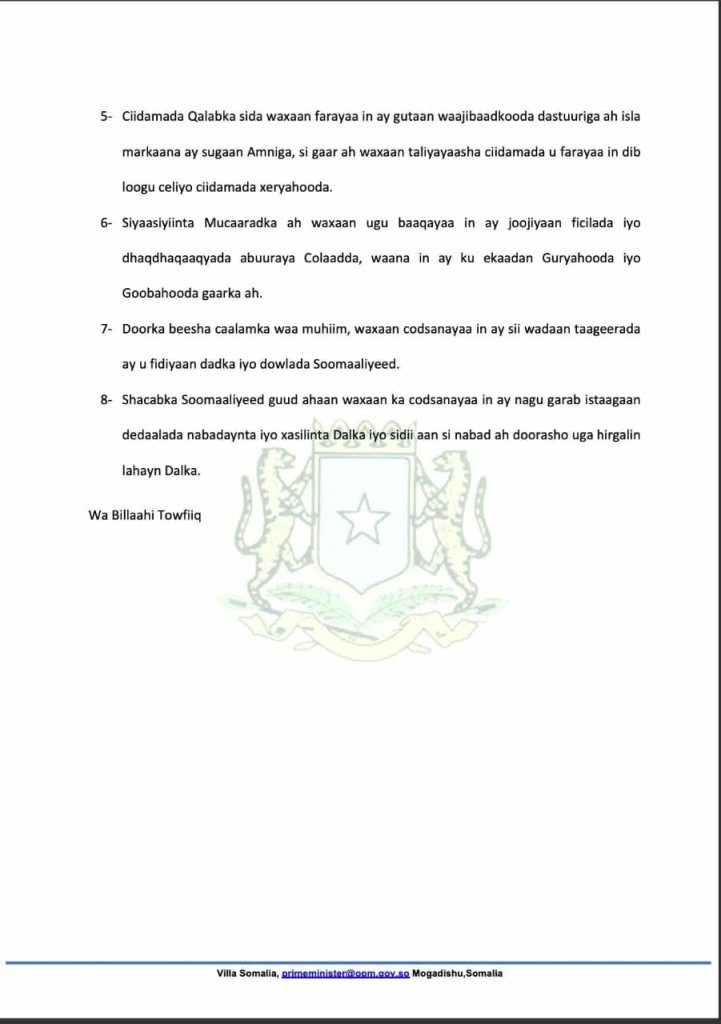
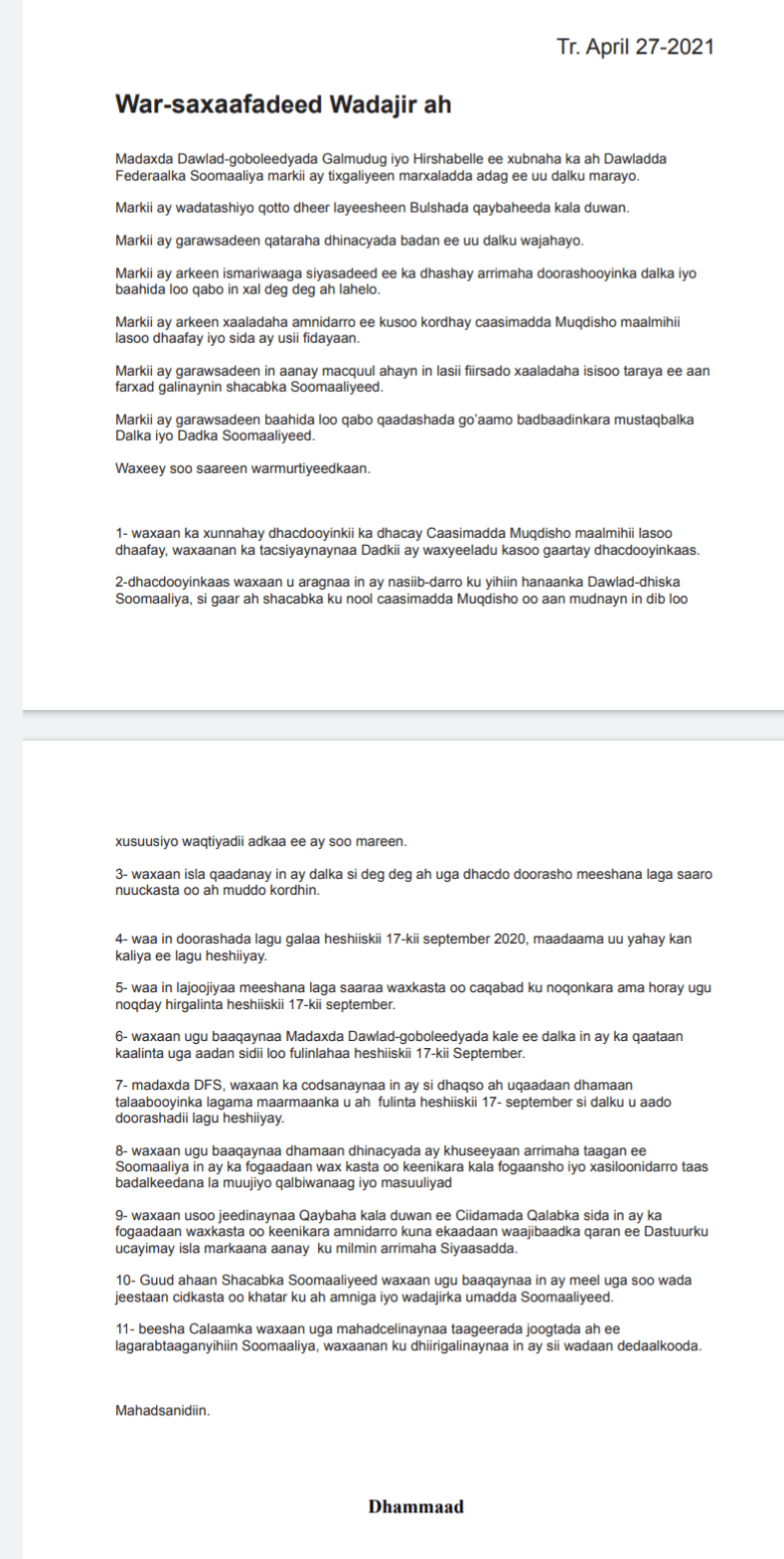
PRIME MINISTER ROBLE’S LETTER OF APPEAL TODAY

WDM BREAKING NEWS. WARMURTIYEED. DEG DEG

Federal Member States of Galmudugh and Hirshabelle denounce Farmajo’s recent mandate extension (April 12, 2021) – called for return to talks on the basis of 17 September 2020 Agreement. This is a significant shift of position. Things are happening in fast pace in Mogadishu. Stay tuned.

STATEMENT ON OUTBREAK OF VIOLENCE IN MOGADISHU

For immediate release
 
JOINT PRESS STATEMENT
 
STATEMENT ON OUTBREAK OF VIOLENCE IN MOGADISHU
 
Mogadishu, 27 April 2021 – International partners* strongly condemn the outbreak of violence in Mogadishu on 25 April.
 
We have repeatedly warned that the extension of mandates would lead to a political crisis and undermine peace, stability and security in Somalia. In the wake of the violence on 25 April, we urge all sides to exercise maximum restraint, resume dialogue, and avoid unilateral actions that may lead to a further escalation.
 
We are alarmed especially by the emerging fragmentation of the Somali National Army (SNA) along clan lines, which detracts from its primary task of combating Al Shabab and protecting the Somali population. Use of security forces for pursuit of political objectives is unacceptable.
 
We reiterate that the 17 September agreement remains the only agreed model for elections and we urge the signatories of this agreement to return immediately to talks on that basis.
 
We welcome the decision of the African Union Peace and Security Council to appoint a Special Envoy and urge that this high-level representative arrives in Mogadishu and to begin work as soon as possible. We stand ready as partners to extend our support to this Envoy, and meanwhile we continue efforts to bring the parties together. 
 
We reaffirm our respect for Somali sovereignty, unity, territorial integrity, and independence.


  • African Union,
    Belgium,
    Canada,
    Denmark, 
    Djibouti,
    Egypt, 
    European Union (EU), Finland,
    France,
    Intergovernmental Authority on Development (IGAD),
    Ireland,
    Italy,
    Japan,
    Netherlands,
    Norway,
    Spain,
    Sudan,
    Sweden,
    Switzerland,
    United Kingdom,
    United States,
    United Nations.

HOW DO YOU UNDERSTAND THIS WARNING BY FARMAJO’S SECURITY MINISTER?

Some people said, it was a declaration of war. Have your say.

WDM YEARLY SUBSCRIPTION

Annual fee

$37.00

WDM EDITORIAL: FOCUS CONDEMNATIONS ON FARMAJO ENABLERS TOO

These include former Speaker of the House of the People of the Federal Parliament, Mursal, whose mandate had expired in December 2020, and his deputies, Mahad and Mudey. These are co-conspirators and enablers of Farmajo’s coup of the Federal Government in April 12, 2021. They are complicit in high crimes against the state, peace and stability of Somalia.

The former House Speaker and his deputies should be marked and barred from holding any future public office. Moreover, a list should be drawn up to include all facilitators and enablers among high profile national figures, who had committed crimes against Somali State and people of Somalia.

The culture of impunity for crimes committed against the people, their interests, peace and wellbeing must stop immediately.

It is disappointing that opposition leaders aren’t deliberating on issues of national interest and abuses in public offices. One may wonder whether they are merely interested in replacing Farmajo and would embark upon committing same abuses of power.

ON SAVAGERY OR CIVILIZATION

US CONDEMNS FARMAJO’S MANDATE EXTENSION

Take a listen.

https://editorials.voa.gov/a/united-states-condemns-mandate-extension-gambit-in-somalia/5867536.html

KEEP ABREAST WITH THE LATEST POLITICAL DEVELOPMENTS IN SOMALIA

WDM, the first site to check out on Somali political issues and more. https://ismailwarsame.blog
Don’t miss any article. Keep abreast with the latest critical analysis behind the news. Subscribe to the blog, support it, donate and follow.

WDM NEWS BRIEF ON MOGADISHU SECURITY SITUATION

In a last desperate attempt to continue squattering in Villa Somalia, Farmajo is reportedly bringing in more troops to Mogadishu. Units of militia associated with the so-called Somali National Army, SNA, are being flown in from Gedo, while those, who were sent earlier to Eritrea and Ethiopia for military training, are being rushed in. It will be seen how effective fighting forces they could be in an urban warfare in unfamiliar terrain in Mogadishu. The new additional forces, however, will give Farmajo more room to negotiate with mainly Hawiye opposition leaders from a position of strength. With that, he will also pose a challenge to the members of the international community stationed in Halane Campound in Mogadishu.

It is amazing to note here the fact that most Somali politicians, or the so-called political stakeholders, aren’t calling it for what it is: A coup d’etat of the Federal Institutions took place in April 12, 2021. Yes, they talk about the end of Farmajo’s four-year mandate and his illegal extension, but that isn’t the full picture of what had happened. Farmajo had overthrown the Federal Government of Somalia as he did with the Federal Member States of Galmudugh, Hirshabelle and Southwest to pave the way for this coup. It would be rather naive to expect him to give up what he has taken away by force and through illegalities, until he is compelled to do so.

WDM YEARLY SUBSCRIPTION

Annual fee

$37.00

MOGADISHU: WDM SECURITY SITUATION ANALYSIS

CONFLICTING FORCES


On one side, confronting Farmajo’s forces, though not for same objectives and reasons, are:

  1. Al-Shabab
  2. Hawiye clan militia led by the opposition
  3. Militia of anti-government businesses and interest groups.
  4. Stray militia for robbery and looting

On the other side, Farmajo’s Forces are:

  1. Military, police, secret services, recruited and hailing from Hawiye, Marehan and Digil&Mirifle clans.

Barring de-escalation of armed confrontations in Mogadishu, Farmajo is extremely vulnerable, based on increasing likelihood that many of current FGS forces will desert him along their sub-clan lines. So much for the Farmajo’s Somali National Army, SNA.

Last night Farmajo had realized that his main military forces, Gorgor and Haramcad, couldn’t be trusted, as the opposition used clan cards in their respective areas to fragment the forces along sub-clan lines. Then, last night Farmajo have been calling people like Abdi Qaybdid and others to reduce tension. But, the oppostion demanded Farmajo to withdraw his forces, which he did. So what is the solution now? Farmajo has to accept election process to proceed with assurance by third part (1). Security forces will be influenced by the opposition to remain calm till Farmajo promise is seen rolling in (2). If above two go well, all the rest of militias wouldn’t have chance to destroy the state (3).

Hawiye are now understood to be avoiding destruction of Mogadushu. But, if Farmajo refuses to compromise, then Hawiye are ready to fight on, even if the city could be destroyed. That is their position now.

Once Farmajo’s forces are defeated, it would be back to square one between Islamists and warlords in the same manner as now defunct Union of Islamic Courts and Warlords were then.

The presence of international community in Halane Campound in Mogadishu Airport could be reduced radically, and AMISOM mission in Somalia would change, and if the worst scenario plays out, could be pulled off altogether. Western embassies would relocate, reducing some heads of missions to the status of “Special Envoys” to Somalia.

There wouldn’t be any talk on holding elections as Federal institutions could begin to unravel. We could look back at FGS as an experiment that went badly.

Forces of proxy would intensify their operations in a war zone and power vacuum left by Farmajo Regime.

TESTED IN THE INSTIGATION OF CONFLICTS, STAGING COUP D’ETAT AND DESTABILIZING REGIONAL STATES

https://ismailwarsame.blog/2021/04/25/somalia-a-new-warlord-in-town-4/

WDM YEARLY SUBSCRIPTION

Annual fee

$37.00

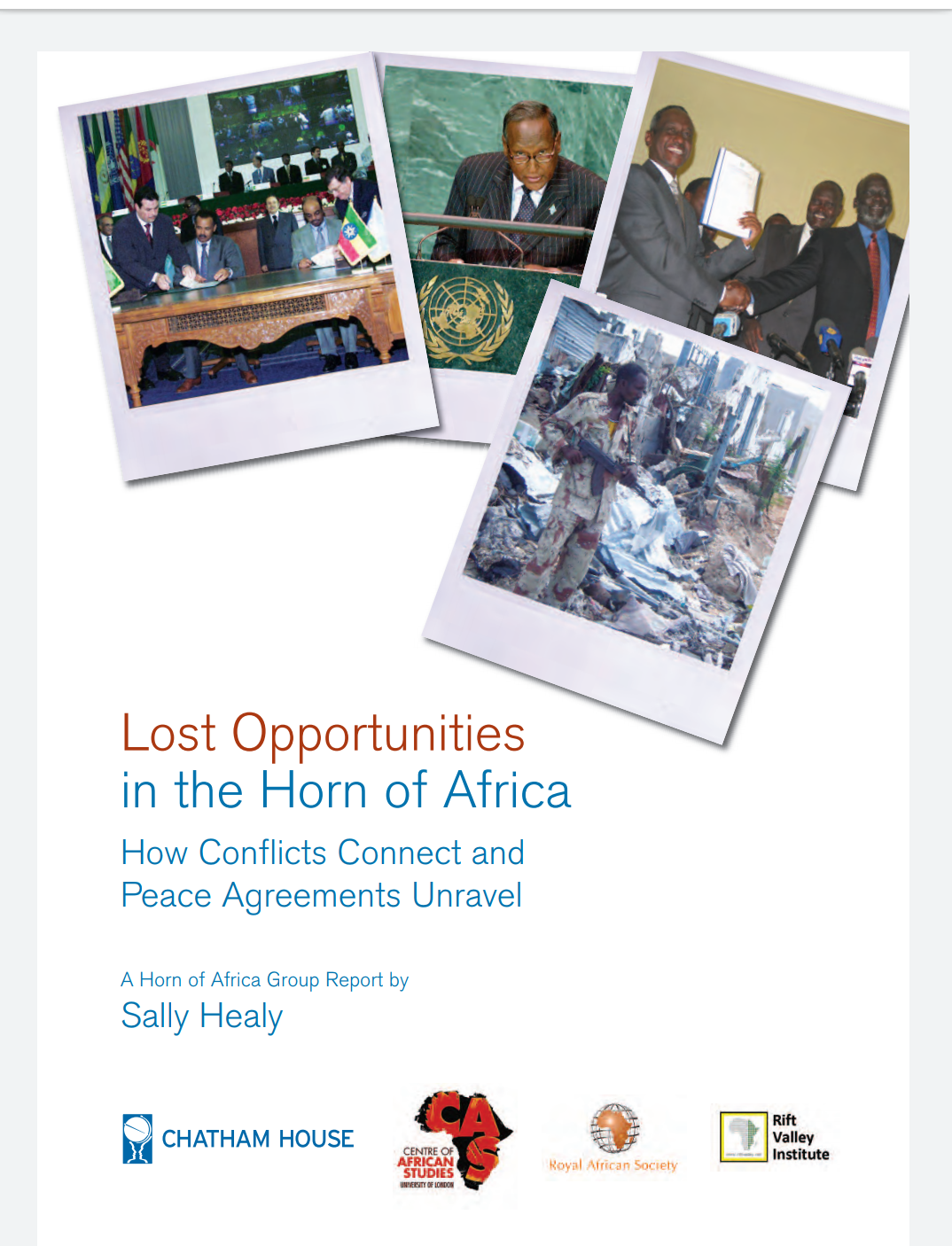
LOST OPPORTUNITIES

WDM YEARLY SUBSCRIPTION

Annual fee

$37.00

Photo from WDM Somalia MONITOR

WDM BREAKING NEWS

Conflagration and escalation of armed hostilities between Farmajo and opposition forces are happening now in different quarters of Mogadishu. Tension is building up and precarious security situation in the Capital is of deepest concern now to all Somalis. Eyewitness reports indicate fluid and dangerous conflagration of armed clashes with the use of heavy military weapons and hardware. Somali politicians may be negotiating for military ceasefire soon instead of talking about elections. This is a developing story.  Stay tuned.

SOMALIA: A NEW WARLORD IN TOWN

https://ismailwarsame.blog/2021/03/31/somalia-a-new-warlord-in-town/

AN OPEN LETTER TO THE POLITICIANS, PRESIDENTIAL CANDIDATES, INTELLECTUALS AND ELDERS OF HAWIYE

The crimes of the Somali Civil War, crimes against humanity and mass -cleansing of Darood residents of Mogadishu by USC leaders and forces had put the accounting for the past civil and human rights abuses of the Regime of Dictator Siyad Barre off the hook to escape justice – a historical mistake that would never face a day of reckoning in a court of law. The massive crimes of USC leaders had changed Somalia’s sense of justice fundamentally for good, creating a culture of total impunity for all sorts of crimes against the state, the individual, public and private properties.

These historical abuses of Hawiye leaders under the banner of rebels of United Somali Congress (USC) had given relevance and political cover to the criminals and henchmen of “Kacaanka” Siyad Barre. It is an irony of history that yesterday’s violators of civic and human rights of the Military Regime came forward multiple times to get elected to the highest office in the land. Now, you can’t separate Farmajo from that “Regime”. I am not suggesting that he had committed such crimes as he was too young to hold a position of responsibility then, nevertheless, he was a diplomat working for and with the regime. That alone disqualifies him for seeking the presidency and/or the post of prime minister of Somalia.

Because of what USC had done post-Barre, every yesterday’s Barre henchman now argues that Barre and his brutal regime were far better off and more patriotic than Aydid’s and Ali Mahdi’s. How would you handle such argument?

Fast-forward now to the problem of Farmajo, his disregard to the rule of law, his most recent coup d’etat, the humiliation he causes to former presidents of Somalia, Hassan Sheikh Mohamud and Sheikh Sharif Sheikh Ahmed, among other prominent members of the civil society in Mogadishu and beyond. Do you have the moral high ground yourselves, when you aren’t ready yet to condemn USC historical abuses? How do you plan to serve justice for the victims of Farmajo, if you were guilty of worst abuses?

Finally, when you had allowed and elected to the Federal Parliament a whole bunch of vicious warlords of USC Civil War, like Abdi qaybdid, Sudi Yalaxow, Qanyare Afrah, among others, you had proved to the Somali people that you weren’t ready to turn a new page in helping rebuild Somalia on the ashes of state failure.

Kormeeraha WDM SOMALIA. “Soo Dhawee Adeegsiga Xoriyadda Saxaafadda”

Warqad Furan oo ku socota Siyaasiyiinta, Musharaxiinta Madaxweynaha, Waxgarad iyo Guurtida HAWIYE

Dembiyadii Dagaalkii Sokeeye ee Soomaaliya, dambiyadii ka dhanka ahaa bini’aadanimada, ka-sifayntii Muqdisha dadka Daarood ah ee ku noolaa ee ay geysteen hoggaamiyeyaashii iyo xoogaggii USC, waxay keeneen xisaabcelin la’aanta dambiyadii hore ee shacabka iyo xuquuqul insaanka ee Taliskii kaligii-taliyihii Siyaad Barre, si ay uga cararaan cadaaladda – waa qalad taariikhi ah oo aan waligiis wajihi doonin maalin xisaab maxkamadeed. Dembiyadii waaweynaa ee hogaamiyayaashii USC waxay badaleen dareenka Soomaaliya ee cadaalada asal ahaan, wanaaga, abuurista dhaqan gabi ahaanba ciqaab la’aan dhamaan noocyada danbiyada ka dhanka ah dowlada, shakhsiga, hantida guud iyo tan gaarka ah.

Xadgudubyadaan taariikhiga ah ee hoggaamiyeyaasha Hawiye ee hoosta calanka jabhadii United Somali Congress (USC) waxay siisay muhimad iyo dabool siyaasadeed dambiilayaashii iyo raggii gacan ku dhiiglayaasha ahaa ee “Kacaanka” Siyaad Barre. Waa wax lagu qoslo taariikhda in kuwii shalay ku xadgudbay xuquuqda madaniga iyo xuquuqul insaanka ee Nidaamkii Milatariga ay soo baxeen dhowr jeer si loogu doorto xafiiska ugu sareeya dalka. Hadda, ma kala saari kartid Farmaajo “Nidaamkaas”. Uma soo jeedinayo inuu galay dambiyo noocaas ah maaddaama uu aad u yaraa oo uusan qaban karin xil masuuliyadeed markaa, si kastaba ha noqotee, wuxuu ahaa diblomaasi u shaqeynayay lana shaqeynayay nidaamka. Taas oo kaliya ayaa u qalmin inuu raadsado madaxweynenimo iyo / ama jagada ra’iisul wasaaraha Soomaaliya.

Sababtoo ah wixii USC ay sameysay kadib-Barre, maalin walba baryahan adeeggayaashii Barre ayaa ku doodaya in Barre iyo taliskiisii naxariista darnaa ay aad USC wanaagsanaayeen, kana wadanisan yihiin Ceydiid iyo Cali Mahdi. Sideed u maareyn laheyd dooda noocaa ah?

Si dhakhso leh hadda ugu soo soco dhibaatada taagan ee Farmaajo, tixgalin la’aantiisa sharciga, inqilaabkiisii ugu dambeeyay, ceebeynta uu ku hayo madaxweynayaashii hore ee Soomaaliya, Xasan Sheekh Maxamuud iyo Sheekh Shariif Sheekh Axmed, iyo xubno kale oo caan ah ee bulshada rayidka ah ee Muqdisho iyo wixii ka baxsan. Ma leedihiin laftiina damiir sarre, markii aydaan weli diyaar u ahayn inaad cambaaraysaan xadgudubyada taariikhiga ah ee USC Sideed u qorsheyneysaa inaad cadaalad ugu adeegto dhibbanayaasha Farmaajo, haddii aad dambiile ugu tahay xadgudubyada ugu xun?

Ugu dambeyntiina, markii aad u oggolaatay oo aad u dooratay Baarlamaanka Federaalka koox aad u tiro badan oo ka mid ah hoggaamiye kooxeedyadii foosha xumaa ee Dagaalkii Sokeeye ee USC, sida Cabdi qaybdiid, Suudi Yalaxow, Qanyare Afrax, iyo kuwo kale, waxaad ummada Soomaaliyeed u caddeysay inaadan diyaar u ahayn bog cusub ka fura gacan ka geysashada dib-u-dhiska Soomaaliya ee burburay dowladnimadii

WDM YEARLY SUBSCRIPTION

Annual fee

$37.00

Tweet from Ismail Warsame (@ismailwarsame)

Ismail Warsame (@ismailwarsame) Tweeted: “Talking Truth to Power in Undemocratic Tribal Context”, #TTTP https://t.co/POJgCAFHB0 https://twitter.com/ismailwarsame/status/1386167124666765312?s=20

ON THE LATEST DEVELOPMENTS FROM SOMALIA’S FRONT

https://ismailwarsame.blog/2021/04/24/on-the-latest-developments-from-somalias-front/

Watch “The Kenya-Somalia Maritime Border Dispute Explained” on YouTube

ON THE LATEST DEVELOPMENTS FROM SOMALIA’S FRONT

So, what is happening politically in Somalia, after an outrage condemning Farmajo’s unconstitutional extension of his mandate for two more years?

  1. Despite mixed signals from some political circles in the country, Somalis predominantly rejected this illegal power grab and coup d’etat by Farmajo.
  2. The world community too has rejected Farmajo’s disregard for the rule of law in Somalia.
  3. AU has condemned the extension of Farmajo’s mandate and is set to designate a mediator tasked to bring Somali parties together in building a consensus towards holding the delayed elections.
  4. The rest of the world has put their support and trust behind the AU position on the matter and mediation efforts.

In the meantime, the disgraced outgoing Farmajo is holding up in Villa Somalia, with none in the world community recognizing him as a legitimate Somali leader – even President Ismail Omar Ghuelleh of Djibouti avoids inviting Farmajo to the inauguration.

They say that it is always calm before the storm. They also say that if you don’t understand what could happen in the future, then you don’t understand what is happening at present. There is no doubt that Somalia is in deep trouble, and the political situation is as an unpredictable as it is dangerous. The storm will come to pass amid unprecedented constitutional crisis the country had ever faced, thanks to Farmajo.


FAKE AND UNTRUSTWORTHY