Breaking Ties: A Firsthand Account of Somali-Ethiopian Political Tensions Under Meles Zenawi

The Arta Conference, Power Plays, and the Unraveling of a Fragile Alliance

Author: Warsame Digital Media
Category: Politics & History
Date: January 31, 2021


Background: The 2000 Arta Conference and Ethiopia’s Skepticism

In 2000, the Somali Reconciliation Conference in Djibouti’s coastal town of Arta sparked cautious hope for peace in Somalia. However, Ethiopia’s leadership under Prime Minister Meles Zenawi viewed the initiative with disdain, dismissing Djibouti’s capacity to mediate. Their skepticism turned to alarm as the conference gained momentum, threatening to produce a government outside their influence.

Ethiopia’s strategy shifted: they sought to co-opt key Somali leaders into the process. Among their targets was Abdullahi Yusuf, then President of Puntland, a region critical to regional stability.


The Addis Ababa Gambit: Luring Somali Leaders

In a bold move, Ethiopia dispatched a Saudi-Ethiopian billionaire’s private jet to Garowe, Puntland, to ferry Yusuf’s delegation—including myself—to Addis Ababa. Upon arrival at Bole Airport, we bypassed immigration formalities, whisked to the Addis Hilton in government limousines.

Ethiopian diplomats, including Dr. Tekeda Alemu (then Deputy Foreign Minister) and Seyoum Mesfin (Foreign Minister, later killed in the Tigray War), engaged us in informal talks. Their goal: persuade Yusuf to join the Arta process. Yusuf countered by proposing to include Mogadishu warlords, who felt sidelined by Djibouti’s civil society-focused approach. Ethiopia agreed, arranging charter flights to transport them.


Resistance and Political Theater

Behind the scenes, tensions simmered. When Ethiopian officials pressed Yusuf to endorse Arta, we recognized a trap. Secretly, we coordinated with Mogadishu warlords to boycott the Ethiopian-chartered flights and secured an escape plan via a Damal Airlines plane.

The climax came in a tense meeting with Seyoum Mesfin, who arrived in casual attire, expecting compliance. Instead, we cited the need to consult Puntland’s institutions—a diplomatic rebuff. Mesfin, stunned, watched us depart Addis the next day without formalities, marking a rupture in trust.


Aftermath: From Mbagati to Regime Change

The fallout was lasting. Ethiopia opposed Yusuf’s 2004 election as Somali President at the Kenya-led Mbagati Conference, backing rivals like Sheikh Sharif Ahmed. By 2009, Ethiopia orchestrated a Djibouti conference to expand parliament and oust Yusuf, who resigned and fled to Yemen.


Legacy of Distrust

This saga underscores Ethiopia’s dual role as both mediator and manipulator in Somali politics. The Zenawi government’s tactics—coercion, divide-and-rule, and abrupt policy shifts—left enduring scars. For Somali leaders like Yusuf, collaboration with Addis Ababa became a precarious dance of defiance and survival.

Key Figures:

  • Meles Zenawi: Ethiopia’s late Prime Minister (1995–2012), known for pragmatic authoritarianism.
  • Abdullahi Yusuf: Puntland President (1998–2004), later Somali President (2004–2008).
  • Seyoum Mesfin: Ethiopia’s Foreign Minister (1991–2010), pivotal in regional security strategies.

Conclusion: A Lesson in Sovereignty
The Arta episode reveals the fragility of alliances in Horn of Africa politics. For Somalia, external mediation often masked foreign agendas. Yet, it also highlights moments of agency, as Somali leaders navigated—and occasionally thwarted—the designs of regional powers. The echoes of these clashes resonate today, as Ethiopia grapples with its own internal fractures.


Warsame Digital Media is a platform analyzing Somali political history through firsthand accounts and archival research. Follow for more insights into the region’s complex geopolitics at iwarsame@ismailwarsame.blog/ismailwarsame@gmail.com, @ismailwarsame.

[This post edited after posting].

A FLIGHT TO NOWHERE

I was not in that flight to Jowhar in that early evening when planes couldn’t land there. But, I was in Nairobi, communicating on Thuraya satphone with Mayor of Jowhar, Mohamed Habeeb (Mohamed Dheere), throughout the evening. Dheere had been arranging enough cars with headlights blazing to light up the entire runway. I agree it was a risk flight too. There was no way Yusuf could return to Kenya as he was deemed extra burden on Kenyans having two presidents in town, blocking their streets traffic when moving around. Remember at time no aircraft could land in any of Somali airports, perhaps, Hargeisa ( I am not so sure), which was no go for Yusuf.
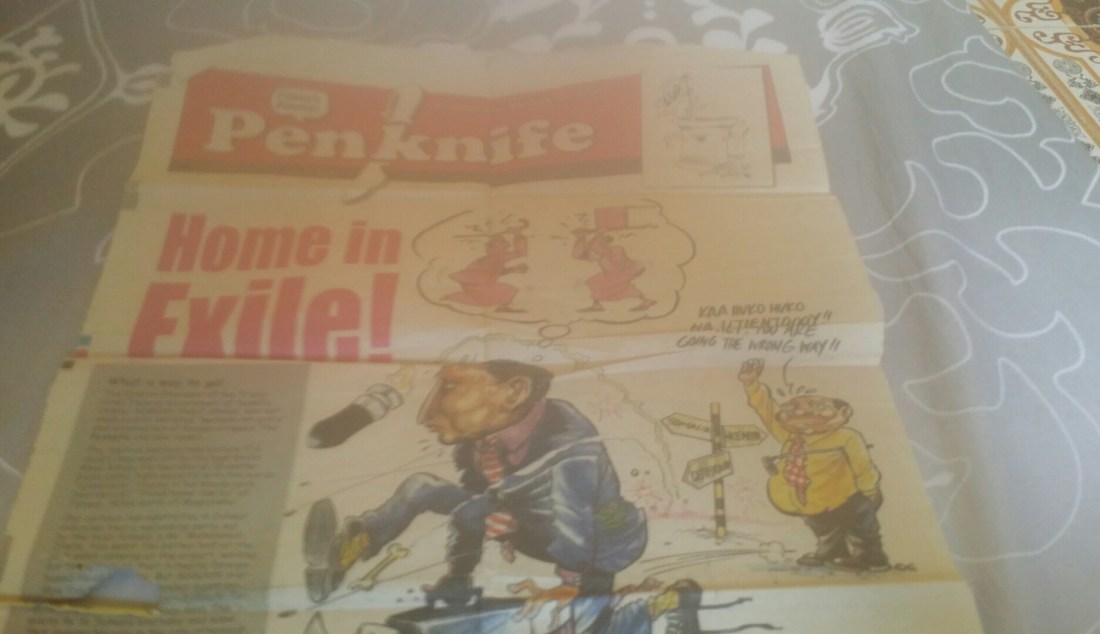
It was a mistake done by the organizers of the President’s trip to Jowhar, making such a delay to fly into Jomo Kenyatta Airport. I could confirm President Kibaki had been at Airport throughout the day with Yusuf, waiting for that flight to take the later to Somalia. Why such a delay had occurred? Later I learned that a merchant of Qat had persuaded the trip organizers that he would pick up Yusuf in the same day after he transports Qat to Somalia. Such a mess and poor judgment. Also recall I was not with TFG at the time. In fact, I was communicating with Mohamed Dheere on the trip on my own to help out. It was me who informed Dheere that the President’s plane had landed in Djibouti, to his much needed relief. ( Above is a cartoon by Penknife, Sunday Nation, on the occasion. It is dated June 19, 2005. I have been keeping in in possession since then).

FEDERALISM IS A GUARANTOR OF PEACE AMONG SOMALI CLANS

https://t.me/c/1065393089/660150

A FLIGHT TO REMEMBER

Air-Transport in Somalia

I am not sure whether you are fully familiar with air-transportation in Somalia now, and particularly then, in the year 2000. It is completely dominated by foreign pilots and foreign charter planes. Somali pilots are almost non-existent here, and nowhere to reach them for advice momentarily when you need them. Basically, then there were no resources available to us. We knew airport conditions in Ceelbare in Bakool Region because we had people on the ground there. But, who could predict the situation in Bardaale? The Kenyan pilot didn’t tell us that he had lost the way until he landed in Bardaale. As I got off the aircraft alone because I left others inside for security reasons, I found myself distributing pieces of cigarettes to the militiamen as a relief worker on humanitarian mission. In the drama, I was aware that each militiamen was watching at my personal items I was wearing like the watch, shoes, suit, eye-glasses etc to grab once I was eliminated. While throwing pieces of cigarettes at mob-like militia surrounding me, I was spying for information about whose militiamen they were. Surprisingly, militia commanders weren’t forthcoming with this info, and finally discovering the fact, let two of them go onboard the plane to greet the head of our delegation, the late Abdullahi Yusuf, then President of Puntland State of Somalia.

BREAKING OUT OF POVERTY

January 26, 2021

By Paul Krugman
Opinion Columnist

Today’s column was about the Democratic proposal to give most families with children a substantial cash grant. It is, as I said, a very good idea. What I didn’t have space to talk about was a broader issue: What should we do about Americans with low income — and their children? Should we make a new push to reduce or eliminate poverty, and if so, what should it involve?

As with everything else in modern America, the two parties have starkly different positions on this issue. I’m being careful not to say different philosophies or different analyses because, to be honest, I don’t believe that the Republican position on this, or for that matter on any major policy issue I can think of, reflects a good-faith attempt to figure out what works best. But the expressed views of the parties do show a big divide about how the world works.

You can actually see those expressed views in two dueling reports released six years ago, 50 years after Lyndon Johnson initially declared his War on Poverty. One was produced by the Obama administration. The other was produced by House Republicans — essentially Paul Ryan, back when Ryan was still widely perceived as a policy visionary, and those of us who described him from the beginning as a flimflam man were marginalized (we were right).

The Republican view is basically that anti-poverty programs aren’t the solution, they’re the problem. How so? When you have “means-tested” programs — programs that are only available to people with sufficiently low incomes, or that phase out as income rises — you are in effect imposing high marginal tax rates on the relatively poor. That is if, say, a single mother manages to increase her earnings from $15,000 to $20,000 a year, she will find much of that extra $5,000 taken away in the form of reduced benefits.

This high de facto taxation, conservatives say, discourages efforts to break out of poverty. And they also say that it fosters a culture of dependency. So they argue that to help the poor we should, well, offer them less help.

Progressives don’t deny that incentives can matter. To use one of my favorite examples, countries that offer generous benefits to people who retire early, like France, end up with many people, you guessed it, retiring early.

But economists on the center left generally argue that the disincentives created by anti-poverty programs are exaggerated, and that the main thing actually trapping people in poverty is a lack of resources: It’s hard to get an education, start a business, even move to a place where jobs are available, when you have no money in the bank and are living hand-to-mouth.

Also, being poor imposes a lot of cognitive stress: It’s hard to focus on self-improvement when you’re constantly worrying about where the next rent check will come from or how to pay medical bills.

If you see resources as the main problem for the poor, the answer to poverty is to provide more resources; this doesn’t just improve the lives of the poor in the short run, it also increases their chances of breaking free of the poverty cycle.

This is the kind of debate that should be settled with evidence. And for what it’s worth, there is growing evidence that the resources view of poverty is much closer to the truth than the incentives view. As I explained in the column, this is especially true for programs that help families with children, which seem to improve the lives of those children long after they’ve matured past receiving aid.

Unfortunately, only one of our two major political parties believes in looking at evidence. Sorry if that sounds partisan, but it’s the simple truth.

But my sense is that the growing weight of evidence, combined, to be fair, with a general leftward shift in the Democratic Party, has set the stage for a new effort to fight poverty. Nobody will call it the War on Poverty 2, but it will be an important shift, and can do a lot of good

When Citizens, For Good Reasons, Take The Law Into Their Hands

Somalia is a country without a traffic police, regulations and even driving permits (except on demand). Puntland urban towns are not exceptions. When you rarely see a few isolated traffic police look-alike, they are in that particular spot to stop traffic to beg some pennies.

Under this circumstance, I often see and even got help from a few volunteer civilians in Garowe town, taking public traffic regulations into their own hands. These good Samaritans felt sorry for the state of affairs in their country in the absence of government role in the safety of the citizens along dangerous roads from reckless and unlicensed drivers.

I would like to thank those volunteers, especially a young man, who is often on guard, regulating public transit at one of bottlenecks of Garowe poorly maintained roads. He is as nameless as unknown soldier.

How Kenya nurtured Somalia’s transitional government—then lost influence years later

Africa
Mohamed Abdullahi Mohamed
File | PSCU
AFRICA PRIME
How Kenya nurtured Somalia’s transitional government—then lost influence years later
Sunday, January 24, 2021
By Sunday Nation Correspondent
Nation Media Group

Fourteen years ago, in January 2007, Somalia President Abdullahi Yusuf Ahmed set foot in Mogadishu for the first time since taking office in 2004. His triumphant entry in the capital symbolised victory for Somalia’s Transitional Federal Government (TFG) and indeed Kenya, from where he had ruled his country for three years.

Ever since, there has been a lot of water under the bridge and the initial goodwill, partnership and enthusiasm between the two nations has died down.

Kenya was at the forefront in the mediation exercise under the Inter-Governmental Authority on Development (Igad), which brought to end the political leadership quagmire in Mogadishu and led to the formation of TFG. With time, however, this history seems to have gradually faded, giving room for suspicions and bad blood to creep in.

From protests by Kenya that battles between Somalia-based militia groups and government forces often cause insecurity along the border line to planned repatriation of Somali refugees residing in Kenya and the unresolved maritime boundary dispute, the hostilities keep piling up.

The latest revolves around Kenya’s alleged interference in Somalia’s internal affairs, leading to Mogadishu’s decision to sever relations with Nairobi.

Kenya-Somalia border row has ‘metamorphosed’: Prof Midamba
This new development is causing fears that lukewarm diplomatic relations between Nairobi and Mogadishu — against the backdrop of general elections in Somalia — pose a big threat to regional security and political stability.

Read: Somalia admits tiff with Kenya ‘profiting’ Al-Shabaab militants

Pointing out that a stable Somalia is good for Kenya, Foreign Affairs Chief Administrative Secretary (CAS) Ababu Namwamba stresses that Nairobi is committed to working with Mogadishu to rebuild a peaceful, secure, prosperous and stable State and “to help secure the Horn of Africa region”.

“The recent reopening of a fully-fledged Somali embassy in Nairobi after several decades of civil strife and chaos is a most emphatic confirmation that Somalia is readying itself to, once again, play an important role as a key member of the regional and international community. This is a vital step for regional peace and prosperity,” said Mr Namwamba.

Democracy
Somalia’s Prime Minister Mohamed Hussein Roble similarly pointed out that a peaceful Somalia is good for the region. Roble pegs the country’s political tranquility to the delivery of a free, fair and transparent election.

“This will usher in the much-needed stability and progress to our people, besides strengthening our democracy. This election will help to shape the future of Somalia and our great people,” he said.

Kenya-Somalia border row has been messed-up by the Ministry of Foreign affairs – Hashi
The optimism from the Kenyan and Somali government officials notwithstanding, tension between the two nations remains. In fact according to security and political pundits, it is unlikely that the diplomatic hostilities will end anytime soon before the polls in Somalia, slated for later this year.

Some government officials in Somalia have openly claimed that Kenya’s initial role was persuaded by selfish business and political interests.

Read: Kenya, Somalia tiff hurts Sh16m-a-day miraa trade

“Indeed this is a perception held by many Somalis who believe that Kenya is keener on exploiting existing business opportunities and controlling our country’s political destiny. That precisely explains the current hostilities, especially during this electioneering process,” explains Abdishakur Ahmed, a Mogadishu-based analyst.

He says the tiff between Mogadishu and Nairobi serves President Farmaajo’s political interests so well “because his government has for long been considered to be a puppet of the West and subservient, particularly, to Kenya”.

That Farmaajo is (finally) standing up against the Kenyans has earned him accolades locally and his ratings have improved,” says Abdishakur.

But Kenya is not alone in this Farmaajo storm. He has also had strained diplomatic relations with United Nations representatives, leading to the expulsion of UN’s Special Representative in Somalia Nicholas Haysom in 2019 “for meddling in the internal affairs of Somalia”.

In the Haysom instance, Farmaajo’s message was to affirm to the Somali community, within the country and in the diaspora, as well as the international community, that Somalia was serious about guarding its sovereignty, and that no individual, whatever their status, can liberally undermine the government and people of Somalia.

Oil is the root cause of the maritime row between Kenya and Somalia – Irungu
The Farmaajo Government also considers the support of Kenya for the breakaway Jubaland, and particularly its President Ahmed Mohamed Islam alias Madobe, as an encroachment on its internal affairs.

Read: Somalia Severs Diplomatic Ties With Kenya

On the flipside, Kenya perceives the Jubaland region as an important buffer zone between its territory and Al-Shabaab-controlled regions in Somalia. The Kenyan government, says security analyst Joash Maina, supported the election of Madobe to ensure the safety of its own borders. This was despite opposition from the governments of both Somalia and Ethiopia.

“The dictates of foreign policy are that each country’s interests come first. In our case it is about securing our borders and we cannot therefore afford to have an enemy or unfriendly federal government of Somalia bordering us,” says Maina.

Kenya also hosts a huge number of refugees from Somalia, and the authorities consider this a security threat. One reason for this is their back-and-forth cross-border movements and the fact that they are difficult to differentiate from Kenyan citizens of Somali ethnic descent. Somali refugees and Somali locals share the same language and the Islamic faith, are divided into clans, sub-clans, and lineages, and have a long history of interactions across the Kenya-Somalia border.

Citing military and economic support accorded to Somalia over the years, including the country’s role in the formation of TFG, Mr Namwamba says Kenya has all along demonstrated a spirit of good neighbourliness.

“It is a sacrifice that Kenya has had to pay dearly in terms shedding of the blood of soldiers engaged in the Amisom peace mission as well as ordinary citizens, who are often easy targets of Al-Shabaab militants. We are not paying such a price for sheer fun, but rather for the love of our neighbours and for our commitment to internal and regional peace,” the CAS told this writer.

Nonetheless, Kenya and Somalia have experienced more political friction under Farmaajo than any other leader in recent times. In fact, of the latest crop of Somali leaders, observers single out the Head of the TFG Government, Abdullahi, as friendlier and more cooperative. They partly attribute this to the fact that he was alive to Kenya’s role in his country’s political emancipation efforts.

But it is this apparent preference by Kenya — regarded as Big Brother — of certain candidates that makes the political process in Somalia dicey and generates resistance from several quarters. Part of the current friction stems from fears that “Big Brother” is hellbent on influencing the Somalia political process. Mr Namwamba refutes that claim.

https://nation.africa/kenya/news/africa/how-kenya-nurtured-somalia-s-transitional-government-then-lost-influence-years-later-3266936

The Danger to Democracy, Federalism, Power Sharing, Checks and Balance by Ignorant Masses

Governments are ran by political and bureaucracy elites. In a democracy, political elites come to power through manipulation of mostly ignorant masses to vote for them, who can’t hold their leaders accountable for the abuses in office. These leaders tend to tyranny or dictatorship. In turn, checks and balance are lost. Now, everything suddenly depends on the wishes and whims of these leaders. When corruption is widespread and erodes the traditional values of the society, things even get worse with corruption facilitating the absolute power of the ruling elites.

For those, who debate the issues of democracy, federalism, devolution of power in Somalia, there must be written rules of the road as a guide for implementation. This is the constitution to which all have to adhere to. Without this mechanism in place and respected, don’t expect things to go to the right direction and there shall be always leaders to exploit the weaknesses of the system and situation of ignorant masses.

UNKNOWINGLY MISSING IN ACTION

These days you hear rumors circulating in the Somali media about scores of Somali soldiers killed in Tigray Province of Ethiopia. These rumour mills were created by the absence of responsible central authorities in the country. The outgoing Federal President, Farmaajo, and PM Roble, resist to dispel these rumors, creating the suspicion that, in fact, that might be the case.

The reluctance of Mogadishu authorities to address publicly national issues is a pattern rather than an exception, whether it is news, statistics of victims of COVID-19, controversial election issues or nature of disputes and disagreements with the Federal Member States (FMS).

To keep silent and do nothing while issues of national interest and safety of Somali people are at stake, is more than betrayal of public trust, but committing national treason. How could you describe it otherwise when people are saying that Somali soldiers took part in Ethiopian conflict without any public knowledge, and as possibly outgunned, suffered heavy causalities?

Being unable to speak publicly and transparently on such critical national and security issues is not only beyond the pale, but could qualify as criminal negligence.

Author: Warsame Digital Media WDM

USA EXPOSED

Democracy by general elections and peaceful transfer of power made US great. Opportunity for everyone willing to compete and be successful in America has been attracting millions around the world. High standards of educational excellence brought in thousands of talented foreign students – many chose to remain in the US, contributing devastating braiñ-drain from their respective countries of orgin.Talents in every field of human endeavors got special welcome in US by especially designed Visa programs. America has been projecting an image of power and prosperity around world. It became a competition of ideas and ideology between East and West. This heralded a bitter Cold War after World War Two. Eventually, it led to the collapse of the East, exemplified by the demise of the Soviet Block, paving the way to the supremacy of US in world arena as the only Superpower.

Like historical empires before it, political polarization and partisan bickering set in, leading to disharmony and mistrust between the elites and parties. Opportunists like Donald Trump seized this chance to propel themselves into power in the US. Trump as the most powerful chief executive officer of US government wasted no time to dismantle America by eroding its core democratic values and cherished traditions of self-government. This gave rise to white extremist groups, neofascists and domestic terrorists.

Enter election of Joe Biden in 2020. He is a part of the US establishment and hardly will serve for a short period of time, not enough to make fundamental changes in systemic barriers on the road to equal opportunity for all, making provisions of US Constitution a pipe-dream for a long time in the lives of many Americans.

The historical ascent to the post of US vice-president by a woman and black lady, Kamala Harris, may backfire to usher in another Donald Trump next time around, just as it did with the election of Barack Hussein Obama. It looks it is the only way GOP could win future elections in a demographically changing America.

Photo from Ismail Warsame

It is too early to self-congratulate , Mr. President.

Set out priorities and develop public- private partnership projects and self-reliance Puntland plans. Send fact-finding delegations and trainers to Rwanda and to learn how they made that country progress a miracle in Africa.

Encourage research and establishment of quality think tank #centers. Right now Puntland lacks such capabilities, and nominally existing ones are either failing or no match for the required scope of Puntland potentialities.

Watch “Trump gets SHOCKWAVE after Lindsey Graham siding with Pelosi over his STUPID ‘show'” on YouTube

https://youtu.be/WZEhPtryK4U

forum_for_new_ideas_2021

Isn’t great to travel anywhere in #Somalia, speaking the same language, practise same religion without restrictions on other beliefs, eat similar foods with local diversities, feel at home etc. while you still know that you are in a different Federal Member State (FMS) in one #Federal_Somalia.

FORUM_FOR_NEW_IDEAS_2021

A reformed and fairer 4.5 Rule could be developed into a suitable Somali Federalism. The job is more than half done alreay. Congratulate the Founding Fathers of 2nd Somali Republic.