SUUGAAN

Take a note

ONCE UPON A TIME

(Photo credit: Islaan Bashir Islaan Abdulle)

Suugaan

Take a listen

https://ismailwarsame.blog

@ismailwarsame

On Parallel Jubaland Poll

AFRICA POLICY INSTITUTE – AFRICA RESEARCH NOTES

1 Issue No. 50
Africa Research Notes
July, 2019
Issue No. 50 Africa Research Notes July, 2019
AFRICA POLICY INSTITUTE
Knowledge is Power Africa Policy Institute
COMING RULING ON MARITIME DISPUTE
SEVERELY TESTING KENYA’S SOFT POWER
PETER KAGWANJA
The pursuit for a non-adversarial negotiated settlement and durable solutions to the security
challenges arising from the Somali-Kenya maritime dispute, solely rests on Kenya’s soft power
tact. Undesirably, Kenya faces an existential threat of losing its access to international waters,
resources and geo-strategic advantage.
Kenya has to use its instruments of soft power to settle the maritime boundary dispute with Somalia amicably / Photo: U.S. Navy 3rd Class Derek
The clock is ticking towards the September 9-13,
2019 tipping point, when the international Court
of Justice (ICJ) at The Hague, Netherlands will
decide on the maritime delimitation case filed by
Somalia against Kenya on August 28, 2014.
Never before in its history has Kenya’s capacity to
harness the technologies of soft power to protect
its interests been so severely tested. In the
information age, soft power, defined the Harvard
Professor, Joseph Nye as the ability of countries
to attract and co-opt, rather than coerce (hard
power), is the handmaid of diplomacy.
Kenya’s think tanks and universities are the white
knights of soft power in the search for durable
solutions to the security challenges arising from
the Somali-Kenya maritime dispute. It is in this

2 Issue No. 50
Africa Research Notes
July, 2019
context that the Horn Institute (the International
Institute for Strategic Studies) convened over 30
experts of think tanks, universities and research
consulting firms from across Africa in Nairobi on
July 25-26, 2019.
For many, the gist of the Kenya-Somalia Maritime
dispute is the 160,579 square kilometers (62,000
square-miles) oil-rich triangle in the Indian Ocean.
But what is at stake is that Kenya faces the
existential threat of losing its access to international
waters, resources and geo-strategic advantage.
Its landlocked neighbours have to explore viable
alternative access to the Indian Ocean ports.
Kenya’s soft power blitz has to rest on six planks.
First, Nairobi has to put its house in order by
winning the hearts and minds of its domestic
constituency and carry its people along in this
decisive case. Up to this point, the threat level to
Kenya’s territorial integrity, economy and security
among its citizens is very low.
Kenyans need to know that what is at stake is
not just the vast deposits of hydrocarbons in
the Indian Ocean. The equidistant line running
South will intersect the Parallel east line marking
Kenya-Tanzania border, severely reducing Kenya’s
territorial waters, closing its access to international
routes and literally turning it into a “landlocked
country”. Ships entering Kenya may have to seek
clearance from Mogadishu or Dar-es-Salaam,
a real threat to Kenya’s territorial integrity and
sovereignty. Sadly, Kenya’s coast waters will be no
more than a large swimming pool of no strategic
worth.
Second, despite the case Kenya must continue with
its economic, security and other activities within
its territorial waters in line with the international
principle of “Effective Occupation”. Ungoverned
spaces in the territorial waters will give sway
to pirates, water-borne terrorists and other
criminals. Kenya’s newly created Coast Guard has
to move quickly and work with relevant County
Governments and local communities to support
and empower fishermen and local communities as
engines of maritime development.
Third, Kenya need to deploy its soft power to
effectively blunt residual Somali nationalism.
This is necessary to deter Somalia’s political elite
from weaponizing the case. The timing of the
ICJ September ruling is perfect for Mogadishu’s
elite to inflame public passion and whip Somali
nationalism to a fever-pitch as a strategy to win
the 2020 presidential election. Nairobi has also to
stay alert to the possibility of the weaponization of
terrorism in the conflict, giving al-Shabaab a new
lease of life as a bona fide defender of the Somali
nation.
Fourth, Kenya has to convince the world that
while it is still committed to a rule-based
international system, the International Court
represents a redundant Anglo-Saxon adversarial
court system. The American law professor and
Director of the Center for Conflict Resolution at the
University of California, Carrie Menkel-Meadow,
rightly characterized this adversarial system as
“inadequate, indeed dangerous, as a dispute
resolution system”. It cannot guarantee a decision
that will be acceptable to all parties or end the
dispute amicably. Indeed, it will complicate
regional peace in the volatile horn of Africa region.
Moreover, the Court has serious moral deficit as
an honest impartial broker. The Court’s President,
Abdulqawi Ahmed Yusuf (2009-2027) is a Somali
citizen. His election in 2009 actually made the Court
route attractive to Somalia, which unilaterally
exited a negotiated path, jettisoned the 2009
Memorandum of Agreement on the demarcation
the Kenya-Somalia maritime border and took the
court’s adversarial route.
The success of Kenya’s soft power or quiet
diplomacy will be measured by its ability to get the

3 Issue No. 50
Africa Research Notes
July, 2019
court to either delay the case or to withdraw it all
together to give way to non-adversarial negotiated
settlement of the matter.
Fifth, Kenya has to use its instruments of soft power
to expose the role of the geopolitical interests of
the Gulf States in the dispute. The spill-over effects
of geopolitical wars pitting the Turkey-Qatar axis
against the Saudi Arabia-United Arab Emirates
front in the Gulf region are fanning the crisis.
Sixth, also under severe test is the capacity of
Kenya’s knowledge-based institutions and lobbies
to use soft power to produce evidence and expose
the role of the Oil Corporations and other interests
in masterminding and bankrolling the case at
the international court of justice and fanning the
Kenya-Somalia dispute.
Seventh, Kenya has to use soft power to influence
the policy of the emerging African Peace and
Security Architecture to support negotiated
solutions to maritime disputes on the continent,
and specifically the Kenya-Somalia dispute. This
demands that Kenya ride on the “2050 Africa’s
Integrated Maritime Strategy (2050 AIM Strategy)”,
designed to enhance maritime viability for a
peaceful and prosperous Africa.
Finally, Nairobi has to win over the key members
of the UN Security Council–America, United
Kingdom, France, China and Russia–to the reality
that the ripple-effects of the ICJ case have the
potential of destabilizing the entire Indian Ocean
beyond Kenya-Somalia territorial waters. All
maritime boundaries in the West Indian Ocean run
parallel East. Upholding the equidistant principle
will demand that all boundaries along the East
Coast be adjusted, with the potential of opening
new conflicts.
________________________________________
Professor Peter Kagwanja is a former Government
Adviser and Currently the CEO of the Africa Policy
Institute

(Credit)

NEWS BRIEFING: THE SOMALI STATE OF THE UNION

August 12, 2019

Eid Al-Adha

Eid Al-Adha is now over with no serious security incidents reported in the country after the horrific bomb- blast recently in Mogadishu that took away the lives of leading City Officials in the Capital. That security vulnerability of the nation’s Capital shook up the confidence of the fledgling Federal Government and international security partners of Somalia.The damage is so huge that it wears out any remaining trust in Mogadishu security systems currently in place to counter terrorism and stop the daily mayhem.

Puntland

The honeymoon for Puntland President, Said Abdullahi Deni, after January Election of 2019, is now over. He should own up the complex socio-economic and security challenges Puntland State is now facing. With shaky security situation in the State, especially in the commercial Port-city of Bosaso, dwindling state revenue, lack of business and consumer confidence due to security threats from extremists and inadequate security and intelligence capabilities, expect serious economic recession in the most important economic source of Puntland. Moreover, thousands of Puntland high school leavers have little hope of continuing their education, while there are diminishing returns for job opportunities for youth in the State. The Federal Department of Education is playing a leading role in denying scholarship opportunities for Puntland students – a FGS policy based on short-sighted considerations. There is no movement towards political resolution of existing stalemate between FGS and Puntland.

Puntland Cabinet looks dysfunctional to meet the challenges of the time, while some Cabinet members are engulfed in major financial scandals, administrative inefficiency, management incapacity and political failures that make them hot potatoes to keep them in place without tarnishing the President himself politically.

Jubaland

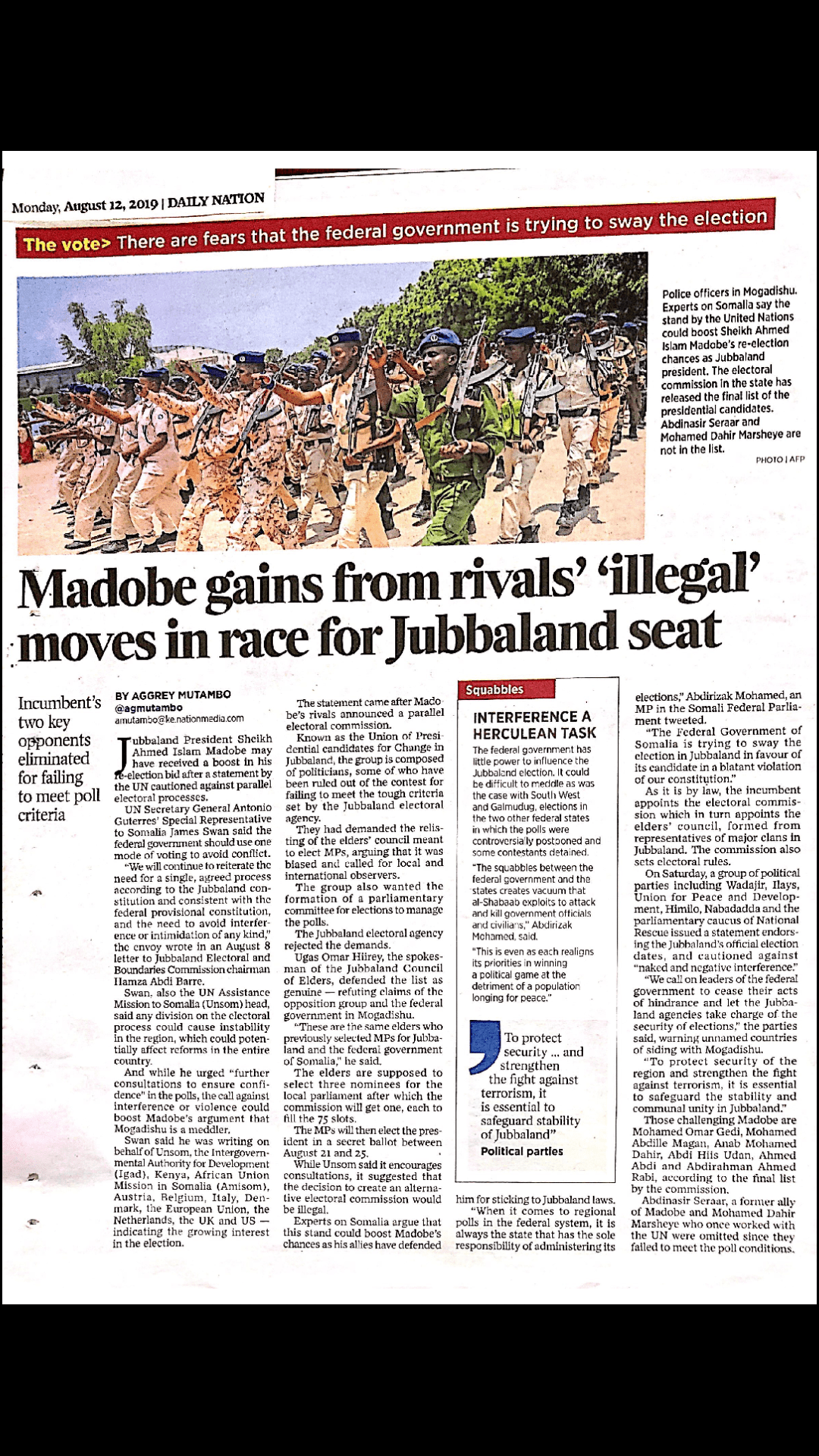
Jubaland State is at crossroads with potential election violence and internal destabilization with unpredictable consequences. The incumbent is set to secure 2nd term in office in this August poll by any means necessary, while the ill-advised leaders of FGS are focusing on removing the incumbent State President by all means, including outright violations of the the Federal Constitution, use of bribery and propping up alternative candidates. Swathes of Jubaland territory is still under the control of extremists with Ahmed Madoobe, AMISOM and FGS unwilling to venture out beyond Kismayo City. There is an undeclared regional power-play between Ethiopia and Kenya in Jubaland too. That is why Ethiopian and Kenyan forces there don’t want to push back Al-Shabab in the regions to justify their suspicious presence in Kismayo through AMISOM. AMISOM is now is part of security-military for profit enterprises that don’t want to rock the boat. For AMISOM soldiers , there is no incentive to return home. They are engaged in profitable risk management businesses. They are complecent and comfortable with the status quo.

Galmudugh

Galmudugh, the home-base of both FGS President Farmaajo and Prime Khayre, is in disarray and in a status of political limbo. It would take a long time before we see a modicum of a united operating administration. It was wrongly concocted myth of a regional state in the first place. The myth is now burst open for all to discover. The town of Ceelbuur in Galmudugh is Khayre’s Murursade clan base still under the full control of Al-Shabab. Dayniile quarter of Mogadishu, where Murursade/Hawiye clan of Prime Hassan Khayre predominantly lives, is also under the full grip of Al-Shabab. Thus, both Farmaajo and Khayre have neither the moral authority nor the political will to work towards the liberation of their own immediate clan territories and political power-base. For them, it is easier to try to boss around in other parts of Somalia, an irony and paradox in Somalia’s clan dominated politics.

Hirshabelle

Hirshabelle is another myth hardly recognizable and separatable from Banadir Region. It is an entity hardly existing now.

Southwest

Southwest acts and looks like a region coming under the direct rule of the so-called N&N Government with all the security entanglements of extremists and heavily infiltrated NASA, besides the hidden and indirect influence of Ethiopian boundary forces nearby.

Somaliland

Somalilanders have been suffering from misinformation and false indoctrination for three decades for an elusive independent statehood. The bitter reality is now sinking in for residents to think over alternatives for both personal life-planing and future of the people of Northwest Regions. In a delusional behaviour of ignoring realism, President Muse Bihi is hell-bent nowadays visiting as many countries as he could to relieve the pains of diminishing returns for an independent “Somaliland”. It is also an attempt on his part to devise new tricks to try to calm restive population caused by poverty, hopelessness and internal clan conflicts. Despite boasting multi-party democracy for nearly three decades, Somaliland Parliament had changed only once, with more than two-third of its members hailing from a single Isaaq clan, not to mention about the injustices relating to resources and power-sharing in Somaliland.

Conclusion

But, it isn’t all that negative. Somalia is still theoretically a sovereign country. The world community is engaged with Somalia. The fledgling public institutions are desperately trying to be relevant.

https://ismailwarsame.blog

@ismailwarsame

Support WDM with

Annual subscription

$37.00