On the Political Stagnation of Puntland

The latest political announcements (press statements) by Puntland political parties and their petition to Puntland State President, the Electoral Commission and to some members of the international community under the heading: Resolving Local Municipality Elections Stalemate, issued in Garowe, March 21, 25, 2013, indicate either the non-existence of mutual dialogue or break-down of political discourse within the State on the best way forward for holding local government elections. A number of political parties including UDAD, Midnimo, PDP and Wadajir seem to have forged an association to challenge the Government on its latest reform proposals and planned changes in Voter IDs registration. Among other things, these new political parties demand the immediate delay of Municipal Elections in Puntland until adequate preparations are done to insure fair public participation and a new independent Electoral commission installed.

As a neutral person on the current disagreements, “stalemate” as they put it, I think it is not appropriate for me to comment on these specific documents and respective political statements surrounding these issues, despite repeated requests by members of the Puntland public to do so.

Discussing democratization process in Puntland State, however, gives me a great deal of pleasure. But, it is long overdue. It is unfortunate that Puntland State has not come out of age yet and still in the woods. In other words, Puntland has been heavily suffering far too long from political stagnation since its foundation in August 1998. Democratization in the State has never been in the good books of its successive leaders as it was never contemplated as political imperative or priority for the continued survival and sustainability of the regional administration against all imaginable upheavals of Somali clan politics and rocky relationships with the rest of Somalia.
It is extremely important to note here that rushing things of such importance and magnitude is not wise for it creates more problems and serious fatal errors in hasty fashion to feel and look good in the eyes of foreign donor community. The fate of the State hangs on it and nobody has the right to gamble at the expense of nation’s existence, public safety and regional political stability. It requires tremendous efforts, resources, thorough preparatory work and ample time to build political consensus and legal framework for the final implementation of the electoral process in fair and transparent manners.
They said commonly, “A thousand-step journey starts with first one”. Leaders of Puntland State (authority and opposition) task and obligation to their people is to make sure that ‘One First Step” towards democratization must be moved straight forward towards the right direction. The alternative spells danger and political suicide for all concerned.

Somalia: A Government Failing at its own Peril

BY FAISAL A. ROBLE  03/23/2013 

Preface

Somalis could aptly capture the disappointment with Hassan Sheikh Mohamoud’s administration in the following proverb: “Dha’do roob noqonwaayday!” and a fittingly comparable Indian saying goes “Clouds come floating into my life, no longer to carry rain or usher storm….,”

One must wonder why conditions in Mogadishu and adjoining southwestern regions of Somalia are descending back to anarchy and to a renewed conflict.  One may also wonder why all the fanfare orchestrated in the month of February when Somalia’s new leader, Hassan Sheikh Mohamed, visited the US and Europe so quickly dissipated.  Yet, most Somalis suspect that policy makers in WashingtonD.C. and its proxy country in the Middle East – the kingdom of Qatar – were hasty to declare “mission accomplished” in the long conflict of Somalia.

If indeed true, that would have been good news to be welcomed by Somalis – a population so hungry for peace, development and security in their own backyard.  But it was not meant to be so.  As matter of fact, the month of February, 2013 could go into the annals of the history of this troubled country as the month when hope for lasting reconciliation and a new history making among the country’s disparate clans was thrown into oblivion.  As such, there is a credible fear the adage of “clouds floating into our life, but no longer carrying rain”could be the true fate of the nation in the lurking. 

The government of Hassan Sheikh Mohamoud, who has been eroding whatever little is left of Somalia’s cohesion and coexistence, is responsible for, in the words of Dr. Weinstein, the production of a “renewed conflict” between the center and the regions.

A novice in politics who enjoys deep roots in religious radicalism (Africa Confidential, October 2012), Hassan Sheikh took power in September of 2012.  At the outset, his lack of experience worked in his favor, because, as often noted by those who elected him in September of 2012, he was perceived as the lesser of two evils (between him and the former President Sheikh Sharif).  In a sense he is a man without history and without paper trail.

Alas, a Somali scholar who spent with Hassan Sheikh (almost three days of a grueling session in Djibouti in 2010) said this:  “for three hard working days of deliberations and discourse, Hassan said nothing.  All that was feasible in his face was that he came across as a man of tremendous anger and partisanship.”

Despite some cosmetic gains, most often orchestrated by donors who are anxious to hand over Somalia’s affairs and make her leaders responsible for their citizens’ protection and management, Hassan Sheikh’s policies so far bear truth to this cogent observation by one of Somalia’s prominent academics.

Let us skin off the layers of the ongoing dismantling of the tangible gains Hassan Sheikh Mohamoud’s predecessors so far made and the rapid dissention to the abyss of conflict.

Jubbaland:  The residents of Jubbaland had seen enough terror, occupation and wanton bloodshed in the hands of militia commanded by the late Aidid Farah, who is alleged to have introduced into Somali political culture what Dr. Lidwein calls “clan cleansing.”

They have also suffered multiple invasions by the allied forces of Jubbland valley (Dooxada Juba) encouraged and funded by the first transitional government, headed by Abdi Qasim (Qasim is now a close advisor to Hassan Sheikh).  The longest occupation of the region has been under the forces of Al-Shabab.

In 2008, a new chapter ushered in Jubbaland where a grass roots effort was launched to establish a local administration that would tackle invading outsiders and possibly put security matters in the hands of locals (this effort was based on an earlier effort carried out by the United Nations in 1993). The objective was to empower local folks not only to govern themselves, but to also protect and provide for their security.  This was advised by a theory that combines the tools of local governance and grass roots approach to neighborhood protection.

Instead of joining and promoting this noble effort, the government of Hassan Sheikh Mohamoud made its number one national policy to fight and dismantle the gains so far registered in this region.  By doing so, he deliberately violated key Sections of the provisional Federal Constitution of Somalia, including but not limited to Sections of Articles 48, 49, and 47. Worse, he used divisive languages and politics of wedge that eroded the prestige of his own office.

The very perception that the President of Somalia is painted with such an ugly picture as “tribalist,” or “vendetta carrying USC cadre,” makes him an irrelevant of a leader with no national appeal.  Unless he shows some significant and immediate mending of relations with all sections of the Somali communities, his administration is looking for a rocky future ahead.

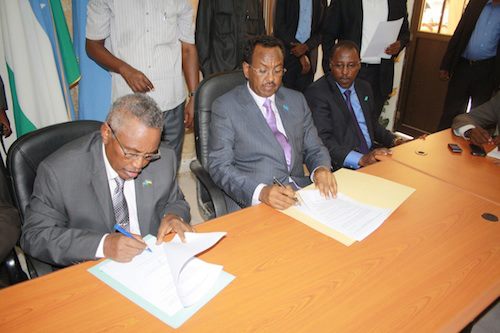
For a potential amelioration of the situation and perhaps the only way to save his presidency, a must–study lesson to him in this respect would be the recent agreement  reached between Puntland and his own Prime Minister, Saacid Farah, a more calm and conciliatory figure.

Somaliland:  Somaliland had declared a unilateral secession from the rest of Somalia in 1991 on the ashes of Somalia’s failed state.  It is recalled that Barre’s regime exacted an unforgettable massacre against the Issaq population in the region.

The hope for meaningful talks on the nagging question of Somaliland’s unilateral secession, and the resolution to the conflict in Khatumo, was dashed first by mismanaging the talks, and finally by the immature request by this government to lift the 20 year-old arms embargo.

A lasting reconciliation between Somaliland with Mogadishu requires trust-building and Mogadishu recognizing the limits to its power.  It would also require finding reputable ways to give Khatumo leaders a prominent role in the talks for they are major stakeholders in the outcome.

The search for more arms and weapons for Mogadishu-commanded militia army, the so-called “Somali National Army (SNA)” is in total contradiction to the spirit of fostering genuine and productive talks with Somaliland and the resolution to the question of secession.  The conflict in Somalia is not due to lack of arms, but more arms in the wrong hands in southern Somalia at a time of heightened insecurity and tangible suspicion of Mogadishu by the regions.

On March 17, 20013, only weeks after the UN’s lifting of arms embargo on Somalia, massive amounts of ammunitions, rifles (AK47s) and other weapons  were “stolen” from the presidential palace of Hassan Sheikh Mohamoud.  Whether or not the loss of such a huge amount of weapons was the design of an inside job is beside the point.  The lesson here is that Somalia is still awash with weapons, particularly Mogadishu, and most of it is in the wrong hands.

Moreover, Hassan Sheikh Mohamoud’s government does not have the right infrastructure and legal capacity to keep weapons from falling into the wrong hands.  Thus, peaceful communities in Somaliland, Puntland, and Jubbaland are not comfortable with weapons flying all over.

Return of Terror/Anarchy to Mogadishu: On March 19, 2013, the New York Times  carried a front-page story about Al-Ahabab resuming its aggressive acts of terrorizing the residents of Mogadishu. This is one of a series of troubling signs of the deterioration of Hassan Sheikh’s administration.  Despite his premature and uninitiated over-pledging pronouncement to the nation that his three top priorities are “security, security, security,” the nation is less secure now than six months.  Security is slipping out of hand; dead bodies continue to turn up in Mogadishu’s dark alleys as if we were experiencing a de javu of the days of extreme anarchy.

About ten days ago, the corpses of six civilians with their hand and legs cuffed together were dumped by government soldiers in to the city’s allies.  Rape cases are not abated, despite the international attention received by the rape of a Somali woman, only because of a human rights advocate from Europe who refused to let the issue get buried under the rhetoric of the President as a “friend of women.”

Moreover, Somalia’s equal opportunity critic and cartoonist, Amin Amir, had recently posted at aminarts, a serious of cartoons reflecting the Somali sentiment; the disposition of Mogadishu becoming a “one-clan city;” pressure for the immediate return of “stolen or looted properties” is building up; prisoners freed out of government jails in a freak way, and massive amounts of weapons stolen from the government’s depot located at the presidential campus.  If the worsening conditions are not arrested, the euphoric welcome extended to this President is soon to be replaced with despair and a potential demise to the modicum of gains so far registered.

Baydhabo region:  Who thought that millions of Somalis would worry at the very news of Ethiopia’s leaving Bydhabo region?  Local and international news media is awash with concrete information that as soon as Ethiopians pulled out of Xudur, a prominent town within the Bydhabo region, Al-Shabab easily overran the ragtag militia soldiers reporting to Mogadishu.

It is also reported that, if reinforcement is not given to the AMISOM troops stations in Baydhabo, Al-Shabab is poised to recapture the regional seat of the Digil Mirigle coalition.

Is the comeback of the Al-Shabab, therefore, simply a military question, or an indication that Hassan Sheikh Mohamoud’s government is losing the faith of the Somali people at-large?

There is some truth to the argument that his imprudent conflict with the leadership of IGAD, with his neighbors who through unfortunate circumstances hold sway on Somalia, particularly in the area of security, and with the officers of the United Nations Office for Somalia (UNOS) is partially a cause to the faltering security conditions in the southwestern regions of the country.

Unfortunately, the main reason why security is deteriorating in Mogadishu and in Southwestern regions is a function of bad internal politics.  Since assuming power, the government’s domain has been narrowing and it lost faith with Puntland, Somalialnd, Jubbaland, and to some extent the Digil Mirifle coalition.  The recent brouhaha over the rights of Galmudug to form its state, which could have been discussed in private chambers and the clashes in Marka, also further eroded this government’s grip on the nation’s affairs.

Whereas his government was supposed to reach out to all section of the Somali society, Hassan Sheikh arrogantly narrowed his power base to a coalition representing some members of his clan and that of his religious group, Dumjadid.

While writing this piece I reached out to my good friend, Said Samatar, a prominent historian and an authority on Somali political culture and asked him what good could Hassan Sheikh have done at the outset to get this time right?

This is what he said:

Hassan Mohamed should have put on his Maawis (Somali garb), wrap his Shaaland, and carry his Bakoorad (cane); with that take a tour consisting of a coalition of Hawiye elders to Puntland, Jubbaland, Bay, Bakol, and Somaliland; meet and great those elders, give a peace and justice overtures; let the Hawiye elders convey the message that their son is ready to respect Somali Xeer and mutual respect to each other.

In one of his speeches to the Somali Diasporas  Hassan Mohamoud prematurely and triumphantly announced that the role of the elders is finished.  Considering how deeply he sinking in so many fronts, particularly with security slipping out of his hands, one is tempted to give a try to Said Samatar’s traditionalist approach to interject a dose of optimism and hope to the faltering search for peace in Somalia.  After all, the government and the land belong to the people of Somalia and it is their responsibility to fix it.

Source: Wardheernews.com

More Trade News in Brief – Week 12 (18 – 24 March 2013)

Bogdan Marius Beleuz's avatarTrade News in Brief

 
* ISO Guidelines for Armed Maritime Guards
 
14 March 2013
 
ISO has developed a guideline for armed maritime guards and to defend the ship navigation from piracy attacks.
 
ISO/PAS 28007:2012, Ships and marine technology – Guidelines for Private Maritime Security Companies (PMSC) providing privately contracted armed security personnel (PCASP) on board ships (and pro forma contract).
 
Check here.
 
——————————————————————————————————————————————–—
 
* OECD – Guidelines on Measuring Subjective Well-being
 
 OECD releases Guidelines on Measuring Subjective Well-being to provide advice on the collection and use of measures of subjective well-being.
 
The Guidelines is developed under the OECD’s Better Life Initiative.
 
Please follow the link.
 
——————————————————————————————————————————————–—
 
* Cayman & Brazil Sign TIEA
 
Cayman Islands sign a landmark tax information exchange agreement (TIEA) with Brazil.
 
Check here for more.
 
——————————————————————————————————————————————–—
 
* Spain & Argentina Sign Fresh…

View original post 25 more words

Why Obama’s Israeli Trip is One Big Mistake

NETANYAHU INSULTS THE PRESIDENT, BACKED ROMNEY, AND HASN’T MOVED THE PEACE PROCESS. NO WHITE HOUSE SHOULD REWARD BEHAVIOR LIKE THAT, NOT EVEN FROM AN ALLY.

By Janine Zacharia, Tuesday, March 19, 2013
Iran is accelerating its nuclear program. Syria’s gruesome civil war is beginning to bleed across its borders. Two years after Hosni Mubarak’s ouster, Egypt’s political transition is, at best, dicey. And yet according to deputy national security adviser Ben Rhodes, “more important” than all of that “in some respects” is that President Obama take this opportunity to “speak directly to the Israeli people.’’
I get the logic of whoever dreamed up the president’s trip to Israel this week: Send Obama to reassure the Israelis he’s got their back on Iran. Demonstrate he doesn’t prefer the Arabs—an impression left in his first term when he visited Cairo but didn’t stop by Tel Aviv. Pay his respects at the graves of Israel’s fallen and acknowledge the historical artifacts that show Jews’ ties to the land. Let them know he really admires their technological prowess. Then maybe Israelis will feel more inclined to make peace with the Palestinians knowing the relationship with their most important ally is solid.
But this trip—the timing and the script—makes no sense. And even more than simply being a big waste of Obama’s time at a moment when he has little time to waste, it’s burning crucial American political capital that ought to be reserved for moments that truly warrant it.
The White House says the president is going to hear out what the newly appointed Israeli government has planned. Here’s a quick preview:Defense Minister Moshe Ya’alon wants to bomb Iran and Housing Minister Uri Ariel wants to build new settlements. If Obama wants to talk about drafting ultra-Orthodox Jews into the Israel Defense Forces or the price of apartments in Tel Aviv, he’ll find an audience. Those relatively marginal issues are what dominated Israel’s recent election, not the future with the Palestinians.
Three years ago, Vice President Joe Biden went to Israel tasked with a similar mission—reassure Israelis that Obama loves them. Biden hit all the right notes, saying that the bond between Israel and the United States was “unshakeable” and “unbreakable” so many times that we reporters who covered that trip started keeping a running tally. Then as the vice-presidential motorcade was leaving the Yad Vashem Holocaust museum, news that Israel’s Interior Ministry had authorized 1,600 housing units in East Jerusalem destroyed what should have been a pure celebration of American-Israeli ties. Biden returned to his hotel to consult with the White House on what to say, leaving Netanyahu waiting awkwardly at his residence for an hour and a half for dinner. When Biden arrived, he issued an unprecedented rebuke that embarrassed the Israeli prime minister as they sat down to eat.
American-Israeli ties remained sour. Two months after Biden’s visit, Obama refused to hold a photo op with Netanyahu when he visited the White House. The next year, when the president agreed to share the stage with Israel’s prime minister, Netanyahu lectured him before the cameras in the Oval Office on why Obama’s (hardly original) idea that the 1967 borders could be a baseline for peace negotiations with the Palestinians was bunk. In 2012, Netanyahu—frustrated that he couldn’t goad Obama into saying when the U.S.would bomb Iran—publicly suggested the president had no “moral right” to stop Israelfrom taking action itself. All the while, Netanyahu, over the past few years, did nothing to further peace with the Palestinians. He floated via surrogates that he thought Obama was naïve on the Middle East. And he left the strong impression last year that he was rooting for Mitt Romney to win the U.S. presidential election.
n spite of all this, the president is headed to Tel Aviv. The anti-Obama peace-process skeptics can’t help but gloat. As Barry Rubin, a conservative, pro-Israel American pundit put it on his Facebook page: “I think we have just won a huge victory … Obama has admitted defeat on trying to bully, manipulate, or pressure Israel.”
The White House doesn’t want this trip to be about Netanyahu or his new government. That’s why Obama will address Israeli college students in a convention hall rather than speak to politicians in the Knesset. But when it comes to how this trip will be perceived inIsrael, it will be all about Netanyahu and his political fortunes. Netanyahu will be seen as the victor in his battle with Obama, rewarded not only for defying—or standing strongly against, depending on one’s political perspective—an American president. And Netanyahu will learn one powerful lesson from Obama’s visit: I don’t have to do anything on the Palestinian issue. I can continue to expand settlements, focus solely on Iran, and insult the U.S. president, and he will still come and thank me with a two-day dog-and-pony show.
It’s clear why the White House wants to avoid the thorny Israeli-Palestinian disputes ofJerusalem, settlements, and refugees. Past presidents have expended enormous time and energy on the matter and failed miserably. The last time Obama tried to articulate some guiding principles on borders, he got shouted down by Bibi. The United States “will always continue to be engaged in this process in terms of trying to move it forward,’’ Rhodes told reporters in a pretrip briefing that illustrated just how radically Obama has scaled back his ambitions since September 2010, when he said he thought peace could be achieved within a year.
So why is Obama going? Is it really an attempt at “repairing relations with America’s primary Middle East ally” as the Washington Post’s Scott Wilson wroteOr as Jeffrey Goldberg wrote in a column for Bloomberg, to reintroduce himself to Israelis and convey to them that he understands their situation? Perhaps. But if it is, then this is truly a waste of time. Just as Defense Secretary Chuck Hagel—whose nomination was held up by those who worried he wasn’t pro-Israel enough—wasn’t running for Israeli defense minister, Obama isn’t running for Israeli office (or any office for that matter). And anyone who knows Israelis and their current mindset on the Palestinians (Palestinians, who?) knows that a little ego stroking isn’t going to get that population behind a peace deal.
That doesn’t mean the trip couldn’t do some good. While the president is there ostensibly repairing the relationship with Israelis who’ve felt jilted, Obama may be sending an important signal to Tehran. The message: Just because I can’t stand Bibi doesn’t mean I won’t stand with him in preventing you from getting a nuclear weapon.
Since Obama is making the 12-hour flight, there’s one important thing he can accomplish if he wants to achieve something beyond simply making Israelis feel good. When he delivers his speech in Jerusalem on Thursday, he can remind Israelis that if they want their nation to be a nation like all others—one with internationally accepted borders, no longer targeted by divestment campaigns, and not facing a possible third Intifada—they need to stop saying they have no partner and make peace with Palestinian President Mahmoud Abbas before it is too late. And if they can do that, he looks forward to coming back a second time as president—when they have a peace deal to sign.


How to Create a Regional State in Somalia’s Context

There are a few simple steps along the way to establish a regional state in Somali context. These are critical steps to follow for a successful conclusion of the creation of a federal state:

1. Respectful of the Federal Constitution, two or more regions must have common political, security and economic interests and must have potential to operate as a cohesive political block as well as a viable and sustainable economic unit.

2. Regions must have overwhelming grass-root support for the idea of creating their own state. These include all levels of their masses, and traditional elders at forefront.

3. A fully representative people’s congress must be held initially as Consultative Conference to resolve and agree upon:

a) Endorsement of the very idea and need for the creation of the state

b) Selection of Constitutional Committee for drafting the state’s constitution

c) Selection of Preparatory Committee for the final Constitutional Congress

d) Selection of Chairing Committee of the Constitutional Congress

e) Selection of Fund-raising and Finance Committee

f) Selection of Security Committee

g) Selection of logistics and Accommodation Committee

h) Selection of the venue of the Constitutional Congress

i) Allocation of delegates to each participating region to the Constitutional Congress for the subsequent division among clans in each region along the traditional sub-clan proportionality.

j) Creation of an atmosphere of voluntarism and regional political activism to spark off enthusiasm for urgent people’s action and personal contributions.

k) Avoidance of confrontation with central authorities in the attempt to create the state.

4. Convention of Constitutional Congress to pass the draft Constitution.

5. Setting up an independent electoral or supervisory Committee with the formulation of criteria for their mandate.

6. Election of the Chief Executive Officers (e.g. President, Vice President) if they are to be elected by the Congress.
7. Selection of members of the Legislative Council (local parliament) by the participating regions either directly by the residents or in an indirect democratic fashion by their constituencies through traditional customs to be double-checked by the Electoral Committee; Election of the Speaker and his Assistants, and immediately the Chief Executive Officers by the newly constituted Assembly if they are to be elected that way.

8. Start of regional power-sharing negotiations to form the Cabinet.

Critical mistakes to avoid:

1. When forming a regional state, never start from power-sharing approach. This is a non-starter and a recipe for failure.
2. Avoid prematurely announcing candidates for leadership and never allow anyone to put their candidacy forward until the final execution of points 1-5 above. This is the main source of division within the participants and sure factor to fail the whole idea of successfully concluding the efforts.

3. Denounce anyone seeking special clan, regional privileges or status.

3. Suppress any hints of intimidation against Congress participants. Free will of people and expression must reign supreme. Everyone must feel comfortable and feel secure and safe in the Congressional environment. Everyone must feel ownership of the state to be created.

All successful Somali regional conferences including those of Puntland, Somaliland and TFG conform to the above simple steps. All those that failed violated them by starting first with power-sharing and leadership competitions.

-End-

‎”An examined life is not worth living” said Greek philosopher, Socrates.

A strong nation must be built on positive arguments and never ceasing constructive debates. If you follow the story of the Government of the United States, a successful union in the history of human race, it is built entirely on democratic discourse. I strongly believe that a nation built on arguments will never fall and will beat all other nations. It is not “gossiping” as President Hassan Sh Mohamud put it recently. It is a part and parcel of democracy and it is quite healthy. Current Somali debates are still mixture of all sorts. Public consensus will eventually develop as the nation recovers and matures. I am very pleased with the lively debates underway within Somali communities world-wide. Excellent job, citizens!

The world needs to adjust to new realities and reform in Somalia, says PM

Prime Minister Shirdon with Puntland President Faroole (Photo: Courtsey of Garoweonline)

His Excellency Prime Minister Abdi Farah Shirdon today urges the international community to take note of the changed situation in Somalia and adjust their policies accordingly. In a hard-hitting editorial in The National, the leading English language newspaper of the Middle East, the Prime Minister calls on Somalia’s international partners to modify their policies to fit the new circumstances of “a fledgling democracy taking the first steps of reconstruction and development”:

“For years our international relations have been conducted on a one-way basis, invariably on a humanitarian level. That model is now an anachronism and must change. We are a sovereign government… and the outside world needs to start treating us like one. It is no good criticising our lack of government capacity and then funding NGOs to execute projects while sidelining government institutions altogether. This merely perpetuates a cycle of dependence, denies us the learning experience and ensures government capacity remains limited.”

In a wide-ranging editorial entitled “Somalia replaces extremism with a programme of reform”, the Prime Minister emphasises the recent security gains that have brought Al Shabaab to its knees. “To be discussing policing, tax collection and judicial reform in Galgadud, a region that only recently was a no-go area ravaged by extremists, gives you an indication of how far we have come,” he writes, commenting on last week’s Listening Tour to the regions, in which the PM also signed a landmark deal with Ahlu Sunna Waljamaa and facilitated the establishment of local administrations.

“Only recently we could barely move safely inside our own capital.” The Prime Minister also highlights the vigorous legislative activity within the government and parliament. “Laws are the foundation of a functioning state,” he writes, noting the forthcoming parliamentary votes on legislation governing human rights reform, judicial reform, and district and regional authorities reform.

“We will also be passing legislation restructuring the police and security forces, creating specialist anti-terrorism, anti-piracy and anti-trafficking institutions, governing the Central Bank, assisting refugees and providing legal aid.”

Perhaps nowhere is reform so critical as in policing and the judiciary. “Judicial reform is one of our greatest priorities,” the Prime Minister writes. “Nothing underlines the need to reform our police and judiciary more than the decision to send a rape victim and the journalist who interviewed her to prison. Yet that regrettable verdict was a symptom, not the cause, of the problem, a lack of the rule of law.”

The Prime Minister concludes with a call for strengthened partnerships adapted to the new realities. “The need for partnerships with our international friends, which the world will see at the London Somalia Conference in May, has never been greater. We know that we cannot do it alone, but there is no turning back.”

source: AMISOM MEDIA MONITORINGPrime Minister’s Media Office

An Open Letter to President Hassan Sh. Mohamoud, a Re-joiner.

Said Faadi’s recent open letter to Somalia’s incumbent President, H.E. Hassan Sh Mohamud, in WardheerNews was quite articulate, relatively fair and consistent with current political developments in Somalia and its nascent, renewed foreign relations. I, however, take some critical exceptions to the credit Mr. Faadi has accorded to the President regarding the latter’s recent foreign trips and high profile symbolic receptions he received in Washington, Brussels and London. One would also argue that a dignitary, who could not pull himself, organize and adhere to the basics of protocol requirements in his meetings with his foreign counterparts, and thus suddenly finding himself alone knocking the doors of 10 Dawning Street, has the diplomatic skills, leadership, efficient political machinery and think-tank in place to claim this credit within a few months after his election.

Am I being mean to the President? Not at all. Am I happy and pleased with the President’s successful foreign missions? Absolutely, yes! Then, one would ask logically, what was my problem for not giving the President the credit he might have deserved in securing meetings with President Barack Obama and Prime Minister David Cameron.

Well, here is my problem. Leaders of Western countries judge leaders of developing countries in black and white approach: Either they have created and own these leaders or they don’t regardless of the leadership qualities and vital national interests of developing countries (a euphemism for third grade and poor nations). To demonstrate this point in Somalia’s context, a few years ago I was Nairobi, Kenya, as the New Somali National Authorizing Officer (NAO) Designate with the European Union. At the time, the Transitional Federal Government of Somalia (TFG) was trying to re-claim that position as a member of ACP (African-Caribbean-Pacific) countries through the Lome, Cotonou treaties with the EU. The NAO position was taken over by the European Commission as the Somalia’s Central Government collapsed in 1991. But, in the absence of a government in Somalia, there was no European Commission Delegation to Somalia. Strangely enough, the EU had created a “Somali Operating Unit” within the European Commission Delegation to Kenya, and acting arrogantly and disrespectfully of Somalis as the Official National Authorizing Officer for Somalia, representing the interests of the country within the world community, while at same time solely managing or mismanaging hundreds of millions of US dollars contributed and collected in the name of Somalia for relief and humanitarian assistance. Nairobi European Resident Officers working for the infamous “Somali Operating Unit” seemed to be trained in hatred and demeaning attitude towards the Somali person and especially, to any Somalia’s authorities, always bent to undermine Somalia’s credibility and abilities to function as sovereign.

While still in Nairobi, trying desperately to re-establish the Office of the National Authorizing Officer for Somalia to reconnect the TFG with the ACP establishment and world community, in general, I received a phone call from the Head of the “Operating Unit” during that period of time, informing me of planned visit to Nairobi by the European Commissioner for Development and humanitarian Assistance, Luis Michelle, to discuss on Somalia’s issues. The Unit Officer told me in that phone conversation that the Commissioner would not would like to meet with the Somalia’s TFG Prime Minister, Ali Mohamed Ghedi. I thought this was not only disrespectful, but also absurd and irrational. Prime Minister Ghedi, who was in town at the time, did meet with the Commissioner against the best wishes of that Officer.

To further demonstrate Western leaders hypocrisy in their dealings with and standards for poor and weak nations, when the Former President of the Transitional Federal Government, Abdullahi Yusuf Ahmed, was making his first trip to New York a few months after the establishment of the TFG 2004, to attend the UN Annual General Assembly Meeting, the same United States Government of the day issued him a restricted diplomatic visa that he wouldn’t be allowed to travel beyond the perimeters of the City of New York. This was the Leader, who is genuinely the father of the 2nd   Republic of Somalia; a man who laid the solid foundations for Somalia’s recovery, operating from his offices in villa Somalia, Mogadishu, after a long vacancy, and made possible for Mr. Hassan Sheikh Mohamud to get elected President of the Somalia. The AMISOM, the National Security and Stabilization Plan and IGAD commitments to get involved in Somalia’s recovery are the selfless efforts, achievements and the historic works of the man. Would Somalis recognize and remember him? A government with zero revenue couldn’t function indefinitely. Western leaders through their surrogate organizations in Nairobi sabotaged the TFG, and finally when they feared that the Somali militants were fast becoming a threat to their own national security interests, they had to pick up the pieces again. However, they needed a new face since they messed up and lost credibility with Yusuf’s Government. They found that in former President Sheikh Sharif for only temporary use.

The question is: Why was TFG President Yusuf treated that way by Western leaders, Ethiopia? It is simple and pure; he was a nationalist and his own man. He was willing to pay any price in the best interests of his own country.

Finally, Prime Minister Shirdoon’s most recent statement in the media outlets on the formation of Jubaland Administration sounds like the proverbial boy whose mother was praying for God’s help to enable him speak , and when the son spoke up finally with obscene words addressed to his own parent, prayed again for his silence for good.

Is Carmo (Armo) National Somalia Police Academy being neglected by the Somali Federal Government?

The Armo (Carmo) National Police Academy is a Somali Federal institution invested heavily by Somalia with the help of international organizations for the purpose of training police officers at national level. A good number of police officers have graduating the school over the years. Former cadets of the academy are already active police officers in Mogadishu and Puntland State of Somalia.

The current Somali Federal Government looks neglecting that important institution despite its declared policy statements on national security as priority number one. If this were not intended as double talk, Carmo Police Academy should be fully utilyzed as important infrastructure in the country. They should not be sending cadets all the way to Uganda when they can do the same here at home.