Somalia: The Damage Is Already Done

©️ 2025 WDM Copyright

The Somali Republic, once proudly stitched together by camel milk and poetry, has now been digitally dismembered by TikTok dances and clan hashtags. Social media didn’t just kill the family; it embalmed it with filters and buried it under viral skits where the new Somali proverb is: “If it’s not livestreamed, it didn’t happen.”

Forget reconciliation—Somalis now specialize in mutual annihilation as a national sport, each clan sharpening its hashtags like spears. Politics has degenerated into a blood feud fought on Facebook comment sections, where warriors armed with broken English and ALL CAPS do more damage than Kalashnikovs ever did.

Extremists? Oh, they’re thriving. Why not, when the government outsourced the war against them to wishful thinking and empty donor conferences in Nairobi hotels? Meanwhile, the only serious battles Somalis fight are over diaspora remittances and who gets to dominate TikTok’s daily clan-bashing session.

Strategic resources? Foreign vultures are already circling the Somali coast, sniffing the oil, the fish, and the geopolitics, while locals are too busy trending: “#MyTribeIsBetter.” The country is being carved up like a sacrificial goat, only this time the guests are outsiders, and Somalis are the ones serving the meat with a smile.

And yet, while all this unfolds, Somalis themselves are like partygoers in a burning house—arguing over who owns the living room while the roof caves in.

The truth is harsh: Somalia is not just being destroyed from outside—it is being hollowed from within. Not by bombs, but by memes. Not by colonizers, but by self-inflicted division. Not by dictators, but by an army of dancing robots who forgot that survival requires more than Wi-Fi.

Welcome to Somalia 2.0: irreconcilable, incoherent, and irretrievably entertained.

Review of Somaliland Status Policy on “Review by Ambassador (ret.) Larry André”

Ambassador Larry André’s piece is a thoughtful, sober, and experience-driven analysis of one of the Horn of Africa’s most contentious political issues: the status of Somaliland. Drawing on decades of diplomatic engagement in Somalia, Djibouti, and the wider region, André calls for a measured and fact-based U.S. policy review at a time when advocacy for Somaliland recognition is growing louder in Washington.

Here is the link to the piece:

https://open.substack.com/pub/larryandre61/p/somaliland-status-policy-review?utm_campaign=post&utm_medium=web

Strengths of the Article

1. Pragmatism Over Idealism
André avoids simplistic solutions. He carefully outlines three U.S. policy options—status quo, liaison office in Hargeisa, or full recognition of Somaliland—and persuasively argues for the middle ground of opening a U.S. office in Hargeisa under Mogadishu’s embassy framework. This cautious approach reflects both regional realities and U.S. strategic interests.

2. Deep Regional Context
Unlike many Western commentaries on Somaliland, André situates the issue within the complex clan dynamics of the Somali people, emphasizing that clan loyalties often outweigh national ones. His acknowledgment that the Isaaq overwhelmingly drive Somaliland independence while other clans (Dir, Darod) remain ambivalent is particularly important—and often overlooked.

3. Balanced Consideration of Facts
The article highlights uncomfortable truths on both sides. For example, André notes Somaliland’s stronger governance and stability compared to southern Somalia, but also its intolerance of pro-unionist voices, illustrated by President Bihi’s blunt admission about jailing “traitors.” Similarly, he dismisses unproven allegations about Somaliland collusion with al-Shabaab, while recognizing that Somaliland’s security partly benefits from international efforts in southern Somalia.

4. Comparative Insights
The discussion of federalism models (Canada–Quebec, UK–Scotland, Tanzania–Zanzibar) adds intellectual weight, suggesting creative constitutional arrangements as alternatives to either secession or forced unity.

Weaknesses of the Article

1. Limited Somali Voices
While André emphasizes consultation, the essay still largely reflects a diplomat’s top-down perspective. More engagement with grassroots Somali perspectives beyond political elites and business leader would have enriched the analysis.

2. Underplaying External Geopolitics
Although he briefly mentions Turkey, the UAE, and rival powers, the piece could have more fully assessed how great-power competition (China, Gulf states, Western powers) intersects with Somaliland’s recognition question, especially regarding Berbera port and Red Sea security.

3. Ambiguity on U.S. Interests
André stresses “do no harm” and regional stability, but is less clear on what concrete U.S. interests—counterterrorism, maritime security, great-power competition—would ultimately drive Washington’s decision.

Overall Assessment

This is an enlightening, cautious, and authoritative contribution to the Somaliland debate. Its greatest strength lies in tempering passionate advocacy with historical perspective, lived diplomatic experience, and a clear warning against reckless unilateralism. By urging a process rooted in consultation, facts, and creative federalist thinking, André positions himself as a voice of prudence in a debate often dominated by emotion and lobby-driven arguments.

The article does not settle the Somaliland question—but it is not meant to. Instead, it provides a framework for responsible deliberation, reminding U.S. policymakers that decisions made in Washington can carry unintended, and possibly explosive, consequences in Hargeisa, Mogadishu, and beyond.

Verdict: A must-read for anyone serious about Somali politics, U.S. Africa policy, or the geopolitics of the Horn.

What Is “Weaponized Interdependence”?

Coined by political scientists Henry Farrell and Abraham L. Newman, the term refers to the strategic leveraging of global economic networks—like finance, supply chains, and communication systems—to exert coercive pressure on other states. This isn’t traditional military force, but control via chokepoints or surveillance-like power in the global economic architecture .

Chokepoint effect — Dominant players can restrict or penalize access to critical network hubs.

Panopticon effect — They can monitor and observe others’ activities through embedded informational structures .

U.S. Economic Power as a Weapon

Financial Coercion

The United States has weaponized its dominance in global finance—primarily through:

The U.S. dollar’s centrality in foreign exchange and global reserves.

Influence over SWIFT and financial messaging systems.

Its role in global debt issuance .

These tools enable economically punitive measures—like sanctions—without firing a weapon .

Trade and Manufacturing Limitations

However, the U.S.’s coercive capacity in trade is more limited:

China dominates manufacturing and critical materials, granting it leverage in areas like rare earths, lithium, cobalt, and semiconductors .

U.S. export restrictions—e.g., on chipmaking technologies—have prompted retaliatory supply controls from China, highlighting mutual vulnerabilities .

China’s Strategic Countermeasures

Unlike the U.S., whose sanctions tend to have legal justification, China employs more opaque, politically motivated coercion. This includes:

Trade restrictions or boycotts following political slights—e.g., countries meeting with the Dalai Lama.

Private sector compliance or self-censorship (companies removing content or apologizing to avoid Chinese backlash).

Tourism bans, restrictive trade practices, and market access limits .

This strategy shapes behavior by creating a mental environment of deference—discouraging criticism of China due to fear of economic repercussions .

Global Impacts and Responses

Risk of Fragmentation

Continuous economic coercion risks destabilizing the global economic order.

Sanctions can backfire: countries may seek alternatives, fragmenting global systems.

Scholars note resemblances to the interwar era—sanctions undermining cooperation and security .

Regulatory vs. Abolitionist Approaches

Regulatory Mode: Proposes legal/ethical frameworks to minimize humanitarian harm from economic coercion (akin to laws of armed conflict).

Abolitionist Mode: Rejects economic coercion outright, especially unilateral measures that undermine sovereignty .

Multilateral and Collective Resilience

Solid strategies to resist coercion include:

Diversifying trade partners and supply chains.

Strengthening legal/regulatory frameworks (e.g., the EU’s ACI).

Coordinated responses through institutions like the G7, WTO, OECD, or ad-hoc coalitions .

Key Takeaways

1. Global economic networks now serve as instruments of power, beyond just trade and finance—encompassing communication technology, supply chains, and messaging systems.

2. Both the U.S. and China weaponize interdependence—but in different ways:

The U.S. uses transparent, legally justified leverage via finance and sanctions.

China uses less transparent coercion tied to political objectives and market control.

3. Overusing coercive economic tools risks fragmenting globalization, reducing system resilience and multiplied vulnerability.

4. The path forward should blend regulation and cooperation, leveraging alliances, legal safeguards, trade diversification, and institutional reform to restore stability and limit coercion’s destructive capacity.

Trump’s Cheap Bargain at the White House

By WDM Political Desk

Donald Trump, once again, summoned European leaders to the White House as if he were a circus master calling his performers to line up for the evening show. This time the star attraction was President Volodymyr Zelensky of Ukraine, reluctantly standing beside Trump in what looked like a family portrait of a very dysfunctional household.

Trump, notorious for turning high-stakes geopolitics into cheap reality TV, avoided repeating last February’s debacle with Zelensky—not out of wisdom, but out of sheer self-interest. Two reasons drove him this time:

First, Trump needed to show Vladimir Putin that he has “control” over Zelensky. To Trump, Ukraine is not a sovereign nation, not a battlefield of survival, not a bleeding edge of European security—it is just a bargaining chip, a poker card to trade away slices of Ukrainian territory in exchange for Russian favors. He dreams of calling Putin on live television and boasting: “Look Vlad, I made your boy sit down quietly. Where’s my deal?”

Second, Trump’s everlasting obsession: the Nobel Peace Prize. Obama got one for breathing air in the Oval Office, and that burns Trump’s ego daily like acid. He wants the same, even if it means auctioning Ukraine’s sovereignty on the Nobel Committee’s altar. “Nobel Prize! Nobel Prize!” is Trump’s mantra—he craves it like a toddler screaming for candy in a supermarket.

But Europe is not fooled. Macron, Scholz, Rutte, Meloni, and the rest flew in not to humor Trump but to chain themselves around Zelensky. They know the game: if Ukraine falls, Russia won’t stop at Kyiv—it will march to Warsaw, Berlin, Paris, and maybe even Brussels. Trump may play diplomat, but Europeans know he is dangling Ukraine as bait while sharpening the knife under the table.

The tragicomic scene at the White House was clear:

Trump puffing his chest, grinning like a salesman desperate to close a deal.

Zelensky, trapped in a photo-op he didn’t want, surrounded by allies who looked more like bodyguards shielding him from Trump than partners in peace.

European leaders, smiling stiffly for cameras while whispering in each other’s ears: “God save us if this maniac sells Ukraine to Moscow.”

History will remember this summit not as diplomacy but as a pawn shop negotiation where Trump tried to trade Ukrainian land for personal glory. Europe left Washington more worried than when they arrived—because the real threat is not only Russia’s tanks, but also Trump’s hunger for applause, prizes, and Putin’s approval.

Trump wants to be crowned peacemaker. Instead, he looks like a desperate broker selling Europe’s security for a Nobel medal.

CODENAMES FOR CLAN CLEANSING AND GROSS HUMAN RIGHTS VIOLATIONS IN SOMALIA

September 8, 2014

By Ismail H. Warsame

(c) WDM copyright 2025

It was in April 2000, on the eve of the Arta Conference (May 2, 2000), when I transited through Egal International Airport in Hargeisa on my way to Bosaso, Puntland. I had flown in from London via Djibouti to visit my family. At the time, I was serving as Chief of Staff in the Puntland Presidency. Relations between Somaliland and Puntland were tense, and I was not at ease in the airport’s transit hall.

After two uneasy hours of waiting, I was relieved when boarding was announced for the small propeller plane to Bosaso. When I chose to pass through Hargeisa, I assumed—correctly, I thought—that no one would recognize me there. And even if they did, I trusted in the historical camaraderie once shared between the Somali Salvation Democratic Front (SSDF) and the Somali National Movement (SNM) against Siyad Barre’s dictatorship. In the back of my mind, I also hoped my maternal lineage—my grandmother, Ayeeyo Dhoofa, hailed from a dominant Isaaq clan—might shield me from any misfortune while transiting through Somaliland.

While waiting for my flight, I exchanged US dollars for Somaliland shillings. The sight of cash in my hands drew a stream of airport staff, each asking for shaxaad (handouts). When I offered them Somaliland shillings, they scoffed: “This is not real money. We want dollars. War ninyahow, dhabcaalsanidaa ma Majeertayn baa tahay?” (“Are you Majeertayn—how can you be so mean?”).

Onboard, I was seated next to a jovial businessman from Hargeisa, bound for Dubai via Bosaso. I will call him Dahir (not his real name). After casual introductions—where I kept my official position discreet—he suddenly asked me: “War nimankii Dhulbahante iiga warran?” (“Tell me about the Dhulbahante in Puntland.”).

Puzzled, I asked him to clarify. He explained that many Dhulbahante had left Somaliland because they were constantly stigmatized as Faqash. In gatherings, someone might casually mutter “War Faqash baa joogta” (“The Faqash are here”), forcing others to apologize profusely: “We didn’t mean you, cousin!” But the damage was done—the Dhulbahante felt alienated and unsafe.

Looking back, I doubt Dahir grasped the deeper reason why Dhulbahante and Warsangeli chose to co-found Puntland. It was not merely about insults; it was about survival in the absence of a functioning central government, and in the face of atrocities committed by both USC and SNM—atrocities denied to this day by their leaders. Denial of clan cleansing remains the greatest obstacle to reconciliation and rebuilding trust among Somali clans.

The Meaning of “Faqash”

Faqash became one of the most notorious codenames for human rights abuses in Somaliland’s northwest regions after the collapse of the Somali central state. Originally, northerners used it to describe conscripted soldiers from Somalia’s inter-river farming communities, imitating the sound of their marching boots. Under SNM, the word morphed into a weaponized label for Darood clan cleansing.

Prof. Lidwien Kapteijns, in her authoritative book Clan Cleansing in Somalia: The Ruinous Years of 1991–1992, details the codenames used during the civil war to legitimize mass violence: Looma-ooyaan (“No one sheds tears for them”), Lahaystayaal (“hostages”), Kacaan-diid (“anti-revolutionary”), Haraadi (“remnants of the old government”), among others. Each term stripped individuals of protection, marking them as fair game for abuse, dispossession, rape, and murder.

Targeting the Majeerteen

In Siyad Barre’s regime, labels like Kacaan-diid, Dib-u-socod, Daba-dhilif, and Haraadi were used primarily against the Majeerteen sub-clan of Darood. This was no accident—it was a deliberate political project. Barre recognized that the Majeerteen had the numbers, resources, history of self-governance, and leadership potential to challenge his absolute rule. From the first day of his coup, he sought to marginalize them, purge them from government, and turn the rest of Somalia’s clan system against them.

Once branded, a Majeerteen lost all rights of citizenship and became vulnerable to dispossession, abuse, or even the theft of his wife. Disturbingly, even Somalia’s educated class embraced Barre’s propaganda. To this day, any Majeerteen political ambition must confront that toxic legacy.

The “Mujaahidiin” That Became Mooryaan

Both SNM and USC called their militias Mujaahidiin (“holy fighters”). But when Siyad Barre fell on January 26, 1991, law and order collapsed. These “fighters” degenerated into Mooryaan—bandits who looted, raped, and massacred, particularly in Mogadishu, Gaalkacyo, Kismayo, Brava, and Baydhabo.

In their twisted hierarchy, rank was measured not by military discipline but by body count: tobanle (ten kills), kontonle (fifty kills), boqolle (a hundred kills). Many still roam Mogadishu, traumatized, unrehabilitated, and unfit for soldiering—yet celebrated by some as “pioneers of victory over Darood.”

Other Codenames of Horror

Looma-ooyaan: The unprotected, the abandoned—usually non-Hawiye individuals left in Mogadishu. If killed, no one would mourn them. This chilling mindset explains the fate of figures like singer Saado Ali Warsame and General Xayd.

Lahaystayaal: Minorities like the Reer Hamar and Bravanese, reduced to hostages, extorted for ransom, their women taken.

Dib-u-socod, Daba-dhilif, Haraadi: Political labels of dehumanization used to erase citizenship rights.

Prof. Kapteijns’ work remains the most meticulous study of this era, but even it cannot capture the full vocabulary of cruelty Somalis invented to justify barbarism.

The Unfinished Reckoning

The greatest tragedy is not only what happened during those years, but the continuing denial. Political elites who presided over clan cleansing still refuse to acknowledge it. Without truth-telling, reconciliation remains impossible. Without reconciliation, Somalia’s very survival as a nation is imperiled.

That, more than anything, is the looming tragedy still waiting for us.

Let us pray

Ismail H. Warsame
WardheerNews Contributor
ismailwarsame@gmail.com
@ismailwarsame

TRUMP, THE EPSTEIN FILES, AND THE BLACKMAILERS’ SYMPHONY

Donald J. Trump didn’t just inherit bankruptcy filings, bad casinos, and failed steaks — he inherited the biggest file cabinet of filth in American politics: Jeffrey Epstein’s little black book. Except this time, the “filing cabinet” wasn’t for keeping records — it was for keeping politicians on a leash.

(c) WDM copyright 2025

The Epstein Files — that forbidden archive of power, sex, and compromise — are still suppressed. Who killed them? Who has them in a vault? My suspicion: three men keep the keys to Trump’s deepest nightmares — Trump himself, Benjamin Netanyahu, and Vladimir Putin.

Yes, you heard it. The “art of the deal” was never about real estate. It was about Trump bargaining with his own scandals. Netanyahu and Putin play the oldest game in global politics: blackmail as foreign policy. Every time Trump pretends he’s the strongman in the room, just know two men keep their thumbs pressing down on his bloated ego: one from Moscow, the other from Tel Aviv.

And the evidence? Look no further than the Christopher Steele Dossier and the Robert Mueller Investigation. Both launched like rockets, both fizzled out mid-air. Why? Because to expose Trump’s kompromat is to expose the entire global establishment that swam in Epstein’s sewer. Washington, London, Moscow, Tel Aviv — they all dipped their hands in that poisoned pool. And Trump, rather than being the master manipulator, is the dirtbag pawn — the one too obscene to let the truth out, because if he sinks, the whole rotten elite goes down with him.

So, Trump suppresses the Epstein files not out of loyalty to anyone, but out of survival instinct. He knows Netanyahu whispers: “I know what you did in the penthouse.” Putin smirks: “I have the tapes.” And Trump, that hollow clown, rants about witch hunts while living every day in the dungeon of his own secrets.

The Epstein Files aren’t just a scandal. They are the nuclear button of political blackmail. And Trump, instead of draining the swamp, became the swamp’s dirtiest, most useful crocodile.

TRUMP, PUTIN AND THE UKRAINIAN AUCTION

(c) WDM copyright 2025

It is no longer about Ukraine’s sovereignty, democracy, or the blood of its fallen. It is about real estate. Trump and Putin appear ready to redraw borders like brokers at a Manhattan property show. The Kremlin brings the tanks, Trump brings the signatures, and Ukraine? Ukraine brings the land.

President Volodymyr Zelensky, once a comedian on stage, is now cast in the cruelest skit of history: to stand before Trump in the White House, under chandeliers and cameras, while being told that his country must be partitioned to “end the war.” A forced peace, a coerced surrender, wrapped in the language of “deal-making.”

The irony is poisonous. Trump, who claims “America First,” now wants Ukraine Last — reduced, carved, parceled out like a bankrupt casino on the Atlantic City boardwalk. Putin, smiling like a fox fattened on global cowardice, couldn’t have asked for a better partner than a man who confuses foreign policy with property flipping.

Europe watches with clenched jaws. Leaders in Paris, Berlin, Warsaw — all know that the “Ukraine question” is not Ukrainian alone, but European to the bone. A partitioned Ukraine is a destabilized Europe, an open door to Russian expansion, and a betrayal of every European value paraded in Brussels conferences. Yet Europe dithers. Their support for Zelensky “depends” — depends on whether he bows or breaks in Washington. Europe, which should lead, is once again waiting on Washington’s mood swings.

Trump sees Ukraine as a bargaining chip for his red-carpet friendship with Putin, a stage-prop for his “I alone can make peace” narrative. But peace built on partition is not peace; it is a funeral dressed up as a treaty. It is Yalta revisited — Churchill and Roosevelt in 1945 giving Stalin half of Europe. Except now it is Trump, with no cigar, handing Putin what his armies could not win outright.

Zelensky faces an impossible test. To stand up to Trump is to risk isolation. To give in is to betray not only Ukraine but the idea of Europe itself. History’s burden now rests on his shoulders: resist being strong-armed in Washington, or watch his country auctioned off at the geopolitical bazaar.

Make no mistake: Ukraine is not Trump’s to sell, not Putin’s to buy, not Europe’s to delay. It is Europe’s frontline, democracy’s trench. And if Zelensky bows to pressure, the next partitioned country will not be across the Black Sea — it will be in the heart of Europe.

PUNTLAND’S LEGISLATIVE FUTURE: A PARLIAMENT OF GHOSTS

(c) WDM copyright 2025

Puntland stands today at the edge of its own manufactured abyss. The supposed “stable” state in Somalia’s chaos, the self-branded “island of relative peace,” is now no more than a shaky raft patched together with old clan deals, fading loyalties, and the last drops of remittance dollars. At the center of this mess looms the biggest question no one dares to answer: what happens to Puntland’s 66-member legislature when half of its foundations are crumbling beneath it?

Let’s start with the facts no one in Garowe’s political salons wants to admit out loud: SSC-Khatumo is gone. Dhulbahante elders have slammed the door shut on Garowe’s pretensions. They do not want to send delegates to a Puntland House that legislates in their name. Yet Puntland’s entire arithmetic of legitimacy—the sacred number of 66—was built on their inclusion. Without SSC, the house is not just incomplete, it is illegitimate. Puntland’s legislature is becoming a parliament of ghosts, haunted by missing seats and empty loyalties.

And who is left to fill the vacuum? Certainly not the voters. The much-trumpeted democratization project, with its glittering promises of universal suffrage, is dead—buried without ceremony by a leadership that decided Garowe is not enough of a throne, that only Villa Somalia’s golden chair is worthy of ambition. Said Abdullahi Deni’s eyes are fixed on Mogadishu’s spoils, and in the process, he has left Puntland’s democratization to rot in the graveyard of broken promises. Elections in Puntland remain a hereditary lottery, reserved for those with the right bloodline and the right clan balance. Universal suffrage? A cruel joke in a state where even universal electricity and clean water are luxuries.

Meanwhile, the ground beneath Puntland burns. In the mountains of Bari and Sanaag, ISIS and Al-Shabaab are not hiding—they are nesting, multiplying, embedding themselves into the crevices of Puntland’s fragile society. The security forces are underpaid, demoralized, and busy guarding checkpoints where they shake down starving traders instead of fighting terrorists. And while Garowe politicians debate the sacred “number 66,” the real masters of the eastern mountains are carrying out recruitment drives among unemployed youth whose only alternatives are migration, piracy, or militancy.

The economic downturn has turned into a freefall. The air-money system—this Ponzi scheme masquerading as a financial sector—remains the fragile lifeline. Hard cash is gone. Bank deposits are fiction. A technical glitch in the Golis or Somtel servers could freeze the entire state into panic. The few wealthy elites are already transferring what’s left of their fortunes abroad, buying real estate in Nairobi and Dubai, while ordinary Puntlanders quietly vanish—boarding boats to Yemen, braving deserts to Libya, or taking the long road to Europe.

Urban centers are shrinking. Drive through Garowe, and you’ll feel the difference—the bustle of markets is gone, the chatter of young people replaced by silence and empty tea shops. Poverty and unemployment have reached levels that would once have sparked rebellion, but today only fuel quiet despair. Puntland is bleeding people as fast as it is bleeding legitimacy.

And yet, the political class continues its performance: the 66 seats must remain 66, even if half the members come from thin air. Empty chairs can still be counted. Ghost MPs can still vote. Legitimacy can still be fabricated with ink and stamps. This is Puntland’s political genius: to govern nothing and pretend it is something.

The tragedy is not that Puntland is collapsing. The tragedy is that it is collapsing quietly, with no drama, no great battle, no revolution—just a slow leak of people, of money, of legitimacy, of hope. By the time anyone wakes up, Puntland’s legislature will no longer represent its people but only its absence. A state of shadows, a parliament of ghosts, legislating in the name of a population that has already fled.

PUNTLAND’S ECONOMY — BUILT ON SHIFTING SANDS

(c) WDM copyright 2025

When nations speak of economic growth, they refer to tangible progress — industries rising, entrepreneurship thriving, banks expanding capital, and treasuries enforcing stability. Puntland, however, is not a nation of production but of illusion — a fragile bubble inflated by air-money.

Here, in the so-called “stable state of Somalia,” there is no hard cash. There is no meaningful bank deposit system. No treasury. No fiscal control. Puntland’s economy is a digital mirage: numbers on a screen, vulnerable to a technical glitch, a wire cut, or a corporate whim from Golis, Somtel, or MyCash.

What happens when the system collapses for a day? Shops close. Food markets freeze. Salaries vanish. Panic erupts. Families cannot buy a sack of rice or a cup of tea. Life halts — suspended in the invisible cloud of Djibouti’s servers, where the actual money resides, far from Puntland’s reach.

This is not an economy; this is gambling with survival. Mogadishu, with all its corruption and clan feuds, at least enforces some limits on mobile-money. Hargeisa, with its Somaliland experiment, maintains central control. But Puntland — supposedly the veteran of Somali federalism — is running headlong into disaster, surrendering its economy to foreign-controlled telecom giants without oversight, without regulation, without thought.

The erosion of entrepreneurship is clear: who dares to build industry when every shilling is trapped in air-money accounts? Brain drain accelerates — youth flee to escape economic paralysis. Capital flees. What remains is dependency, imported food, imported fuel, imported everything — paid for by digital air that could vanish in a second.

A single software glitch could unleash famine. A banking freeze in Djibouti could bring down Puntland overnight. And yet, leaders sit idle, dreaming of Villa Somalia power games, while their house is on fire.

Puntland’s economy is not fragile. It is suicidal. Built on sand dunes that shift with the desert wind, it waits for the inevitable collapse. When that collapse comes, there will be no bailout, no safety net, no treasury — only hunger, chaos, and regret.

WDM warns: a state without control of its own money is not a state at all. Puntland today is not managing an economy. It is mismanaging a countdown to disaster.

READERS’ SILENT FUNERAL – THE SAD POLITICS OF NON-PARTICIPATION

(c) WDM copyright 2025

When you read WDM, ask yourself a simple question: Did you pay for it? No. You didn’t. And yet you act like some silent saint, reading in the shadows, lips sealed, hands idle, eyes pretending to be innocent. What is this hypocrisy? You don’t pay, you don’t comment, you don’t share—yet you soak up the fire like a sponge and walk away as if you did WDM a favor by glancing through a few paragraphs.

Do you think WDM survives on your silence? Do you imagine that truth spreads itself without readers lifting a finger? This is the tragedy: our readers are like the Somali opposition—loud in private whispers, invisible in public stance. They consume, they nod in agreement, but when it comes to showing support, they fold like a cheap umbrella in the wind.

This isn’t gratitude, it’s graveyard silence. You read enlightening essays, yet you don’t light a single candle of reaction, not even a flicker of a “like,” not even the courage of a simple share. You read, you smile secretly, and then you lock it up in your head like contraband.

What is your measure of gratitude? To scroll by? To act as if WDM is writing into a void? Do you think knowledge grows stronger by being hidden under your mattress? The enemies of truth celebrate when readers are cowards. Non-participation is their victory.

Reading without engagement is like going to a wedding, eating the food, and sneaking out without clapping for the bride and groom. Worse still, it is like attending a funeral, sitting silently, and refusing to say “Innaa Lillaahi.” What kind of audience is that?

WDM writes. You read. But truth is not a one-way street. If you believe silence is neutrality, you are mistaken. Silence is complicity with ignorance. Silence is betrayal of the very enlightenment you just consumed.

So here is the challenge: break the chains of mute readership. If you can’t pay, at least react. If you can’t contribute, at least share. If you can’t fight, at least stand up and clap. WDM doesn’t ask for your blood, only your finger on the “share” button.

Remember: reading in silence doesn’t make you a thinker—it makes you a ghost.

THE ALASKA SUMMIT — WHEN BLUFF TURNED TO A RED CARPET

(c) WDM copyright 2025

Didn’t WDM warn you before? Didn’t we tell you that the United States respects only nuclear deterrent, not human rights, not international law, not the suffering of small nations? Welcome to the Alaska Summit — America’s diplomatic theatre where Trump’s megaphone threats dissolved into a Hollywood handshake with Putin.

Trump had promised “consequences” if Russia dared defy him. Consequences? Yes — for Ukraine. The Russian army marches, the world watches, and Trump rolls out the red carpet. A salute, a smile, and a handshake — the ceremony of surrender dressed up as diplomacy.

This was no summit. It was a political striptease — Washington exposing its impotence, Moscow flexing its nuclear chest hair. Ukraine, the bleeding victim, wasn’t even allowed in the room. Peace talks without the war’s primary casualty — a joke so cruel it deserves its own category in international comedy festivals.

And what did Trump offer? Gratitude. Gratitude to Putin for showing up, as if the Russian President had gifted him Alaska back. It was Helsinki 2.0 — only colder, faker, and more humiliating.

WDM says it plainly: America only negotiates when faced with nuclear teeth. Without nukes, you are treated like a mosquito — swatted, ignored, or lectured. With nukes, you are ushered in with trumpets, champagne, and flattery. That is the world order exposed in Alaska: power respects only annihilation.

The Alaska Summit will be remembered not as a breakthrough, but as a capitulation in broad daylight. It was the day Ukraine was erased from its own war, the day US threats turned into a public grovel, the day Trump proved once again that his foreign policy is a reality TV episode with Putin as the producer.

So let’s not call it diplomacy. Let’s call it what it is: Nuclear Blackmail Incorporated, doing business as “Peace Summits.”

WDM SAID SO — NOW THE CROWS HAVE COME HOME TO ROOST

(c) WDM copyright 2025

It is either in the news or slithering through Mogadishu’s rumour mills — President Hassan Sheikh Mohamud has done what all corrupt power brokers eventually do when faced with noisy opposition: he bought them. Not through persuasion, not through policy, but with the oldest currency in Somali politics — cash in briefcases, land titles in dusty folders, and hollow promises of ministerial chairs.

The so-called Mogadishu opposition — those who once roared like lions in front of microphones — have now been reduced to house cats purring on the lap of Villa Somalia. The revolutionary fire that once burned in their speeches has been extinguished by envelopes and title deeds. Their once-defiant slogans now sound like whispers of gratitude.

WDM warned about these men long ago. We told you their principles were not rooted in ideology or patriotism but in opportunity cost. We said their loyalty was not to the people but to the highest bidder. We told you that Somali politics has perfected the art of turning opponents into waiters at the presidential table. Now, it has happened — live and unashamed — before your eyes.

What does this mean for Somalia? It means the so-called democratic checks and balances have been reduced to cheque and balance transfers. It means the opposition’s “political struggle” was never about state-building, justice, or accountability — it was a long and tedious job interview for government posts. It means Hassan Sheikh has bought himself a choir of praise singers dressed up as reformists.

Villa Somalia, once the symbol of Somalia’s fragile hopes, is now the largest livestock market in the Horn — except here, the cattle walk in wearing suits and come out chewing their cud of privilege. And as for the Mogadishu streets, they are quieter now, not because the people are happy, but because their “leaders” have traded protest placards for personal benefits.

In the end, WDM’s prophecy stands vindicated: Somalia does not have an opposition. Somalia has a waiting list.

TALE OF TWO LETTERS — THE ART OF DIPLOMATIC DISASTER

International diplomacy is supposed to be a dignified ballet — polite, precise, and subtle. What we have here is more like a drunken wedding dance: a Senator from a superpower openly scribbling to his President, “Hey boss, let’s break up Somalia — should be fun!” while the Somali ambassador writes back, “Dear Mr. Trump, we love your joint strikes and your friendship, please don’t forget we are a steadfast partner.”

One letter is a sledgehammer to the sovereignty of a so-called ally, the other is a thank-you note for the sledgehammer.

Let’s be clear: Ted Cruz isn’t just “expressing an opinion” — he is lobbying his own President to dismantle another UN-member state, in writing, on official U.S. Senate letterhead, dated and signed like a high school permission slip. This isn’t a side whisper in a diplomatic corridor — it’s a neon sign reading: We hereby invite chaos to the Horn of Africa.

And the Somali Embassy’s reply?
No outrage. No calling it a violation of the UN Charter. No telling Washington that meddling in Somalia’s internal affairs is unacceptable. Instead, they’re busy praising joint drone strikes like a client praising his barber: “Twenty strikes this year, sir, even better than last year!” The elephant in the room — an American Senator calling for Somalia’s dismemberment — is politely ignored like an unpaid bar bill.

This is the problem with modern African diplomacy: When a superpower steps on your neck, you thank them for polishing their boots. Somalia’s so-called “steadfast partnership” reads less like a defense of sovereignty and more like an audition for “Best Loyal Sidekick” in a Hollywood war movie.

If international law were a living person, it would have choked on its coffee reading these two letters. One openly undermines a sovereign state; the other avoids saying anything that might be construed as standing up for itself. The result? The message to Washington is loud and clear: Somalia won’t even raise its voice when you carve it up.

The art of diplomacy used to be about protecting national interests. Now, it’s about making sure your colonial babysitter doesn’t get offended when you cry — so you don’t cry at all.

PRESIDENT SAID ABDULLAHI DENI — PUNTLAND’S SELF-INFLICTED WOUND

Said Abdullahi Deni was elected to lead Puntland State — a fragile, strategic territory balancing on the knife-edge between resilience and collapse. Instead, he has turned Puntland into his personal political launchpad for the coveted Villa Somalia seat, leaving his own state exposed to the very dangers he swore to protect it from.

As he redirects resources, attention, and state machinery toward his second presidential run in Mogadishu, Deni leaves Puntland to the mercy of ISIS cells in the mountains, Al-Shabab infiltration in rural districts, and an economy bleeding out from neglect and mismanagement. The man who vowed to defend Puntland’s unity has allowed SSC to be bartered away to Mogadishu power brokers and Somaliland’s secessionists, even striking quiet understandings with Abdirahman Ciro while Puntland’s eastern flank disintegrates. Sanaag and Haylaan came perilously close to falling under the banner of a so-called “North East State,” a separatist fantasy that grew in the cracks of Deni’s political absenteeism.

Deni is a master of policies that never see daylight. Announcements are made with fanfare, projects are launched on paper, then buried in the dust of unkept promises. He governs from behind closed doors, shutting out Puntland’s brightest thinkers, civil society voices, and diaspora expertise. In his mind, consultation is weakness, intellectual challenge is disrespect, and elders — the backbone of Puntland’s traditional legitimacy — are simply props to be discarded when inconvenient.

His leadership has taken on the character of a family business franchise — opaque, insular, and insulated from accountability. When he travels abroad, the “official delegation” is often his immediate family, while qualified state officials are left at home to watch the news like everyone else. The state’s resources are now tools for his personal vendetta against Hassan Sheikh Mohamud, as if political revenge were a developmental policy.

Meanwhile, Puntland’s infrastructure — especially in Mudugh — has deteriorated to a level that borders on abandonment. Roads crumble, port stagnates, and no functional system exists to regulate the quality of goods entering the market. From toxic foodstuffs to counterfeit medicines, the absence of quality control is a silent killer stalking Puntland’s population. The health sector has withered into a skeletal institution, underfunded, mismanaged, and incapable of meeting even basic standards.

Deni has yet to grasp the simple truth that governance is not a one-man show. A state leader must juggle multiple priorities — security, economy, diplomacy, social cohesion — all at once. His style is the opposite: monofocused, vindictive, and allergic to scrutiny. He presides over a Puntland increasingly fragmented, disillusioned, and exposed to existential threats.

If Puntland falls further into disarray, history will not remember Deni as the leader who tried and failed — it will remember him as the man who walked away from his post in broad daylight, leaving the gates open for every wolf at Puntland’s borders.

WDM SATIRE — SOMALIA’S YOUTH: THE PERMANENT FUTURE THAT NEVER ARRIVES

They say Somalia’s youth are the future of the nation. True — but they never tell you this future comes with no arrival date. “You aren’t the future, you are the present, do not be misled by older politicians”, Said Nuradin Aden Dirie, in a speech to the gathering in Martisoor Hall tonight.

The numbers don’t lie: 75% of Somalis are youth. The majority. The muscle. The energy. The ones who should be driving state-building. But instead, they’re treated like free campaign posters and disposable labor for warlord-turned-politicians.

Every speech is the same recycled nonsense:

“The youth are the backbone of the nation.”
Yes, and Somalia has been walking with a broken back since the Civil War.

Politicians love the youth’s naivety and inexperience — perfect qualities for a loyal servant. Some lucky ones break through the unemployment wall, not because of talent or hard work, but through nepotism. Their reward? To serve as obedient houseboys and tea-bearers for the same ex-militia leaders who once looted their parents’ homes.

In Mogadishu, “youth empowerment” means giving a microphone to a 25-year-old who reads a speech written by a 70-year-old ex-warlord wearing imported Italian shoes. In Garowe, it’s football caps with Puntland X Anniversary painted — as if polyester hat can fix corruption. In Hargeisa, it’s telling graduates to “be patient” while every government job goes to the ruling party’s nephews.

Meanwhile, the real state-building work — the cleaning of streets, the running of small schools, the starting of businesses — happens quietly in neighborhoods and villages, far from donor-funded workshops and ministerial selfies. No one cuts a ribbon for those youth. No one calls Al Jazeera to report on them.

And still, the myth continues: youth are the “leaders of tomorrow.” But tomorrow is always postponed. And the bus to the future? Still stuck in the mud, while the ministers drive past in stolen Land Cruisers yelling, “Your turn is coming!”

If Somalia truly valued its youth, they wouldn’t be the permanent audience to state-building — they’d be the ones writing the script. Until then, the politicians will keep clapping for them on stage while robbing them backstage.

Somalia’s Constitution: The Last Glue Tube Hassan Sheikh Wants to Squeeze Empty

Hassan Sheikh Mohamud

Once upon a post-war time, Somalia had nothing left holding it together except clan grudges, bullet holes, and a dusty little thing called the Provisional Federal Constitution — a transitional document so fragile that even a sneeze from Mogadishu could tear it apart. It wasn’t perfect. It wasn’t sacred scripture. But it was the last tube of glue keeping Somalia’s fractured clan plates from sliding off the table. And there was a clear rule: don’t mess with it until the Somaliland question is settled.

Enter President Hassan Sheikh Mohamud and his Damul Jadid club of power-gamblers — a group whose political philosophy can be summed up in three words: Siyad Barre Reloaded. These folks saw the glue, read the warning label, and decided to squeeze it for their own political collage project.

Federalism? Never Heard of It

In theory, federalism means the regions have a say. In practice, Hassan Sheikh thinks federalism means the regions can vote… as long as they vote yes. Damul Jadid’s version of “dialogue” is sending troops, starving states of funds, and rewriting the constitution behind closed doors while telling the rest of the country it’s all “for unity.”

It’s the same playbook that drove the old Somali Republic straight into the grave — only now they’ve added a few Twitter hashtags and donor-funded “constitutional review workshops” to make it look modern.

Tampering: From Siad Barre’s Playbook

The President’s political vision isn’t about reconciliation or consensus. It’s about owning the rules of the game — literally. If you control the constitution, you control the referees, the ball, and the scoreboard.

Back in the late ’80s, Siyad Barre played this game until the whole country exploded. Hassan Sheikh seems determined to run the same experiment, apparently convinced that the results will be different this time. (Spoiler: they won’t.)

The Civil War: Damul Jadid’s Season 2

Some say the civil war ended in 2004. Damul Jadid says: Hold my tea. This crew has found a new way to keep the war alive without all the messy tank battles — just pick apart the one legal document that prevents the regions from walking away completely. Call it civil war by pen.

Of course, the PR machine insists this is “reform.” But in Somalia, “reform” usually means: We couldn’t win under the old rules, so we changed them.

The Warning Label on Somalia’s Future

The Provisional Federal Constitution is the one thing every region reluctantly agreed to respect — a truce written in legalese. Destroy that, and you’re left with Mogadishu shouting orders into a vacuum while the peripheries quietly pack their bags.

Hassan Sheikh isn’t just tampering with the glue — he’s peeling the wallpaper off the walls and selling the bricks while calling it home renovation.

If this continues, the next chapter of Somalia’s history won’t be titled Nation Rebuilt. It’ll be Siyad Barre: The Sequel — starring Damul Jadid as the centralist dreamers who thought they could bully federalism into submission.

And as every Somali elder knows, sequels are usually worse than the original.

Presidential Contender Dirie Ignites State-Building Debate at Frontier University Forum

Byline: Warsame Digital Media Special Report | Garowe, Puntland 
August 13, 2025 

GAROWE, PUNTLAND – In a rare display of intellectual rigor and political transparency, Frontier University hosted a landmark public forum on Somalia’s fragile state-building efforts Tuesday night, headlined by presidential hopeful Nuradin Aden Dirie. 

Organized by the Puntland-based think tank “May Fakeraan“, the event drew academics, civil society leaders, students, and political observers into a spirited three-hour discourse on national reconstruction. At its center stood Deriye—a polyglot diplomat and emerging political force—who issued a stark warning: “Somalia remains mid-process in state formation. If we fail now, we risk vanishing from the map altogether.”

The Man in the Spotlight 
Dirie, a Xudur-born veteran of Somalia’s civil service and foreign postings, leveraged his multilingual fluency (Somali, May May Southwest dialect, English, Arabic, Italian, and French, to dissect governance challenges with uncommon precision. His address blended academic depth with charismatic delivery, dissecting institutional reform, federalism, and the urgent need for political maturity. 

Beyond Scripted Politics 
The forum broke from Puntland’s typically cautious political theater. Deriye’s unfiltered passion ignited a marathon Q&A where attendees grilled him on: 
– Tensions between federal and state governments 
– Systemic corruption 
– Youth exclusion from governance 
– Inter-regional distrust 
His evidence-backed replies, described by observers as “refreshingly unrehearsed,” drew repeated applause. 

Unscripted Impact 
Audience engagement defied the clock, with students and policymakers lingering long past the scheduled end—a testament to the discussion’s resonance. Multiple attendees called it “the most substantive political dialogue in Puntland in years,” praising Dirie’s willingness to address “taboo truths.” 

What’s Next 
“May Fakeraan” confirmed the debate will reconvene tonight, August 14, at Garowe’s Martisoor Hall to be hosted by different actors, and amplifying scrutiny on Somalia’s leadership vacuum. Deriye’s performance positions him not just as a policy voice, but as a credible contender in a nation hungry for change. 

End Report

Frontier University Hosts Powerful State-Building Discourse with Presidential Hopeful Nuradin Aden Dirie

Garowe, Puntland – WDM Special Report

In a rare evening of intellectual vigor and political candor, Frontier University in Garowe became the stage for one of the most compelling public forums Puntland has witnessed in recent years. Organized by a Puntland-based think tank (May Fakeraan), the event brought together academics, civil society leaders, students, and political observers for a night dedicated to one of Somalia’s most pressing challenges: state-building and nation-building.

Nurudin Adan Deriye, file picture.

The keynote speaker, Nuradin Aden Dirie, a seasoned diplomat and polyglot, is widely regarded as a rising political force — and a potential contender in Somalia’s next presidential race. “Somalia is still in the process of state formation, and if not done right, it risks disappearing altogether”, said Mr Dirie. Born in the historic town of Xudur in Southwest State, Deriye’s roots run deep across Somalia’s diverse cultural and linguistic landscapes. Beyond his native Somali, he commands English, Arabic, Italian, French, and the Somali May May dialect with equal fluency, an asset that has fortified his long civil service career and diplomatic engagements abroad.

From the outset, Dirie’s presence commanded attention. His delivery was marked by precision, charisma, and an effortless rapport with the audience — qualities that transformed the night into more than just a lecture. Drawing on decades of government service, foreign postings, and policy experience, he dissected the mechanics of nation-building in a fractured political environment. His message was one of unity, institutional reform, and the urgent need for political maturity in Somalia’s governance.

What set the evening apart was not just the content, but the energy. Unlike the cautious, scripted exchanges that often dominate Puntland’s political stage, Deriye’s engagement brimmed with passion and spontaneity. The Q&A segment stretched for hours, with attendees pressing him on federalism, inter-regional relations, corruption, and youth participation in governance. His answers were sharp, evidence-based, and delivered with an openness rarely seen among political figures.

The crowd — ranging from university students to veteran policymakers — lingered long after the scheduled close, a testament to both the relevance of the topic and the magnetic quality of the speaker. Several participants described the session as “unprecedented” in depth and sincerity for Puntland’s current political climate.

The dialogue is far from over. The think tank announced that the debate will resume tomorrow night at Martisoor, promising another round of high-stakes discourse in a political season where Somalia’s future leadership hangs in the balance.

If tonight’s performance was any indication, Nuradin Aden Dirie has placed himself firmly on the radar — not only as a thought leader on governance but as a formidable figure in the political contests ahead.

The end,

WDM Eyewitness Report

[This article has been updated after posting].

Blue Jeans, Chewing Gum, and Rock ’n’ Roll: A Foreign Student’s Memory of the Soviet Union

I arrived in Moscow in the autumn of 1985 (date imagined for privacy), a scholarship student from the Global South, carrying more than just a suitcase—I carried the idea that I was about to see socialism at its peak. The Soviet Union was, after all, a sverkhderzhava—a superpower—capable of defeating fascism, launching Sputnik, and standing toe-to-toe with America. I imagined a land of efficient planning, abundance, and ideological confidence.

But on my very first week, I stepped into a univermag (department store) and saw the truth: three lonely jars of pickled cabbage on an otherwise empty shelf. The shop smelled faintly of boiled beets and cheap soap. Outside, babushkas in headscarves sold sunflowers seeds by the paper cone, and queues snaked around the block for kolbasa (sausage) that might or might not arrive that day.

It was the first crack in the marble statue I’d built in my head.

Life in the Obshaga

My dormitory—the obshaga—was a towering concrete block in the grey sprawl of a mikrorayon (Soviet housing district). The hallways smelled perpetually of cabbage soup and cigarette smoke. Four of us shared a room the size of a pantry, furnished with creaky metal beds, a wobbly table, and a communal wardrobe that seemed older than Lenin.

The bathroom was down the corridor, shared by an entire floor. Hot water was a rumor more than a reality, and we learned to take po-kovboyski (“cowboy-style”) showers—quick splashes of cold water before running back to our rooms. At night, we gathered in the komnata otdykha (common room), where the walls were plastered with faded posters of Soviet heroes and a sagging couch hosted endless debates about Marx, Brezhnev, and football.

Foreign students—Africans, Asians, Latin Americans—were treated with a mix of curiosity and caution. Many Soviet students were warm and eager to make friends, but some whispered that we were inostrantsy (“foreigners”) with suspicious freedoms.

The First Pair of Levi’s

One evening, my Indian roommate returned from a trip abroad wearing Levi’s 501s—deep indigo, sharp creases, the unmistakable copper rivets. The reaction was electric. Soviet students ran their fingers over the fabric like it was gold thread. One offered his “khozyaistvenny” (utility) wristwatch in trade. Another asked if he could just wear them for one day—just to be seen in them.

These were more than pants—they were defitsit (scarce goods), symbols of the West’s abundance and individuality. I later learned they could fetch a month’s salary on the black market. In Moscow’s chernyy rynok (black market) near Izmailovsky Park, whispers of “Levi’s, Marlboro, gum” passed between strangers like spy codes.

The Gum That Made Me Popular

Chewing gum—zhevatel’naya rezinka—was my accidental weapon of soft power. My family sent me a care package from home with several packs of Wrigley’s Spearmint. I didn’t think much of it until I unwrapped one in the university cafeteria.

It was as if I had taken out bars of gold. Students leaned in, eyes wide. “Is that… American?” one whispered, glancing around as if the KGB might burst in. I handed out a few sticks, and my popularity soared. People chewed slowly, savoring every minute. Some washed their gum at night to “renew” the flavor. One girl told me she planned to keep hers until New Year’s Eve.

From then on, whenever I walked through campus, I’d hear my name called from across the quad, followed by, “Hey, do you have more gum?”

Moscow Streets and Forbidden Music

By day, Moscow was a mosaic of contradictions. The grandeur of Red Square, with Lenin’s Mausoleum and the bright onion domes of St. Basil’s, stood in sharp contrast to the endless lines of concrete apartment blocks in the suburbs. The wide prospekty (avenues) were flanked by giant propaganda billboards—smiling workers, tractors, and slogans like “Nasha tsel – kommunizm!” (“Our goal is communism!”).

But at night, the city changed. In the obshaga, radios were tuned carefully to forbidden stations—Voice of America, Radio Free Europe—through a hiss of static. I’ll never forget the night my Soviet friend Sasha invited me to his room. He pulled a thin, translucent disc from under his bed. It wasn’t vinyl—it was an old chest X-ray, cut into a rough circle, with grooves scratched into it. He placed it on the turntable, and the crackling strains of The Beatles’ Let It Be filled the room.

We sat in silence, barely breathing. That music—illegal, foreign—felt dangerous yet liberating. Sasha whispered, “They tell us this is capitalist poison… but it feels like truth.”

The Real Weakness

I had come believing the Soviet Union’s strength lay in its tanks, rockets, and ideology. But what I saw was that its real vulnerability was human desire—the longing for choice, color, and self-expression. No matter how many speeches the Party gave, they couldn’t make a pair of stiff, shapeless Soviet trousers feel like Levi’s. They couldn’t make “Soviet gum” taste like Wrigley’s, or a state-approved folk choir stir the heart like a Beatles song.

By the time I left Moscow, I could see the cracks widening. The young people I knew still loved their country, but the queues, the shortages, the dullness—they no longer felt like sacrifices for a greater cause. They felt like proof that somewhere else, life was simply better.

Years later, when the Soviet Union collapsed, I wasn’t surprised. I had already seen the quiet revolution. It didn’t come with tanks in the streets—it came with smuggled jeans, chewing gum, and music on bones.

History, I learned, can be toppled not only by bombs or revolutions, but also by a single stick of gum and a forbidden song.

[This is based on a true story].

WDM SATIRE — PUNTLAND’S POISON ECONOMY

(c) WDM copyright 2025

Welcome to Puntland — the only place on earth where the free market is so free that even poison competes for shelf space. Here, “food safety” is just a colonial plot designed to keep honest merchants from adding that special local touch — whether it’s lead, formalin, or a sprinkling of last night’s cockroach dust.

In Garowe, the Ministry of Public Health operates much like a mirage — visible in speeches, absent in reality. Its budget was swallowed long ago, and now the only time you see the Minister is when he’s cutting a ribbon at a “Public Health Awareness Workshop” in a five-star hotel, smiling in front of a buffet table safer than anything outside the lobby.

Meanwhile, makeshift kiosks bloom overnight like political manifestos. They hawk counterfeit cigarettes, stuffed with God-knows-what, to boys whose lungs seem to have been nationalized. By fifteen, these boys cough out black smoke, but at least the shopkeeper can pay school fees — for his children in Dubai, where milk comes without worms.

And then there are the real survivors — the single mothers and abandoned wives of deadbeat fathers. You’ll find them squatting on dusty pavements or under tattered umbrellas, selling bundles of qaad leaves, the only crop guaranteed to keep the men awake for their political arguments. There’s no microcredit, no welfare, no training programs — just a relentless grind to feed five to ten children on a profit margin thinner than the leaf stalks in their hands. Their business license? Hunger. Their business hours? Until the last leaf wilts or the last coin clinks.

Accountability? In Puntland’s public health and economic sectors, it’s an imported luxury — rarer than Swiss chocolate and far more expensive. You could sue if tainted milk kills your child, but the court will first ask if you can pay the “inspection fee” for the judge’s afternoon tea.

And so, if you can’t trust the water, the milk, the meat, the air, or the economy… at least you can trust the government — to do absolutely nothing, with remarkable consistency.

Mohamud’s Crocodile Tears

(c) WDM copyright 2025

President Hassan Sheikh Mohamud — the self-styled “Peacemaker-in-Chief” who manages to ignite more fires than a pyromaniac at a petrol station, and then shows up with a thimble of water for the cameras.

This is the man who airlifted federal troops to Ras Camboni — not to defend against foreign threats, mind you, but to attack the very Jubaland Administration he is constitutionally meant to work with. He then airlifted another batch of soldiers to Balad Hawo in Gedo Region, pouring petrol into the already raging inferno of clan rivalry. And just in case the fire didn’t spread fast enough, he’s been busy meddling in Puntland, planting a rival administration in Laas Caanood, and dispatching political arsonists to Sanaag.

But wait, there’s more! While the nation suffers under the grip of poverty and insecurity, Villa Somalia has been caught in red-handed trafficking arms (MV Sea World )— a government moonlighting as a gun-runner, like some bizarre Netflix crime drama where the villain also happens to be the “President.”

And now, after his meddling and machinations left Balad Hawo soaked in blood, Mohamud dons his trademark pained expression, moistens his eyes for the camera crew, and starts preaching “peace” for Gedo. Peace? From the same hands that loaded the gun, aimed it, and pulled the trigger?

These aren’t tears — they’re political saline solutions, squeezed out for international optics, while the real agenda is as ruthless as ever. The tragedy isn’t that Hassan Sheikh Mohamud has no shame. The tragedy is that he wears his shamelessness as a political crown and still expects applause.

In the theatre of Somali politics, he’s both the playwright and the arsonist — penning scripts of peace while burning down the stage.

[This article has been updated since posting].

Warsame Digital Media (WDM) Commentary

When Political Flies Fight Over Rotten Meat

The other day, at a busy internet Cafe shop in Garowe, Puntland, I had the misfortune — or perhaps the blessing — of overhearing a heated debate between two young “activists.” I use the word loosely, because in Somalia “activism” has devolved into the fine art of online propaganda for hire.

One lad, chest puffed out like a seasoned politician, accused the other of being an official of Hassan Sheikh Mohamud’s CBB — Cayayaanka Baraha Bulshada — the buzzing, tweeting, and trolling insects employed to defend the Mogadishu regime. His opponent, not to be outdone, fired back that the accuser was nothing more than a Garowe mouthpiece, the type who would print a press release from the Puntland presidency and call it investigative journalism.

They went back and forth like this — federalist fly versus regionalist roach — each pretending to be a principled patriot while in reality fighting over which corrupt master’s leftovers they preferred to gnaw on.

What struck me was not the intensity of their insults, but the absence of any real political vision. These were not debates over policy, governance, or the future of the Somali people. No — this was just another episode in the tragic sitcom called “Clan-Driven Politics, Season Infinity.”

One was proud to “stand for the unity of Somalia” as long as unity meant unquestioned obedience to Mogadishu. The other was equally proud to “protect Puntland’s autonomy” as long as autonomy meant immunity for Garowe’s failings. Neither cared that the constitution they claim to defend is being torn to shreds daily by the very people they serve.

The truth is, whether you buzz for Villa Somalia or chirp for Garowe, you are still an insect in someone else’s political jar — and the jar is getting smaller by the day.

WDM says: Until Somali youth stop renting out their voices to the highest bidder, our politics will remain nothing more than a noisy swarm circling a rotten carcass.

By Ismail H. Warsame
Warsame Digital Media (WDM)

Somalia: A New Warlord in Town

Reposted: March 31, 2021 (updated for clarity)

This is how Modern Warlordism in Somalia started:

Introduction: Warlordism Reimagined

In the lexicon of Somalia’s turbulent politics, the term warlord usually points to armed, self-appointed commanders who rely on force—not law or democratic legitimacy—to enforce their will. By this definition, Mohamed Abdullahi “Farmajo” has emerged as Somalia’s most unexpected warlord, not through military uprising, but via political manipulation.

Rise to Power: 2016’s Contested Election

Farmajo ascended to power in 2016 through a highly controversial parliamentary vote. Accusations of procedural fraud and manipulation shadowed his victory, infusing his presidency with an aura of illegitimacy from its inception. This pattern echoes the modus operandi of traditional warlords—those who operate above law by claiming divine or exclusive authority.

Tools of Control: Patronage, Militias, and Foreign Support

Farmajo’s grip on power is buttressed by a multifaceted network:

Unaccountable financial backing, sometimes referred to as “Qatari dinars,” hint at clandestine patronage systems.

AMISOM protection, which shields him militarily.

External alliances with Turkey and Ethiopia, offering political and strategic cover.

Dependence on clan-based militias from southern-central Somalia, reinforcing his dominance through armed loyalty rather than democratic consensus.

These pillars create an image of a leader untouchable by constitutional norms or public opinion.

Defiance of Norms: Electoral Impasse & Political Standoff

Since the end of his term, Farmajo has resisted public and international pressure to step down. The resulting electoral deadlock and political standoffs have stalled progress and undermined fragile state institutions—exactly what warlords historically do when their authority is threatened.

Why This Matters: Beyond Political Labeling

Labeling Farmajo as a “warlord” is not mere sensationalism—it reframes how we understand governance in Somalia:

Erodes constitutional legitimacy: When power is upheld by arms, not law, democratic growth stalls.

Reduces public trust: Citizens grow disillusioned with a system that values coercion over consensus.

Perpetuates instability: Political deadlocks and factionalism invite further unrest.

A Path Forward: Rebuilding Institutional Governance

To escape the cycle of warlordism:

1. Revitalize electoral processes — ensure they are open, transparent, and credible.

2. Reassert institutional authority — strengthen parliamentary, judicial, and civil society checks on executive power.

3. Decentralize security — integrate militias like the Maawisley into formal security structures under federal oversight. Their origins as community defense groups could be leveraged positively.

4. Promote inclusive dialogue — address demands from clan factions and political actors through negotiation, not force.

In Summary

Mohamed Abdullahi Farmajo’s tenure bears the hallmarks of warlordism—coercive authority, unaccountable networks, and systemic impunity. Acknowledging this reality is essential for resetting Somalia’s political trajectory toward true institutional legitimacy and stability.

Modern Warlordism in Somalia: The Root Crisis of the State

Warsame Digital Media (WDM)

August 2025

1. Introduction

Somalia’s deeply entrenched institutional dysfunction is often summarized through terms like corruption, Al-Shabab, absenteeism, or foreign interference. Yet these are surface-level symptoms. At its core, the existential challenge is modern warlordism cloaked in pseudo-federalism, a system that perpetuates personalistic governance as opposed to state-building.

2. Historical Context: Institutional Capture of Warlordism

Somalia’s federal architecture, proclaimed the Provisional Charter in 2004 and the Provisional Constitution in 2012, intended to distribute authority across federal and regional tiers to prevent authoritarian collapse and fragmentation . However, regional administrations—such as Puntland—have failed to democratize or devolve governance as prescribed, reflecting institutional erosion and personalized control .

3. Characteristics of Modern Warlordism

3.1 Constitutional Ambiguity and Personal Rule

Federalism in Somalia suffers from constitutional vagueness, undefined boundaries, and contested legitimacy—features that enable political actors to sidestep democratic norms and entrench authority .

3.2 Clan-Based Territorial Governance

Federal member states often align along clan lines and correspond to localized power bases, reinforcing clan loyalties over civic identity. This dynamic entrenches sectionalism at the expense of national cohesion .

3.3 Structural Dysfunction Across Government Tiers

Research documents how both the Federal Government and Federal Member States repeatedly overstep their jurisdictions and neglect the institutional mechanisms—such as constitutional courts and intergovernmental forums—intended to resolve disputes and enforce norms .

4. Why Modern Warlordism Is More Durable Than Overt Violence

Unlike the open warlordism of the 1990s, which existed in a vacuum of legitimacy, today’s warlord-politicians benefit from formal titles, recognition, and donor support, thereby entrenching them in power while preserving the illusion of state authority.

5. Societal Impacts

Political stagnation—policymaking is hampered by chronic conflict over authority.

Loss of trust—citizens view governance as self-serving and nepotistic.

Elite capture of resources—administrative positions and revenue streams become patronage outlets.

Undermined reconciliation—clan-based politics fracture national unity.

6. Reform Strategy: Dismantling the Warlord Class

To restore state legitimacy, Somalia must:

1. Uphold Term Limits and Enforce Transition—no indefinite rule.

2. Operationalize Constitutional Structures—activate institutions like the constitutional court and national reconciliation councils .

3. Promote Civic Federalism Over Clanism—federal units must reflect governance structures, not kinship networks .

4. Entrench Meritocracy in appointments and policymaking.

5. Transparency in Foreign Engagement—eliminate patronage dynamics.

6. Invest in Civic Education—promote legal literacy and citizenship awareness.

7. Conclusion

Modern warlordism in Somalia is not a historical relic but a presently operative system disguised as federalism. Unless Somalis confront this political class—and its international enablers—the cycle of dysfunction will persist. The starting point is systemic renewal: discard the warlord model and rebuild governance abiding by constitutional norms.

————

Bibliography & Suggested Further Reading

Dahir, Abdinor & Sheikh Ali, Ali Yassin (2021). Federalism in post-conflict Somalia: A critical review of its reception and governance challenges. Regional & Federal Studies, 34(1), 1–20.

Ahmed, Dayib Sh. (2025). Somalia’s Crisis Isn’t Federalism, It’s a Failure of Leadership. WardheerNews.

Somalia is Trapped by Clan Warlordism, Crippling Federalism and Paralyzing Foreign Diktat. WardheerNews.

Kimenyi, Mwangi S. (2010). Fractionalized, Armed and Lethal: Why Somalia Matters. Brookings Institution.

The Nomadic Man Who Lost His Way: A Somali Case Study in the Erosion of Territorial Consciousness

By Ismail H. Warsame
Warsame Digital Media (WDM)
August 11, 2025

Abstract
This study explores how the Somali collective psyche has transitioned from a historically grounded nomadic identity—anchored in land, clan, and survival—to a modern condition marked by dislocation, diluted national attachment, and entrenched political instability. Utilizing comparative frameworks involving Palestinians and Kurds, the paper argues that Somalia’s enduring struggle to forge a unified state reflects an erosion of traditional territorial values that once defined nomadic life.

1. Introduction

For centuries, Somali pastoral nomads maintained an intimate, survival-driven bond with land—grazing territories and seasonal routes defined livelihoods, security, and prestige. Territorial boundaries were fiercely protected through clan-based mechanisms rather than centralized authority. Yet contemporary Somalis often struggle to embrace the more abstract notion of territoriality inherent in modern statehood.

2. Nomadic Territorial Values

In Somali society, territorial loyalty was intensely local and clan-centered. Each clan maintained a historically rooted mosaic of grazing lands rather than a single unified national territory, reinforcing micro-level loyalties but not fostering a broader national identity. Mobility—essential in arid ecosystems—reinforced adaptability and undermined the cultural affinity toward fixed borders and centralized governance .

3. The Urban Transition and the Displacement of Values

Colonial rule, post-independence modernization, and conflict-induced displacement propelled Somalis toward cities. This shift eroded the traditional land-based identity: although clan identities persisted, they were detached from their historical territorial roots. Urbanized Somalis became more mobile in a different sense—not as seasonal pastoralists, but as economic migrants, refugees, and members of a far-flung diaspora.

The collapse of the Somali central government in 1991 marked a pivotal moment in this transformation. Many nomads—who formed the backbone of the United Somali Congress (USC)—swiftly began seizing both private and public lands amid the lawlessness that ensued after state collapse. This phenomenon reflected deeply ingrained nomadic raiding traditions, but in the urban context, it mutated into predatory land grabs and opportunistic economic activity .During this period of anarchy, urban upheaval in Mogadishu manifested as widespread looting and banditry. Insurgent groups, including the USC, contributed to the chaos—they didn’t so much control the uproar—they facilitated it. Crowds and militias targeted public offices, state-owned businesses, and banks, turning what began as nominal resistance into destructive appropriation .

During this period of anarchy, urban upheaval in Mogadishu manifested as widespread looting and banditry. Insurgent groups, including the USC, contributed to the chaos—they didn’t so much control the uproar—they facilitated it. Crowds and militias targeted public offices, state-owned businesses, and banks, turning what began as nominal resistance into destructive appropriation .

4. Comparative Lessons: The Palestinians and the Kurds

The Palestinian experience—marked by statelessness, fragmented territory, and continuing diasporic identity—illustrates how national consciousness can persist even without direct control over territory. Similarly, Kurds, divided across multiple nation-states, have cultivated robust diasporic nationalism that often transcends legal citizenship or territorial sovereignty.

Somalis, in contrast, possess a recognized territorial state—yet they have struggled to value it collectively. This paradox suggests that possession without shared stewardship can be as destructive as dispossession itself. Without internalized national loyalty, sovereignty becomes hollow.

5. The Crisis of Somali Nationalism

Mid-20th-century Somali nationalism initially held promise in unifying Somali-inhabited territories. However, its collapse amid authoritarian rule, civil war, and foreign interference fractured this identity into competing clan loyalties. The nomadic instinct to defend one’s localized “turf” re-emerged—this time, micro-territorial instincts eclipsed national unity.

6. Conclusion: Relearning the Value of a Homeland

Beyond rebuilding institutions, Somalia must reforge a shared sense of territorial belonging. Cultural, educational, and civic innovations should frame the state not as an abstract construct, but as a tangible legacy—akin to the pastoral fields once zealously defended. Without such reorientation, Somalia risks drifting into a fragmented global identity devoid of territorial anchoring.

WDM SPECIAL EDITORIAL

PUNTLAND IS DYING — AND ITS PEOPLE MUST DECIDE IF THEY WILL SAVE IT OR BURY IT

“If you are silent now, you are already part of the problem.”

For the first time since its creation, Puntland is rotting from the inside.
The tragedy is not that enemies are attacking us — it is that our own so-called leaders are dismantling the very house they swore to protect, brick by brick, deal by dirty deal.

The people’s faith is collapsing. Disillusionment is spreading.
This is the most dangerous moment in Puntland’s history because the betrayal is coming from within.

While the public is distracted with daily struggles, a corrupt political class is auctioning off Puntland’s future — to Mogadishu power-brokers, foreign meddlers, and private greed.

WHO IS RESPONSIBLE?

We must speak the truth: Who is responsible for the

1. Political decay?

2. Security collapse?

3. Economic stagnation?

Under whose watch:

1. Puntland became a playground for opportunists

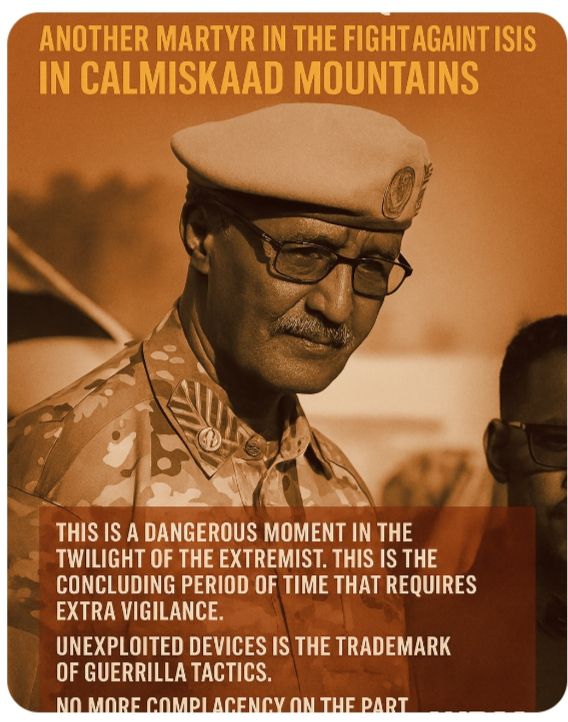
2. ISIS extorts our businesses in the Cal Miskaad Mountains

3. Mogadishu agents buy loyalty from former Puntland leaders to undermine federalism

4. And the silence of many so-called elders?
➡ Cowardice in the face of treachery.

Puntland was not built on cowardice.
It was forged in the fire of a four-decade struggle, paid for in the blood of thousands, created to stand as a bulwark against chaos.

Now, it is in the hands of men who think leadership means clinging to power and cutting secret deals.

“When the going gets tough, only the tough get going.”
Well — the going has never been tougher.

If you love Puntland, you either rise to defend it now, or you become an accomplice in its destruction.

WDM CALL TO ACTION

PUNTLAND WILL NOT SAVE ITSELF — THE PEOPLE MUST

Puntland stands at the edge of a cliff.
Words alone will not pull it back. Action will.

Every citizen must understand: the fight is NOW — not next year, not after the next election.

7 STEPS TO SAVE PUNTLAND

1.  EXPOSE THE BETRAYERS

Name them. Shame them. Confront them.
Whether in Garowe, Mogadishu, or abroad — make their betrayal public.

2.  MOBILIZE THE PEOPLE

Form grassroots committees in every district.
Demand transparency. Defend federalism. Organize peaceful protests.

3. DEFEND PUNTLAND’S SECURITY

Support real security forces — not political cronies in uniform.
Resist ISIS extortion and criminal networks with community-led defense.

4.  REJECT MOGADISHU’S POLITICAL BRIBES

Federalism is being dismantled with cash and promises.
Any leader or elder selling loyalty is a traitor to the State.

5.  DEMAND ACCOUNTABILITY

Push for independent investigations into corruption, security failures, and secret deals — including the MV Sea World weapons scandal.

6.  STAND UNITED ACROSS CLANS

The vultures thrive on division.
Unity is our strongest weapon.

7. PREPARE FOR LEADERSHIP CHANGE

The current order is beyond repair.
Groom principled, educated, unbought, unafraid leaders.

WDM’s message is clear:
If you are silent now, you will have no right to speak when Puntland is gone.

History is watching.
The blood of those who died for this State is watching.

Act now — or be remembered as one of those who stood aside and let Puntland be buried.

Make a one-time donation

Your contribution is appreciated.Donate


Make a monthly donation

Your contribution is appreciated.Donate monthly


Make a yearly donation

Your contribution is appreciated.Donate yearly

WDM YEARLY SUBSCRIPTION

Annual fee

$37.00

Click here to purchase.

Ismail Warsame, the Quiet Architect of Somali Political Narrative 

Long before the echoes of Civil War faded from the Somali landscape, there was a man who had already begun to sketch a different future—not with guns, but with policy papers and quiet resolve.

His name was Ismail.

In 1998, Puntland State had just been born, a fledgling experiment in governance amidst the ruins of national collapse. At the heart of this fragile beginning, working behind the scenes, was a man entrusted with extraordinary responsibility: Ismail Warsame, the very first Chief of State—also known then as the Chief of Cabinet. His role was not symbolic. It was foundational.

While others scrambled for power or sought foreign patronage, Ismail operated with an eye on legacy, not limelight. He kept the wheels of state turning during those formative years, often the last one to leave the compound at night, cigarette burning low and papers strewn across his desk.

Ismail Warsame is one of the key founders of Puntland. Many believe he is the man who made the idea of Puntland State work and take root. Through tireless planning, relentless diplomacy, and a deep understanding of Somali political dynamics, he laid down the administrative and ideological foundation that allowed Puntland to emerge as a relatively stable region. He was not just managing a presidency—he was shaping a vision.

More importantly, he is one of the original architects of federalism in Somalia, a system designed to reconstitute the failed Somali state by restoring people’s trust in public institutions through shared governance and decentralization. While many doubted the idea, Ismail stood firm in his belief that federalism could knit the country back together—region by region, voice by voice.

But his journey did not end when his term in Puntland’s state house concluded in 2004. The mission simply expanded.

By 2005, as the world turned its cautious attention back to Somalia, Ismail joined a fragile effort—the UN and World Bank’s Reconstruction and Development Program.  The Somali New Deal (The Somali Compact) approved in Brussels in 2013 between Somalia, its regions, civil society and the international donor community was based on these studies to promote peace, security and development. Appointed as Zonal Technical Coordinator for Puntland, and later as the National Authorizing Officer (NAO), he became the vital bridge between international donors and local realities. In the harsh corridors of Galkayo and the makeshift offices of Garowe, he translated development jargon into tangible progress—water wells, roads, clinics. When the Transitional Federal Government beckoned, he moved south, stepping into the role of National Aid Technical Coordinator, this time liaising with the European Union. Still no headlines, just heavy responsibilities.

But politics, like history, has a strange rhythm. With time, Somalia’s dreams were hijacked by new factions, foreign meddling, and cynical calculations. Ismail, disillusioned by what politics had become, quietly relocated to Toronto. It was not an escape, but a vantage point. From his modest home, lined with books and dusty Somali flags, he began to write.

Not to reminisce, but to warn.
Not to mourn, but to awaken.
Not to flatter, but to challenge.

Through Warsame Digital Media, his blog, he became an elder voice in a digital age—surgical with his analysis, unafraid to speak truth to clan, state, or superpower. While others pursued social media fame, he pursued intellectual integrity. Occasionally, he would write pieces on modern Somali politics with an embedded memory of its historical origins—reminding young activists and foreign observers alike that Somalia’s problems weren’t born yesterday, and neither was its resilience.

Ismail is also the author of four books, including the Amazon bestseller “Talking Truth to Power in Undemocratic Tribal Context.” His writings cut through propaganda, offering insights rooted in experience, clarity, and conviction.

What many don’t know is that he’s also a PhD candidate in Thermal Power Engineering by profession—a rare blend of technical expertise and political wisdom. A writer, journalist, administrator, political strategist, and analyst—Ismail is a man of many callings who has walked in many shoes but never wavered in his mission: to serve truth, reform governance, and inspire change.

In every line he publishes, there is the weight of someone who has sat at the center of power—and walked away when it mattered most.

And though few may know his face, many know his words.

He is the quiet architect of a Somali Political narrative still unfolding.

And he can still be reached at: ismailwarsame@gmail.com.

Read more posts by Warsame Digital Media →
https://ismailwarsame.blog

By WDM EDITORIAL TEAM

WDM EDITORIAL: A Reckoning in Somalia’s Telecom Industry — Starlink is Here

http://www.starlink.com/Somalia

“Starlink now available in Somalia!” With those simple words, Elon Musk may have just sparked the most disruptive technological reckoning Somalia has seen in decades.

For years, Somali telecommunications companies have operated in a fragmented, monopolistic fashion, profiting from the very dysfunction they refused to fix. Despite Somalia’s brilliant entrepreneurial potential and the rise of mobile money and digital tools, Somali Telcos have shamefully failed to do the one thing people needed most: connect with one another.

It is a known fact across Somalia’s towns and cities that families, friends, and businesses were forced to carry multiple SIM cards — Hormuud, Somtel, Golis, Nationlink — just to call different networks. Why? Because these telecom giants refused to interconnect. It was not a technical problem. It was greed, negligence, and hostage-style capitalism.

Poor Somalis, displaced families, rural traders, and even civil servants were paying the price: disconnected, digitally excluded, and forced to navigate a deliberately fragmented system. For far too long, Somali telecom monopolies were accountable to no one — not to government regulators, not to consumer needs, not to national interest.

But now, Starlink has arrived.

Elon Musk’s satellite-powered internet service offers more than just fast broadband. It offers freedom — freedom from the monopolistic control of local telecoms, freedom from patchy coverage, and freedom from overpriced, overcontrolled services.

With Starlink, a Somali villager, student, business owner, or journalist can now bypass the local Telcos completely and beam their signal from space. No SIM card battles. No interconnectivity chaos. No political manipulation through telecom blackout. It’s a true technological revolution — one that couldn’t come at a better time.

What Happens Next?

Now that Somalia is lit up on the Starlink coverage map, Telcos must reckon with three hard truths:

1. Your Monopoly is Over – The era of exploiting Somali citizens through exclusive SIM networks and refusing interconnection is coming to an end. The people now have another way.

2. You Must Evolve or Die – Compete with real services, real prices, and real innovation. No more hiding behind clan loyalties or political deals. The market is being liberated.

3. Connectivity is a Human Right – For years, Somali Telcos acted like gatekeepers of communication. Starlink shifts that power directly to the people.

A Wake-Up Call

To Somali regulatory authorities, if they exist at all: this is your moment. Stop being bystanders. Enforce mandatory interconnectivity, consumer protections, and fair competition laws. The private sector must no longer operate like rogue cartels.

To Somali entrepreneurs and tech minds: leverage this shift. With Starlink, build the next wave of apps, services, education platforms, and fintech that truly connect Somalia — not divide it by SIM card.

To the people of Somalia: demand better. The days of being forced to carry 3 SIM cards to speak to your cousin are over.

Starlink may have come from the sky, but it has delivered a very earthly message: the future belongs to those who connect.

Further Reading:

Telecom companies in Somalia are prime examples of Somali disunity and disharmony

WDM Editorial Team
http://www.ismailwarsame.blog

Make a one-time donation

Your contribution is appreciated.Donate


Make a monthly donation

Your contribution is appreciated.Donate monthly


Make a yearly donation

Your contribution is appreciated.Donate yearly

WDM YEARLY SUBSCRIPTION

Annual fee

$37.00

Click here to purchase.

BREAKING

WDM NEEDS YOUR SUPPORT — SUBSCRIBE & DONATE NOW

Unbiased & Fearless Media

Fearless. Independent. Uncompromising. Support Somalia’s Boldest Voice.

Dear WDM Readers Across the Globe,

We at Warsame Digital Media (WDM) are not just another news outlet. We are a volunteer-run, fiercely independent digital platform dedicated to truth-telling, hard-hitting analysis, and exposing the uncomfortable realities others fear to touch — especially in Somalia, the Horn of Africa, and beyond.

We refuse funding from governments and political actors, and we proudly operate without corporate sponsors, because we believe media should serve the people, not power.

WDM exists because we believe in something bigger:
1.  Fearless reporting on corruption, conflict, and misrule.
2.  Unfiltered voices and grassroots perspectives.
3.  A platform for truth, even when it’s inconvenient.
4.  Freedom of expression, protected at all costs.

But the truth has costs.

Despite our growing international readership, WDM remains critically under-resourced. We have no budget for field equipment, transportation, or investigative tools. Our dedicated team of volunteer writers and analysts work with passion, but we urgently need your help to keep going.

We are now making this urgent appeal to YOU — our trusted readers and supporters:

HELP US GROW WDM’S IMPACT:

1.  Make a donation — however small, it makes a big difference.

2.  Subscribe to support our long-term sustainability.

3. Share this appeal widely with your networks.

We don’t beg. We stand tall. But this time, we’re asking those who believe in fearless journalism to stand with us. If you believe in independent Somali voices, in truth before politics, in shining light where others fear to go — then WDM is your media. And now, we need you.

Support WDM Today:

Tel/Sahal/WhatsApp: +252 90 703 4081
EVCPLUS: +252 61 588 388
MyCash: +252 71 681 4371
PayPal: ismail.warsame@yahoo.ca

Visit us: Warsame Digital Media (WDM); https://ismailwarsame.blog

With gratitude and determination,
The WDM Editorial Team
Unbought. Unbossed. Uncompromising.

WDM EDITORIAL on Diplomatic Scandal in Mogadishu: Incompetence, Treason—or Both?

Diplomat’s past social media campaign against Somali unity

A scandal of staggering proportions has erupted in Mogadishu, exposing either criminal negligence or outright treachery at the highest level of the Somali presidency. An Ethiopian social media activist—well-known and documented for his relentless online campaign against Somali unity, federalism, and territorial integrity—has been officially accepted as the new Ethiopian Ambassador to Somalia.

Let us not mince words. This is not a clerical oversight. This is either willful betrayal or catastrophic incompetence. The Somali presidency has once again proven to be a revolving door of humiliation, allowing foreign-backed agents of chaos to walk freely into the State House—this time with diplomatic immunity. A man who, for years, advocated the recognition of Somaliland, cheered Egyptian interference, and mocked Somalia’s unity was handed an official diplomatic role on Somali soil.

Was due diligence ignored or intentionally suppressed? Either way, the consequences are damning.

Thanks to the viral social media posts of Suleiman Dedefo, a former Ethiopian diplomat and vocal proponent of Somali fragmentation, the Somali people now have irrefutable evidence of the political schizophrenia afflicting Villa Somalia. Dedefo’s tweets make it abundantly clear: Ethiopia’s policy has never been about supporting Somali peace or sovereignty. From harboring terrorists, to weaponizing diplomacy, to manipulating AMISOM, Ethiopia’s record is crystal clear—they thrive on Somali division. And now, they’ve been handed the keys to the capital.

Where was Somalia’s National Intelligence and Security Agency (NISA)? Where was the Ministry of Foreign Affairs? Where was the President’s own political judgement?

This is not merely a diplomatic embarrassment—it is a national security breach. It is the equivalent of accepting an ambassador from a foreign power who publicly celebrated the dismemberment of your nation, only to later see them attend your cabinet meetings and diplomatic receptions. It is madness, plain and simple.

To make matters worse, this scandal comes at a time when regional powers like Egypt and Ethiopia are using Somalia as a chessboard for their geopolitical rivalry, as Dedefo has himself described. These are not neutral players. They are invested in Somali instability, in a weak central government, in the permanent balkanization of Somalia.

This incident also reveals something far more sinister—a deliberate normalization of Somalia’s fragmentation from within Mogadishu itself. How else do we explain why someone advocating for the recognition of Somaliland, the secession of SSC-Khatumo, and regional disintegration was embraced by the very state he has been trying to dismember?

Enough is enough.

We call for the immediate revocation of the ambassador’s credentials. We call for a parliamentary inquiry into the vetting process. We demand full accountability from those in Villa Somalia who enabled this farce to take place. And we call on all patriotic Somalis—regardless of clan or region—to reject the slow-motion betrayal of our national sovereignty.

Somalia does not need foreign stooges in ambassadorial robes. Somalia needs defenders, not enablers of disintegration.

The time for silence is over. The time for reckoning is now.

— WARSAME DIGITAL MEDIA (WDM)

WDM EDITORIAL ON MV SEA WORLD SCANDAL: PUNTLAND GOVERNMENT’S SILENCE IS DEAFENING

What has happened to the promised investigation by the Puntland Government regarding the MV Sea World—the mysterious ship intercepted off the coast of Bareda carrying heavy weapons? The public was told there would be a full disclosure. There was supposed to be accountability. Yet weeks have passed, and the silence is deafening.

When the vessel was captured, it sparked national concern. A ship loaded with military-grade arms docking quietly on the Somali coast is not just a security matter—it is a national emergency. Who sent it? Who was it meant for? Was it linked to terrorists, local militias, foreign actors, or worse—a shadow operation by a state entity? These are not questions we can afford to ignore.

But ignore them we did. Or rather, the Puntland authorities decided the public didn’t deserve answers.

A Government That Deals in Shadows

Instead of transparency, what we are witnessing appears to be another backroom deal—the kind of shady maneuvering that has come to define President Said Abdullahi Deni’s administration. The MV Sea World case, once heralded as a breakthrough for Puntland’s maritime security efforts, has instead turned into a symbol of state-level complicity or, at best, cowardice in the face of international pressure.

Reports are now circulating that the Turkish Ambassador to Mogadishu flew to Bosaso, and in what can only be described as a cloak-and-dagger operation, the MV Sea World was handed over to Turkish custody. No adequate explanation. No meaningful public statement. No accountability. What gives the Turkish government the authority to interfere in Puntland’s security jurisdiction without going through proper diplomatic or legal channels?

And what happened to the UN Arms Monitoring Group, supposedly tasked with tracking all such suspicious shipments in the region? Their silence is equally troubling. Are we witnessing a coordinated cover-up, involving international powers, meant to avoid scrutiny into who was behind the weapons and their intended destination?

A Pattern of Betrayal

This is not an isolated case. Puntland’s leadership has increasingly shown a disturbing willingness to sacrifice public trust and national sovereignty for secretive deals and foreign appeasement. Whether it is the rise of ISIS in the Cal-Miskaad Mountains, the surrender of Bari Region’s maritime integrity, or now this arms shipment, President Deni’s administration appears incapable—or unwilling—to put the people’s security first.

The people of Puntland are not blind. They have been demanding answers, only to be met with silence. Is the MV Sea World incident being buried to protect foreign interests? Was Puntland’s coast being used as an arms transit corridor? Was the Turkish government involved directly, or simply cleaning up a mess created by others?

Demand for Accountability

This editorial is a call for full disclosure. The Puntland Government must release:

The official findings of the MV Sea World investigation (if it ever took place).

The identities of those behind the weapons.

The exact circumstances under which the Turkish ambassador was allowed to assume control of the vessel.

The communications between Puntland officials and the Federal Government or foreign diplomats regarding the ship.

Furthermore, we call on the UN Panel of Experts on Somalia to explain their silence and disclose any intelligence they have on the MV Sea World arms shipment. The international community cannot claim to support peace in Somalia while looking the other way when blatant arms smuggling takes place under their noses.

If Puntland’s leaders think they can brush this incident under the rug, they are mistaken. The people deserve the truth. Anything less is a betrayal not just of Puntland’s sovereignty, but of its very future.

WDM – Warsame Digital Media
Where Truth Matters.

SSC-KHAATUMO: THE FAILURE OF PUNTLAND POLICY

WDM EDITORIAL

The political mishandling of SSC-KHAATUMO by the Puntland Government marks one of the most reckless and shortsighted decisions in Puntland’s recent history. After the heroic liberation of Laas Caanood—a victory made possible by the blood and determination of Puntlanders—the region stood at a historic crossroads. Two clear and strategic options were available for Puntland leadership. Both could have solidified Puntland’s legacy, protected its interests, and maintained unity in the northeast.

The first option was to reassert Puntland’s rightful claim over SSC territories with a nuanced approach—granting SSC a special self-governing administrative status under the Puntland constitutional framework. Such an approach would have honored the shared history, acknowledged SSC’s autonomy aspirations, and preserved Puntland’s sphere of influence in the region.

The second option was to embrace the newly declared SSC-KHAATUMO administration as a brotherly regional partner. By recognizing and working with SSC-KHAATUMO, Puntland could have created a stronger federalist bloc—one capable of resisting Villa Somalia’s creeping centralism, while deepening cultural, political, and economic cooperation with the Sool, Sanaag, and Cayn communities.

But instead of decisive leadership, President Said Abdullahi Deni and his administration chose paralysis and political cowardice. They abandoned the moment to Mogadishu, allowing Villa Somalia to hijack SSC-KHAATUMO for its own ends. This betrayal of opportunity has only emboldened federal actors—especially the Damul Jadiid network, now tightening its grip on Laas Caanood with a vision of centralized control dressed as “self-rule.”

This is not just a blunder. It is a total collapse of Puntland’s policy doctrine, a self-inflicted wound that weakens Puntland’s strategic depth and federalist standing.

The consequences are now visible:

Anti-Puntland elements are regrouping, forming a new alliance of convenience in Laas Caanood, emboldened by Puntland’s absence.

Opponents of President Deni—from political veterans to marginalized communities—have found a unifying cause: the betrayal of SSC and the mismanagement of regional leadership.

Deni’s one-man governance model, much like that of Hassan Sheikh Mohamud in Villa Somalia, has alienated allies and suppressed open dialogue, reducing government to a club of cronies and loyalists with no strategic vision.

For over one and a half terms, President Said Abdullahi Deni presided over a growing security catastrophe in the Cal Miskaad Mountains—a catastrophe that flourished not in secrecy, but in full view of the Puntland government. While the international community kept a watchful eye, ISIS quietly entrenched itself in the rugged terrain of Bari Region, building infrastructure, intimidating local communities, and extorting the Puntland business sector in a campaign of mafia-style taxation.

The question is not how ISIS gained a foothold in Bari—but why the Puntland government under Deni allowed this to happen.

Instead of mounting a comprehensive and strategic counter-terrorism campaign, President Deni turned a blind eye. For years, no serious ground or intelligence operations were launched, and Puntland’s security apparatus became a shell of its former self—underfunded, politicized, and paralyzed by crony appointments and neglect. Local elders and business owners cried out for help. The administration responded with silence, denial, or empty rhetoric.

It wasn’t until Washington, Abu Dhabi, and Tel Aviv—yes, three foreign capitals—sounded the alarm that any meaningful action was taken. These powers recognized the global implications of an ISIS stronghold in Puntland’s mountains. They understood that the Bari Region had become a geopolitical security risk, not just to Somalia or the Horn of Africa, but to global shipping, intelligence interests, and counterterrorism priorities in the region.

Under foreign pressure, and only then, did Deni’s government reluctantly join the campaign to dismantle the threat. Even then, the coordination and leadership came not from Garowe, but from foreign intelligence and drone warfare, with Puntland playing a junior role in its own backyard.

This is more than an embarrassing lapse. This is a grave betrayal of Puntland’s people and its foundational duty to protect the region. When a president watches international terrorists build a network in his territory—and does nothing until the United States and UAE air forces and intelligence forced his hand—he has failed.

President Deni’s two-term legacy will be remembered not just for political mismanagement—but for allowing Puntland’s sovereignty and internal security to be compromised under his watch. His failure has cost Puntland dearly in credibility, security, and independence.

The time has come for a reckoning in Puntland governance. A leadership that waits for foreign powers to secure its territory is not a leadership—it is a liability. The fight against terrorism must begin with local responsibility, not outsourced urgency.

The people of Puntland must now ask themselves: who really governs this state? A president concerned with long-term stability and unity? Or a political operator obsessed with controlling power at any cost—even if it means forfeiting core territories and allies?

The writing is on the wall. Puntland must either course-correct immediately and re-engage with SSC-KHAATUMO in good faith, or it will become an increasingly isolated and irrelevant actor in the rapidly evolving federal map of Somalia.

History will not be kind to leaders who chose silence when bold leadership was required. And Puntland will not survive another term of miscalculation and detachment. The people deserve clarity, vision, and action—not abdication.

Warsame Digital Media Editorial Board
WDM Editorials | August 2025

[Article has been updated since posting.]

WDM EDITORIAL ON A COUNTRY HELD HOSTAGE: WHY ALL CURRENT SOMALI LEADERSHIP MUST BE SWEPT ASIDE

It is no longer a matter of debate or diplomatic restraint—it is a national imperative. The entire current crop of Somali leadership, at all levels of government—federal, regional, and local—must be discarded. Not reformed. Not reshuffled. Removed wholesale. They have failed the Somali people. Worse, they have betrayed them.

These so-called leaders, parading around as statesmen, are nothing but hollow vessels of ambition. They lack vision. They offer no roadmap, no measurable goals, no meaningful development agenda. Somalia, a nation blessed with immense resilience, cultural strength, and strategic potential, is instead shackled by mediocrity, corruption, and criminal negligence. These men and women sit atop crumbling institutions and collapsing infrastructure, utterly clueless—or entirely indifferent—about how to fix it.

Let us be blunt. Somalia is not suffering from a lack of talent or resources. It is suffering from bad leadership—incurably bad leadership. Every tier of Somali government is infected by cronyism and patronage networks that enrich the few while dooming the many. Public offices have become family estates. State contracts are bartered in backroom deals. Qualified individuals are sidelined in favor of loyal sycophants, incompetent allies, and tribal enforcers. No merit. No ethics. No accountability.

Worse still, these so-called “leaders” do not serve the Somali people—they serve foreign interests. Some are the lapdogs of regional powers, others the darlings of donor agencies. But they all have one thing in common: they are puppets. Their strings are pulled from Nairobi, Doha, Ankara, London, Abu Dhabi, and Washington. Their loyalty lies not with Somalia but with the foreign paymasters that fund their corruption. They will sell national sovereignty, constitutional integrity, and the dignity of their people for a briefcase and a podium.

This is not just incompetence—it is treason masquerading as governance.

They speak the language of unity while stoking division. They hold peace conferences while buying weapons. They smile for donors while looting the budget. Every move they make is a performance, staged for foreign backers, and broadcast to an exhausted public that no longer believes the lies.

The truth is stark and unavoidable: There will be no national recovery, no federal revival, no peace, and no meaningful development under the current leadership. Somalia cannot be rebuilt by those who ruined it. We cannot entrust our future to those who are prisoners of the past.

This is a call—not for cosmetic changes, not for another cycle of empty dialogue—but for a total political overhaul. A clean slate. A generational shift. A new, accountable, and people-centered leadership must emerge from the ashes of this dysfunctional system.

Somalia deserves leaders who care. Leaders who plan. Leaders who protect. The current leadership class has proven time and again that it does none of these. It must go.

And the Somali people must make that happen. The future of this nation demands it.

—Warsame Digital Media (WDM)
August 3, 2025

THE CRITICAL NEED FOR AN ACCOUNTING FIRM TO MANAGE DONATED FUNDS IN MUDUGH

“If money meant for the people is wasted, the people will waste away.”

A Call for Transparency and Accountability in Mudugh’s Mega Construction Projects

Mudugh, a region with immense potential yet burdened by decades of marginalization, insecurity, and crumbling infrastructure, now finds itself at a turning point. For the first time in years, there is renewed energy around development—fueled by the community’s resolve and increasing attention from the diaspora and international donors. Schools need rebuilding, roads remain unpaved, hospitals operate under candlelight, and cities like Gaalkacayo struggle to survive even moderate rainfalls.

Yet in a poverty-stricken region like Mudugh, where every dollar matters, the question is no longer if funds will be donated, but how they will be managed.

The Risk: Mismanagement, Erosion of Trust, and Donor Fatigue

The single greatest threat to sustainable development in Mudugh is not war or drought—it is mismanagement. In many regions of Somalia, too often we have seen donated funds disappear into black holes of corruption, nepotism, and bureaucratic inefficiency. The result? Donor fatigue. Projects stall. Trust evaporates. Communities are left betrayed and in worse conditions than before.

We cannot afford to let Mudugh go down this path.

Every penny donated must be tracked, managed, and distributed with laser-focused accountability. To do that, Mudugh needs more than good intentions; it needs systems.

The Solution: Establishing an Independent Accounting Firm

It is imperative that Mudugh immediately establishes an independent accounting firm—a transparent, apolitical, and professional institution dedicated solely to the safe-keeping and management of funds designated for mega construction projects and humanitarian development.

This firm must:

Be staffed by qualified professionals: Only experienced accountants, auditors, and financial controllers with proven integrity should be considered. Community connections alone are not qualifications.

Operate independently: It must not be beholden to political actors, clans, or government offices. Independence is the foundation of trust.

Be compensated fairly: We must abandon the outdated notion that “volunteers” will do serious work for free. If we want results, we must pay professionals what they’re worth.

Work hand-in-hand with the Mudugh Development Committee: Coordination is essential. The accounting firm must be in constant consultation with a representative community committee to ensure funds align with development priorities and reflect the actual needs on the ground.

Adopt international standards of financial reporting: Let audits be public. Let budgets be transparent. Let there be no mystery where the money went.

Use digital tools: In today’s world, there is no excuse for opaque ledgers. Every transaction, every disbursement, every contract should be digitized and accessible to stakeholders.

A Preventative Strategy, Not a Reactionary One

Critics may ask, “Isn’t this premature? We haven’t even received the funds yet.” That’s exactly the point. You don’t install a smoke detector after the fire. The accounting structure must be in place before a single dollar is received. Waiting until money arrives before putting safeguards in place is like building a dam after the flood.

A Message to the Diaspora and Donors

To the generous Mudugh diaspora who tirelessly raise funds for roads, hospitals, schools, and water wells: your efforts are not in vain—but your donations need protection.

To international partners and development organizations watching from afar: Mudugh’s people are ready to work. What they need is a system that ensures your contributions create change, not chaos.

Don’t just send the funds—demand the structure.

Building Trust: The First Brick in Any Project

Before cement is poured, before a road is leveled, before a school is rebuilt—the first and most important structure we must construct is trust. And that trust is built with accountability, transparency, and proper financial governance.

Let us not waste this critical moment. Mudugh has been waiting too long for progress. But progress without systems is failure in disguise.

Let us choose wisely. Let us build responsibly. Let us be the region that not only receives funds but honors them with results.

#MudughRising
#AccountabilityFirst
#TransparentDevelopment
#FromDonationsToDevelopment

Authored by Warsame Digital Media (WDM)
August 2, 2025

DISTRESSING REPORT FROM GALKAYO: A CITY BETRAYED, A PEOPLE BROKEN AND FORGOTTEN

A Grim Discovery After the Conclusion of the Galkayo Community Conference

The much-anticipated Galkayo Community Conference has come to a close. What should have been a launchpad for meaningful change, recovery, and governance reawakening has instead revealed an ugly, unbearable truth: Galkayo is a broken, bleeding city—betrayed by the very institutions and leaders who claim to represent it.

The façade of progress and development carefully erected by government mouthpieces has collapsed under the weight of undeniable reality. Conference deliberations and post-event assessments have unearthed a deeply distressing picture of Galkayo—a city drowning, literally and metaphorically, in abandonment, dysfunction, and despair.

1. A City Sinking Under the Sky

Every rainfall now brings catastrophe. The city’s drainage systems are either nonexistent or choked with years of neglect. School buildings—once iconic centers of learning like Bardacad School, now stand shuttered, flooded, and crumbling. The collapse of landmark educational institutions after repeated submersion in rainwater is more than a failure of infrastructure; it is a direct assault on the future of the next generation.

The government’s excuse? “This is no different from the rest of the country.”
Let that sink in.

This dismissive, lazy, and grossly irresponsible statement encapsulates the rot that has infected governance. Galkayo is not a victim of nature—it is a victim of state and community negligence.

2. Lawlessness Reigns as the Police Stand Powerless

The city’s police force is a shell of its former self—under-equipped, underpaid, and overwhelmed. Banditry, inter-clan killings, and revenge crimes go unpunished. Police morale is nonexistent. There is no civilian trust. Galkayo’s law enforcement institutions have been systematically weakened to the point of irrelevance.

Security is now in the hands of whoever holds a gun. Justice is bought or executed on the streets.
Is this what the state calls governance?

3. Financial Drain: Galkayo’s Wealth Transferred, Not Invested

It is no secret anymore: Galkayo’s monthly revenue is siphoned off to Garowe under the pretext of state revenue. This is outright theft disguised as administrative routine. What the people of Galkayo pay in taxes never comes back to them in services, investment, or development. Instead, their money builds office towers, guest houses, and highways in far-off cities—while Galkayo remains a mud pit of broken streets and shattered hopes.

This is not federalism.
This is exploitation.

4. Infrastructure in Ruins—No Road, No Airport, No Dignity

What remains of Galkayo’s roads are barely passable trails. Its airport is a decaying relic. Economic infrastructure that once connected the city to the rest of the Horn of Africa has deteriorated beyond repair. In other cities, the government builds. In Galkayo, it demolishes by omission. The private sector has fled. Investors avoid it. The youth emigrate en masse.

There is no mobility, no trade, no future.

5. A Social Fabric Torn by Tribal Hatred and State Failure

Tribal hatred and mistrust have taken deep root in Galkayo. Traditional elders once respected for wisdom and reconciliation now openly hate one another—fuelled by manipulation, power struggles, and the absence of a neutral state apparatus to mediate. The government has not only failed to address social fragmentation—it has profited from it, turning clans into tools of political control.

Today, Galkayo’s strongest export is its people—fleeing poverty, insecurity, and hopelessness. Its most educated sons and daughters are now in Nairobi, Addis Ababa, or Istanbul. Its youth fight wars that aren’t theirs. Its women endure famine, fear, and silence.

6. The Government’s Excuses Are an Insult

The claim that Galkayo’s disaster is “just like the rest of the country” is not only untrue—it is cruel. Galkayo has borne the brunt of every conflict, every betrayal, and every failed promise. The deliberate underdevelopment, marginalization, and mistreatment of the city cannot be glossed over by lazy comparisons.

This is not normal.
This is not acceptable.
This is deliberate destruction through neglect.

Call to Action: Enough is Enough

The Galkayo Community Conference was supposed to ignite a movement. Now it must fuel a revolution of civic resistance and demand for justice. The people of Galkayo cannot afford to wait for Garowe, or Mogadishu, or foreign donors to rescue them.

We demand:

1. Immediate restoration of basic infrastructure—roads, schools, drainage, and healthcare.

2. Autonomous control over local revenue, with transparent budgeting and public oversight.

3. Reconstruction and reequipping of the Galkayo Police Force, free from political interference.

4. An independent inter-clan reconciliation initiative, protected from state co-optation.

5. Accountability mechanisms for the state institutions that have siphoned public funds from Galkayo for over a decade.

Conclusion: Galkayo Will Not Be Silent

This post-conference report is not a lament—it is a warning. The people of Galkayo will not accept second-class citizenship in their own homeland. Those who have allowed this crisis to fester must know: silence has ended.

The rain may drown the streets, but it will not drown our voices.

Galkayo lives. Galkayo resists. Galkayo will rise again—with or without you.

By WDM Editorial Team
August 2, 2025

WDM EDITORIAL: BREAKTHROUGH IN GALKAYO: A DEFIANT COMMUNITY MOVES THE NEEDLE IN PUNTLAND POLITICS

Strong Message to Garowe: You Can’t Muzzle the People Forever

Galkayo City sinking in rainfall

In a powerful display of grassroots determination, the Galkayo Community Conference—deliberately obstructed and politically sabotaged by the Said Abdullahi Deni administration—has finally convened and concluded successfully, sending shockwaves through Puntland’s fragile political structure.

A Historic Moment the Deni Administration Tried to Bury

Let’s be clear: this conference was not welcomed by the current Puntland leadership. In fact, every trick in the book was deployed to prevent this gathering—from intimidation and administrative sabotage to propaganda campaigns painting the conference as anti-government or “chaos-driven.” President Deni’s administration had hoped to suppress it entirely under the false narrative that it would serve as a platform for hostile actors. But they were wrong—badly wrong.

What emerged instead was a genuine people-driven dialogue, a shining example of what constitutional participatory governance is meant to look like. Representatives from across Mudug—from professionals and youth leaders to elders and civil society advocates—showed up and made their voices heard.

The Real Fear: Accountability

Why would a government fear a community conference?

Because this administration is allergic to accountability. For far too long, the Deni regime has ruled with top-down arrogance, believing that the people of Puntland—particularly in strategically important cities like Galkayo—are passive subjects to be managed, not citizens to be consulted. That illusion has now been shattered.

Galkayo is not Garowe’s backyard. It is a city of resilience, a community tired of crumbling infrastructure, environmental neglect, and stalled development projects. The people have real questions:

Where are the long-promised roads, airports and city-sanitation networks?

Why is Galkayo—a city that has historically stood at the crossroads of Somali unity—treated like a neglected outpost?

Why has the regional government turned a blind eye to the deteriorating security and rising youth unemployment?

The Conference Outcome: Message Delivered, Loud and Clear

The Galkayo Community Conference became more than just a meeting—it was a political awakening.

1. It reaffirmed the community’s right to convene, debate, and organize.
The Constitution of Puntland—and of Somalia at large—protects civic assembly. Today’s conference was not an act of rebellion but of responsibility. The community has every right to organize and demand what the government has failed to deliver.

2. It exposed the paranoia of the Deni administration.
The groundless fears of “agents of chaos” or “anti-government movements” were exposed for what they were: a desperate excuse to justify authoritarian overreach. This was not an opposition rally; it was a civic dialogue. That it was feared speaks volumes.

3. It set a precedent for all other Puntland regions.
If Galkayo can do it, so can Bossaso, Qardho, Buuhoodle, and beyond. The era of muffling community voices under the guise of state security is ending. Puntland citizens are waking up to their constitutional role in governance.

A Warning to Garowe: The Tide Has Turned

President Deni and his advisors must understand that this is no longer the Puntland of One-man show, where leadership controlled both the narrative and the people. The people of Galkayo have spoken: you will not be allowed to rule in silence or with impunity.

The message is clear: the days of unilateral rule are numbered. Any future administration in Puntland must engage the people, listen to the ground, and allow bottom-up development.

This conference was a warning shot, not a declaration of war. But if the current leadership continues to stifle legitimate civic expression and refuses to course-correct, they will soon find themselves politically obsolete.

Final Word: From Galkayo, A New Chapter Begins

Let the record reflect:
The Galkayo Community Conference was held.
It was peaceful.
It was powerful.
It was necessary.

Let Puntland’s people across all districts take courage from this. Your voice matters. Your city matters. Your future must not be decided behind closed doors in Garowe.

The silence is broken.
The people are speaking.
And they will not be silenced again.

#GalkayoConference #PuntlandPeopleFirst #CivicPower #CommunityMatters #EndPoliticalArrogance

BREAKING: From SSC to Khatumo to SSC-Khatumo to Northeast — A Transition Wrapped in Ambiguity or a New State in the Making?

SSC-KHAATUMO has unintentionally opted out of the Somali Federation by renaming itself Northeast State as a New Federal Member State. Northeast State is Puntland State. Would SSC-KHAATUMO rejoin Puntland State proper?

In the ever-shifting political terrain of Somalia, names are never just names. They are loaded with history, claims, identity, and territorial ambition. The recent emergence of a new term — “Northeast State” — associated with the territories formerly grouped under SSC, Khatumo, and now SSC-Khatumo raises serious political and constitutional questions. Is Somalia witnessing the rebirth of Puntland under a different name, or is this a veiled attempt to clone a new state using the old political skeleton?

Let’s unpack the progression and implications.

From SSC to Khatumo: The Roots of Resistance

The SSC (Sool, Sanaag, and Cayn) regions historically resisted incorporation into Somaliland, and the Khatumo movement emerged as a response to both Somaliland’s territorial ambitions and what was seen as neglect by Puntland. Khatumo was originally envisioned as a decentralized state structure loyal to the Somali Federal Government, but independent from both Puntland and Somaliland.

However, factionalism, lack of resources, and regional rivalries weakened the original Khatumo project. Its revival came only through armed struggle and public resistance that culminated in the Laas Caanood uprising, leading to the rebranding of the movement into SSC-Khatumo.

SSC-Khatumo: Between Autonomy and Uncertainty

SSC-Khatumo has gained both sympathy and suspicion. On one hand, it’s hailed for resisting Somaliland’s occupation of the Laas Caanood area. On the other hand, its ambiguous federal status, secretive dealings, and potential alignment with Mogadishu’s Damul Jadiid clique have caused alarm — especially in Puntland, which historically claimed and defended the same regions.

The SSC-Khatumo movement’s embrace of the name “Northeast” introduces a new layer of confusion. For many Somalis, “Northeast” was the original label for Puntland before it formally declared itself a federal member state in 1998. The term has strong historical, territorial, and emotional ties to Puntland identity. Using that term now raises legitimate questions:

Is SSC-Khatumo transforming into a parallel Puntland?

Or is this a deliberate political maneuver to either provoke or preempt Puntland from reclaiming the regions?

Puntland and the Trademark Dilemma

There’s currently no formal trademarking system for Somali state names — no legal mechanism to stop any federal or aspiring state from naming itself as it wishes. However, in practice, names like “Jubaland”, “Puntland”, or “Southwest” are deeply embedded in public memory and political geography.

To reuse a name like “Northeast” — which has long been associated with Puntland — could be interpreted as:

1. A symbolic challenge to Puntland’s political heritage.

2. A claim of legitimacy as the real or original Puntland, rising again after being sidelined.

3. A bid for statehood, packaged in familiar language to ease public acceptance.

Regardless, this will likely ignite controversy and even territorial competition between Garowe and Laas Caanood.

Is This Another Puntland in the Making?

If SSC-Khatumo rebrands as Northeast State, and seeks federal recognition as a member state, the implications are massive:

Territorial Overlap: It could mean two federal member states (Puntland and Northeast) claiming the same lands.

Political War: It could trigger internal Somali political infighting and realignment of alliances.

Identity Crisis: Residents in Sool, Sanaag, and Cayn could be forced to choose between allegiances — weakening collective Somali federalism.

Foreign Interference: Neighboring countries and factions within Mogadishu could exploit this ambiguity to weaken Puntland, one of the most functional Somali states.

Final Thoughts: A Need for Clarity and Unity

While political creativity is necessary in Somalia’s complex reality, the current shift from SSC to SSC-Khatumo to Northeast must not be used to sow confusion or undermine existing federal states. If the goal is federal statehood, then the actors must come clean: Is this a new state or a return to Puntland?

Federalism should unite regions under agreed frameworks, not fracture them through semantic games. Somalia doesn’t need more names — it needs more unity, shared security, and governance based on clarity, consent, and law.

If Northeast is just a euphemism for “Anti-Puntland Khatumo”, then it is a strategic misstep with dangerous implications. But if it’s an honest rebirth of Puntlandian ideals, then let that be declared openly and with a call for regional reconciliation.

Recommendations:

Clarify Intention: SSC-Khatumo leaders must explain the meaning and purpose of “Northeast State.”

Avoid Parallelism: Federalism cannot function with overlapping states. Puntland and SSC-Khatumo must engage in dialogue.

Preserve Identity: If the Northeast identity is merely a nostalgic reference, it must not be used to undermine Puntland.

Federal Oversight: The FGS must not exploit or manipulate these transitions to weaken federalism further.

Somalia cannot afford political name games at the cost of regional unity. The time to choose clarity over confusion is now.

But, now it looks like that, legally, SSC-KHAATUMO has unintentionally opted out of the Somali Federation by renaming itself Northeast State as New Federal Member State. Northeast State is Puntland State. It looks like they didn’t consult with legal minds when they were renaming themselves.

Would SSC-KHAATUMO rejoin Puntland State proper?

#NortheastState #SSC-Khatumo #Puntland #SomaliaFederalism #StateFormationCrisis

The Damul Jadiid Agenda: A Calculated Destruction of Somalia from Within

WDM COPYRIGHT

What is Wrong with Damul Jadiid? Why Are They Hellbent on Burning Somalia to the Ground?

Everywhere you turn in Somalia today, there is a trail of destruction, division, and disorder—and one ideological cabal sits at the center of it all: Damul Jadiid, the radical political faction operating from Mogadishu, once disguised as religious reformers and now fully exposed as power-hungry saboteurs of national unity.

From Gedo to Sool, from Beledweyne to Beled Xaawo violence and political strife seem to follow them like a curse. This is no coincidence—it’s a blueprint. A deliberate attempt to break the back of Somalia’s fragile federation and to install a centralized theocratic elite that answers to foreign funders rather than the Somali people.

A Movement That Thrives on Chaos

Damul Jadiid’s tactics are dangerously clear:

Fuel clan rivalries to weaken unity.

Undermine federal states by bribing local actors or sponsoring armed militias.

Create friction with any region that dares to assert autonomy, especially Puntland and Jubaland.

Weaponize religion to silence dissent and intellectual opposition.

They do not govern—they manipulate. They do not build—they burn bridges. They have infiltrated every corner of the Federal Government of Somalia (FGS), using state resources to fan the flames of civil strife.

Who the Hell is Funding This Madness?

Let’s ask the hard questions:

Who benefits from a Somalia in flames?

Who keeps Damul Jadiid afloat with finances, platforms, and propaganda?

Why do their leaders always survive the chaos they unleash, comfortably nestled in Mogadishu villas while innocent Somalis die in the crossfire?

Many fingers point toward external religious networks, foreign intelligence agencies, and regional actors who prefer a divided Somalia over a strong and united one.

Where Will Damul Jadiid Run When Somalia Burns?

They must be asked: Where the hell will you go when this country collapses under the weight of your reckless ambitions?

To Qatar? Turkey? Or the United Arab Emirates? Or will you hide behind your mosques while Somalia turns into another failed theocracy?

History is ruthless. Those who tear nations apart in pursuit of short-term power eventually become victims of the very fire they light.

Somalis Must Wake Up Now

We cannot allow this rogue faction to destroy what little progress we’ve made as a nation. The Somali people—north, south, central, and in the diaspora—must rise above sectarian politics, reject this cancerous ideology, and defend the constitutional federalism that offers all Somalis a place in the future.

Enough is enough.

Damul Jadiid must be exposed, rejected, and held accountable. Not tomorrow—now.

Mudugh at a Crossroads: This Conference Must Be a Turning Point, Not Another Empty Talk Show

WDM COPYRIGHT

The upcoming Mudugh Community Conference should not, must not, be another ceremonial gathering of speeches, selfies, and fruitless resolutions that die in their own echo chambers. This is not the time for hollow patriotism, nor for repeating tired mantras of “unity” while continuing the same self-defeating behaviors that have left Mudugh Region a cautionary tale in recent Puntland politics. This conference must dig deep, face the hard truths, and most importantly—it must chart a course forward rooted in accountability, collective will, and radical honesty.

Stop Pretending the Problem Is Only Governmental

Let’s be absolutely clear: you can’t solve the problems of Mudugh by pointing fingers at Garowe or waiting for handouts. Governance failure is real—but so is community failure. Roads don’t build themselves, but neither do they get built by communities who are fragmented, distrustful, and sabotaging each other behind tribal curtains.

Is the backwardness societal or governmental? The answer is both. And until we accept this, nothing changes. Mudugh’s stagnation is not a coincidence; it is a direct result of:

Lack of a common purpose

Chronic disunity among residents

Toxic local rivalries

A short-sighted elite class more interested in positioning than progress

The Two Sides of the Same Coin: Society & State

You can’t expect the Puntland Government to invest in infrastructure, security, and services in a region whose people are perpetually divided. Imagine trying to install electricity in a house where the family keeps tearing out the wires to blame each other. That’s Mudugh today.

Likewise, blaming the government alone ignores the community’s own paralysis, internal bickering, and refusal to self-organize around a unified agenda. The only way the government can be effective is if the society acts like it deserves governance.

Three Pillars That Must Be Addressed at the Conference

1. Stalled Infrastructure Projects

The road network between Galkayo and other districts has become a symbol of betrayal, mismanagement, and apathy. This conference must demand timelines and accountability, not just pledges and wishful thinking.

Galkayo, once a hopeful urban center, is now choking under urban decay. There is no cohesive plan for drainage, urban roads, or even traffic regulation. If a city reflects its people, then Galkayo is the mirror that doesn’t lie.

2. Environmental Degradation

Galkayo’s environment is in total collapse. The conference must not ignore the horrendous stinging water ponds after each rainfall, severe deforestation, garbage-laden neighborhoods, and disappearing greenery. Local leadership has utterly failed in this area, and silence on it equals complicity.

3. Security & Public Order

Peace is the foundation of everything. The fact that Galkayo remains vulnerable to violence, gang activity, and militia-based influence shows that the rule of law remains fragile. The conference must make security and local policing a community-wide responsibility, not just the business of overstretched Puntland police.


The Elephant in the Room: Disunity

Let’s be brutally honest: Mudugh suffers not from a lack of resources or potential, but from a disease of disunity. Every sub-clan pulling in its own direction. Every “leader” playing chess with community interests. Every elder more concerned about his own standing than the collective good.

This conference must be a reckoning. A funeral for the old mentality that made unity conditional on who gets the mic, who gets the contract, who gets the praise.

Without unity, there will be no progress. Without progress, there will be no future.

The Role of Puntland Government: Not a Savior, But a Partner

Puntland cannot—and will not—solve Mudugh’s problems while the community stays dysfunctional. It is time to stop waiting for miracles from Garowe, and instead force a new relationship where Mudugh speaks with one voice, negotiates with clarity, and holds both itself and its government accountable.

The government’s role must be redefined:

Not as a parent to spoiled children, but as a partner to a mature community ready to move forward.

Demanding concrete plans for roads, airport, schools, and hospitals—yes.

But also ensuring that the local leadership doesn’t waste, steal, or politicize every opportunity.

What Must Be Done: A Call to Action

This conference must end with actions, not just resolutions. Here’s what must be demanded and immediately implemented:

1. A Unified Community Committee

With representatives from every sub-clan and urban neighborhood, tasked with tracking development promises and pressing Garowe with one voice.

2. A Public Infrastructure Watchdog

An independent, locally formed body to monitor project implementation and call out delay tactics, corruption, or sabotage.

3. Environmental Cleanup Campaign

Launch city-wide campaigns to clean, plant, and regulate the urban and rural environment. Partner with Puntland Ministry of Environment—but initiate it from the bottom up.

4. Youth & Security Forum

Involve youth in securing the city. Not just as police assistants but as proactive members of a civic guard or neighborhood councils to reduce radicalization and violence.


Final Words: This Is Mudugh’s Last Chance

If this conference becomes yet another staged event, then Mudugh deserves the neglect it suffers.

But if this becomes a moment of self-reflection, unity, and decisive action, then it could be the beginning of a real transformation. No outsider will rescue Mudugh. Puntland can only help those who help themselves. It’s time for this community to grow up, stand up, and rise up.

The world owes us nothing. Puntland owes us nothing.
We owe ourselves everything.

#Mudugh2025
#GalkayoUnited
#FixOurselvesFirst
#PuntlandAccountability

Let the conference be the rebirth. Or let it be a final tombstone.
The choice is ours

Further reading:

GALKAYO: THE DYSTOPIAN CITY OF SOMALIA