THE ROAD TO DEMOCRACY THROUGH ONE CITY-STATE, DICTATORSHIP, WARLORD-ISM AND RELIGIOUS EXTREMISM IS ROUGH.

Annual subscription

$37.00

Garowe, June 13, 2019

Transition to democracy from the evils of one city-state, dictatorship, warlordism and religious extremism is fraught with despair and many disappointments along the way on the rough road.

In Somalia’s case, the journey had caused untold massive sufferings and havoc on all lives, particularly the most vulnerable, women, children, the weak and advancedly aged. But, the saddest of all is the lack of recognition and remorse for wrong-doing in such massive scale as it had happened in Rwanda and South Africa to heal the nation.

What does that mean to would-be a nation-state like Somalia? This is where despair sets in as there is no accountability of gross human abuses of yesteryears, which in turn, means that there is no guarantee that it wouldn’t happen again. With no accountability and genuine national reconciliation, there is no basis for coming together again for common nation-wide objectives.

Somali political leaders never understood why it has become difficult to revive the Somali State – the problem is not Al-Shabab. The problem is two-fold:

1. Mogadishu War Economy

2. Public Mistrust

Both have their root causes not only in the civil war, but also in the imposition of pseudo-socialism mode of production and political orientation by Somalia’s Military Junta of 1969-1991, where the population was compelled to fight for meagre resources available in the black market as the authoritarian regime abused the national economy and made it a crime to own personal produce and fruits of one’s labour. These abuses had only to intensify during the civil war, and still raging in Mogadishu. Business community there is predatory and unreignable by neither public institutions, weak and fledgling transnational governments, nor by invitation of more AMISOM troops to Mogadishu. They are hardest nuts to crack.

Mistrust among Somali clans is quite obvious to all, but nobody minds to address it. The political situation and thinking in the country sees the need for national reconciliation as taboo subject not to talk about. Taugh love! Let me say frankly that until we find moral courage to address the legacy and mayhem of the Civil War, our political leaders would be moving in vicious circles. The weak centre and peripheral regional states would always be in loggerheads, and blame and counter-blame would go on for ever. The IC and Somali foreigner partners have also found comfort in making rounds along these spirals of fictious circles for over three decades now. Taugh love too!

Welcome to the real world and realities on the ground in Somalia.

Go back

Your message has been sent

Warning
Warning
Warning
Warning

Warning.

WHY DO I WRITE IN ENGLISH?

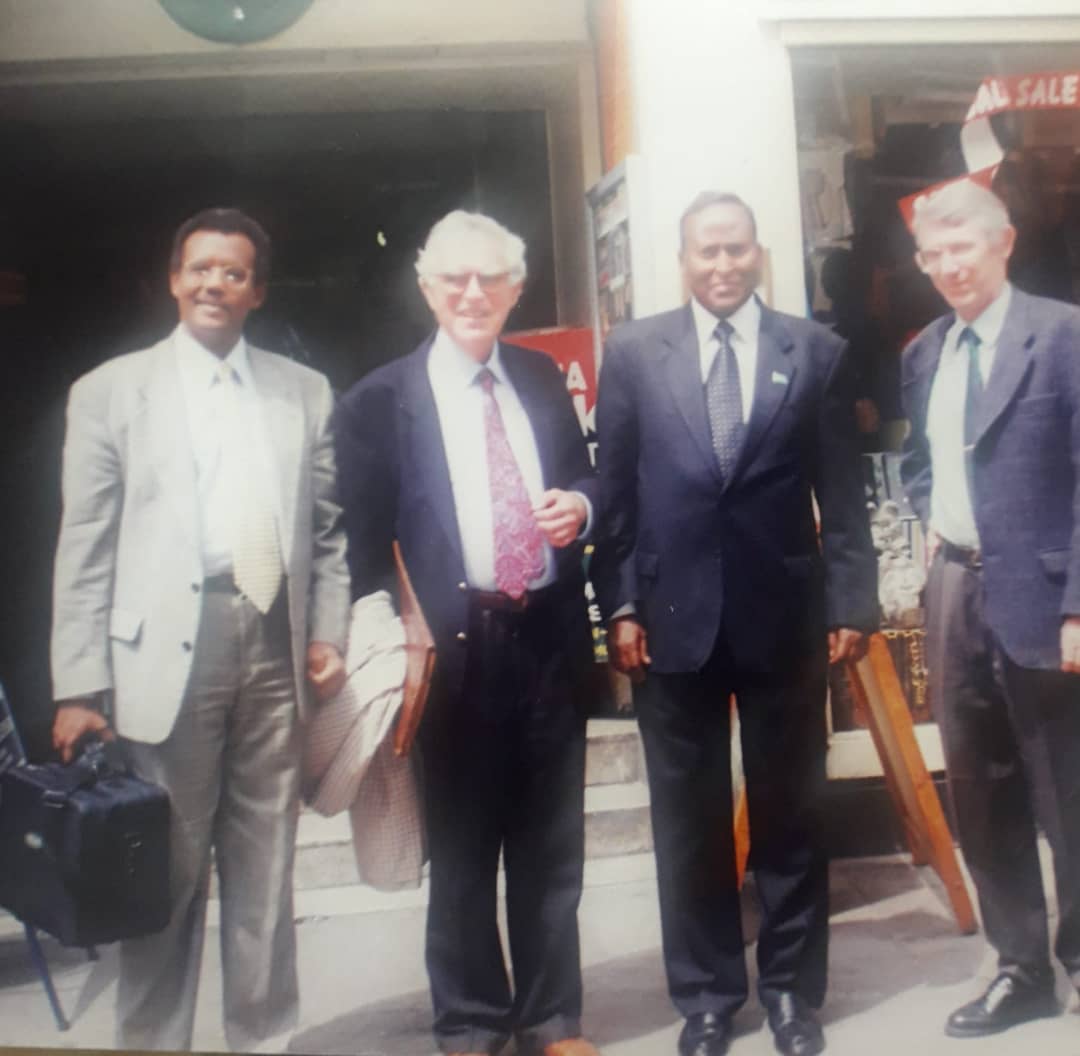
Galkayo, May 31, 2019 – A number of my readers at WDM (https:/ismailwarsame.blog) ask me why I write my articles in English, a 2nd foreign language I had picked up in life, together with Russian and Arabic along with a working tongue of Italian. The issue is made more complicated by the claim of Somali language specialists and anthropologists, both foreign and native like Late Prof. I.M. Lewis (RIP), pictured here with me (2nd from left) and Prof and Somali linguist, B. W. Andrzejewski (RIP), (forgive me for not naming just a few of the well known scholars of Somali literature and history, that it is so poetic, romantic and richer tongue that only a few languages of the world could compete it in literature prowess. But, this sticking question from readers further increases the intensity of my guilty feeling for not utilizing my native tongue to express myself better. Frankly, I sometimes find myself numb in answering the question, for there is no easy answer to satisfy the questioner as to what is my reasoning behind writing in a foreign language. In fact, the reasons are many and may still be implausible to many of my unconvinced audiences. Among my justifications include: 1. A writer needs wider audiences and circulation to reach. 2. Hundreds of thousands of people of Somali origin are born overseas, live and work abroad. They don’t use Somali as a working medium. 3. Many existing Somali internet websites don’t use standard, thoughtful texts in Somali, and that turns readers off, not reading articles beyond a few lines in the first paragraph. Just the opposite, Somali texts nowadays frighten readers, including myself. Huge and careless Facebook entries, violating all rules of Somali grammar, play a leading role in Somali language deterioration- that low standard of unschoolled writings, indicating the extent of deterioration happening to the Somali language over the years in a stateless environment, makes it difficult to understand today’s authors of Somali articles. 4. That is why most Somalis, who don’t utilize any foreign language, prefer listening to audio/video clips. They also like to read about events and news rather than browsing for thought-provoking and critical articles. 5. I have been testing my readers by occasionally writing articles in Somali, and the results were very disappointing. 6. My Somali readers are also not taking into account that WDM has been attracting many foreign readers as well, and I suspect that they don’t want to be cut off. In conclusion, perhaps some of you may understand me for choosing English as my language of communication out of necessity.
Thank you,
Ismail Warsame
BlogPostscript: I would recommend to my Somali readers to use Google Translator to get a rough meaning of the contents of any article