PUNTLAND: CRISIS OF IDENTITY OR LOSS OF VISION?

Is PUNTLAND in a state of national crisis in every aspect of its public endeavors? Would the anouncement of a forthcoming PUNTLAND Congress or Conference scheduled in March 15, 2020, respond to this crisis or troubling political disillusionment of its residents, and youth, in particular? Would Puntland continue to hold the unity and cohesion of its constituency member regions, after it had lost parts of its founding members? Would the reckless and unconstitutional activities by the leaders of the Federal Government of Somalia take advantage of Puntland administrative and security vulnerabilities in Mudugh and Bari Regions? Would Puntland stage and maintain fiscal, public and security sector reforms?  Would democratization of Puntland governance finally come true before the end of President Abdullahi Said Den’s Term in office? Would Puntland leaders be able to manage the persistent political and constitutional frictions with Farmaajo Administration? Would Puntland so-called “universities” be allowed to continue to ill-educated Puntland youth with fake diplomas and degrees with the production of illiterate graduates with no work skills?


These are critically important questions before the Puntland Forthcoming Congress, begging for answers in fundamental ways.

Puntland Government role in this Congress must be limited only to security, funding and help in organization, but the public debate and agenda setting must come from the delegates to the conference. Delegates should monitor any manipulation by government agents and politicians. The Congress must be conducted in an atmosphere of freedom of expression and genuine debates on outstanding issues of the day and current Puntland socio-economic stagnation, whereby sick persons still embarrassingly go and seek medical care in Hargeisa and Mogadishu, after more than two decades of Puntland statehood and self-government. This is the legacy of systemic and run-away corruption in Puntland public health sector.

In a nutshell, Puntland Forthcoming Congress must be conducted along the Founding Principles of the State and in manners resembling the Founding Congress of the State with benchmarks and objectives to achieve in timeframes.

Finally, Farmaajo Administration is engaged in dismantling the federal system agreed upon in the foundation of the 2nd Republic in 2004. What is the Puntland State strategy and vision towards the New Somalia being created out of the Civil War? What is the alternative to a central dictatorship? Are there lessons to learn from that past experience and experiment in post colonial Somalia? Are Somalis ready relive tyranny and central command government?

Puntland State and its residents have still the potential to recover lost opportunities to mend past policy mistakes and re-gain blurred original vision


https://ismailwarsame.blog


@ismailwarsame


Annual subscription

$37.00

A WORD OF PRAISE TO SOMALIA’S FORMER PRESIDENTS

October 18, 2019


They say, give the devil his dues. The former Somalia’s Presidents of the Federal Government, Hassan Sheikh Mohamud and Sheikh Sharif Sheikh Ahmed, have become politically mature enough to keep engaged in Somali affairs, irrespective of their political ambitions to seek 2nd chance at the Federal Presidency. That is citizenship. They sought public service to a make a difference. They know they had left huge problems behind and figured out that they still could contribute to a better Somalia. The mere fact that they are still publicly engaged in to help resolve Somalia’s predicaments as active and enlightened citizens of Somalia is highly commendable. Compare them with Abdulqassin Salad Hassan and Ali Mahdi Mohamed. What do you say to that?


Also engaged and still  politically active is  former federal Prime Minister, Ali Mohamed Geedi. He deserves praise for still getting involved in fixing Somalia. Compare him with the two Abdiwelis, CCC and Saacid. Are they even comparable to him? I know they would say that they had had their term and they couldn’t meddle in other politician’s mandate. But, we all know that they are still politically as ambitious as Farmaajo and Khayre.


Former President of Puntland State, Senator Abdirahman Faroole, turned out to fare far better politically speaking, and in terms of good citizenship than the two Abdiwelis, CCC and Saacid combined. Would you argue?


In fact, one could argue that those politicians, who have turned out to be indifferent to Somalia’s plight and daily suffering and struggles of the citizens, after they were rewarded with the full trust of the masses in the highest offices of the land, were fake and selfish, in the first place. Do you agree? 

It is rather disappointing as it is surprising that even Abdirahman Abdishakur Warsame is doing a much better job in Somalia’s politics than a bunch of our former prime ministers and state presidents.


Have your say.


httlps://ismailwarsame.blog


@ismailwarsame

ANOTHER TURNING POINT IN SOMALIA’S GOVERNANCE


October 11, 2019


Since the adoption of the Provisonal Charter of 2004, a political battle has been raging on between federalists and centralists. A turning point in that political war came to half-way win for the federalists in confronting then former FGS President Hassan Sheikh Mohamud, who had eventually capitulated to the formation of Jubaland. That was a strong message to the centralists that the clock couldn’t be turned backed to the departing position of one city-state status.


President Hassan Sheikh Mohamud and his team of Damul-Jadiid had no choice, but to rush up a centrally sponsored formation of Hirshabelle and re-invigrated Galmudugh, as there was a political panic among Hawiye, as they saw themselves being left behind as the rest of Somalia had embraced upon federalism.


The centralists, however, didn’t give up their political struggle to turn the tide of popular desire for decentralization, even after formation of federal member states of Southwest, Hirshabelle and Galmudugh. They had to think of another way to continue the fight against federalists. Since they assumed the Daroods were spearheading the new notion of federalism, they had to find a Darood leader willing to sacrifice his constituency, like Siyaad Barre, for the position of a nominal presidency in Somalia. They struck gold in President Mohamed Abdullahi Farmaajo, a Mogadishu born politician of former military regime, whose italian nickname, Farmaajo (cheese), sounds sweet to the residents of Banadir.


Farmaajo, heavily promoted and advertised by centralists, once elected under limelight of popular welcome, immediately started a war against what was supposed to his own power-base in Somalia’s clan politics, just in the same manner his former late boss ran things from Mogadishu then, while trying very hard to unravel the gains of the 2nd Republic. The only difference is that Farmaajo had deceptively chased out even the Marehans to project an inital image that they too aren’t welcome in Villa Somalia.


Regardless of whether the recent Jubaland election was properly and legally conducted or not, the bigger issue was that the centralists were using Farmaajo in the same way they were using HSM then. It looks that Jubaland is another turning point, again, that Somalia resists the temptation to restore one city-state dictatorship. 


https://ismailwarsame.blog 


@ismailwarsame


Annual subscription

$37.00

INDIRECT RULE OR CONTAINMENT OF SOMALIA


October 5, 2019


The international community, including her neighbours consider Somalia dangerous, not because of the extremists she produces, foreign radicals she hosts or sending huge refugees to the Western World. These can be easily defeated or managed as they aren’t more difficult than those in Syria or Iraq. Somalia is regarded dangerous because of the characters of her people. From her colonial rulers and observers to the present Somali Partners’ Forum, the conclusion is keeping Somalia under indirect rule or containment, taking clue from past colonial anthropologists, explorers, travelers, administrators and leaders of colonial powers of Great Britain, Italy and France as well as historically hostile neighbors of Somalia, Ethiopia, Kenya, and even Tanzania, which has no borders with Somalia, and lately Djibouti, exploiting the spoils of collapsing Somali Central Government.


As the Somali Central Government had failed in 1991, the International Community had set up the Somali Aid Coordinating Body, the SACB, to direct and manage the problems of  Somalia, basically taking over the sovereignty of the Somali State. As the Transitional Federal Government of the Somali Republic, TFG, was elected in 2004, the Somali Coordinating and Monitoring Committee, CMC, was created immediately to hang on to Somali sovereignty and not letting it go. That is why the TFG couldn’t operate. Somali Partners’ Forum is the similar grouping as SACB with just different friendly name, doing the same function of indirect rule of Somalia.


The common character of these groups, specifically designed to handle Somalia, is their lack of accoubtability. They aren’t accountable to anyone. They have no common address. Their membership is difficult to know as International NGOs and foreign security services often take part in their activities. They often issue no-reply statements. They always take advantage of high turn-over of naive and inexperienced Somali leaders. The problem is that Somalia, in her desperate humanitarian, governance and security situations, needs the individual countries and organizations that make up such Western oranizations as they need or interested in Somalia too.


In my personal capacity as representative of Puntland Government then, I had to reject the decisions and letters from SACB at the time, reiterating the fact that Puntland was not signatory to 1993 Addis Ababa Treaty on creating the SACB, its Code of Conduct and Policy Paper On Working With Responsible Somali Authorities. In 1993, only Somaliland existed. The rest of these “Responsible Authorities” were traditional leaders, local NGOs and other civil societies, if any.

The reasoning behind the mindset of these foreign organizations is based on historical writings of Richard Burton, Sir Richard Ellot, Enrico Cerrulli,  I.M. Lewis, Gerald Hanley and others, descriping Somalis as proud, firecely independent, extremely intelligent and violent by nature. If not contained and marginalized, they would move beyond their native borders to own up entire East Africa first, after which they could surprise the rest of the world. Their danger lies in the fact that they consider themselves more equal than the white European people. To paraphrase one British colonial administrator of East Africa, the white man couldn’t accept a black man, who thinks he is superior than the European man. They should be contained within the borders of Jubaland. Take a listen to Sir Richard Eliot:


https://ismailwarsame.blog


@ismailwarsame


Annual subscription

$37.00

YouTube credit: Ramad TV

PUNTLAND: ABSENCE OF COHERENT STATE POLICY


October 3, 2019


Could anybody pinpoint the policy objectives of Puntland Government on the way forward locally and nationally? If you can do, share these policy goals with us.


I don’t see a Policy Paper on what Puntland State is doing or intends to do for all its residents to know and work towards achieving these objectives involving socio-economic targets; formulating State policy towards the rogue policies of the Federal Government; General Election 2020/21; its relationships and coordination with other Federal Member States; working with international partners and organizations; security and stability of Puntland State, among other issues of vital importance.


Puntland State seems unable or reluctant to formulate adequately a coherent policy on her political differences with the Mogadishu Regime, thus creating a confusion in the minds of Puntland people as from whom they take the political lead in going forward with regards to Somali national and local affairs. It looks that the State is in permanent political limbo situation. This is isn’t acceptable as it is dangerous – citizens not knowing where their country is heading to, how to help the State and what to hope for.

 
President Said Abdullahi Deni and his administration officials should know that the status quo is no longer acceptable, and that Puntland couldn’t stay put to wait for something happening to her, instead of Puntland State leading something to happen and shaping its future and that of Somalia.


There should be a White Paper on Puntland’s political objectives and actions to back them up. This should come out upon studies and thoughtful deliberations to produce serious policy alternatives on pressing issues of the State and Somalia. There should be mass communication strategy to inform Puntland general public and that of the people of Somalia and international community. Get the confusion and dilemmas out of the way. Puntland shouldn’t be playing Proverbial Ostrich.

“Finally, it is highly recommendable to recall all Puntland representatives, members of Federal Parliament and the Senate to come home for urgent consultations as a first step to work out a new Puntland strategic policy”


https://ismailwarsame.blog


@ismailwarsame


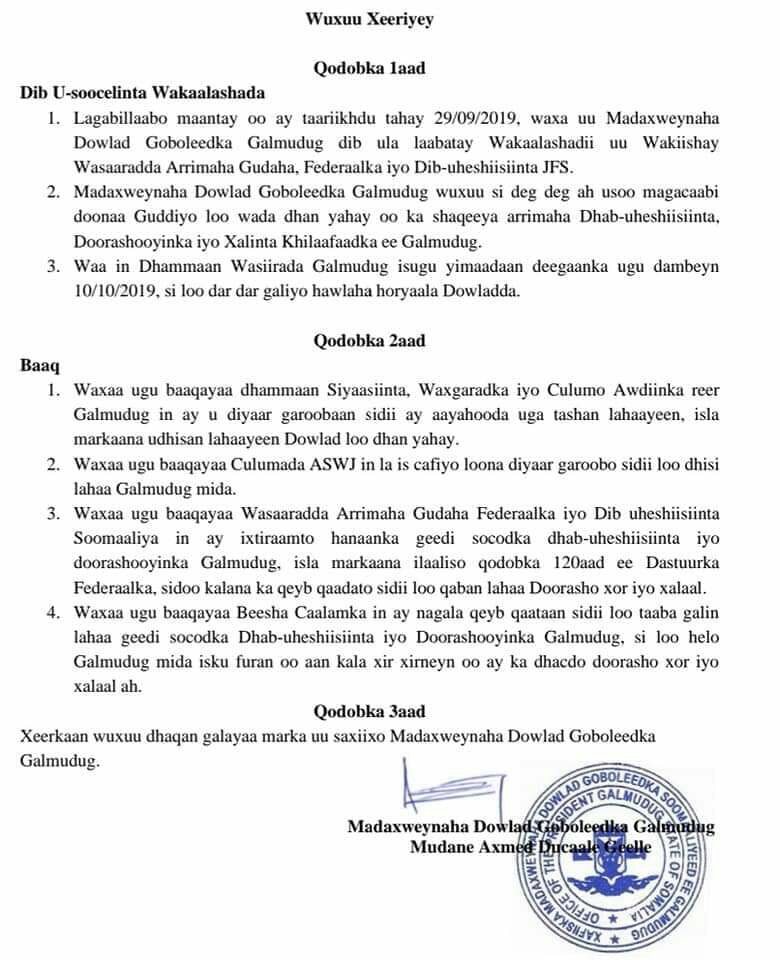
GALMUDUGH OO DIB-U-BARAARUGTAY

WHO COULD BE SUPPORTERS OF N&N  ELECTION 2020/21 IN PUNTLAND?

September 29, 2019


If an election were held in Puntland today, whom do you think would vote in support of N&N?
It isn’t a wild guess work, but a predictable scenario based on keen observation on the mood, utterings and attitudes of sections of the Puntland population.

  1. Historically, there were portions of the population in the State, who are uncomfortable with the numerical superiority of the Majertain sub-clan groupings. These would vote N&N at expense of Puntland interest.
  2. There are young and politically naive social media fans, who know neither the history of Puntland struggle nor what N&N stands for.
  3. There are people, who fell victim to Dr. Ali Khalif Galayr’s type of hate speech directed at Puntland  State.

Consequently, all these groups are turning out to be anti-federalists and anti-self-government in their campaign to discredit the formation of federal member states in favor of a strong N&N led central government, even dictatorship from Mogadishu.

Historically, this political culture of hatred towards certain sections of Northeastern population had been cultivated and developed by the former military regime of Siyaad Barre. President Farmaajo is a product and student of that repressive regime. This is Farmaajo’s basis for purging Puntlanders from Federal Public Service, exactly in the same way Siyaad Barre did then. That is why Puntland students are being punished for belonging to the wrong Federal Member State. He isn’t learning from recent Somali political history. As he got chance and a shot at Somali politics, he didn’t know enough persons of Puntland origin. As TFG Prime Minister, he was compelled to tap someone seemingly from Northeastern Regions of Somalia. He placed his bet on Abdiweli Mohamed Ali (Gaas), his fellow resident of US Buffalo NY State, the only one person he knew from Majertain, and also Gaas was former resident of Dusa-Mareeb in Galgaduud Region of Central Somalia, where Farmaajo sub-clan family hails from. President Farmaajo now thinks that even Abdiweli Gaas had betrayed him as the former had lost the Somali Prime Ministership to the latter.


Given the situational analysis of Puntland, any administration in Puntland ought to study and pay attention to these societal contradictions, as it should address any real or perceived grivances harbored by certain sections of Puntland residents, including Somali IDPs.


hattps://ismailwarsame.blog 


@ismailwarsame


Annual subscription

$37.00

N&N 2020 GENERAL ELECTION PLAYBOOK IS WELL UNDERWAY NOW

July 11, 2018
N&N Concept Note on Federal Election 2020 boils down to removing the carpet under the feet of leaders of the Federal Member States by-passing them to convey N&N message directly to the general public, especially to the youth. So far, the plan is working well.
The remaining hold-outs among the Heads of the Federal Member States are feeling the N&N political pressure now to either give in or get eliminated. The battle grounds are now shifting to Puntland and Jubaland. In the case of Puntland, there is still a political space for Puntland President Deni to maneuver as he was elected a half year ago for a 5-year Puntland mandate. Ahmed Madoobe of Jubaland is now fighting for survival. He is deeply entangled with vicious confrontation with leaders of N&N. How this would end up is everybody’s wild guess.
Prime Minister Khayre’s visit to Galmudugh and Northern Galkayo in an uncoordinated fashion with the local authorities tells volumes of information on how this political game will play out in the next few months and beyond. The plan has risk factors that could spark off renewable of the civil war. It is a daring political gamble. But, it seems to have the overwhelming support of youth in the country. And this is the very reason why N&N leaders are reluctant to approach politics as usual by ignoring community leaders, civil societies and local governments. These are to be undercut and undermined by talking to the people directly. That populalist political approach had made the election of Mohamed Abdullahi Farmaajo possible in 2016, to the surprise of those who regarded themselves political weights.
So far, no local politicians are equipped to deal with the N&N Concept on populalist agenda.This is how electioneering and political campaigns are conducted in democratic one-person one-vote elections. But, the Heads of Federal Member States are doing politics in the conventional Somali ways: clan politics. That is why they are losing battles one after the other. Puntland President Deni had underestimated Khayre’s recent visit to Galkayo by sending junior politicians to deal with the issue. The gathering yesterday in a North Galkayo stadium tells the rest of the story. But, the war has not been won or lost yet, and the final casualties are unpredictable.

FLASH BACK: ROOTS OF APPEARANCE OF PUNTLAND ON THE POLITICAL SCENE

  1. This AP Dispatch was a Prelude to the Appearance of Puntland

    ETHIOPIA SLAMS EGYPT OVER SOMALIA

    ABEBE ANDUALEM, Associated Press

    Dec. 24, 1997 1:58 PM ET
    (AP) _ Ethiopia accused Egypt on Wednesday of hijacking a peace process to end seven years of fighting in Somalia and claimed the agreement reached in Cairo by Somali factions could do more harm than good.
    The government-run Ethiopian News Agency quoted an unnamed diplomat as saying the agreement signed Monday by 26 Somali faction leaders to form a national government and end fighting could create more divisions rather than help to achieve reconciliation.
    Ethiopia, which had been conducting its own peace initiative for Somalia, apparently felt left out after Egypt and the Cairo-based Arab League invited 28 Somali leaders to Cairo where they came up with a deal after 41 days of negotiations at a hotel for Egyptian military officials.
    All but two Somali factions signed the complex power-sharing deal and agreed to a national reconciliation conference in the central Somali town of Baidoa Feb. 15 which would name the country’s first national government in seven years.
    “The Egyptian government has hijacked the Somali reconciliation process and as a result it has created more divisions within the Somali factions, thus seriously damaging efforts and gains of seven years of reconciliation among Somali faction leaders,” the agency quoted the diplomat as saying.
    The diplomat was not named but his comments were believed to reflect views of the Ministry of Foreign Affairs, which often uses the news agency to communicate government opinion.
    In Cairo, the Foreign Ministry made no formal comment. But a ministry official, speaking on condition of anonymity, said:
    “This is nonsense. We are not in the business of hijacking peace processes. These charges were not issued by the Ethiopian government, but by a Somali who is living in Addis Ababa … and the motives are clear.”
    © 2015 The Associated Press. All rights reserved. This material may not be published, broadcast, rewritten or redistributed. Learn more about our Privacy Policy and Terms of Use.
    ————————————
    Postscript, August 2015: The above was, in fact, based on my article to the Ethiopian main newspaper at the time, The Ethiopian Herald. The Egyptian dplomat in Cairo was right on the source of the information. Abdullahi Yusuf and General Aden Gabyow were still in Cairo, trying to get out of Egyptian diplomatic wrestling. That was December 1997 in Abdis Ababa. Two fateful nights for the future State of Puntland would follow from that AP despatch from Addis Ababa – Ismail H. Warsame
Loading

HOW TRUTH DIED IN SOMALI POLITICAL DISCOURSE

One would wonder how this phenomenon came to be. A Muslim society strictly supposed never to lie while following its Islamic teachings and traditional culture whose cherished values include “a man’s word is as important as himself”, and to be called “a liar” was the ultimate insult to a person. A person caught in lies used to have lost credibility and good standing in the society, and presumed to have strayed from God’s right path as well.
In nomadic society, keen to listen to the latest information on resources (rain, water, grazing etc) and security, they would come to listen to the news from a visitor from distant places, but would double check first any information concerning whether the new visitor was reliable and worthy of his word. If they would find out he was not reliable, they wouldn’t mind debriefing him. That was how we were for thousands of years.
What has happened in Somali society is a case study for sociologists, anthropologists’ and other experts of human studies. As a lay man, I can share my personal observations.
There are three venues where you can gauge how truth has died in Somali politics, possibly in other areas human of endeavor:
1. Political debates online (social media), TV and other media outlets of Somali origin.
2. Live group discussions among Somalis on events happening in their country
3. The so-called Clan Spokespersons lately appearing on the political scene (Afhayenka Beellaha Hawiye, Hag, Somali Concern, armed factional organizations, some of the civil society organizations, etc. as an example).
After observing, reading, listening to and watching the contents of the efforts of these groupings, I have tried to figure out what was the root cause of this strange culture of lies and misrepresentations of facts in Somalia. Are there historical roots for now all-encompassing phenomenon?
I am finding out that national and clan politics are hugely contradictory. National politics is a new phenomenon in Somali tribal society. Central authority was born in Somalia with the colonial powers of Italy, Britain and France. The word “Somalia” rarely existed before these powers came in the late 18th and early 19th centuries. Yes, there was the word Somali, but not Somalia as we know it.
National politics in an early stage started from Sayid Mohamed Abdallah Hassan Darwiish Movement. This was the first attempt by a political figure to transcend beyond the clan lines in both Italian and British occupied Somalia. Before that moment, Somalis were clans and sub-clans. Clans or tribes had no national politics. There were no interests beyond those of the clan, whether they involve in resources or clan security.
As political parties started to appear in the urban centers of the colonies, attempts were made to bring clans together for a common cause: Political Independence. Surely, the members of the most popular political party, the Somali Youth league (SYL) knew and quickly took steps to fight clannism, which was public enemy Number One, worst than the occupying colonial powers. Clannism was the single most important obstacle to building a nation-state. They succeeded in uniting Somalis to some extent, but fell short of a long term solution to the problem. Clannism re-emerged immediately as Somalis started to self-govern. Political parties established themselves along clan lines. The old modus operandi of safeguarding clan interests took precedence in governance. Suspicion and clan-hatred took deep roots. Deception, lies and morale degradation took hold among the new rulers of Somalia. Other enemies of Somalia such as ignorance, hunger, diseases, and backwardness had been forgotten altogether. There was no vision for Somalia to be and to prosper. In the end, it collapsed and became a failed state.
Now that that had happened, are there any lessons learned for the current leaders of Somalia, if it is going to be Somalia? Some people doubt very much. Others are quite skeptical. Still others believe that we could keep trying to benefit from the past mistakes despite strong centrifugal and centripetal forces acting on the possibility of realizing a Somali “nation-state” one day.
What you see today is the growth of clan politics at macro-level in the form of regional administrations and micro-level in the shape of clan representation in central government. The mentality here is no different from of that of 18th century when there was no Central Somali Authority, except in lies and mischaracterization. It is an attempt to mislead, misrule and misappropriate. It is self-denial leading to another failure for repeating past mistakes over and over again. It is like making your past your present and future. It is actually like missing “Both Worlds”. It is denying the truth.
Ismail H. Warsame

Twitter: @ismailwarsame

———————————————-Posted 29th March 2017 by Ismail Warsame Blog

Ismail Warsame Blog is uniquely and objectively devoted to political analysis, opinions, news, views, commentaries and modern history of Somalia, in general, and Puntland, in particular. The blog is associated with the former Chief of Staff of Puntland Presidency and one of its key founders (1998-2004).He worked with the Joint Secretariat of United Nations and World Bank on Somalia’s post civil war re-construction and Development Programme (RDP) under Joint Needs Assessment (JNA, 2005-2006).