
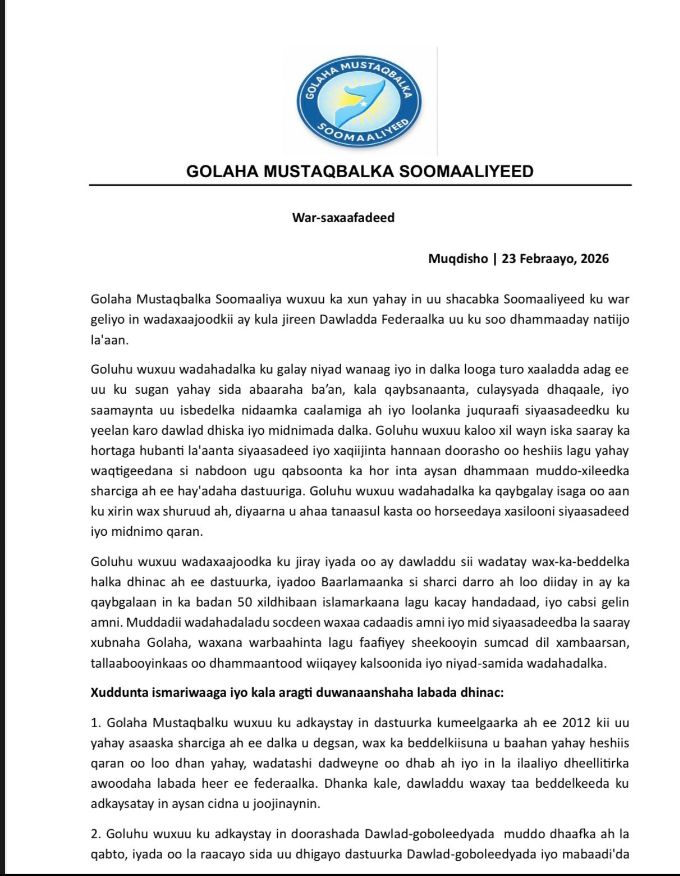
The much-anticipated meeting between Golaha Mustaqbalka Soomaalia and President Hassan Sheikh Mohamud has collapsed.
Not adjourned.
Not postponed.
Collapsed.
Yes, there remains talk of compromise. Somali politics never dies; it mutates. But let us not confuse diplomatic oxygen with political survival. The immediate outcome of this breakdown is brutally clear:
Everyone walked away with added value — except the President.
And that is the most dangerous kind of exposure in Somali politics.
Halane Shock: The International Community Wakes Up
Here is the twist no one anticipated.
The international community and donor representatives were visibly surprised by the collapse.
For months, many maintained a standby posture — cautiously observing what appeared to be a manageable constitutional dispute. They underestimated the depth of mistrust and overestimated the President’s ability to contain federal dissent.
The sudden breakdown has triggered renewed activity inside Halane Camp and beyond.
Shuttle diplomacy has intensified.
Phone lines between Mogadishu, Nairobi, Brussels, Ankara, Abu Dhabi, Cairo, and Addis Ababa are warmer than before.
Ambassadors who preferred distance are now studying seating charts.
Why?
Because instability at this moment threatens everything: constitutional review timelines, election preparations, ATMIS transition planning, and donor-funded state-building programs.
The collapse has transformed passive observation into active intervention.
And that intervention itself shifts the political chessboard.
1. Hassan Sheikh Mohamud: The Emperor Without Federal Clothes
The collapse has confirmed what critics have long argued: the administration’s overreach to dismantle the constitutional order is no longer an opposition slogan — it is now a publicly visible fact.
For months, the Federal Executive behaved as though the 2012 Provisional Constitution was clay in its hands. Amendments without consensus. Electoral models without buy-in. Security leverage over political negotiation. Venue control as psychological warfare.
But when negotiations collapse under your own roof, the optics are devastating.
Instead of appearing as a unifier, the President now appears as the principal architect of stalemate. Instead of commanding federal consensus, he is exposed as attempting to impose it.
And in Somalia, perception is power.
He has lost the narrative.
2. Said Abdullahi Deni: From Self-Isolation to Strategic Re-Entry
If there is one man who quietly gained political oxygen from this episode, it is Deni.
For years, he kept Mogadishu at arm’s length — partly out of calculation, partly out of political survival. That self-isolation carried costs. It painted Puntland as aloof, reactive, defensive.
But now?
Deni has re-entered the capital not as a guest — but as a contender.
His outreach to the Banadir community has been deliberate and symbolic. Reconnecting with old allies. Visiting familiar political circles. Reopening dormant networks. In Somali politics, relationships are currency. Deni is minting new coins.
The key question is this:
Will this Mogadishu re-entry translate into political capital before he returns to Garowe?
Because re-entry without gravitational pull is just tourism.
For this to be deemed successful, Mogadishu must begin orbiting Garowe again — politically, strategically, and psychologically.
3. Ahmed Mohamed Islam (Madoobe): Recognition Without Apology
While others debated legitimacy, Ahmed Madoobe walked away with something far more valuable: recognition.
By standing firm and engaging in the process as a principal actor, he has reinforced his status as the undisputed leader of Jubaland. The federal center can no longer pretend ambiguity about Kismayo’s authority structure.
Indictments fade. Political isolation dissolves. Presence equals legitimacy.
Madoobe did not need fireworks. He needed visibility.
He got it.
4. Golaha Samatabixiinta Soomaaliya: From Fragment to a Force
Perhaps the most underrated beneficiary of this collapse is Golaha Samatabixiinta Soomaaliya.
By associating with Puntland and Jubaland leadership, they have acquired political weight beyond their individual capacities. Alone, they were critics. Together, they became a bloc.
Somali politics respects coalitions — even fragile ones.
Their alignment with federal member state presidents has shifted them from the margins to the negotiating table as consequential actors.
That transformation is not small.
The Real Shift: Momentum
The collapse of talks does not mean paralysis.
It means momentum has shifted.
The President entered negotiations with venue control, executive leverage, and federal machinery.
He exits with an exposed overreach.
Deni entered Mogadishu cautiously.
He exits with renewed networks and symbolic re-legitimization in the capital.
Madoobe entered as a regional leader under scrutiny.
He exits as a confirmed federal power broker.
Golaha Samatabixiinta entered fragmented.
They exit politically amplified.
Only Mohamud’s office has shrunk in stature.
The Gravitational Test for Garowe
Here is the final verdict.
Deni’s return to Mogadishu cannot be cosmetic. It cannot be episodic. It cannot be a one-time political re-birth.
For Garowe to declare this mission successful, Mogadishu must feel the gravitational pull of Puntland again — in parliamentary blocs, in donor corridors, in Halane diplomacy, in Banadir alliances.
If Deni returns home without converting this exposure into durable leverage, the moment will evaporate.
But if he converts relationships into structure, outreach into coalition, and presence into positioning — then this collapse may be remembered as the turning point before 2026.
Conclusion: Exposure Is Irreversible
Compromise may still come.
Somalia’s political class is allergic to finality.
But something irreversible has happened:
The image of federal overreach has crystallized.
And once power is exposed rather than projected, it weakens.
The collapse of talks was not a dead end.
It was a redistribution of political gravity.
The only question now is:
Who understands that gravity best?
[This article was updated after posting].
 Warsame Policy & Media Network (WAPMEN)