
WAPMEN | Commentary and Critical Analysis
There is always a man you don’t see.
In Somali politics, the loudest voice is rarely the most consequential. The man at the microphone is often not the one holding the script. And in the current high-stakes negotiations between the Federal Government and Golaha Mustaqbalka Soomaalia in Mogadishu, many are asking:
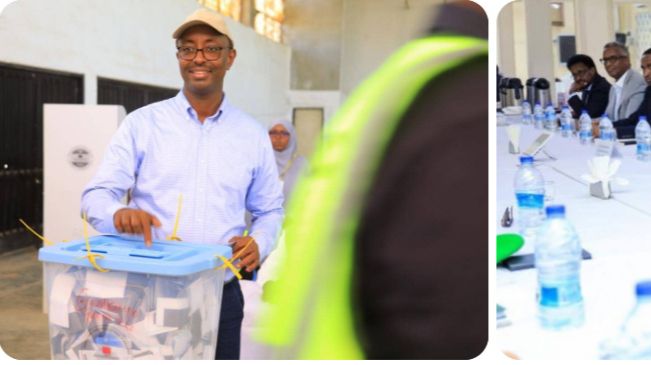
Where is Mohamed Abdirahman Dhabancad?
He is officially a member of the joint Technical Committee. Yet he is nowhere to be seen in photo-ops. No grand speeches. No visible posturing. No theatrics at Aden Adde Airport. Silence.
But seasoned observers know better.
The Pillar Behind Deni
Let us be frank: Dhabancad is not a side character in Puntland politics. He is one of the structural pillars of President Said Abdullahi Deni’s administration.
Those who underestimate him misunderstand how Puntland governance actually functions. Deni may dominate the stage, but Dhabancad has long been embedded in policy architecture, security calculus, and federal engagement strategy.
When Puntland repositioned itself after the SSC-Khaatumo political shock, when Garowe recalibrated its approach toward Mogadishu, when messaging to the international community needed refinement — Dhabancad was there.
Quietly.
The Halane Factor
If you want to understand power in Mogadishu, you must look beyond Villa Somalia. The diplomatic gravity center sits in Halane Camp.
Halane is where narratives are shaped, briefings are delivered, and political futures are quietly assessed by external stakeholders — the UN, the EU, regional powers, ATMIS contributors, and security partners.
Do not assume that absence from public meetings equals irrelevance.
It is entirely plausible that Dhabancad is operating where it matters most:
Maintaining channels with international missions
Framing Puntland’s federal stance in acceptable diplomatic language
Preparing contingency scenarios should the current federal structure implode
This is not street politics. This is statecraft.
The Prime Minister Question
Let us address the elephant in the room.
If Prime Minister Hamse Abdi Barre falters before 2026 — and Somali prime ministers have historically had short political shelf lives — who steps into the vacuum?
Somalia’s power-sharing arithmetic is not random. It is engineered through clan balance, geopolitical comfort, and donor acceptability. A replacement prime minister would need:
Federal experience
Puntland backing or at least acquiescence
Acceptability to Mogadishu elites
Non-threatening optics to external partners
Capacity to negotiate constitutional and electoral turbulence
Dhabancad checks more boxes than many currently visible aspirants.
He is neither flamboyant nor reckless. He is measured. That makes him dangerous in Somali politics — dangerous in the sense of being viable.
The Misreading of Visibility
Somali political culture worships visibility. We mistake television presence for influence. We confuse loud rhetoric for strategic depth.
But the real players often operate in committees, in briefing rooms, in corridors between Villa Somalia and Halane, in late-night strategy sessions where no cameras are allowed.
Dhabancad’s invisibility may not be absence. It may be preparation.
Deni’s Insurance Policy?
Another uncomfortable possibility:
If President Hassan Sheikh Mohamud consolidates short-term control, and if Deni recalibrates toward 2026 federal ambitions, having a trusted ally positioned for a potential federal premiership becomes strategic insurance.
A Dhabancad premiership could:
Provide Puntland leverage inside the federal executive
Balance Villa Somalia without open confrontation
Create an internal counterweight within the federal cabinet
Protect Garowe’s long-term interests
In Somali federal chess, this would not be accidental. It would be calculated.
Why the Silence?
Because premature ambition kills careers in Mogadishu.
Announce yourself too early, and you become a target.
Signal too loudly, and you trigger clan resistance.
Move too fast, and the international community grows uneasy.
The art of Somali political survival lies in appearing reluctant while preparing relentlessly.
Dhabancad understands this.
Watch the Technical Committee
Do not focus only on plenary sessions between the President and Golaha Mustaqbalka Soomaalia. Watch the technical layers. That is where frameworks are drafted, compromises engineered, and exit strategies built.
If the constitutional deadlock deepens…
If electoral modalities collapse…
If the premiership becomes expendable…
The quiet man may step forward.
The Future of Federal Power-Sharing
Somalia’s federal model remains fragile. The 2012 Provisional Constitution is under strain. Federal Member States are distrustful. The center is overreaching. Donors are fatigued.
In such volatility, compromise figures emerge — not the loudest, but the most structurally positioned.
Mohamed Abdirahman Dhabancad fits that description more than many realize.
Somali politics is never only about who is speaking.
It is about who is preparing.
And somewhere between Garowe and Halane, a file may already be open with his name on it.
Watch carefully.
——-
Support WAPMEN — the home of fearless, independent journalism that speaks truth to power across Somalia and the region. Tel/WhatsApp: +252 90 703 4081.
 Warsame Policy & Media Network (WAPMEN)