
WAPMEN EDITORIAL
A working lunch has been held today between Golaha Mustaqbalka Soomaalia and President Hassan Sheikh Mohamud. Smiles were exchanged. Plates were served. But let us not be fooled by the choreography of civility.
The issue before Somalia is not protocol. It is not optics. It is not who sat closer to the head of the table.
It is the foundation document of the Somali state — the Constitution.
And constitutions are not amended between tea and dessert.
The Only Existing Consensus: 2012
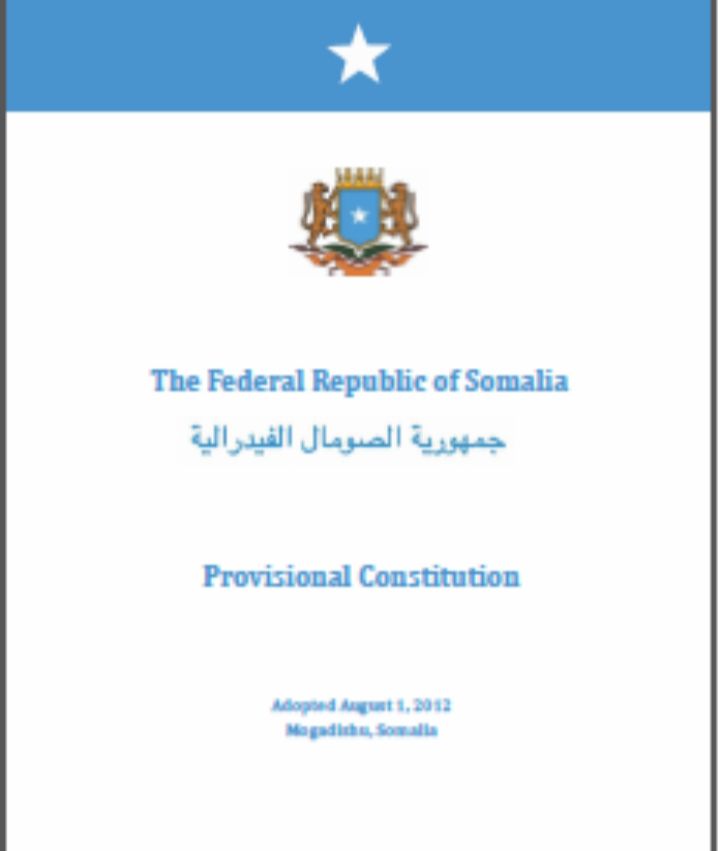
The only legitimate, political consensus Somalia possesses today is the Provisional Constitution of Somalia adopted in 2012.
It was imperfect.
It was hurried.
It was incomplete.
But it was agreed upon.
It was the minimum national contract that held the country together after decades of collapse.
Everything else — every unilateral revision, every selective reinterpretation, every so-called “completion process” conducted without broad federal consensus — is legally and politically fragile.
Let us speak plainly:
A constitution is not a presidential memo.
It is not a party manifesto.
It is not a tactical campaign tool.
It is a political covenant.
And covenants are not altered by ambition.
Electoral Modalities Are Secondary
The political class loves to argue about electoral formulas. One-person-one-vote. Indirect elections. Delegates. Technical committees.
But this is putting the cart before the camel.
Without agreement on:
The distribution of powers,
The nature of federalism,
The limits of executive authority,
The role of the Federal Member States,
any election is merely a transfer of crisis.
Electoral modalities are mechanical questions.
The Constitution is existential.
If the foundation is cracked, the building collapses — no matter how elegant the voting system.
Leave It for the Next Administration
There is a logical, sober course of action:
Freeze constitutional tinkering.
Respect the 2012 framework.
Stabilize the political climate.
Let the next administration — with fresh legitimacy — handle constitutional review.
Why?
Because no sitting president seeking political advantage can credibly be both referee and contestant in rewriting the rules of the game.
Any constitutional “completion” process conducted under political tension will not produce legitimacy. It will produce resentment.
And resentment in Somalia has a long shelf life.
Unilateral Amendments Are Politically Dead on Arrival
Golaha Mustaqbalka Soomaalia is correct on one core principle:
Any unilateral constitutional amendment is unacceptable.
Federalism in Somalia is not a gift from Villa Somalia.
It is a de facto political reality born out of civil war.
No administration — past or present — has the authority to dismantle it through procedural shortcuts.
Attempts to centralize power under the banner of “national unity” are nothing but recycled authoritarian reflexes.
Somalia has tried centralized rule before.
It did not end well.
Farmaajo’s Late Entrance: Political Fishing Season
And now enters Mohamed Abdullahi Mohamed, offering himself as mediator, convenor, elder statesman.
Let us not romanticize political opportunism.
A presidential candidate cannot present himself as a neutral broker in a constitutional crisis. That is not statesmanship. That is positioning.
If one is seeking Villa Somalia again, one cannot simultaneously pretend to be the guardian of constitutional purity.
It is political fishing season.
And the crisis is the bait.
What original constitutional vision has been presented?
What innovative framework has been proposed?
What lessons have been publicly acknowledged from past unilateralism?
Silence.
Grandstanding is not governance.
Re-entry into the arena requires ideas, not nostalgia.
The Real Question
The real question facing Somalia is simple:
Will we build a republic based on consensus —
or gamble it on presidential calculations?
Because the constitution is not about Hassan Sheikh.
It is not about Farmaajo.
It is not about 2026.
It is about whether Somalia can finally agree on the rules before competing for power.
Without constitutional consensus:
Elections become theatrical.
Parliament becomes ornamental.
Federalism becomes rhetorical.
The state becomes transactional.
And transactional states collapse at the first shock.
A Republic Cannot Be Governed by Appetite
A working lunch is a pleasant diplomatic gesture.
But Somalia cannot be governed by appetite.
The Constitution must be removed from the battlefield of short-term politics.
The 2012 consensus must be respected.
Unilateral revisions must be declared null and void in political practice.
Stability first.
Consensus second.
Elections third.
Reverse that order — and the cycle of crisis continues.
WAPMEN has said it before:
Somalia’s problem is not a shortage of politicians.
It is a shortage of restraint.
And until restraint becomes fashionable in Mogadishu,
every working lunch will be followed by political indigestion.
——
Support WAPMEN — the home of fearless, independent journalism that speaks truth to power across Somalia and the region. Tel/WhatsApp: +252 90 703 4081.
 Warsame Policy & Media Network (WAPMEN)