
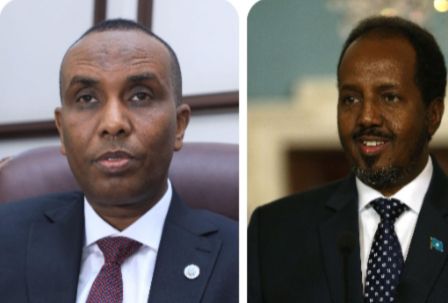
There is a question hanging over Mogadishu like a low cloud before a storm:
Who controls the tongue of Somalia’s Defence Minister — and who answers for it?
The current holder of that office, Ahmed Moallim Fiqi, is not a talk show activist. He is not a Facebook commentator. He is not a clan mobilizer at a roadside tea stall. He is the Minister of Defence of the Federal Republic of Somalia — entrusted with the integrity of the armed forces and the dignity of the state.
And yet, what we have witnessed resembles political street theatre rather than ministerial discipline.
The Weight of the Office
The Ministry of Defence is not a gossip ministry. It is not a propaganda bureau. It is the nerve center of national security.
When a defence minister speaks, he speaks to:
Soldiers risking their lives.
International partners coordinating security assistance.
Federal Member States whose cooperation is essential.
A fragile nation still healing from decades of war.
If such a minister publicly insults or libels a sitting Federal Member State president — in this case Said Abdullahi Deni — then the issue is not personal rivalry. It becomes constitutional misconduct.
Is This Personal — or Coordinated?
Let us ask the uncomfortable questions:
Is the minister freelancing?
Or is he speaking what others prefer not to say?
Is he being used as an attack dog against Puntland?
If so, who unleashed him?
Because in any functional government, cabinet responsibility is collective.
If Hassan Sheikh Mohamud and Hamza Abdi Barre disagree with Fiqi’s conduct, they must say so publicly. Silence becomes endorsement.
If they agree with him, then the federal government is officially adopting confrontation as policy.
There is no third option.
Accountability Is Not Optional
A defence minister does not have the luxury of behaving like a partisan blogger. His words carry state authority. If those words include:
Insults toward elected leaders
Defamation of political rivals
Incendiary rhetoric that deepens federal fractures
Then the responsibility does not end at his podium.
Under any parliamentary system:
The Prime Minister supervises ministers.
The President embodies national unity.
Cabinet misconduct is government misconduct.
If Fiqi libels, the government libels. If Fiqi provokes, the government provokes. If Fiqi destabilizes federal relations, the government destabilizes them.
This is not about Puntland versus Mogadishu. It is about constitutional culture.
The Federal Fragility Factor
Somalia is not Canada. It is not Germany. It is not a mature federation.
It is a fragile federal experiment balancing:
Clan realities
Security threats
External interference
Internal mistrust
When a defence minister publicly attacks a Federal Member State president, it sends one dangerous message:
The centre views the periphery as an adversary.
That is how federations collapse.
Political Strategy or Strategic Miscalculation?
If the intention is to weaken Said Abdullahi Deni politically ahead of 2026 calculations, then the method is reckless.
Why?
Because Somalia’s political history is clear:
Presidents are not defeated by insults.
They are defeated by alliances.
Public humiliation tactics rarely eliminate rivals. They elevate them.
The more a federal minister attacks Puntland’s leadership, the more he risks strengthening Puntland’s internal cohesion.
Politics 101.
The Deeper Problem: Normalized Impunity
The real crisis is not Fiqi’s temperament. It is the normalization of impunity.
No parliamentary reprimand.
No cabinet clarification.
No presidential distancing.
No formal correction.
Are we now in a system where ministers can:
Defame without consequence?
Weaponize state platforms?
Turn security portfolios into political megaphones?
If so, then the Provisional Constitution is becoming ornamental.
A Simple Constitutional Question
Who is responsible for a cabinet minister’s gross misconduct?
The answer in every functioning democracy is simple:
The head of government.
Which in Somalia means:
The Prime Minister carries operational responsibility.
The President carries political responsibility.
If they do nothing, they own it.
Final Word
Somalia does not need attack dogs in cabinet. It needs statesmen.
The Ministry of Defence should project:
Discipline
Neutrality
Institutional maturity
Not partisan hostility.
If Minister Fiqi cannot separate political rivalry from state responsibility, then those who appointed him must answer for that failure.
Because in governance, misconduct at the top is never individual.
It is systemic.
And systems either correct themselves —
or collapse under their own recklessness.
——
Support WAPMEN — the home of fearless, independent journalism that speaks truth to power across Somalia and the region. Tel/WhatsApp: +252 90 703 4081.
 Warsame Policy & Media Network (WAPMEN)
You must be logged in to post a comment.