MOGADISHU’S POLITICAL BAROMETER IS RISING

The Airport Compound Whispers of a Power Shift
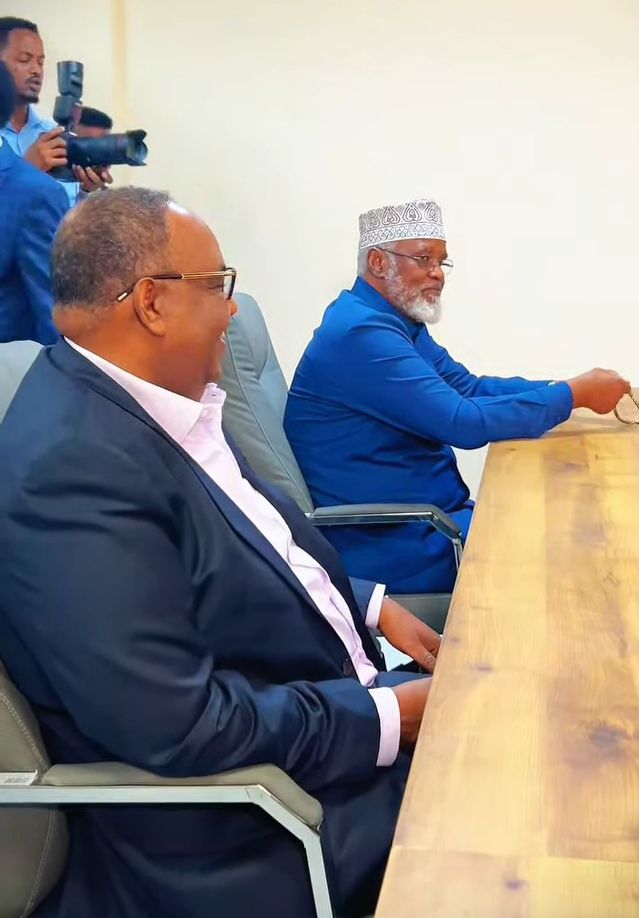
Deni & Madoobe


There are moments in Somali politics when nothing official has happened — yet everything has changed.
Right now, Mogadishu feels different.
The air is thick. The corridors are restless. The tea houses are whispering. And inside the fortified Airport Compound — that strange hybrid of sovereignty and supervision — two residences have suddenly become the epicenter of national gravity: those of Said Abdullahi Deni and Ahmed Mohamed Islam.
You can measure power in Somalia not by decrees, but by footsteps.
And the footsteps are heading in one direction.


The Airport Compound: Somalia’s Real Political Thermometer
For years, Villa Somalia pretended to be the center of gravity.
But in truth, real politics in Somalia often unfolds inside the blast walls of Aden Adde Airport — where federal leaders, regional presidents, diplomats, and intelligence brokers circle one another in cautious choreography.
And right now?
There is a steady procession of MPs, business elites, clan elders, former ministers, and foreign envoys walking into two particular residences.
Not for courtesy calls.
For calibration.
Ahmed Madoobe: The Stabilizer
Let us be clear.
Ahmed Mohamed Islam (Madoobe) is not expected to run for Villa Somalia. He does not need to. His leverage lies elsewhere. He represents continuity in Jubaland, regional autonomy, and a bloc that can tilt any federal equation.
His presence in Mogadishu right now is strategic, not theatrical.
He is the stabilizer — the man who can either neutralize a transition or accelerate it.
When Mogadishu politicians visit him, they are not asking about Kismayo.
They are asking about the future alignment of power.
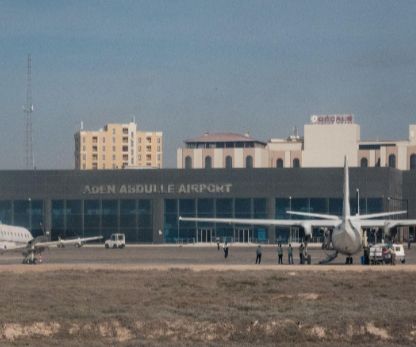
Airport Compound


Deni: The Wild Card Returns
But the real temperature spike is around Said Abdullahi Deni.
Let us not romanticize it.
Let us analyze it.
In 2022, Deni was seen as energetic but politically premature. He misread Mogadishu’s subterranean clan arithmetic. He underestimated the entrenched networks around Villa Somalia. He was bold — but not calibrated.
This time feels different.
There is composure.
There is calculation.
There is maturity.
The stream of visitors is not accidental. It reflects three emerging realities:
Fatigue with centralized micromanagement.
Fractures within the ruling coalition.
Donor and regional actors quietly hedging their bets.
Somali politicians have one instinct sharper than ideology: survival.
And survival instincts are pulling them toward where they sense momentum.


Hassan Sheikh’s Shrinking Orbit
Power in Somalia erodes quietly before it collapses publicly.
When leaders begin to lose informal control — when MPs stop seeking daily validation — when foreign diplomats begin making “courtesy visits” elsewhere — when elders hedge their loyalties — that is when the clock begins ticking.
Villa Somalia may still command protocol.
But protocol is not power.
The psychological center of gravity appears to be shifting.
And in Somali politics, perception becomes reality faster than ballots do.


The Clan Equation Recalculates
Let us be intellectually honest.
Somalia does not operate on ideology. It operates on alliances. Fluid, temporary, transactional alliances.
Deni’s recent outreach — to defectors, to rival constituencies, to Banadir circles — signals that he has finally internalized this truth.
Ahmed Madoobe’s alignment signals that regional presidents are no longer willing to be reduced to ceremonial governors under a centralizing presidency.
This is not rebellion.
It is recalibration.


The International Dimension
Do not underestimate Halane’s quiet diplomacy.
Regional actors — Egypt, Ethiopia, Türkiye, UAE — are all watching.
They do not invest in political nostalgia. They invest in trajectories.
And trajectories right now are under review.
When the international community intensifies shuttle conversations without press releases, it means one thing: contingency planning has begun.


Is Change Inevitable?
Somali politics is notorious for sudden reversals.
Today’s front-runner becomes tomorrow’s exile.
But there are early warning indicators of transition:
Increased political pilgrimage to alternative power centers.
Growing silence from once-dominant presidential networks.
Subtle shifts in media tone.
Business community hedging behavior.
All four are visible.
Change is not declared.
It is felt.
And Mogadishu feels like a city preparing for rearrangement.


The Deeper Question
Here is the uncomfortable question for Somalia:
Is this merely a shift in personalities —
or a shift in governance philosophy?
If Deni rises, will he decentralize power genuinely?
Will federalism be strengthened or instrumentalized?
Will institutions be built — or simply captured?
Somalia has replaced leaders before.
It has rarely replaced political culture.
That is the real test.


Conclusion: The Quiet Before the Announcement
Something is brewing inside those blast walls.
It may not erupt tomorrow.
But it is moving.
Somali politics has entered its pre-election psychological phase — where alliances form quietly, loyalty becomes negotiable, and power begins to migrate before the official announcement.
The Airport Compound is humming.
The visitors keep coming.
And Mogadishu — that eternally unpredictable capital — is once again reminding us:
In Somalia, power does not fall.
It shifts.
And right now, it is shifting.

——
Support WAPMEN — the home of fearless, independent journalism that speaks truth to power across Somalia and the region. Tel/WhatsApp: +252 90 703 4081.

The Mirage of Sisi’s “Humiliation” of Somalia –What Really Happened in Cairo

Internet Spin. Take a watch:

https://www.facebook.com/share/v/17tjDyHr8T/

WAPMEN Fact-check:

By WAPMEN  — Fearless Independent Analysis | February 2026

In the age of social-media outrage, a three-minute clip can go viral — yet distort reality. A recent video circulating online purportedly shows Abdel Fattah el-Sisi humiliating Hassan Sheikh Mohamud on the world stage during a joint press conference in Cairo. The narration accompanying it claims Sisi publicly shamed Somalia as a nation of dysfunction: “30 years of chaos,” “a $1 billion economy,” “only 25 million people who can’t solve their own problems.” This framing isn’t just misleading — it’s a reckless distortion of diplomacy used to fuel nationalist resentment and despair.

Let’s peel back the smoke and mirrors.

 The Press Conference: Reality vs. Online Spin

On 8 February 2026, Egyptian and Somali leaders met in Egypt’s capital for high-level talks — part of a deepening strategic partnership between Cairo and Mogadishu . This was not a confrontation staged for global viral consumption; it was a formal diplomatic engagement featuring a guard of honor, national anthems, and an expanded session of talks .

According to the official transcript from the Egyptian presidency and multiple independent reports:

· President Sisi welcomed President Mohamud to Cairo, referring to him as “my brother, Your Excellency” and affirming the “historical relations and fraternal bonds” between the two nations .
· Sisi repeatedly reiterated Egypt’s support for Somalia’s “unity, security, and territorial integrity,” and condemned any attempts to undermine them, explicitly rejecting “the recognition of the independence of any part of its territory” — a direct reference to recent moves regarding Somaliland .
· Egypt pledged participation in the African Union Support and Stabilization Mission in Somalia (AUSSOM) and committed to deepening cooperation in security, trade, development, health, and capacity-building . Reports following the visit confirmed Egypt deployed approximately 1,100 troops with armored vehicles and air assets .
· President Mohamud, for his part, thanked Egypt for its support, praising Cairo’s role in backing Somalia’s independence and expressing “profound appreciation for Egypt’s support for Somalia’s unity and stability” .

Nowhere in the official transcript or media coverage of the press conference does Sisi deride Somalia as a “failed state,” nor does he publicly read out Somalia’s GDP, population, or poverty statistics to an Egyptian audience as a spectacle of blame. In fact, Sisi explicitly stated: “Egypt will always remain a sincere partner and a steadfast supporter of Somalia” .

What’s missing from the viral outrage? Context. Official records show support, not mockery.

The Misleading Narrator and the Social-Media Lens

The sensation-seeking clip circulating on Facebook and Instagram relies on snippets of body language and tone — not substantive statements — to suggest a “humiliation.” But as analysts and diplomatic correspondents have made clear, reliable reporting contradicts that interpretation .

This is classic narrative manipulation:

· Soundbite cherry-picking — A serious geopolitical speech becomes “proof” of mockery through selective highlighting.
· Conspiracy framing — Claims that Sisi deliberately injured Somalia’s dignity for domestic political gain lack evidence.
· Emotion over evidence — Viral posts trade on anger and resentment, not quotes or data.

There’s no credible source confirming that Sisi stated Somalia is a “$1 billion economy” or scolded the Somali president for incompetence at the press podium. That narrative is internet fabrication — not verified fact.

Why This Matters: Geopolitics, Not Public Shaming

Understanding the Egyptian-Somali context is vital:

· Egypt has a longstanding strategic relationship with Somalia, including defense cooperation agreements signed in August 2024 and a strategic partnership declaration in January 2025 .
· Cairo’s interest in Somalia isn’t contempt — it’s geopolitical: securing maritime corridors (the Red Sea and Gulf of Aden), counteracting regional instability, and countering recent moves such as Israel’s recognition of Somaliland in late 2025, which Egypt explicitly rejected .
· The meeting’s purpose was coordination on security and development, not a televised diplomatic roast. Talks specifically covered Egypt’s upcoming AUSSOM troop deployment, counter-terrorism cooperation, and even a planned Egyptian medical mission to Somalia .

The danger of mislabeling diplomatic speech as humiliation is not cosmetic — it erodes trust, fuels misdirected anger, and sows division within Somali politics at precisely the time when national unity is both fragile and essential.

The Bigger Picture: Viral Outrage vs. Real Diplomacy

If the real speech was as humiliating as claimed, why did every reliable news source report a tone of cooperation and mutual support? Why did Egyptians emphasize Somalia’s territorial integrity? Why did both leaders walk away talking of partnership, troop deployment, and trade?

Because diplomacy is not a reality TV show:

· Presidential speeches follow protocol and nuance.
· Leaders project national interests — not personal insults — in official forums.
· Strategic alliances are negotiations, not contemptuous grandstanding.

Reducing a complex diplomatic interaction to a meme about “humiliation” is political clickbait — and a betrayal of Somali interests.

WAPMEN Verdict: The Story People Told Is False, But There Is a Story Worth Telling

No, President Sisi did not publicly humiliate President Mohamud in Cairo — that’s an online fabrication contradicted by official transcripts, Somali and Egyptian state media, and independent international news agencies .

Yes, the narrative reveals a deeper issue: Somalis are tired of global narratives that paint their nation as helpless or failed. That frustration — real and justified — gets weaponized online into memes of insult, but such memes do far more harm than good. In reality, Somalia’s president stood in Cairo negotiating hard interests — securing Egyptian troop commitments, rejecting Somaliland recognition, and deepening a strategic partnership — not being publicly scolded.

In an age of weaponized misinformation, the gravest humiliation is letting fabricated narratives shape Somali political identity.

—–

For fearless analysis that cuts through the noise — stay with WAPMEN.