
WDM EDITORIAL
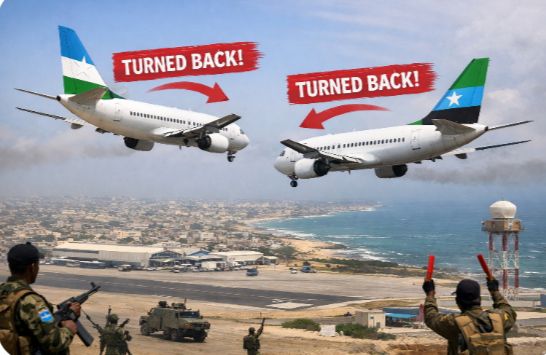
Sunday’s farce at Aden Adde International Airport—where the Federal Government denied landing rights to delegations from Puntland and Jubaland citing a “serious threat to national security” posed by their security contingents—did not merely disrupt travel; it exposed a constitutional absurdity so stark that satire almost feels redundant. Almost.
When public trust evaporates, Somalia’s federal bargain collapses into its raw mechanics. Yet, when leaders invited for unity talks are blocked because their approved security detail (30 uniformed, 10 plainclothes) is deemed a “heavily armed contingent” arriving without coordination, federal logic is replaced by gatekeeping. The center, unable to secure the nation from Al-Shabaab, now desperately secures the airport from its own partners. The message was simple and insulting: Mogadishu no longer belongs to Somalia; it belongs to those who control the gate.
Welcome to Villa Somalia International Border Control.
This is not security; this is sovereignty theater. A presidency that lectures about unity, while suspending parliament after clashes over centralizing constitutional amendments, practices administrative secession. Puntland and Jubaland were treated not as constitutional partners, but as foreign missions arriving without clearance—their protests that the decision “endangered” their staff held up to the glass by security operatives performing loyalty tests.
In a functioning federation, the capital is neutral ground. In today’s Somalia, it behaves like a besieged city-state, rationing access to power through airport turnstiles. The irony is lethal: the runway has become the constitution; the security checkpoint, the Supreme Court.
Let us be blunt. If Federal Member States need revocable “clearance” to land in Mogadishu, then Mogadishu has seceded from Somalia in practice, if not in name. It has declared itself the property of an incumbency—guarded, gated, and weaponized against dissent.
And what does this teach the public? That federalism is conditional. That partnership is revocable. That the capital is a reward for obedience, not a right of belonging. This lesson arrives not in isolation, but amidst a pattern where the “shared house” is under renovation by one tenant.
History will record this moment not as a security incident, but as a constitutional humiliation. A day when the center confessed its weakness by acting like a jealous province. A day when the airport replaced parliament as the arena of politics.
Somalia does not need more checkpoints. It needs a center confident enough to be open, and a federation brave enough to be honest. It needs protocols built on trust, not tarmacs ruled by suspicion. Until then, expect more “security visas” at the gate—and fewer reasons to call Mogadishu a national capital at all.
WDM | Warsame Policy & Media Network
Fearless. Independent. Accountable Journalism.
 Warsame Policy & Media Network (WAPMEN)