
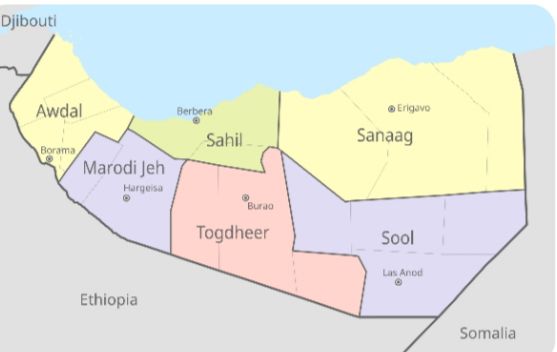
The fantasy of a recognized Somaliland is finally colliding with the hard wall of geography, demography, and power politics. Strip away the slogans and flags, and what remains is an increasingly reduced, brittle enclave—politically narrowed, territorially fragmented, and socially contested. Recognition, even if theatrically announced by Israel, does not manufacture viability. It exposes fault lines.
Moreover, the recognition has been met with near-universal diplomatic condemnation. Key international bodies—including the African Union, Arab League, and European Union—alongside major powers like the United States and United Kingdom, have all explicitly rejected the move and reaffirmed support for Somalia’s sovereignty and territorial integrity
The Shrinking Core
What is marketed as “Somaliland” today is no longer the broad northern coalition once claimed in 1991. Sool, Sanaag, and Cayn are outside effective control. Awdal is restive. The project has collapsed inward into a single-clan core, while borderlands reject rule by decree from Hargeisa. This is not statehood; it is contraction.
Recognition as Militarization
To keep a reduced entity alive, recognition would have to be backed by force. That is the unspoken premise. A paper recognition without security is meaningless; a security guarantee without legitimacy is combustible. Any external patron—Israel included—would be compelled not merely to defend but to expand control to create “strategic depth.” Translation: militarization of contested territories, especially Dhulbahante lands. That is a recipe for war, not state-building.
The Inevitable Blowback
Such a move would ignite conflicts across the north and trigger a counter-alignment. The irony is sharp: external arming intended to “save” Somaliland would reunify its opponents. Puntland—which has kept a wary distance from Mogadishu—would be pushed back into strategic coordination with the center, alongside the Federal Government of Somalia. Not out of romance, but necessity. Security pressure forges alliances faster than speeches.
How the Project Ends
This is how the Somaliland experiment ends—not with a UN seat, but with overreach. Recognition that requires tanks, drones, and proxy militias to redraw clan borders is not recognition; it is annexation by violence. The backlash would harden resistance, internationalize local grievances, and collapse the remaining political space Hargeisa still occupies.
The Verdict
A “recognized Somaliland” that exists only by arming itself into other people’s territories is unviable by design. The attempt would likely finish Somaliland as we know it—by forcing a northern consolidation against it and by stripping the project of any remaining moral or legal claim to self-determination.
Statehood is built on consent and cohesion. When recognition demands conquest, the math is simple: collapse is inevitable.
——-
Support WAPMEN — the home of fearless, independent journalism that speaks truth to power across Somalia and the region. Tel/WhatsApp: +252 90 703 4081.
 Warsame Policy & Media Network (WAPMEN)