
Israel’s formal recognition of Somaliland on December 26, 2025, is not a bolt from the blue. It is an invoice arriving—late, stamped, and payable—after years of Somalia behaving like a state that wants the title deed to unity but refuses to maintain the house of governance.
In geopolitical terms, recognition is rarely a moral reward; it is a transaction. Somaliland did not suddenly become “more real” today. It simply became more useful to an external actor. And Somalia, by becoming ungovernable, made the transaction cheaper.
What did we expect after making the country ungovernable? We expected exactly this.
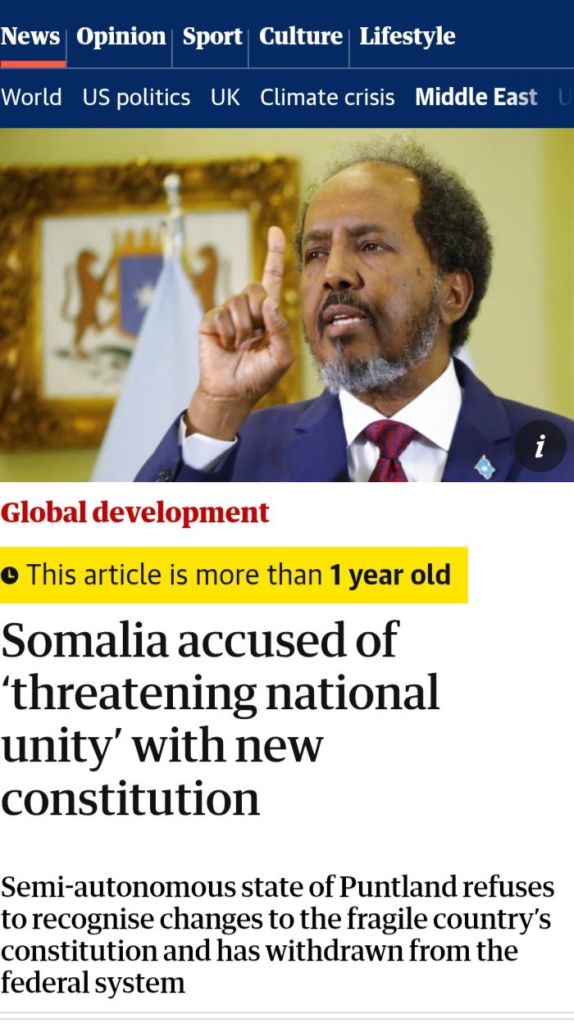
When a federal center treats the Provisional Constitution as a suggestion box—opening the door to corruption, land grabs, and unconstitutional power plays—it does not “strengthen the state.” It advertises the state as for sale. The recent constitutional changes, which Puntland refused to recognize and which led it to withdraw from the federal system, are a prime example. Mogadishu was accused of “threatening national unity” by concentrating power.
This trajectory was not state-building; it was state-unbuilding.
For years, WDM has warned that Somalia’s federal experiment “has now entered its terminal crisis stage,” where relations between the center and member states have decayed into “mutual suspicion, coercion, and political trench warfare”—fertile ground for fragmentation. We explicitly framed Somalia’s future as a fork in the road: “A negotiated consensus” or “A dangerous fragmentation—where Mogadishu’s unilateralism spawns rival governments, contested institutions, and international confusion”.
We warned that the Garowe–Mogadishu confrontation was not political theatre, but a collision course that could breed “parallel governments (Garowe vs Mogadishu model)” and invite increased foreign meddling. We doubled down that delay is a strategy of cowards: “Somalia always pays more when it waits. More instability. More fragmentation. More foreign interference”.
So no—this is not “Somaliland winning.” This is Somalia defaulting.
The weaponization of the center normalized fragmentation.
The pattern of the federal center treating member states as targets, not partners, hardened in recent years. WDM documented that under the regimes of Farmaajo and Hassan Sheikh Mohamud, the National Consultative Council (NCC) was transformed from a dialogue platform into “a forum to pressure Puntland and Jubaland” and “a tool to override federalism”. Once a state normalizes internal war-by-politics, it should not act surprised when outsiders start treating its map as negotiable.
“Other countries to follow?” Yes—because the center taught them how.
Reuters frames Israel’s move as a “first”. That word is the danger. Once one country crosses the line, the next ones will not need to argue the entire case again. They will only need to ask: What do we gain? What does Mogadishu offer? What can Hargeisa deliver?
Somalia’s federal center, by violating the spirit and procedures of its own constitution, has made itself a weak negotiator—sometimes not even a negotiator at all, just a loud protester outside the room. This is the strategic humiliation: a state that cannot keep its own federation intact will struggle to keep its sovereignty arguments persuasive abroad.
How long have we been warning? Long enough that the warnings now look like minutes of a meeting Somalia refused to attend.
When WDM titles an essay “Garowe vs. Mogadishu: The Looming Political Collision Course” and explicitly lists fragmentation as a probable outcome, that is not commentary—it is an alarm. When WDM publishes “Somalia’s Federalism in Paralysis” and describes terminal decay, that is not pessimism—it is diagnosis. When WDM says Somalia must choose confederation or fragmentation, that is not provocation—it is an exit map from a burning building.
The Bottom Line
Somaliland’s recognition is not merely Somaliland’s diplomacy. It is Somalia’s self-inflicted emptiness being filled by other people’s interests.
If Mogadishu wants to stop the dominoes, it must stop behaving like a landlord who evicts tenants (member states), then screams “unity!” from the rooftop of a collapsing building.
Somalia’s unity cannot be enforced by decree, purchased by corruption, or performed on television. It must be negotiated, constitutionally, and collectively owned—or it will be internationally auctioned, piece by piece.
By the way, how much do you think the recent Somalia’s E-VISA controversy has contributed to this balkanization of Somalia? Have your say.
Citations
1. Garowe vs. Mogadishu: The Looming Political Collision Course. WDM Editorial, Nov 3 2025.
2. Somalia’s Federalism in Paralysis. WDM White Paper, Nov 27 2025.
3. The Price of Delay: Somalia’s Leaders Are Choosing Chaos Over Consensus. WDM Editorial, Dec 23 2025.
4. Somalia accused of ‘threatening national unity’ with new constitution. The Guardian, Apr 5 2024.
5. Israel becomes first country to formally recognise Somaliland as independent state. Reuters, Dec 26 2025.
 Warsame Policy & Media Network (WAPMEN)