
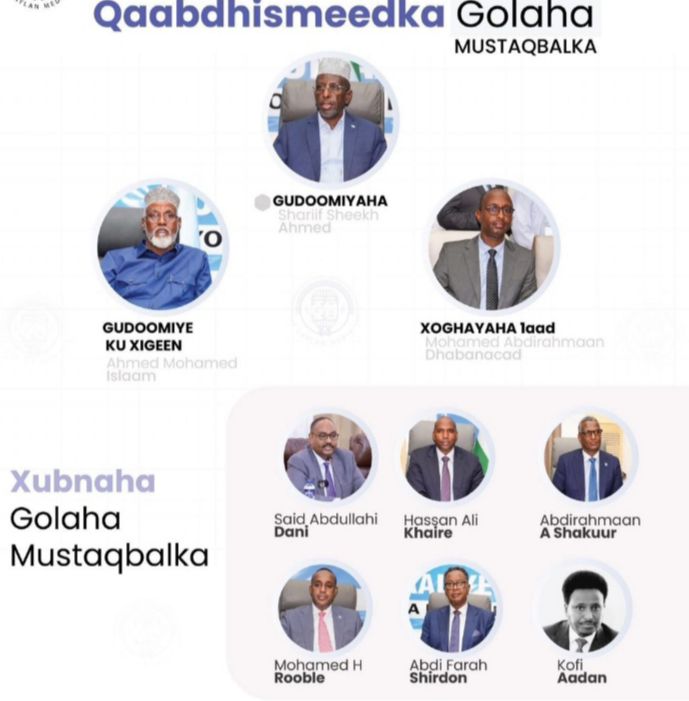
Somalia has learned, painfully, that leadership does not end with ballots, speeches, or borrowed legitimacy from foreign podiums. It ends when reality knocks. And reality, as usual, arrives late, uninvited, and unimpressed.
This image—circulating quietly, almost shyly—does not scream victory. It does not promise miracles. It does not declare itself the future. That alone makes it revolutionary.
What it shows is something Somalia has been starved of for decades: the early outline of post-Hassan Sheikh Mohamud politics, beyond May 2026. Not slogans. Not clan arithmetic. Not Villa Somalia theatrics. But faces that suggest influence, continuity, negotiation, and uncomfortable political conversations.
Although not necessarily more qualitative, it carries visible signs of reckoning—a rare political currency in a country exhausted by grand claims and chronic under-delivery.
In Somalia, that is radical.
The End of the Traveling Presidency
For nearly a decade, Somali politics has resembled a departure lounge. Leadership was measured in air miles, hotel conferences, and donor applause. Governance was something to be discussed abroad, not practiced at home. Federalism became a word to be recited, not respected. National reconciliation turned into an annual slogan, dusted off whenever legitimacy dipped.
The post-2026 moment, however, will not tolerate this circus. The country is exhausted. The regions are assertive. The people are watching.
This image hints at figures who understand that Somalia is no longer governed from one compound, one clan narrative, or one donor briefing. It suggests personalities shaped by friction—between federal member states and Mogadishu, between tradition and modern statehood, between unity and forced uniformity.
A New Kind of Political Gravity
What makes this emerging constellation interesting is not perfection—but plurality.
These are not messiahs. They are not strongmen. They are not loud. And that is precisely the point.
They represent something Somalia desperately needs:
Leaders who know federalism is not rebellion
Figures who grasp that reconciliation is not surrender
Personalities who accept that power must circulate—or it explodes
If Hassan Sheikh’s era was defined by central accumulation and political monoculture, the post-2026 phase—if this image is any indication—may finally reintroduce political gravity, where influence is earned, not imposed.
Satire Aside, This Is Serious
Of course, Somalis are trained skeptics. We have seen promising faces before—only to watch them mutate once they taste Villa Somalia tea. We know how quickly “national figures” become “national disappointments.”
But satire must also know when to pause.
This image does not promise salvation. It promises possibility—not excellence, not genius, but a baseline of political honesty long absent from the stage. And in Somalia’s political history, even that is not cheap.
It whispers—quietly—that the next chapter may not be written by one man, one network, or one borrowed script. It suggests that post-Hassan Sheikh Somalia might finally rediscover dialogue over dominance.
The Real Test Ahead
If these emerging figures truly shape the future, their test will be simple and brutal:
Will they respect federal member states as partners, not provinces?
Will they treat reconciliation as a process, not a photo-op?
Will they govern Somalia as a shared republic, not a captured estate?
If they do, May 2026 may not mark just the end of a presidency—but the end of an era of political recycling.
And if they fail?
Somalia, as always, will survive them too—but poorer in hope.
For now, this image stands as an early signal flare in a long night: the idea that Somalia’s future leadership might finally look forward, not inward.
 Warsame Policy & Media Network (WAPMEN)