After the Long Night: A Glimpse of Somalia After Hassan Sheikh

Somalia has learned, painfully, that leadership does not end with ballots, speeches, or borrowed legitimacy from foreign podiums. It ends when reality knocks. And reality, as usual, arrives late, uninvited, and unimpressed.

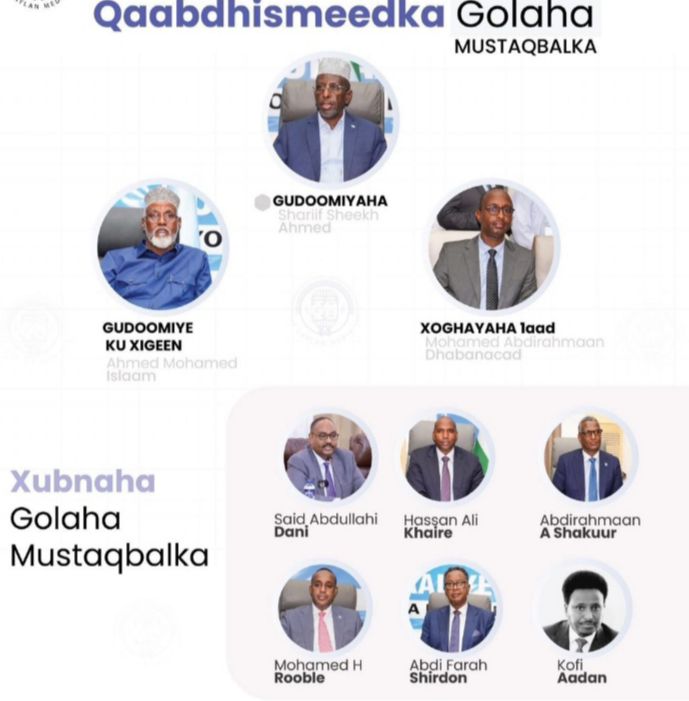
This image—circulating quietly, almost shyly—does not scream victory. It does not promise miracles. It does not declare itself the future. That alone makes it revolutionary.

What it shows is something Somalia has been starved of for decades: the early outline of post-Hassan Sheikh Mohamud politics, beyond May 2026. Not slogans. Not clan arithmetic. Not Villa Somalia theatrics. But faces that suggest influence, continuity, negotiation, and uncomfortable political conversations.

Although not necessarily more qualitative, it carries visible signs of reckoning—a rare political currency in a country exhausted by grand claims and chronic under-delivery.

In Somalia, that is radical.

The End of the Traveling Presidency

For nearly a decade, Somali politics has resembled a departure lounge. Leadership was measured in air miles, hotel conferences, and donor applause. Governance was something to be discussed abroad, not practiced at home. Federalism became a word to be recited, not respected. National reconciliation turned into an annual slogan, dusted off whenever legitimacy dipped.

The post-2026 moment, however, will not tolerate this circus. The country is exhausted. The regions are assertive. The people are watching.

This image hints at figures who understand that Somalia is no longer governed from one compound, one clan narrative, or one donor briefing. It suggests personalities shaped by friction—between federal member states and Mogadishu, between tradition and modern statehood, between unity and forced uniformity.

A New Kind of Political Gravity

What makes this emerging constellation interesting is not perfection—but plurality.

These are not messiahs. They are not strongmen. They are not loud. And that is precisely the point.

They represent something Somalia desperately needs:

Leaders who know federalism is not rebellion

Figures who grasp that reconciliation is not surrender

Personalities who accept that power must circulate—or it explodes

If Hassan Sheikh’s era was defined by central accumulation and political monoculture, the post-2026 phase—if this image is any indication—may finally reintroduce political gravity, where influence is earned, not imposed.

Satire Aside, This Is Serious

Of course, Somalis are trained skeptics. We have seen promising faces before—only to watch them mutate once they taste Villa Somalia tea. We know how quickly “national figures” become “national disappointments.”

But satire must also know when to pause.

This image does not promise salvation. It promises possibility—not excellence, not genius, but a baseline of political honesty long absent from the stage. And in Somalia’s political history, even that is not cheap.

It whispers—quietly—that the next chapter may not be written by one man, one network, or one borrowed script. It suggests that post-Hassan Sheikh Somalia might finally rediscover dialogue over dominance.

The Real Test Ahead

If these emerging figures truly shape the future, their test will be simple and brutal:

Will they respect federal member states as partners, not provinces?

Will they treat reconciliation as a process, not a photo-op?

Will they govern Somalia as a shared republic, not a captured estate?

If they do, May 2026 may not mark just the end of a presidency—but the end of an era of political recycling.

And if they fail?

Somalia, as always, will survive them too—but poorer in hope.

For now, this image stands as an early signal flare in a long night: the idea that Somalia’s future leadership might finally look forward, not inward.

Somalia’s War on Time: When Friday Starts on Thursday and Ends on Early Friday Evening

Welcome to Somalia, the only country on earth where time itself has been federalized, fragmented, and thoroughly humiliated.

Here, clocks are decorative items, calendars are opinion pieces, and Friday—the holiest day in Islam—has been stretched, bent, sliced, and redistributed like a contested aid package. Ask ten Somalis when Friday night begins, and you will receive ten answers, all delivered with absolute confidence and theological authority.

Is Thursday evening Friday?
Is it Saturday on Friday evening?
And most importantly: is a Somali day still 24 hours, or has it been downsized like a donor budget?

No one knows. And worse—no one agrees.

A Day That Begins Yesterday Evening and Ends Tomorrow Evening?

In today’s Somalia, a “day” is no longer a fixed unit of time. It is a political and cultural negotiation.

Friday begins when someone decides it begins. It ends when someone else says it ends. In between, weddings are scheduled, shops are closed, prayers are announced, and public debates erupt—often heated, sometimes violent—over whether now is still Friday or already Saturday.

We have managed to turn timekeeping, one of humanity’s earliest scientific achievements, into a clan-based interpretive exercise.

This is not astronomy.
This is not jurisprudence.
This is chronological anarchy.

Importing Confusion by the Container Load

Where did this madness come from?

Some blame it on “Arab ways of counting time”—the idea that a day begins at sunset, creating a Frankenstein creature made of two halves of two different days. Others point fingers at poorly translated religious traditions, half-learned fiqh lessons, and WhatsApp sheikhs who discovered theology on YouTube last week.

But let us be honest: Somalia did not just import this confusion—it weaponized it.

We imported clocks from Europe, prayers from Arabia, lunar calendars from scholars, solar calendars from colonial offices, and then never bothered to reconcile any of them. The result? A nation where Thursday night can legally, spiritually, and socially be Friday, depending on who is speaking—and where.

Federalism, But Make It Temporal

Naturally, Somalia being Somalia, even time could not escape federalism.

In one town, Friday night starts at sunset Thursday.
In another, it begins at midnight.
In a third, it starts when the mosque loudspeaker says so.
In a fourth, it starts when the wedding hall lights turn on.

We now live under Multiple Time Zones Without Borders.

GMT? Forget it.
EAT? Optional.
Somali Time? Negotiable.

This is federalism taken to its logical extreme: every community is its own time authority.

When Religion Becomes Casual and Science Optional

Ironically, this chaos is defended in the name of religion—yet it violates both religious discipline and scientific reason.

Islam is precise. Astronomy is precise. Prayer times are calculated to the minute. Yet in Somalia, we treat time like a rumor: flexible, adjustable, and open to reinterpretation after dinner.

We argue passionately about when Friday starts, but show little concern for when honesty starts, when accountability starts, or when governance starts.

Apparently, God demands accuracy in prayer times—but not in clocks.

A Nation That Lost Its Watch—and Its Way

This confusion over days is not a small issue. It is a symbol.

A country that cannot agree on when a day begins will struggle to agree on:

when elections should be held

when mandates expire

when contracts start and end

when responsibility begins

When time itself is blurred, accountability evaporates.

Missed a deadline?
“It was still Friday night.”

Extended your term?
“Friday hasn’t ended yet.”

Delayed salaries?
“Time is relative.”

Conclusion: Reset the Clock, Reset the Mind

Somalia does not need new clocks. It needs clarity of thought.

A day is 24 hours.
Friday is Friday.
Night is night.

Religion does not fear precision.
Culture does not require confusion.
And identity is not threatened by a clock that actually works.

Until Somalia makes peace with time, time will continue to mock Somalia.

And somewhere, in the middle of Thursday-Friday-Saturday, a Somali will confidently announce:

“Relax. It’s still Friday night.” The day starts from one morning until the next morning.

———–

Support WAPMEN — the home of fearless, independent journalism that speaks truth to power across Somalia and the region.
Tel/WhatsApp: +252 90 703 4081.

WAPMEN Annual Subscription – Support Independent Journalism

WAPMEN (formerly WDM) delivers fearless analysis, bold editorials, and independent commentary that speaks truth to power.

Subscribe for just US$37 per year and help keep WAPMEN free from political influence and censorship.

Payment options:
• Sahal: +252 90 703 4081
• EVC Plus: +252 61 158 8388
• MyCash: +252 71 681 4371
• PayPal: ismail.warsame@yahoo.ca

Info & assistance:
Email: ismailwarsame@gmail.com
Tel/WhatsApp: +252 90 703 4081

By subscribing, you’re not just supporting WAPMEN—you’re standing for truth, justice, and independent ideas.

Subscribe today. Share widely.

© 2025 Warsame Policy & Media Network (WAPMEN)

New Somalia e-visa security flaw puts personal data of thousands at risk | Investigation News | Al Jazeera

https://www.aljazeera.com/news/2025/12/18/new-somalia-evisa-security-puts-passport-details-of-thousands-at-risk