Democracy

Democracy

KALA SAAR SADEXTA

Kala Saar Maamul Dawladeed, Dhaqanka iyo Diinta

DEAD ABUSE OF POWER IN THE US WHITE HOUSE

Bill Clinton December 2025

https://www.facebook.com/share/v/1DPLtchzST/

[Courtesy: Facebook].

The Somalis

[Courtesy]

[Courtesy].

WAPMEN EDITORIAL — Trump vs. the Somali Spirit: The Fight He Never Expected

Donald J. Trump has many political talents, but foresight is not one of them. In singling out Somali-Americans — a community that has clawed its way through war, exile, oceans, and the grinding machinery of American bureaucracy — he has cracked open a Pandora’s box that will not close again. And inside that box is something Trump never anticipated: a fearless, unbreakable Somali fighting spirit sharpened over centuries, and a rapid, organized American response that has turned his attack into a strategic blunder.

Trump thought he could unleash the megaphone of the White House against one of America’s most resilient immigrant communities. In a Cabinet meeting, he declared of Somalis, “I don’t want them in our country” and stated the U.S. would “go the wrong way if we keep taking in garbage”. He assumed Somali-Americans would cower, scatter, fold under the weight of a presidential assault and the immediate launch of “Operation Metro Surge,” an Immigration and Customs Enforcement (ICE) action in the Minneapolis-St. Paul area. He assumed wrong.

The Somali Spirit Meets the MAGA Machine

Trump’s political survival has often depended on targeting immigrants and Muslims. This time, he miscalculated. Somali-Americans are not a silent community. They are not powerless guests. They are Americans: of the roughly 84,000 to 98,000 Somali-Americans in Minnesota, the vast majority—estimated at 83% nationally—are naturalized U.S. citizens or legal permanent residents.

They are business owners, state legislators, city council members, and a U.S. Representative. Their defiance was immediate. “I am not garbage. I’m a proud American citizen,” said Hamse Warfa, a Somali-born entrepreneur in Minneapolis. This sentiment echoes from a community that understands a painful truth: when the president puts a “bull’s eye” on you, it encourages others to become “more radicalized”. The fear is real—businesses in cultural hubs like Karmel Mall closed, medical appointments were canceled, and people were afraid to leave home. Minneapolis City Council member Jamal Osman, a naturalized citizen, advised constituents to carry their passports, drawing a stark historical parallel.

Yet, the community’s response has been one of disciplined mobilization, not retreat. Organizations scheduled “legal observer training,” established emergency hotlines, and created private networks to share photos of unmarked cars and masked agents. As one community leader put it, “Is there fear? Absolutely. But no one is tucking behind their tail”.

America Responds — And Trump Hates It

Across the United States — and notably throughout Minnesota — Americans of every color and political stripe are rejecting Trump’s attempt to isolate the Somali community.

Political Leadership:

· Governor Tim Walz (D): Called Trump’s statements “vile, racist lies,” and declared that anyone unable to condemn them is “complicit”.
· Minneapolis Mayor Jacob Frey (D): Stood with the community, prompting Trump to dismiss him as a “fool”.
· Minneapolis Police Chief Brian O’Hara: Attended interfaith prayer services and, citing concerns over impersonators, told residents to call 911 if unsure about individuals claiming to be federal agents.

Trump wanted a wedge issue; instead he has triggered a coalition. He wanted fear; instead he has ignited a resolve to protect neighbors. He wanted to intimidate; instead he has exposed his own playbook. As Lt. Gov. Peggy Flanagan stated, this operation is about “striking fear into the hearts of Minnesotans” to distract from a failed record.

Pandora’s Box Is Now Wide Open

Trump doesn’t understand Somalis. A people whose kin in Mogadishu run a city’s only free ambulance service, operate the nation’s first rape crisis center, and build new businesses amid insecurity will not collapse because one man with a bullhorn shouts insults. The diaspora thrives everywhere it lands. Trump imagined he was attacking a small, vulnerable minority. In reality, he struck a transnational community with a generational memory of survival.

He has awakened a political force he cannot control, as seen in the swift launch of initiatives like a campaign for a Somali Heritage Month.
He has energized a voting bloc he cannot suppress—citizens who are now more politically organized than ever.
He has provoked a cultural pride he cannot silence, echoing from Minnesota to Galkayo, where citizens push back by highlighting their resilience and contributions.

Somalis do not fight small fights. And when they fight, they do not lose.

Trump’s Worst Strategic Mistake

In trying to humiliate Somali-Americans, Trump has humiliated himself. In trying to bully them into silence, he has made them louder and more organized. In trying to single them out, he has fused them into a political force and rallied Americans behind them.

His instinct to vilify, honed on other immigrant groups, has this time detonated in his hands. He has united Somalis and their allies in common cause, transforming a moment of fear into a catalyst for powerful, structured defense and advocacy.

Watch What Happens Next

If Trump thinks he can win elections by targeting Somali-Americans, he is about to receive a political lesson in Somali resilience.

For every insult he throws, Somali-Americans become more organized, expanding legal networks and community watches.
For every threat he makes,they become more mobilized, asserting their American identity with defiant pride.
For every policy he weaponizes,they become more entrenched in the American fabric than he ever imagined.

Trump opened the Somali Pandora’s Box. Inside was not the chaos he sought, but the formidable spirit of a community that has overcome hell, and the solidarity of a nation that remembers its ideals. He will not like what comes out of it.

Watch this space. The Somali spirit is awake — and it does not sleep again.

WAPMEN Editorial Board

COLUMN ONE : The Oil Factor in Somalia : Four American petroleum giants had agreements with the African nation before its civil war began. They could reap big rewards if peace is restored.

By MARK FINEMAN

Jan. 18, 1993 12 AM PT

TIMES STAFF WRITER

MOGADISHU, Somalia — Far beneath the surface of the tragic drama of Somalia, four major U.S. oil companies are quietly sitting on a prospective fortune in exclusive concessions to explore and exploit tens of millions of acres of the Somali countryside.

That land, in the opinion of geologists and industry sources, could yield significant amounts of oil and natural gas if the U.S.-led military mission can restore peace to the impoverished East African nation.

According to documents obtained by The Times, nearly two-thirds of Somalia was allocated to the American oil giants Conoco, Amoco, Chevron and Phillips in the final years before Somalia’s pro-U.S. President Mohamed Siad Barre was overthrown and the nation plunged into chaos in January, 1991. Industry sources said the companies holding the rights to the most promising concessions are hoping that the Bush Administration’s decision to send U.S. troops to safeguard aid shipments to Somalia will also help protect their multimillion-dollar investments there.

Officially, the Administration and the State Department insist that the U.S. military mission in Somalia is strictly humanitarian. Oil industry spokesmen dismissed as “absurd” and “nonsense” allegations by aid experts, veteran East Africa analysts and several prominent Somalis that President Bush, a former Texas oilman, was moved to act in Somalia, at least in part, by the U.S. corporate oil stake.

But corporate and scientific documents disclosed that the American companies are well positioned to pursue Somalia’s most promising potential oil reserves the moment the nation is pacified. And the State Department and U.S. military officials acknowledge that one of those oil companies has done more than simply sit back and hope for peace.

Conoco Inc., the only major multinational corporation to maintain a functioning office in Mogadishu throughout the past two years of nationwide anarchy, has been directly involved in the U.S. government’s role in the U.N.-sponsored humanitarian military effort.

Conoco, whose tireless exploration efforts in north-central Somalia reportedly had yielded the most encouraging prospects just before Siad Barre’s fall, permitted its Mogadishu corporate compound to be transformed into a de facto American embassy a few days before the U.S. Marines landed in the capital, with Bush’s special envoy using it as his temporary headquarters. In addition, the president of the company’s subsidiary in Somalia won high official praise for serving as the government’s volunteer “facilitator” during the months before and during the U.S. intervention.

Describing the arrangement as “a business relationship,” an official spokesman for the Houston-based parent corporation of Conoco Somalia Ltd. said the U.S. government was paying rental for its use of the compound, and he insisted that Conoco was proud of resident general manager Raymond Marchand’s contribution to the U.S.-led humanitarian effort.

John Geybauer, spokesman for Conoco Oil in Houston, said the company was acting as “a good corporate citizen and neighbor” in granting the U.S. government’s request to be allowed to rent the compound. The U.S. Embassy and most other buildings and residential compounds here in the capital were rendered unusable by vandalism and fierce artillery duels during the clan wars that have consumed Somalia and starved its people.

In its in-house magazine last month, Conoco reprinted excerpts from a letter of commendation for Marchand written by U.S. Marine Brig. Gen. Frank Libutti, who has been acting as military aide to U.S. envoy Robert B. Oakley. In the letter, Libutti praised the oil official for his role in the initial operation to land Marines on Mogadishu’s beaches in December, and the general concluded, “Without Raymond’s courageous contributions and selfless service, the operation would have failed.”

But the close relationship between Conoco and the U.S. intervention force has left many Somalis and foreign development experts deeply troubled by the blurry line between the U.S. government and the large oil company, leading many to liken the Somalia operation to a miniature version of Operation Desert Storm, the U.S.-led military effort in January, 1991, to drive Iraq from Kuwait and, more broadly, safeguard the world’s largest oil reserves.

“They sent all the wrong signals when Oakley moved into the Conoco compound,” said one expert on Somalia who worked with one of the four major companies as they intensified their exploration efforts in the country in the late 1980s.

“It’s left everyone thinking the big question here isn’t famine relief but oil–whether the oil concessions granted under Siad Barre will be transferred if and when peace is restored,” the expert said. “It’s potentially worth billions of dollars, and believe me, that’s what the whole game is starting to look like.”

Although most oil experts outside Somalia laugh at the suggestion that the nation ever could rank among the world’s major oil producers–and most maintain that the international aid mission is intended simply to feed Somalia’s starving masses–no one doubts that there is oil in Somalia. The only question: How much?

“It’s there. There’s no doubt there’s oil there,” said Thomas E. O’Connor, the principal petroleum engineer for the World Bank, who headed an in-depth, three-year study of oil prospects in the Gulf of Aden off Somalia’s northern coast.

“You don’t know until you study a lot further just how much is there,” O’Connor said. “But it has commercial potential. It’s got high potential . . . once the Somalis get their act together.”

O’Connor, a professional geologist, based his conclusion on the findings of some of the world’s top petroleum geologists. In a 1991 World Bank-coordinated study, intended to encourage private investment in the petroleum potential of eight African nations, the geologists put Somalia and Sudan at the top of the list of prospective commercial oil producers.

Presenting their results during a three-day conference in London in September, 1991, two of those geologists, an American and an Egyptian, reported that an analysis of nine exploratory wells drilled in Somalia indicated that the region is “situated within the oil window, and thus (is) highly prospective for gas and oil.” A report by a third geologist, Z. R. Beydoun, said offshore sites possess “the geological parameters conducive to the generation, expulsion and trapping of significant amounts of oil and gas.”

Beydoun, who now works for Marathon Oil in London, cautioned in a recent interview that on the basis of his findings alone, “you cannot say there definitely is oil,” but he added: “The different ingredients for generation of oil are there. The question is whether the oil generated there has been trapped or whether it dispersed or evaporated.”

Beginning in 1986, Conoco, along with Amoco, Chevron, Phillips and, briefly, Shell all sought and obtained exploration licenses for northern Somalia from Siad Barre’s government. Somalia was soon carved up into concessional blocs, with Conoco, Amoco and Chevron winning the right to explore and exploit the most promising ones.

The companies’ interest in Somalia clearly predated the World Bank study. It was grounded in the findings of another, highly successful exploration effort by the Texas-based Hunt Oil Corp. across the Gulf of Aden in the Arabian Peninsula nation of Yemen, where geologists disclosed in the mid-1980s that the estimated 1 billion barrels of Yemeni oil reserves were part of a great underground rift, or valley, that arced into and across northern Somalia.

Hunt’s Yemeni operation, which is now yielding nearly 200,000 barrels of oil a day, and its implications for the entire region were not lost on then-Vice President George Bush.

In fact, Bush witnessed it firsthand in April, 1986, when he officially dedicated Hunt’s new $18-million refinery near the ancient Yemeni town of Marib. In remarks during the event, Bush emphasized the critical value of supporting U.S. corporate efforts to develop and safeguard potential oil reserves in the region.

In his speech, Bush stressed “the growing strategic importance to the West of developing crude oil sources in the region away from the Strait of Hormuz,” according to a report three weeks later in the authoritative Middle East Economic Survey.

Bush’s reference was to the geographical choke point that controls access to the Persian Gulf and its vast oil reserves. It came at the end of a 10-day Middle East tour in which the vice president drew fire for appearing to advocate higher oil and gasoline prices.

“Throughout the course of his 17,000-mile trip, Bush suggested continued low (oil) prices would jeopardize a domestic oil industry ‘vital to the national security interests of the United States,’ which was interpreted at home and abroad as a sign the onetime oil driller from Texas was coming to the aid of his former associates,” United Press International reported from Washington the day after Bush dedicated Hunt’s Yemen refinery.

No such criticism accompanied Bush’s decision late last year to send more than 20,000 U.S. troops to Somalia, widely applauded as a bold and costly step to save an estimated 2 million Somalis from starvation by opening up relief supply lines and pacifying the famine-struck nation.

But since the U.S. intervention began, neither the Bush Administration nor any of the oil companies that had been active in Somalia up until the civil war broke out in early 1991 have commented publicly on Somalia’s potential for oil and natural gas production. Even in private, veteran oil company exploration experts played down any possible connection between the Administration’s move into Somalia and the corporate concessions at stake.

“In the oil world, Somalia is a fringe exploration area,” said one Conoco executive who asked not to be named. “They’ve overexaggerated it,” he said of the geologists’ optimism about the prospective oil reserves there. And as for Washington’s motives in Somalia, he brushed aside criticisms that have been voiced quietly in Mogadishu, saying, “With America, there is a genuine humanitarian streak in us . . . that many other countries and cultures cannot understand.”

But the same source added that Conoco’s decision to maintain its headquarters in the Somali capital even after it pulled out the last of its major equipment in the spring of 1992 was certainly not a humanitarian one. And he confirmed that the company, which has explored Somalia in three major phases beginning in 1952, had achieved “very good oil shows”–industry terminology for an exploration phase that often precedes a major discovery–just before the war broke out.

“We had these very good shows,” he said. “We were pleased. That’s why Conoco stayed on. . . . The people in Houston are convinced there’s oil there.”

Indeed, the same Conoco World article that praised Conoco’s general manager in Somalia for his role in the humanitarian effort quoted Marchand as saying, “We stayed because of Somalia’s potential for the company and to protect our assets.”

Marchand, a French citizen who came to Somalia from Chad after a civil war forced Conoco to suspend operations there, explained the role played by his firm in helping set up the U.S.-led pacification mission in Mogadishu.

“When the State Department asked Conoco management for assistance, I was glad to use the company’s influence in Somalia for the success of this mission,” he said in the magazine article. “I just treated it like a company operation–like moving a rig. I did it for this operation because the (U.S.) officials weren’t familiar with the environment.”

Marchand and his company were clearly familiar with the anarchy into which Somalia has descended over the past two years–a nation with no functioning government, no utilities and few roads, a place ruled loosely by regional warlords.

Of the four U.S. companies holding the Siad Barre-era oil concessions, Conoco is believed to be the only one that negotiated what spokesman Geybauer called “a standstill agreement” with an interim government set up by one of Mogadishu’s two principal warlords, Ali Mahdi Mohamed. Industry sources said the other U.S. companies with contracts in Somalia cited “ force majeure “ (superior power), a legal term asserting that they were forced by the war to abandon their exploration efforts and would return as soon as peace is restored.

“It’s going to be very interesting to see whether these agreements are still good,” said Mohamed Jirdeh, a prominent Somali businessman in Mogadishu who is familiar with the oil-concession agreements. “Whatever Siad did, all those records and contracts, all disappeared after he fled. . . . And this period has brought with it a deep change of our society.

“Our country is now very weak, and, of course, the American oil companies are very strong. This has to be handled very diplomatically, and I think the American government must move out of the oil business, or at least make clear that there is a definite line separating the two, if they want to maintain a long-term relationship here.”

Fineman, Times bureau chief in Nicosia, Cyprus, was recently in Somalia.

[Courtesy: Los Angeles Times].

An Imperfect Union: The Uneven Landscape of Somalia’s Federal Workforce

The dream of a stable, unified Somalia, rebuilt upon a federal framework, has long been the central pillar of the nation’s post-conflict political order. Yet, beneath the official rhetoric of shared governance and equitable power distribution, a persistent and contentious reality simmers: the profound unevenness in federal employment across the Federal Member States (FMS). While comprehensive, verifiable statistics from sources like the World Bank remain elusive in the public domain, the political discourse in Somalia is saturated with allegations of severe regional imbalance. Critics, particularly from opposition-aligned states like Puntland and Jubaland, contend that the federal civil service is overwhelmingly dominated by employees from Mogadishu and its immediate environs, notably the Hirshabelle state. This perceived inequity is not a mere administrative grievance; it is a live wire electrifying Somalia’s most profound political crises, serving as both a symptom and a cause of the failing federal compact.

The argument, as advanced by voices such as Ismail Warsame, a former Puntland official and vocal commentator, posits a stark disparity. It suggests that a vast majority—potentially up to 65%—of federal positions are filled by individuals from the Mogadishu-Hirshabelle axis, with states like Puntland purportedly holding less than 2.5%. Whether these exact figures are accurate is less critical than the pervasive belief in their truth, a belief that fuels deep-seated resentment. This perception transforms the civil service from a national institution into an instrument of patronage, where jobs are rewards for political loyalty rather than merit-based appointments to serve all Somali people. For states on the periphery, this translates to a tangible exclusion from the economic benefits and decision-making influence of the central government, entrenching a feeling of second-class status within the very union they are meant to co-own.

This imbalance in federal employment is inextricably linked to the broader, more explosive conflicts over political autonomy and constitutional power. The uneven share of jobs is viewed as the human manifestation of a centralizing state, an accusation consistently leveled at the administration of President Hassan Sheikh Mohamud. The current crisis with Jubaland provides a textbook example. When Jubaland proceeded with its own regional election in late 2024, re-electing President Ahmed Madobe against the wishes of Mogadishu, the Federal Government declared the process unconstitutional. This political dispute rapidly escalated into military confrontation in the Ras Kamboni area. From Jubaland’s perspective, Mogadishu’s attempt to invalidate its election is of a piece with its refusal to share federal resources and jobs equitably—both are seen as assaults on the core principles of federalism, designed to subordinate the state to the capital’s will.

Similarly, Puntland, often described as the federation’s most stable and functional polity, has positioned itself as the lead critic of Mogadishu’s centralizing tendencies. Its leadership frames the inequity in federal representation as evidence of a “creeping dictatorship” and has formed a potent opposition coalition with Jubaland. For Puntland and Jubaland, the uneven employment landscape proves that the federal government prioritizes control over collaboration, rendering the constitutional promise of a voluntary union of equal states a hollow one.

Conversely, states perceived to be in closer alignment with Mogadishu, such as Galmudug and the Southwest State, are often characterized in opposition discourse as existing in the “shadows” of the capital. The allegation is that their relative political compliance is reciprocated with a greater share of federal patronage, including jobs, further distorting the national distribution. This dynamic creates a self-reinforcing cycle: closer alignment brings more federal resources to local elites, which strengthens their position, ensuring continued support for Mogadishu, thereby perpetuating the imbalance.

The consequences of this dysfunction are severe and extend far beyond political squabbling. A federal civil service perceived as illegitimate and exclusionary lacks the broad-based credibility to effectively implement national policy. This administrative weakness directly undermines the most critical national struggle: the fight against Al-Shabab. Military offensives require cohesive political and logistical support; a federal government distrusted by major component states cannot marshal a unified front. Reports of Al-Shabab making gains in regions like Hirshabelle in early 2025 occur against this backdrop of profound federal fragmentation, where security strategy is hampered by political distrust.

Ultimately, the debate over the uneven share of federal employees is a debate about the soul of Somali federalism. Is it a genuine pact for sharing power and building a common future, or is it a vehicle for the reconcentration of authority in Mogadishu? The palpable anger from Puntland and Jubaland, manifesting in opposition alliances and even armed clashes, suggests that for them, the current system is failing the basic test of equity. The Provisional Constitution’s vagueness on critical details of resource and power-sharing has created a vacuum filled by political conflict. Until a transparent, verifiable, and equitable framework for federal representation—in both the civil service and political institutions—is agreed upon and implemented, the Somali federation will remain an imperfect and unstable union. The equitable distribution of jobs is not just an administrative task; it is a fundamental prerequisite for building the trust necessary to hold a fragile nation together.

Why Somaliland’s Leadership Crisis Is Repeating Itself—From Goojacadde to Borama

A WAPMEN Editorial — Speaking Truth to Power, Without Fear or Favour

There are moments when a nation’s leadership is tested not by its enemies, but by its own choices. The bloodshed in Borama is one such moment—a direct, preventable crisis born from a failure to listen.

It was not an accident.
It was not a mere“security incident.”
It was thedirect result of a political decision—the plan to host the divisive “Issa Law” ceremony in Zeila—that lit a match in Awdal. The government’s response, using live ammunition against its own civilians, leaving at least 17 dead, is a catastrophic failure of governance written in fire and denial.

But if you thought Somaliland learned anything from the Goojacadde catastrophe—
If you thought leaders in Hargeisa had re-examined their instinct to impose rather than consult—
If you thought the military defeat in Sool had spurred political wisdom—
The Borama massacre proves you wrong. Spectacularly wrong.

Goojacadde: A Lesson in Military and Political Defeat, Thoroughly Ignored

For two decades, Somaliland has sold a global narrative of “democracy” and “stability.” Yet in Sool, it exercised coercive power over a community that did not consent to its rule. The result was not stability, but a popular armed uprising that culminated in the strategic and humiliating loss of the Goojacadde military base in August 2023. Soldiers were captured, equipment was lost, and territory was reclaimed by SSC-Khatumo forces with the help of the so-called “Hiil Walaal”.

Goojacadde was a lesson shouted by history: there is no durable control without the consent of the governed.

Yet, Somaliland’s leadership treated it as a military mishap, not the symptom of a deep political illness—the arrogance of imposing will from Hargeisa.

Borama: The Same Disease, A Different Eruption

Borama is not Sool. It is not Las Anod. It is the city of the 1993 Grand Conference, a foundational pillar of Somaliland’s very project. Here, the crisis was triggered not by years of warfare, but by a single, tone-deaf political maneuver—a law perceived as a territorial threat, unveiled in a region that saw it as a betrayal.

The pattern, however, is lethally familiar: Break trust → impose a decision → meet dissent with lethal force → blame the victims.

Once again:

· Civic outrage was met with a state bullet.
· Youth demanding accountability were treated as enemies.
· The government’s delayed reversal came only after the streets were stained with blood.

This is not governance. This is political self-sabotage on repeat—proving that the disease which infected policy in Sool is now metastasizing at home.

The Crumbling Myth of “The Somaliland Model

Somaliland’s ruling elite operates on a fatal miscalculation: that suppressing grievances creates unity. In reality, it transforms loyal citizens into resistors and turns political disputes into existential crises.

The “Somaliland model” is cracking because its foundation—earned consent—is being eroded. Awdal has its own history and civic culture, but it shares with Sool the experience of being ignored, provoked, and then attacked when it speaks.

Goojacadde taught that you cannot bomb a people into loyalty. Borama now teaches that you cannot shoot your citizens into silence.

A Final Warning, Written in Blood

Sool was not lost because of clan politics. It was lost because of political arrogance and contempt for local will. Borama is not yet lost, but it is wounded—by the very government that claims to protect it.

The lesson is no longer subtle. It is screaming from the battlefields of Sool and the streets of Borama: A government that rules by imposition and fear is building its house on sand.

There is still time—to truly reform, to genuinely reconcile, to replace the barrel of a gun with the humility of dialogue. But if the same instincts that led to Goojacadde and Borama prevail, then Somaliland must be ready to face the consequences: a stability that collapses from within, defeated by its own hand.

——–

Support WAPMEN — the home of fearless, independent journalism that speaks truth to power across Somalia and the Horn of Africa.
Tel/WhatsApp: +252 90 703 4081.

Ismail H. Warsame: Ethics, Federalism, and the Architecture of Somali Governance

By WDM Staff Writer

Introduction: A Voice Forged in the Crucible of State-Building

In the vast and fractured landscape of Somali political literature, few voices combine historical memory, administrative experience, and moral clarity as compellingly as Ismail H. Warsame. His writings—ranging from autobiographical reflections to sharp political essays—exist at the intersection of lived governance and philosophical inquiry. They seek not merely to describe Somalia’s dilemmas, but to understand why state-building has repeatedly faltered and what ethical foundations are required to restore national coherence.

Warsame speaks with authority not because he observed Somalia’s political evolution from afar, but because he helped shape it. As the first Chief of State (Chief of Cabinet) of Puntland during its inception in 1998, he participated directly in one of Somalia’s most durable experiments in political reconstruction. His insights therefore emerge not from abstraction, but from the difficult negotiations, institutional improvisations, and ethical tests inherent in founding a state under conditions of national collapse.

This chapter synthesizes the central pillars of Warsame’s intellectual project:

1. Leadership ethics as the bedrock of governance

2. Federalism as a tool misapplied

3. Puntland as a living experiment in institutional resilience

4. Writing as an act of political service

Together, these themes form a coherent blueprint for understanding Somalia’s governance failures—and the path toward remedy.

1. Leadership Ethics: Rebuilding the Moral Economy of Power

Warsame’s thought begins with a fundamental assertion: Somalia’s crisis is not structural, but ethical. Constitutions can be rewritten, institutions can be funded, elections can be organized—but none will function in the absence of leaders who possess integrity, courage, and restraint.

1.1 Integrity as the Foundation of Political Judgment

Warsame’s formulation is characteristically direct:
“Leadership begins with personal integrity; without it, every decision becomes a negotiation of convenience.”

Integrity, for him, is not a private virtue but a public necessity. It is the internal compass that transforms authority into stewardship. Somali leaders, he argues, too often treat power as a prize rather than a responsibility—a worldview that erodes state legitimacy at its core.

1.2 Accountability as the Bridge Between Authority and Trust

Warsame identifies accountability as the litmus test of credible leadership:
“A leader who fears accountability is already unfit to lead.”

Accountability is not merely administrative; it is the currency of public trust. In its absence, institutions become hollow façades—performing statehood without embodying it.

1.3 The Clan Question: The Ethical Threshold

Clan identity is an unavoidable part of Somali political life, but Warsame argues it must not dominate leadership:
“A leader who cannot rise above clan interests cannot rise to national responsibility.”

This is perhaps his most challenging contribution. He neither romanticizes clan structures nor demonizes them; instead, he frames them as ethical obstacles leaders must consciously transcend.

Warsame’s insistence on ethical leadership is not idealistic—it is profoundly pragmatic. No reform can succeed unless it is underpinned by a moral transformation of political behavior.

2. Somali Federalism: Promise Misunderstood, Practice Misapplied

Somalia’s federal experiment is one of the most contested political projects in East Africa. Warsame approaches it with realism: federalism is not inherently flawed; it is merely poorly interpreted.

2.1 Federalism in Theory: Decentralization as a Safeguard

Properly implemented, federalism aims to:

distribute power

strengthen local governance

reduce center-periphery tensions

balance autonomy with unity

Warsame acknowledges these virtues but stresses that they require institutional discipline and clarity—both lacking in Somalia’s political culture.

2.2 Federalism in Practice: A Distorted Application

Warsame identifies several structural distortions:

Clan-based state formation, which undermines administrative logic

Constitutional ambiguity, fueling perpetual disputes

Resource competition, transforming federalism into economic warfare

Weak national institutions, unable to mediate intergovernmental tension

His conclusion is incisive:
“Federalism is not a magic formula. It is a tool—and tools are only as good as the hands that use them.”

2.3 The Ethical Prerequisite of Federalism

For federalism to stabilize Somalia, Warsame argues, it must be grounded in:

political maturity

respect for constitutional boundaries

leaders committed to compromise

institutions shielded from clan capture

Without these ethical commitments, federalism becomes a mechanism for fragmentation rather than cohesion.

3. Puntland: A State Built in the Shadow of Collapse

No intellectual engagement with federal Somalia is complete without Puntland—the state Warsame helped construct and later critique.

3.1 Foundational Vision

Puntland emerged with three guiding ambitions:

1. Stability in the northeast

2. Institutional development capable of governing sustainably

3. A federal contribution to a future Somali republic

It was conceived not as a secessionist project but as a template for national reconstruction.

3.2 Achievements as Proof of Concept

Warsame highlights Puntland’s relative success:

functional security structures

a workable bureaucracy

regular political transitions

resilience against state collapse

These achievements demonstrate that institutional discipline—however imperfect—can emerge even in contexts of extreme fragility.

3.3 Risks and Drift from Founding Principles

Warsame is equally honest about Puntland’s vulnerabilities:

intensifying clan-political pressures

internal administrative fragmentation

disputes with Mogadishu

political personalization of power

He warns that Puntland’s durability is not guaranteed. States can drift into dysfunction when they forget the principles that created them.

3.4 Puntland as Federal Anchor

Warsame sees Puntland not as a perfect model but as a necessary one. Its success or failure will shape the trajectory of Somali federalism. It remains, in his view, the federation’s most important stabilizing actor—if it upholds its founding discipline.

4. Writing as Political Intervention

Warsame’s stylistic philosophy mirrors his political ethics: clarity, discipline, and purpose. His dictum—
“Write when you feel tired and hungry to kill verbosity and redundancy”
—reveals his rejection of inflated rhetoric in favor of precision.

4.1 The Nomadic Frame of Mind

His autobiographical book HAYAAN offers a portrait of a childhood shaped by:

movement

improvisation

environmental reading

community responsibility

These nomadic sensibilities permeate his political writing, giving it an instinctive awareness of shifting landscapes and emerging dangers.

4.2 Truth-Telling as Civic Duty

Warsame treats writing as an ethical commitment. His essays are interventions designed to reorient political discourse toward:

responsibility

integrity

institutional sobriety

He writes not for flattery but for correction. His truth-telling is a form of public service.

Conclusion: An Ethical Blueprint for a Broken State

Across his writings, Warsame articulates a coherent thesis: Somalia cannot rebuild its state without rebuilding its ethics.

Federalism, decentralization, and constitutional frameworks are necessary but insufficient. Without moral courage in leadership and disciplined governance, Somalia will continue to oscillate between crisis and paralysis.

Warsame’s work—rooted in experience, sharpened by reflection, and disciplined by nomadic pragmatism—offers one of the clearest intellectual pathways toward a functioning Somali state. It calls for nothing less than the reconstruction of Somalia’s political conscience.

In a political culture too familiar with cynicism, Warsame’s voice stands as a reminder that truth—courageously spoken—is the first act of state-building.

“Turkish intelligence report warns of Somalia’s fragility as Ankara boosts military and economic role”

https://nordicmonitor.com/2025/12/turkish-intelligence-report-warns-somalias-fragility-as-ankara-boosts-military-and-economic-role/?s=09

Trump’s War on Somali-Americans: A Battle He Cannot Win

Donald J. Trump—patron saint of grievance politics, high priest of paranoiac nationalism—has once again found a new enemy. This time, his target is Somali-Americans. In a December 2025 cabinet meeting, the former president declared immigrants from Somalia “garbage,” said they “come from hell” and “contribute nothing,” and vowed, “we don’t want them in our country.” [^1] For the Reality-TV Caesar who once mistook the U.S. Constitution for a hotel amenities menu, a tiny, hardworking, overachieving immigrant community is the latest existential threat to the mighty Republic.

And in doing so, he has—unknowingly, unwittingly, and quite foolishly—declared a “war” whose outcome is already written: Somali-Americans will defeat Donald Trump.

Let us be clear: Somalis do not fear political war. They fear boredom. They fear mediocre tea, slow Wi-Fi, and injustice. But a fight? That is where the cultural engine truly ignites. And what Trump has provoked isn’t a policy debate—it is something far more dangerous: a community of citizens that refuses to be erased.

The First Rule of This Fight: We Don’t Lose

Trump thinks he understands toughness. He thinks toughness is yelling into microphones, threatening teenagers on Twitter, and posing with Bibles he hasn’t opened. But the toughness of the Somali-American community is generational. It is forged in the crucible of global displacement and in the discipline of rebuilding lives from zero in places like Minnesota, home to an estimated 84,000 people of Somali descent. [^2]

They don’t lose. Not because they are invincible, but because defeat, after surviving so much, is simply unacceptable. The spirit of “guul ama geeri”—victory or death—is not just a slogan; it’s the fuel for a generation that is now American.

Trump, Meet Your Match: Citizens, Not “Others”

But here is the fatal flaw in Trump’s theatre of hate: those he attacks are Americans. The majority in Minnesota are U.S. citizens, either naturalized or born here. [^2] The constitutional document he treats as a personal diary protects them. This isn’t Somalia vs. America. It’s Somali-Americans vs. Donald Trump.

And guess what?
Somali-Americans have survived:

· Siyad Barre
· Civil war
· Displacement
· Being scapegoats for a massive pandemic aid fraud scandal in Minnesota [^3]
· And now, a president who calls their homeland “barely a country”

Do you honestly think they will be intimidated by a man who lost a fistfight with a staircase?

The Trump Doctrine: Harass Now, Lose Later

Trump’s rage is not policy—it is insecurity. The insecurity of a man who sees Rep. Ilhan Omar, a Somali-American refugee, wielding political power he cannot silence. It is the envy of a man who sees thousands of Somali-American doctors, nurses, and entrepreneurs building America in ways he never could.

It is the panic of a man who knows that every naturalized Somali-American voter is one more nail in the coffin of his political resurrection. So he lashes out with promises to end Temporary Protected Status and directives for ICE operations that even local mayors warn will violate citizens’ rights. [^4]

But harassment is a poor strategy when your opponents have mastered endurance, resilience, and the art of revenge through the ballot box.

America vs. Itself: A War Between Co-Owners

Trump imagines he is launching a war between the U.S. and an outsider group. He forgets the key detail: Somalis in America ARE America. They are no longer guests; they are co-owners. They vote. They organize. They hold office. They are shaping the future of states like Minnesota in ways Trump cannot stop, with a median age far younger than his golf handicap. [^2]

Why Somalis Will Win

This “war” will not end with tanks, but with ballots. Not with sanctions, but with civic participation. Here is why Somali-Americans will win:

1. They are citizens: They have the papers, the passports, and the permanent right to tell Trump to get lost.
2. They are unified: Clan politics dissolves when the opponent is a racist demagogue. Leaders from mosques to the state capitol are standing together. [^4]
3. They are organized: Every Somali home is a mini-parliament, and now those parliaments are focused on political defense.
4. They vote: And they have long, unforgiving memories.
5. They do not break: Not after everything. Certainly not because of a man whose entire brand is fraudulent strength.

Trump is picking a fight with a community whose survival instincts are sharper than his hairline.

The Final Warning

The outcome is inevitable: Somali-Americans will defeat Donald Trump—not with chaos, but with democracy, dignity, and demography.

The man who thinks he can intimidate immigrants is about to learn what happens when those immigrants are also voters, neighbors, and your fellow citizens. They hate to lose. Americans hate to lose. Somali-Americans combine both, multiplied by caffeine and generational ambition.

Watch out, Donald. This is a battle you already lost. The only thing left is for Somali-Americans to collect the victory.

WDM

References

[^1]: Trump’s derogatory comments about Somali immigrants were made during a December 2025 Cabinet meeting, as reported by multiple news outlets.

[^2]: Demographic and citizenship data on the Somali-American community in Minnesota is sourced from historical U.S. Census figures and academic estimates.

[^3]: The context of large-scale fraud cases in Minnesota involving some members of the Somali-American community is a noted part of the current political discourse.

[^4]: Responses from community leaders and politicians, including Minneapolis Mayor Jacob Frey, condemning ICE operations and rhetoric have been widely reported.

The Horn in the Balance: A WDM Review of Conflicting Regional Visions

The Horn of Africa stands as one of the world’s most strategically vital and politically volatile regions. Its stability is fractured by interconnected crises: civil war in Sudan, an unresolved insurgency in Somalia, and most centrally, the existential dispute over the Nile River. Two recent articles—one by Egyptian Foreign Minister Badr Abdelatty and a rebuttal by Ethiopia’s Ambassador to Somalia, Suleiman Dedefo—provide a masterclass in how a core interstate conflict (Egypt vs. Ethiopia) metastasizes into a regional diplomatic war. This review applies a WDM (Conflict, Stakeholders, Balance of Evidence) framework to dissect these competing narratives, revealing a clash not over facts, but over their fundamental interpretation and the very principles of sovereignty, security, and survival.

I. The Core Conflict: Stability vs. Sovereignty

The conflict presented in the two texts is not a simple disagreement over policy but a foundational clash of strategic narratives.

· The Egyptian Narrative (Abdelatty): Egypt frames its renewed engagement as a necessary corrective to regional imbalance. The article constructs a narrative where the Horn, as an extension of Egypt’s national security, has fallen into instability due to “hegemonic tendencies” and “illegitimate” projects—clear references to Ethiopia. Egypt posits itself as the responsible actor returning after a period of neglect to “restore the strategic balance.” Its actions, notably the troop deployment to Somalia (AUSSOM), are framed as collective security contributions. The underlying, though unstated, premise is that Egyptian security, predicated on Nile water and Red Sea stability, is synonymous with regional order.
· The Ethiopian Narrative (Dedefo): Ethiopia’s rebuttal attacks the very premise of Egypt’s narrative, re-casting it as a thinly veiled strategy of encirclement and domination. Where Egypt sees “stability,” Ethiopia sees “hegemonic ambition.” The article systematically deconstructs Egypt’s claims: its “strategic balance” is a disguise, its peacekeeping deployment is a tactical move in a proxy rivalry, and its diplomacy is “the single most important factor that feeds instability.” Ethiopia frames its own quest for Red Sea access as a legitimate economic imperative, contrasting it with Egypt’s “alarmist rhetoric” designed to isolate Addis Ababa.

The fundamental conflict is thus between a status quo power (Egypt) seeking to manage a region it views as critical to its survival, and a rising power (Ethiopia) challenging historical arrangements to secure its own developmental future. This clash makes neutral ground virtually nonexistent.

II. Stakeholders and Their Stakes

The articles illuminate a complex web of regional actors, each with aligned or contested interests. The core perspectives and critical omissions are as follows:

· Egypt
  · Primary Interest (Per Article): Preserving Nile water flow, securing the Red Sea, and countering Ethiopian influence.
  · Underlying Motivation & Omitted Perspective: The article completely omits explicit mention of the Grand Ethiopian Renaissance Dam (GERD), the source of Egypt’s existential hydrological anxiety. Its entire strategic re-engagement is fundamentally driven by the tangible threat of a mega-dam upstream controlling its primary water supply.
· Ethiopia
  · Primary Interest (Per Article): Securing economic development (via the GERD) and obtaining sovereign sea access while resisting “encirclement.”
  · Underlying Motivation & Omitted Perspective: While framing sea access as a historical right, the article downplays how its pursuit—such as the 2024 memorandum of understanding with Somaliland—is perceived by other nations as a threat to state sovereignty, fracturing the African Union’s principle of border inviolability.
· Somalia
  · Portrayal: Presented by Egypt as a partner in stability and by Ethiopia as a victim of Egyptian manipulation.
  · Underlying Reality: Caught between regional giants, Somalia’s government leverages external partnerships (with Egypt, Turkey, and others) to bolster its internal legitimacy and counter security threats, effectively making it a key battleground in the proxy rivalry.
· Eritrea, Djibouti, Sudan
  · Portrayal: Referenced in the Egyptian article as partners in a cooperative framework.
  · Underlying Reality: These states engage with Egypt to gain leverage, investment, or security assurances. Their primary interest, however, is in a balancing act to avoid domination by any single regional power, including Ethiopia.

III. Balance of Evidence and Omissions

A WDM analysis requires weighing the claims against available evidence and identifying critical omissions.

Egypt’s “Stabilizing Role” Claim:

· Evidence For: Egypt has historically been a major regional actor. Its deployment to AUSSOM is a tangible, pledged contribution to a multilateral mission. Its diplomatic outreach is documented.
· Evidence Against: Regional security experts widely interpret the AUSSOM deployment as a geopolitical move to gain a foothold near Ethiopia. Egypt’s deepened security ties with Ethiopia’s rivals (Eritrea, Somalia) objectively create a network of alliances that Addis Ababa would perceive as encirclement.
· Verdict: The claim is strategically instrumentalized. While the action is real, its primary motivation appears more directly linked to countering Ethiopian influence than to altruistic stabilization.

Ethiopia’s “Encirclement Strategy” Accusation:

· Evidence For: The geographical pattern of Egyptian engagement—Somalia (south), Eritrea (north), Sudan (west)—and its explicit opposition to Ethiopian sea access creates a logical strategic constraint.
· Evidence Against: Egypt’s engagements are bilateral and framed as mutually beneficial. The “encirclement” label implies a coordinated military strategy, for which public evidence is scant.
· Verdict: The accusation describes a logical strategic outcome rather than a proven military plan. Egypt’s actions, driven by the GERD dispute, naturally seek to constrain Ethiopia’s options, producing an effect Ethiopia accurately characterizes as encirclement.

The Critical Omission:
The most glaring omission inboth articles is a direct, substantive engagement with the GERD dispute. Abdelatty’s article never mentions it, yet it is the unspoken engine of every Egyptian action. Dedefo’s rebuttal dismisses Egyptian concerns as “alarmist rhetoric” without acknowledging the objective existential threat a downstream nation perceives from a unilateral water project. This mutual refusal to address the other’s core security dilemma is the clearest evidence that both articles are weapons of information warfare, not blueprints for dialogue.

Final Analysis:
In the WDM analysis, the balance of evidence shows that both narratives are internally coherent but externally partisan. Egypt legitimately seeks to protect vital interests but employs a strategy that exacerbates regional polarization. Ethiopia legitimately seeks development and access but pursues it through unilateral projects that neighbors see as destabilizing. The articles are mirror images: each portrays the other as the sole revisionist hegemon while presenting its own actions as defensive and legitimate. The true “balance” is a tragic equilibrium of mutual insecurity, where one state’s survival is perceived as the other’s stranglehold, making the Horn of Africa a cockpit for a conflict with no diplomatic off-ramp in sight. The essays don’t just report on a dispute; they are active artifacts of it.

An Open Letter to the International Community: A Call to Condemn State-Sanctioned Bigotry and Protect Fundamental Rights in the United States

From: Warsame Digital Media (WDM) and concerned citizens of the internet.

We write with grave alarm and urgent purpose. The government of the United States, under the leadership of President Donald J. Trump, has escalated a campaign of dehumanization and targeted persecution against a specific ethnic and religious minority: the Somali-American community.

This is not merely a domestic political dispute. It is a deliberate assault on the principles of equality, non-discrimination, and the rule of law—principles that underpin the international human rights system. We call upon governments worldwide, the United Nations, and all human rights organizations to publicly condemn these actions and exert diplomatic pressure to halt this dangerous escalation.

Documented Violations and Hateful Rhetoric

The attacks are explicit, public, and aimed at inciting fear and violence. They include:

1. Dehumanizing Public Speech: The President has repeatedly labeled Somali immigrants and U.S. citizens of Somali descent as “garbage,” stating, “I don’t want them in our country”. He has falsely claimed they “contribute nothing” and should “go back to where they came from”. Legal analysts warn this rhetoric approaches advocacy for “ethnic cleansing”.

2. Targeting of a Lawful, Integrated Community: Over 84,000 people of Somali descent live in Minnesota alone; 58% are U.S.-born, and 87% of those born abroad are naturalized citizens. They are teachers, doctors, lawyers, and civil servants. The President’s wholesale vilification is a betrayal of these Americans.

3. Policy Actions Fueling Fear: This rhetoric is coupled with punitive state action, creating a climate of terror.

· Immigration and Customs Enforcement (ICE) has conducted raids in Somali neighborhoods.
· The administration has paused all immigration applications from Somalia.
· There is a plan to review the status of nearly 200,000 refugees admitted under the previous administration, sowing widespread anxiety.

A Broader Pattern of Eroding Human Rights

This incident is not isolated. It reflects a systematic effort to redefine and restrict human rights both domestically and in U.S. foreign policy:

· The U.S. State Department has been instructed to distort its annual human rights reports, attacking global efforts on gender equality, and inclusion while ignoring severe abuses.
· This represents a conscious “warping” of the idea of human rights to fit a discriminatory political agenda, which risks weakening protections worldwide.

Our Appeal and Demands

We appeal to you to act. Silence is complicity. We demand you use your voice and leverage to pressure the U.S. government to:

1. Immediately Cease all hateful, xenophobic, and racist rhetoric against the Somali-American community and all immigrant groups.
2. Halt and Investigatethe targeted ICE raids and immigration enforcement actions in Somali-American communities.
3. Uphold its International Obligationsby respecting the human rights of all within its jurisdiction, without discrimination based on race, national origin, or religion.
4. Redirect Diplomatic Energyto meaningfully address the documented human rights crises in Somalia, rather than using the country as a pretext for domestic persecution.

The world watched America build a system of ideals. It must now watch as those ideals are deliberately dismantled from within. The targeting of Somali-Americans is a test case for authoritarianism. If it succeeds in the United States, no minority anywhere will be safe.

We call on you to stand for humanity over hatred, for law over prejudice, and for the universal rights that belong to us all.

The time to speak out is now.

Warsame Digital Media (WDM)

The MAGA Playbook’s Greatest Hits: How to Distract From Policy Failures in Five Racist Riffs

In the grand, unfolding reality show that is American politics, the script has become as predictable as a laugh track. When the narrative sours, when the promised economic boom fizzles into continued inflation and tariff-induced headaches, there is a trusted formula for changing the channel. This week’s episode: “The President and the Garbage,” starring Donald J. Trump and a convenient, resilient, and entirely American community of Somali descent.

The plot twist, of course, is that there is no twist. It’s a rerun. The president stands before the nation, not to announce a plan to lower healthcare costs as subsidies expire, but to declare that an entire group of U.S. citizens and legal residents are “garbage” he doesn’t want “in our country”. His specific target is Representative Ilhan Omar (D-Minn.), a former refugee and now a congresswoman, whom he brands with the same dehumanizing term. The stated pretext is a fraud scandal in Minnesota, but the subtext—amplified to a deafening roar—is pure political theatre. The goal isn’t governance; it’s to gin up the base, deflect from policy failures, and execute a crude but effective two-for-one: attack a progressive lawmaker while terrorizing her constituents.

The Art of the Diversion: A Political Strategy, Laid Bare

The mechanics are transparent to the point of satire. The administration faces scrutiny on multiple fronts, from a defense secretary embroiled in scandals to a domestic agenda struggling to deliver. The solution? Find a villain.

· The Villain: In this case, the Somali-American community, particularly in Minnesota. A handful of individuals implicated in a social services fraud scheme—which the state governor admits may have been too generously administered during the pandemic—becomes grounds for tarring an entire population of over 84,000 in Minneapolis-St. Paul alone, the majority of whom are U.S. citizens.
· The Amplifier: The long-standing feud with Rep. Ilhan Omar, a “prominent critic” who handily wins her district. By tying the community scandal to a personal political foe, the attack gains narrative cohesion for the base. It’s not bigotry; it’s just “fighting back” against a political enemy. This framing ignores the fact that over 90% of Somalis in Minnesota are citizens by birth or naturalization, including teachers, doctors, police officers, and yes, even some who voted for Trump.
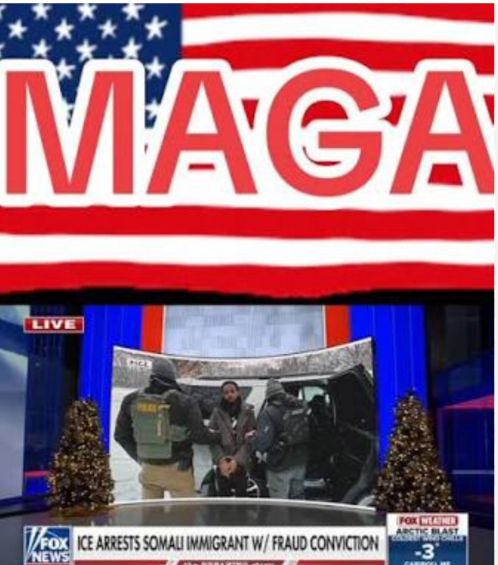
· The Action Sequence: Rhetoric must be married to action to make the threat tangible. As the verbal attacks peak, Immigration and Customs Enforcement (ICE) launches operations in the same communities. Reports surface of masked agents, unmarked cars, and U.S. citizens and lawful residents being detained and questioned—over 170 such instances documented in one recent investigation. The administration denies targeting based on race, but the community’s experience tells a different story. The chilling effect is immediate and deliberate.

The Human Algorithm: When Satire Meets Survival

The community’s response is where the administration’s crude script meets a sophisticated, modern reality. Faced with dehumanization, Somali-Americans have weaponized the very tools of modern discourse: satire, digital culture, and constitutional grit.

Fact Check vs. Fear Mongering:

· The Claim: Minnesota is a “hub of fraudulent money laundering activity” with funds flowing to terrorist groups.
· The Fact: While a fraud scheme is under investigation, federal prosecutors have brought no charges linking it to terrorist financing. Governor Tim Walz calls the terror link claim an unfounded slander against all Minnesotans.

While fear is palpable—businesses close, streets empty, people share photos of unmarked cars in private message groups—a defiant, humorous pushback has flourished online. On TikTok and X, creators have used AI to insert Somali figures into iconic American historical images, a pointed reminder of their place in the national story. They parody other nationalist narratives, joking that Minnesota was promised to them “3,000 years ago”. This isn’t just coping; it’s a masterclass in using First Amendment tools to expose the absurdity of the attacks. As one legal analyst noted, it highlights the ridiculousness of an anti-immigration movement “in a land where the natives were genocided”.

Yet, this digital bravery exists alongside profound anxiety. “Anyone who looks like me is scared right now,” said Minneapolis City Council Member Jamal Osman, a naturalized citizen. The fear is that the president’s rhetoric paints a target, encouraging others to become “more radicalized”. This is not hypothetical. Women in hijabs report being chased, and the number of death threats against Rep. Omar and her staff spikes after each presidential tirade.

The Bigger, Uglier Picture: A Playbook of Prejudice

The attack on Somali-Americans is not an isolated incident but a chapter in a well-thumbed playbook. It follows a consistent logic:

1. Identify a community that is distinct in race, religion, or origin.
2. Seize on a real or alleged crime committed by a few to smear the many.
3. Elevate a cultural or political figure from that community as a avatar of the threat.
4. Marry rhetoric to enforcement action to create a climate of tangible threat.
5. Frame any criticism as sympathy for criminals or opposition to law and order.

We’ve seen this show before. It was previewed in the 2016 campaign launch attacking Mexican immigrants, tested with the “Muslim ban,” and had successful runs targeting Haitian and African migrants. The current season simply features a new cast. It is amplified by a framework of broader policies, like the permanent pause on immigration from so-called “third-world countries” and the termination of Temporary Protected Status for Somalis.

The tragic irony, as Rep. Omar notes, is that this vitriol is spewed by a man who “fails to acknowledge how this country was built on the backs of immigrants and mocks their ongoing contributions”. The greater irony is that this performance may work in the short-term political calculus, energizing a base ahead of a midterm election. But it writes a shameful legacy in real time—one where children go to school knowing the President of the United States called them “garbage”, where citizens fear their own government, and where the promise of America is negotiated down to a nativist punchline.

In the end, the community’s resolve might be the ultimate satire of the administration’s efforts. “We are scared,” said one non-profit director. “But we’re united”. They are responding to a campaign of division with solidarity, to dehumanization with a fierce affirmation of their identity and belonging. They are, in essence, refusing to act according to the script. The president’s goal may be to tear them down, but as Omar concludes, his attacks only seem to make his targets—and the principles they defy—stand taller. The ratings for this particular show, it seems, might finally be falling.

WDM EDITORIAL: Trump’s Targeted Attacks on Somali-Americans: A Fact-Based Examination

Fearless. Independent. Unbought.

By Warsame Digital Media (WDM)

Introduction: The Rhetoric of Division

In recent days, Donald Trump has escalated a long-standing pattern of rhetoric against Somali-Americans, using language that crosses from political criticism into outright derogation, having called them “garbage” and stating, “I don’t want them in our country.” This editorial examines these attacks not just as inflammatory speech, but as part of a concerted political and legal strategy that demands a factual response.

The Minnesota Context: A Community of Citizens, Not “Invaders”

Trump’s focus is Minnesota, home to the nation’s largest Somali community, with an estimated 84,000 people in the Twin Cities area and about 260,000 nationwide. Contrary to the narrative of a foreign “invasion,” about 95% of this community are U.S. citizens or legal residents. They are not newcomers; families have built lives over decades. They are the nurses, truck drivers, business owners, and, yes, the sitting U.S. Representative—Ilhan Omar—that Trump vilifies.

The administration’s actions create a climate of fear. Trump terminated Temporary Protected Status (TPS) for Somalis, a humanitarian protection first granted in 1991. Now, reports indicate a planned ICE operation specifically targeting undocumented Somalis in Minneapolis-St. Paul. While the Department of Homeland Security states enforcement is based on immigration status, the simultaneous public vilification of the entire community paints a clear picture.

By the Numbers: The Facts Trump Ignores

Let us be brutally factual, because Trump’s narrative collapses under the weight of data. The Somali-American community in Minnesota is:

· A rapidly growing part of the state’s social and economic fabric.
· A key driver in revitalizing neighborhoods and commercial corridors, credited by local mayors for bringing new life to their cities.
· A contributor of billions in taxes and commerce, forming one of the fastest-growing Black middle classes in the Midwest.

This is not a threat—it is an asset. But Trump sees a problem: successful immigrants undermine his myth that he alone can “save” America from the people who are actively building it.

Deconstructing the Narrative: The Fraud Case in Context

Trump’s justification often points to a major federal fraud case in Minnesota, where prosecutors allege a $300 million scheme against a child nutrition program involving “roughly 70 people,” many from the Somali community. It is a serious crime. However, using the crimes of a few to label an entire community of tens of thousands as monolithic “garbage” is the definition of bigotry.

The strategic choice to amplify this single case while ignoring the community’s vast contributions is a calculated political tactic, not a genuine assessment of public safety. His entire political machinery requires enemies. Without them, his rallies would be nothing but an aging billionaire ranting into a microphone about people who refuse to applaud him.

Merkel’s Nuanced Legacy vs. Trump’s Calculated Bigotry

The editorial’s original contrast between leaders is instructive but requires nuance. In 2015, Angela Merkel confronted a moral test with the declaration “Wir schaffen das” (“We can do this”), welcoming over a million refugees. It was an act of courage that defined her generation.

However, by 2018, political pressures forced a significant toughening of German and EU migration policy, including proposals for detention centers and accelerated deportations. This doesn’t equate her policy to Trump’s rhetoric but illustrates a complex reality: even leaders guided by principle face political limits. Trump, by contrast, faces no such internal compromise; he manufactures and weaponizes vulnerability as his core strategy. Merkel asked how to help those fleeing. Trump asks why we should not fear them.

Why Trump Targets Somalis: The Real Political Calculus

Trump is not confused. He is strategic. Somali-Americans are:

· Black
· Muslim
· Immigrant
· Politically empowered (exemplified by Rep. Omar)
· Economically improving

In Trump’s worldview, this combination is intolerable. It is the antithesis of the America he wants to resurrect. When racist mobs chant “Send her back!” at a sitting member of Congress, Trump does not silence them. He conducts them. That is not leadership; it’s the orchestration of bigotry for political gain.

America’s Test: Resilience vs. Resentment

History presents a stark choice. Somali-Americans have endured civil war, famine, and displacement. They are now enduring a political campaign of fear. Yet, as St. Paul Mayor Melvin Carter stated, Trump’s attacks are on Somali-Americans—on Americans.

The community’s response has been to assemble, organize, vote, and build. They turn exclusion into political mobilization. This is the real threat Trump fears: a minority that refuses to be silent, invisible, or grateful for mistreatment.

A Call to Action: From Witness to Participant

This is not a moment for passive observation. The targeting of a community based on race, faith, and origin is a threat to the foundational principle of equality under the law. History will judge not only the aggressor but also those who stood by. We therefore call on every reader to move beyond outrage to action:

1. Defend with Facts: Arm yourself with the truth. When you hear lies that Somali-Americans are “invaders” or “garbage,” cite the data: 95% are U.S. citizens or legal residents. Share stories of their contributions as business owners, healthcare workers, and civic leaders. Challenge the single-story narrative with the overwhelming reality of community resilience and success.
2. Support Tangibly: Patronize Somali-owned businesses. Attend community cultural events. Donate to or volunteer with local organizations like the Somali American Task Force or the American Refugee Committee that provide vital services and advocacy. Stand in solidarity at public forums and city council meetings.
3. Hold Power Accountable: Demand that every elected official, from city council members to U.S. Senators, publicly condemn racist rhetoric and discriminatory targeting. Contact your representatives and insist they support policies that protect all citizens and residents from discrimination, and oppose policies based on fearmongering. Make your vote contingent on their courage.

Silence is complicity. Apathy is consent. We must choose the America we want to build: one strengthened by its diversity and compassion, or one weakened by paranoia and division. The choice is in your hands, your voice, and your vote.

WDM’s Final Word

Trump will be remembered as a man who built walls. Somalis will be remembered as a people who climbed them. He will be remembered for dividing America; they will be remembered for expanding it.

When the smoke of his rallies clears and the chants fade, the Somali-American community will still be there, standing tall, building, contributing, and claiming its rightful place in the American story. Because unlike Trump, they don’t need fear to define their future. Their facts, their contributions, and their citizenship already do.

WDM EDITORIAL: THE SOMALI-AMERICAN PARADOX: BETWEEN THE WOLVES AND THE WALL

Welcome to Minnesota — the so-called “State of Nice.” For ordinary Americans, that means free smiles, polite small talk, and a climate so cold it freezes problems before they start. But for the nation’s largest Somali community? It is becoming the “State of ICE” — and not the kind forming on the sidewalk.

The nearly 87,000 Somalis in the Minneapolis area are living a reality that is neither a dream nor a nightmare, but a calculated political limbo. The source of this anxiety is not abstract. It is a specific, planned Immigration and Customs Enforcement (ICE) operation, first reported by The New York Times, that is set to target the Twin Cities. Teams of federal agents are preparing for a sweep focusing on Somali immigrants with final deportation orders, an action local mayors learned about from news reports, not official channels.

These wolves don’t howl at the moon. They howl at the word “immigrant” from the highest office in the land. The operation’s planning coincides precisely with President Donald Trump’s escalating rhetoric. He has referred to the Somali community and Congresswoman Ilhan Omar as “garbage” who should “go back to where they came from,” and stated, “I don’t want them in our country… They contribute nothing”. This, despite the fact that these very immigrants and refugees have transformed once-blighted areas like Minneapolis’s Lake Street corridor into thriving hubs of Somali-owned businesses, bakeries, and coffee shops. As community health worker Nasra Hassan put it, surveying the revitalized streets, “Where would America be without us?”.

THE SURREALITY OF LIVING BY THE NUMBERS

Here lies the first layer of the paradox. The political rhetoric paints a picture of a foreign, undocumented swarm. The data paints a different portrait:

· A majority are citizens. Approximately 95% of Somalis in Minnesota are U.S. citizens. Of the foreign-born, an overwhelming 87% are naturalized citizens.
· A community of Americans. About 58% of all Somalis in the state were born in the U.S.. These are the second-generation kids—born in American hospitals, fluent in English, cheering for the Minnesota Vikings—who now watch as their community is singled out.
· A targeted few. The administration has moved to terminate Temporary Protected Status (TPS) for Somalis, a program that, as of August, covered just 705 people nationwide. The planned ICE sweep is expected to target “hundreds”. The scale of the fear is deliberately disproportionate to the stated bureaucratic targets.

Somali American police officers

Minneapolis Mayor Jacob Frey has vowed that city police will not participate, warning that such targeting means “American citizens will be detained for no other reason than the fact that they look like they are Somali”. Governor Tim Walz has dismissed the operation as a “PR stunt”.

THE GHOST IN THE LUGGAGE: CLAN, A STRUCTURE, NOT A MELODRAMA

As if this external pressure weren’t enough, the essay’s original critique of internal “clan theatrics” requires a crucial factual grounding. Clan affiliation is not merely petty politics or emotional baggage; it is a deep-seated socio-political structure forged in the crucible of state failure.

For decades, with no functioning central government to provide security or justice, Somalis have relied on their patrilineal clan and lineage for protection, resource access, and conflict mediation. This system is a rational adaptation to anarchy, but it comes with a brutal hierarchy. It privileges powerful majority clans with “long genealogies” and access to weapons, while structurally marginalizing minority groups. The U.S. Department of State notes that these minority clans face killings, torture, land theft, and severe discrimination, often with impunity.

This is the complex, life-and-death system that was packed in the luggage—not as a choice, but as an ingrained framework for social organization. Academic research confirms that clan-based conflict is a significant driver of displacement, with a strong statistical correlation to population flight. The danger in the diaspora is not that Somalis are “busy reenacting clan melodramas,” but that they might unintentionally transplant a structure built for survival in a lawless state into a democratic civic space where it can become a source of division.

The bitter irony is acute: while facing a political threat that collectively demonizes them as “Somali,” the community must navigate internal lines of division that trace back centuries. You cannot effectively organize against a monolithic label if you are fractured beneath it.

WDM’S VERDICT: FORGE A NEW CONTRACT

This is the moment of truth.
You cannot fight ICE, DHS suspicion, and presidential vilification while being divided by the ancient, survival-based logic of the clan.
You cannot protect your children’s future—a future where 50% are already U.S.-born—by applying a logic of patronage and exclusion from a homeland many have never seen.
You cannot demand to be seen as lawful, contributing Americans if your internal politics are not transparent and inclusive.

The call is not simply to “drop the clan.” That is naive. The call is to consciously, deliberately build a new social contract for the American context. The existing models are already here: organizations like the Somali Bantu Association of America focus not on lineage but on universal empowerment through ESL classes, citizenship prep, legal aid, and youth programs. They serve over 10,000 refugees of all backgrounds, building unity around shared needs, not shared ancestry.

A CALL TO THE DIASPORA

The era of blind trust is over. The wolves are here, their howls amplified by a megaphone. Your strength is in your numbers, your citizenship, your economic contributions, and your deep roots in cities like Minneapolis.

· Organize politically as Somalis and as Americans. Vote, lobby, and run for office not as representatives of a sub-clan, but of a united community with shared interests.
· Let your institutions reflect your reality. Build community centers, business associations, and advocacy groups that serve everyone, leveraging your strength for the common good.
· Tell your own story. Counter the narrative of “garbage” and “trouble” with the visible truth of revitalized streets, filled classrooms, and patriotic service.

THE FINAL WORD

Fear is not a strategy.
Clanism is not a shield.
Silence is not safety.

The Somali community in Minnesota stands at a crossroads. One path leads to being picked apart, both by external forces and internal fractures. The other leads to forging a new, powerful unity fit for the challenges of America. The choice is stark, and the time to choose is now. Because if you don’t consciously define your place in America, someone else will be all too happy to define it for you.

NOTE:

This essay has been fact-checked and revised with data from U.S. Census figures, reports from CNN, AP, PBS, and the European Union Agency for Asylum, and statements from local officials.