THE PARADOX OF SOMALI CENTRAL GOVERNMENT AND DJIBOUTI’S POLITICAL CIRCUS

By WARSAME DIGITAL MEDIA (WDM)

A President Who Needs a Foreign Microphone
It is one of the strangest spectacles in modern African politics: a head of state who cannot gather his own citizens on his own soil — not in Mogadishu, not in Baidoa, not in Garowe, not even in Laascaanood — but must instead borrow the stage of a foreign autocrat to speak to his own people. President Hassan Sheikh Mohamud, the self-proclaimed defender of Somali unity, has found himself standing not as a host but as a guest, addressing Somalis from Arta, Djibouti — a rented hall under another man’s flag.

The symbolism is deafening. The so-called Federal President uses another country’s legitimacy to perform his national duty. What does it say about sovereignty when the President of Somalia needs to be introduced to his own citizens by President Ismail Omar Guelleh? It’s like a father asking the neighbour’s permission to talk to his own children — a tragic comedy of failed statehood.

Arta 2025: The Sequel Nobody Asked For
The “25th Anniversary of the Arta Conference” is being paraded as a historic reunion — but in truth, it is a desperate rerun of a tired political play. What’s the real purpose of this show? Three things stand out clearly.
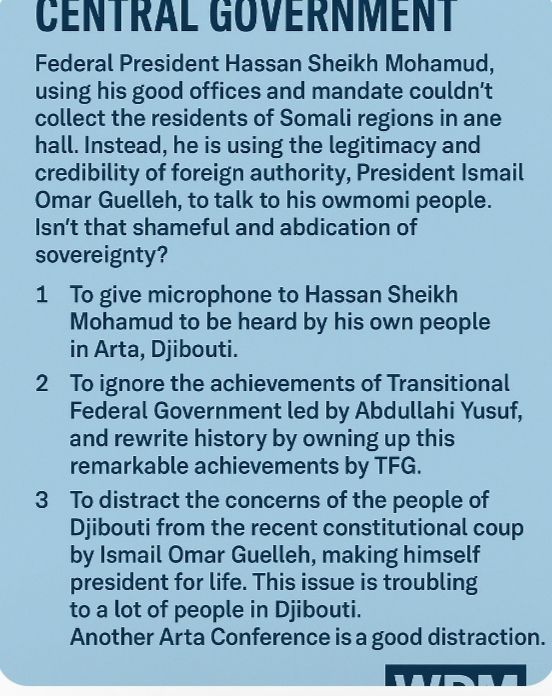
1. Microphone Diplomacy: Guelleh provides the microphone, Hassan Sheikh provides the speech. The Somali President, stripped of domestic credibility, borrows the voice of Djibouti’s palace to make himself heard. A President speaking to Somalis in exile — what a metaphor for the state of Somalia itself.

2. Historical Theft: The gathering attempts to erase the legacy of the Transitional Federal Government (TFG) founded by Abdullahi Yusuf Ahmed, the only Somali leader who built a legitimate post-war central authority and marched it back to Mogadishu and sat in Villa Somalia after Siyad Barre. Arta 2025 is not about peace; it’s about plagiarism. Hassan Sheikh and his Damul Jadiid courtiers are trying to rewrite history, pretending the TFG never existed — as if the journey from Nairobi to Mogadishu happened by divine teleportation, not by political courage.

3. Djibouti’s Domestic Distraction: Let’s not fool ourselves — Guelleh’s new “Arta show” is a smokescreen. His recent constitutional coup, extending his rule into eternity, has angered many Djiboutians. What better way to divert attention from domestic unrest than to resurrect Somalia’s endless conferences? While Djibouti’s youth whisper about political reform, Guelleh waves the Somali flag and declares another “peace initiative.” The irony? There is no peace to be made — just recycled rhetoric and hotel per diems.

But make no mistake: The elephants in the Arta Hall now are TFG and Puntland State.

The Puppet and the Puppeteer
In this theatre of borrowed legitimacy, two aging regimes perform a duet of self-preservation. Hassan Sheikh Mohamud needs Guelleh’s stage to look relevant. Guelleh needs Hassan Sheikh’s chaos to look indispensable. One is struggling to control his federation; the other is struggling to control his own succession. Together they form a tragic alliance of political insecurity.

The Somali President, who once promised “Soomaali Heshiis Ah,” now acts like a tenant of Djibouti’s foreign policy. His ministers chase after photo opportunities instead of federal consensus. Meanwhile, Guelleh, the octogenarian master of political disguise, plays the “wise regional statesman” while chaining his own citizens to perpetual rule.

The Real Message of Arta
The 2025 Arta Conference does not symbolize reconciliation — it symbolizes regression. It marks the return of Somalia’s dependency politics, where every local crisis requires a foreign sponsor, and every Somali leader kneels before a smaller but more coherent state.

If Hassan Sheikh Mohamud cannot summon his own citizens in Mogadishu without foreign permission, then what exactly is he president of? And if Ismail Omar Guelleh’s only legacy after 25 years in power is hosting other people’s problems, then what is Djibouti’s independence worth beyond its borders?

Final Word: The Emperor and the Errand Boy
Somalia’s President borrows legitimacy; Djibouti’s President hides from his own people. One cannot speak at home, the other cannot stop speaking abroad. Together they create the perfect paradox — two leaders bound by insecurity, united by illusion, and blessed by self-deception.

In the end, Arta 2025 will not be remembered for speeches or resolutions. It will be remembered as a political masquerade — where a nation without direction applauded another without democracy.

——

WARSAME DIGITAL MEDIA (WDM)
Support WDM — the home of fearless, independent journalism that speaks truth to power across Somalia and the region.
Tel/WhatsApp: +252 90 703 4081.

Review of “First Footsteps Revisited: Burton and the Somali Frontier” by Abdullahi A. Nor (WardheerNews)

Overview

Abdullahi A. Nor’s narrative is a sweeping historical reconstruction of Sir Richard Burton’s 1854–1855 journey through the Horn of Africa, written with literary polish and ethnographic precision. Drawing heavily from First Footsteps in East Africa, Nor revisits Burton’s odyssey not merely as an act of exploration but as a profound cultural encounter — between the Victorian world of empire and the oral democracies of Somali society.

This is no mere retelling; it is a reinterpretation that situates Burton’s journey within Somali agency, geography, and memory.

Strengths

1. Masterful Historical Framing

Nor situates Burton’s journey in the larger 19th-century “Age of Exploration” but immediately distinguishes him from the rest. The opening lines — invoking “lost cities, the sources of the Nile, and the edges of empire” — evoke the grandeur of exploration while contrasting Burton’s intellectual curiosity against the imperial arrogance of his contemporaries.

The author skillfully connects this to the ancient identity of Punt, grounding the reader in a Somali-centered geography rather than a European map.

2. Ethnographic Fidelity and Respect

Each section dedicated to a Somali clan (Isa, Gadabuursi, Habr Awal, Geri Kombe, Dir) is both vivid and fair. Nor captures the internal diversity and sophistication of Somali society — emphasizing customary law (xeer), lineage politics, and oral governance.
He translates Burton’s occasionally exotic descriptions into respectful ethnography, allowing Somali institutions to stand as coherent systems of law and social contract rather than “tribal curiosities.”

Notably, his description of the Gadabuursi’s “parliament without walls” and the Geri Kombe’s “court beneath a tamarind tree” demonstrate a deep understanding of the Somali moral order.

3. Elegant Prose and Balanced Tone

The writing is lyrical without being overwrought. Phrases like “every man carries his genealogy in his memory, his honor on his tongue, and his sword at his side” echo Burton’s own romantic language but carry a Somali rhythm and restraint.
Nor’s tone remains balanced — critical of colonial ambitions yet appreciative of Burton’s intellectual courage and curiosity.

4. Restoring Somali Centrality

Most English-language writings on Burton cast him as the protagonist and the Somali as the backdrop. Nor reverses this perspective: the land, people, and codes of the Horn become the story’s true framework. Burton appears as a guest navigating a pre-existing civilization.

By calling the Somalis “a democracy of equals,” Nor not only quotes Burton but reclaims the phrase as a historical affirmation of Somali political identity — centuries before the notion of “federalism” entered the region’s discourse.

Weaknesses

1. Limited Critical Interrogation of Burton’s Biases

While the author acknowledges the “colonial assumptions of his age,” he does not fully unpack how Burton’s writings reinforced later imperial projects. A deeper critique of the racial, economic, and religious hierarchies embedded in Burton’s ethnography could have strengthened the analysis.

2. Absence of Contemporary Reflection

The “Epilogue” beautifully connects Burton’s footsteps to the modern Somali landscape, yet the piece stops short of drawing explicit parallels to current identity debates, border politics, or the legacies of British and Ethiopian influence.
A paragraph connecting Burton’s maps to present-day geopolitical fault lines — Somaliland, the Ogaden, Zeila, Harar — would have added resonance.

3. Over-Romanticization

Though Nor’s poetic tone is captivating, at times it risks idealizing precolonial Somali society as an egalitarian utopia. A few nods to internal conflicts, feuds, or hierarchies could balance this romantic portrayal.

Style and Structure

Nor organizes the piece with clarity and rhythm. Each clan is given a standalone section, producing a sense of journey and continuity. The structure mirrors a caravan route — coastal, pastoral, frontier, and highland — culminating in Harar.
His use of bold subheadings and balanced paragraphs makes the text highly readable for both academic and general audiences.

Conclusion

Abdullahi A. Nor’s essay is a rare blend of historical scholarship, literary craft, and cultural empathy. It reframes Burton’s First Footsteps not as a European triumph of discovery but as an encounter between knowledge systems — one written, the other spoken.

It is both a homage to Somali civilization and a critique of how history was told about it. Nor gives voice to the Isa, Gadabuursi, Habr Awal, and Geri Kombe not as footnotes to Burton’s adventure, but as the rightful authors of their own landscape.

In short, this story is not merely about Burton’s footsteps — it’s about the ground he walked on finally speaking for itself.

Rating: ★★★★★ (5/5)
Verdict: A meticulously researched and elegantly written historical essay that reclaims Somali agency in one of the most mythologized episodes of African exploration.

Between History and Hysteria — Why These Interviews Matter, and Why They Rattle the Anti-Federalists

Dear WDM Readers,
Here is why the release of the latest instalment of the interview series (on ­­­Arta Conference and Mbagathi Conference) is nothing less than a breakthrough — and why it should set off alarms in every quarter that profits from confusion, distortion, and the “unitary-only” narrative of Somalia.

What these interviews do

1. Restore the credible chronology — The record of Somali peace, reconciliation and state-building conferences has been battered for decades by selective memory, bad-faith revisionism and outright political opportunism. The new series offers voices that cut through the noise, reminding us: Arta (Djibouti, 2000) though unrepresentative and manipulated by Djibouti President Ismail Omar Guelleh, laid the foundation for what became the transitional federal system, and Mbagathi (Nairobi, 2002) created the Second Somali Republic, the Federal Republic of Somalia.

2. Expose the distortions — For too long, opponents of federalism have reduced these long series of talks to “failed unitary state attempts” or “mere elite bargains.” The interviews draw attention back to the substance: clan and regional delegations, diaspora involvement, the roles of external actors—not just as spoilers but as architects of new national pathways.

3. Clarify Puntland’s missing links — In your own field of interest — the establishment of Puntland (1998 onward) and the subsequent federal trajectory — these interviews provide context. They place Puntland as the leading partner and an integral part of the pre-federal puzzle: those conferences and trajectories originated from the north-east Somalia

4. Punch holes in the “unitary nostalgia” narrative — The forces pushing for a strong centralised Somalia (for understandable motives: control, rents, centralised aid flows) have long misused the conference histories to argue that federalism is a foreign import, a last-resort fallback. The interviews dismantle that line: federal forms were emerging in real time, not hijacked later.

Why this matters politically

Power & resources: Whoever controls the narrative controls how revenue (hydrocarbons, port revenues, diaspora flows, donor funds) is allocated. By reconstructing a credible narrative of federalism’s roots, the interviews shift the terrain away from zero-sum centralisation.

Legitimacy and memory: In Somalia’s fragile political architecture, memory is contested terrain. These interviews insert a counter-memory to the dominant one-state-only mythology. For Puntland, for diaspora networks, for business communities in Galkayo, Garowe, Qardho — this means recognition and standing.

External actors: With your interest in UAE, Turkey, Qatar, IMF/World Bank, etc., recall that many external players prefer a weak centre to negotiate bilaterally. A stronger federal architecture threatens that. The interviews thus irritate not just domestic monopolies but external contractors of ambiguity.

Narratives shape institutions: If the conferences are portrayed as failures or as “throwaways,” then federalism becomes a placeholder. But if the interviews make clear that they were substantive, then federalism becomes an institution with roots and rights — and Puntland’s claim to its piece of that architecture becomes sharper.

But: No piece is perfect. Here are caution flags and opportunities for sharpening.

Selection bias: Make sure the interview series does not give the impression of cherry-picking voices friendly to your agenda. Credibility is built when critics—yes, even opponents of federalism—are present, questioned, held to account.

Depth of archival grounding: Oral interviews are powerful, but must be backed with documentation (resolutions of Arta, minutes of Mbagathi, clan-delegation lists). Without that, critics will accuse you of anecdote substitution.

Vocabulary discipline: Some audiences dismiss the label “federalism” because of its misuse. The interviews should define terms clearly: what “federalism” meant in 2004, how that framework differs from “autonomy,” “confederation,” “unitary state.” Clarify the difference between de facto federalism (as in Puntland’s reality) and de jure federalism.

Avoid triumphalism: While it’s tempting to celebrate the interviews as “the answer,” stay in journal-istic posture: raise questions, point the gaps, invite commentary. That strengthens rather than weakens the piece.

Footnote the economic dimension: Given your interest in infrastructure, remittances, donors, etc., ensure a stronger thread in the interviews about how these peace conferences had direct economic/macro consequences (e.g., how conference outcomes enabled diaspora flows, or how they linked to telecom liberalisation, or how they influenced port logic). This links the political critique to your core interest.

The bottom line

For too long, Somali federalism has been treated like an accident of war, a refuge of clan leaders, or a donor fad. These interviews slash through that fiction. They remind us that–from Arta to Mbagathi to Puntland––there existed purposeful design, contested negotiations, regional and diaspora agency, and institutional potential.
In doing so, they unsettle those who prefer a weak Mogadishu-centric rent-seeking model, who benefit from a fuzzy memory of the past, and who still see federalism as a threat to their resource-grain.

So: Listen. Review. Share. But don’t stop there. Use the interviews as a weapon in the contest of history — because until history is agreed, policy will be surrendered.

Support WDM — the home of fearless, independent journalism that speaks truth to power across Somalia and the region. Tel/WhatsApp: +252 90 703 4081

— Yours in the unflinching fight for Somali accountability and development,
Ismail H Warsame
WDM

Wareysi Muhiim ah. Qaybtii III