
WARSAME DIGITAL MEDIA (WDM) EDITORIAL
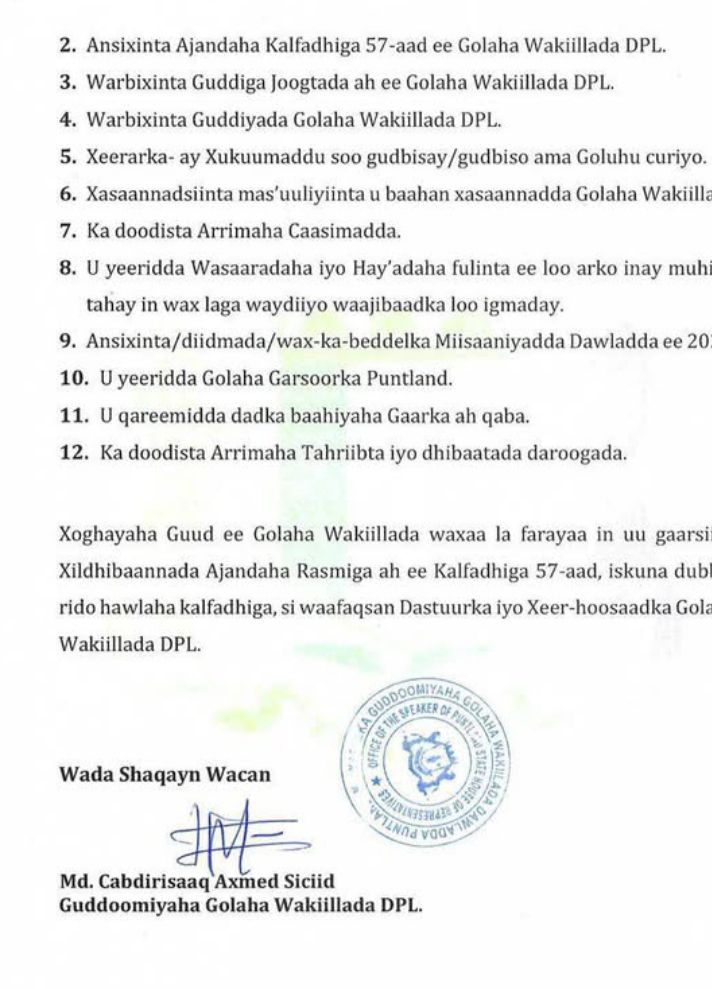
A House of Representation or a Hall of Repetition?
When the Speaker of Puntland’s Parliament cleared his throat to read the “agenda,” citizens expected echoes of urgency — debate on the collapsing economy, dying social services, unpaid civil servants, insecurity in Galkayo, federal paralysis in Mogadishu, and the widening vacuum of legitimacy.
Instead, they got a lullaby of bureaucracy — a hollow recital designed to sedate a weary population.
Not a single item demanded answers from the executive. No call for accountability. No inquiry into unpaid salaries, collapsing hospitals, or decaying roads and airports, and flights of families en masse from the state because of poverty and crumbling social services, fleeing high living costs to Egypt, Kenya (Nakuru), even Somaliland (Borama).
And yet, they still call this institution the Puntland House of Representatives. What a joke. No — what an insult to the intelligence of its people.
The State That Pretends — The Monarch That Reigns
Puntland, once a proud federal pioneer, now resembles a manorchy — a hybrid of monarchy and fiefdom where the “king” rules unchallenged and Parliament performs on cue.
This is not democracy; it is political theater under the shadow of absolutism. The “House” has become his stage; the “Representatives,” his obedient orchestra.
Each session opens with self-praise, proceeds through a symphony of confusion, and ends with a standing ovation for mediocrity. If this is representation, then the people are represented only in their silence.
The Agenda of Absurdities
Examine the Speaker’s agenda carefully: it says much but means nothing. It reflects no real issue — and forbids real solutions. It’s an academic exercise in futility, like reading the weather forecast after the flood. It is an obscene kind of exercise that repeats itself with the same joke over and over every year – no reflection whatsoever on the challenging issues of the time. It is obviously one word document file saved in the laptop of an incompetent Parliament Secretary to be reproduced unedited for every session for the Speaker’s express signature and seal.
Where are the questions on Galkayo’s insecurity, where residents fear the evening?
Where is outrage over unpaid teachers, collapsing hospitals, and the stench of the city’s failed drainage?
Where is the parliamentary courage to ask why Puntland’s economy bleeds while corruption thrives?
Instead, the Assembly gathers to close its moral eyes — singing hymns to ruin while pretending the music still sounds fine.
A Conspiracy of Silence
This Parliament no longer legislates; it merely echoes. It is a soundproof chamber tuned to amplify one voice — the ruler’s.
Inside, MPs congratulate themselves for “thorough deliberations.” Outside, civil servants curse empty treasuries.
No minister trembles under questioning; no executive fears a motion. The Speaker doesn’t guide debate — he conducts it, baton in hand, ensuring perfect harmony between submission and hypocrisy.
In Puntland, the only budget fully implemented is the budget for applause.
Rubber-Stamp State
The tragedy is not that Parliament cannot act — it is that it refuses to.
Its members confuse loyalty with servitude and oversight with obstruction.
The result: a rubber-stamp state, where constitutionalism has been replaced by courtiership.
Every decision is pre-approved. Every motion is pre-censored. Opposition has been exiled from debate, replaced by the hollow rhetoric of “unity” and “progress.”
They sit in Garowe’s old corrugated building, congratulating themselves for “stability” while the foundations of governance rot beneath them.
Conclusion: A Show for the King’s Amusement
The play continues — tickets issued to sycophants and sidekicks to enjoy special performance.
The actors perform with obedient precision; the audience — the public — watches in despair.
History will not remember this Parliament for what it accomplished, but for what it allowed:
It allowed a state built on ideals to decay into a courtyard monarchy.
It allowed silence to replace scrutiny, and flattery to replace freedom.
In the end, the Speaker’s “agenda” is not a plan.
It is a eulogy for Puntland’s democratic soul. This is the legacy of a king handpicking members of a parliament before the eyes of would-be voters without public protests.
—
WDM Footnote:
When a House becomes a hall of applause, and a Speaker becomes the King’s announcer, representation dies in ceremony. The people of Puntland deserve better than orchestrated silence.
———-
Support WDM — the home of fearless, independent journalism that speaks truth to power across Somalia and the region.
Tel/WhatsApp: +252 90 703 4081 ✅
 Warsame Policy & Media Network (WAPMEN)
You must be logged in to post a comment.