
By Ismail H. Warsame
Warsame Digital Media (WDM)
Abstract
This paper explores the political and psychological dynamics of Ethiopian–Somali relations during the Somali Salvation Democratic Front (SSDF) era of the 1980s, focusing on the patterns of manipulation, mistrust, and humiliation that characterized Ethiopia’s foreign policy toward Somali liberation movements. Drawing from first-hand experience as a member of the SSDF Secretariat in Ethiopia, this study examines subtle bureaucratic behaviors—such as deliberate silence and symbolic condescension—were used as tools of imperial control. By analyzing the Ethiopian political psyche and its duality of envy and suspicion toward Somali assertiveness, this paper argues that Ethiopia’s approach to Somali actors was rooted in a colonial tradition of containment and domination rather than partnership.
1. Introduction
The relationship between Ethiopia and Somalia has long been defined by rivalry, insecurity, and cultural contrast. From the late nineteenth century, when the Abyssinian Empire expanded eastward under Menelik II, to the Cold War alliances of the Derg era, Ethiopia has treated Somali political formations as both a threat and a strategic necessity.¹ Somali liberation movements such as the SSDF (founded in 1978 after the failed coup against Mohamed Siad Barre) relied heavily on Ethiopian logistical support, yet that dependence came with humiliation and mistrust.
This paper examines this asymmetrical relationship through the lens of bureaucratic behavior—particularly what may be called Ethiopia’s “silent diplomacy.” The author’s personal recollections of Ethiopian officials, such as the mid-level officer “Aklilo,” illustrate how silence and indifference were transformed into mechanisms of political subjugation.
2. Background: SSDF and Ethiopian Patronage
Following the Ogaden War (1977–1978), Ethiopia, then under the Marxist Derg regime led by Mengistu Haile Mariam, offered sanctuary to Somali opposition figures seeking to overthrow Siad Barre.² The SSDF, led initially by Colonel Abdullahi Yusuf Ahmed, was among the first organized Somali resistance movements to operate from Ethiopian soil. However, the alliance was fraught with tension.
Ethiopia’s military intelligence treated the SSDF less as a partner and more as a controlled instrument of statecraft. Access to resources, movement permits, and communications were tightly regulated.³ Requests for routine administrative tasks—such as travel passes to the frontlines—often became exercises in humiliation.
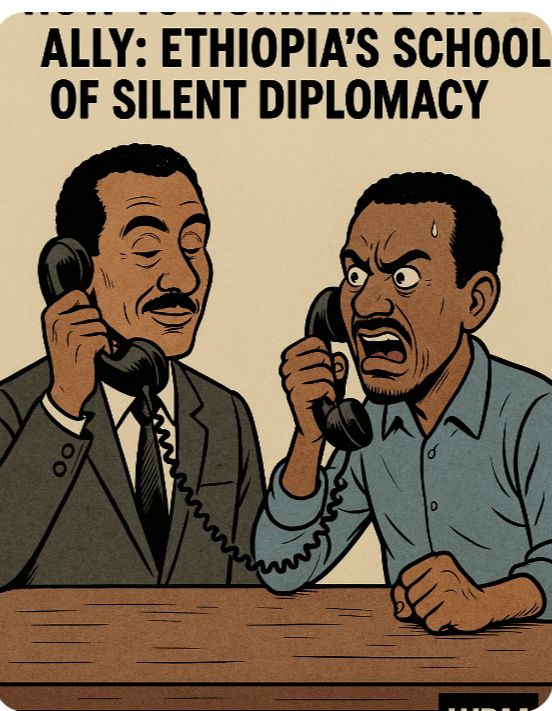
In one revealing incident, an SSDF representative, facing urgent operational needs, called an Ethiopian liaison officer named Aklilo to request official clearance. The officer answered the phone but refused to speak, maintaining a prolonged, uncomfortable silence. Such behavior was not merely rude; it was a subtle assertion of dominance—an unspoken reminder of dependency.⁴
3. The Psychology of Ethiopian Diplomacy
Ethiopia’s statecraft toward Somalis reflected deep historical and psychological contradictions. On one hand, Ethiopians admired the Somali’s independence, eloquence, and mobility; on the other, they feared and resented those very traits.⁵ This oscillation between admiration and hostility produced a political culture that viewed Somalis as both potential allies and existential threats.
The use of silence as a diplomatic weapon symbolized a broader Ethiopian attitude: control through psychological superiority. As Levine (1974) observed in Greater Ethiopia, the Ethiopian elite historically maintained “a politics of guarded distance,” employing ritualized aloofness as a method of asserting hierarchy.⁶ In bureaucratic settings, this manifested as procedural delays, ambiguous communication, and deliberate opacity—techniques designed to reinforce dependence.
During SSDF’s tenure in Ethiopia, such tactics translated into chronic frustration among Somali cadres. While official rhetoric emphasized “solidarity,” the reality was one of containment.⁷ Ethiopia’s silence was not ignorance—it was strategy.
4. Dire Dawa and the Whispered Regrets
During one SSDF conference in Dire Dawa, the author observed an illuminating moment of candid reflection. Outside the meeting venue, a group of Ethiopian officers and civil servants spoke among themselves about the treatment of the Somali movement. Some expressed quiet regret for what they described as the “betrayal” of Somali allies by their own government.⁸
Their tone revealed a dichotomy between the Ethiopian state and its citizens: the regime’s imperial instincts versus the individual’s moral discomfort. This subtle empathy among Ethiopian officials—expressed privately and never officially—underscored the moral fragility of the Derg’s foreign policy. Ethiopia’s leadership feared Somali independence more than it valued genuine regional stability.
5. Silence as Statecraft and the Colonial Continuum
The Ethiopian bureaucratic culture that SSDF encountered was not an invention of the socialist era; it was the continuation of a much older imperial tradition. The Abyssinian court system, and later the modern civil service, were modeled on hierarchical, deferential communication structures where silence symbolized authority.⁹
This cultural dynamic permeated Ethiopia’s external relations. By refusing to engage Somali representatives openly, Ethiopian officials maintained both psychological distance and political leverage. The “diplomacy of silence” became a tool of control, reflecting a belief that dialogue implies equality—something the Ethiopian state historically resisted granting to Somalis.
Such behavior is consistent with the broader colonial psychology described by Fanon, wherein the colonizer enforces hierarchy not only through violence but through symbolic humiliation.¹⁰ Ethiopia’s silence toward Somali liberation actors thus functioned as both a political and psychological form of domination.
6. Conclusion: The Legacy of Humiliation and the Persistence of Defiance
Ethiopia’s “school of silent diplomacy” left a lasting imprint on Somali political consciousness. For the SSDF, the experience revealed the perils of dependency on a neighboring power whose strategic objective was control, not cooperation. The episode of “Aklilo the Mute Bureaucrat” encapsulates a larger truth: silence can wound more deeply than words.
Yet, this history also affirms Somali resilience. Despite humiliation, manipulation, and betrayal, the SSDF laid the groundwork for Puntland State in 1998—an embodiment of Somali political continuity and defiance. The silence of Ethiopian bureaucrats could not erase the voice of Somali determination.
—
Bibliography
1. Marcus, Harold G. A History of Ethiopia. Berkeley: University of California Press, 1994.
2. Lefebvre, Jeffrey A. “Ethiopia, the Horn of Africa, and U.S. Foreign Policy.” Middle East Policy 5, no. 1 (1997): 144–166.
3. Halliday, Fred, and Maxine Molyneux. The Ethiopian Revolution. London: Verso, 1981.
4. Warsame, Ismail H. Personal Field Notes, SSDF Secretariat, Addis Ababa and Dire Dawa, 1983–1986.
5. Samatar, Ahmed I. “Destruction of State and Society in Somalia: Beyond the Tribal Convention.” Journal of Modern African Studies 30, no. 4 (1992): 625–641.
6. Levine, Donald N. Greater Ethiopia: The Evolution of a Multiethnic Society. Chicago: University of Chicago Press, 1974.
7. Clapham, Christopher. Transformation and Continuity in Revolutionary Ethiopia. Cambridge: Cambridge University Press, 1988.
8. Author interview and recollection, Dire Dawa, 1985.
9. Bahru Zewde. A History of Modern Ethiopia, 1855–1991. London: James Currey, 1991.
10. Fanon, Frantz. The Wretched of the Earth. New York: Grove Press, 1963.
 Warsame Policy & Media Network (WAPMEN)