WDM STATE OF THE UNION: THE POINT OF NO RETURN

By Ismail H.Warsame
Warsame Digital Media(WDM)

Somalia stands at a precipice, haunted by a single, unavoidable question: where do we go from here?

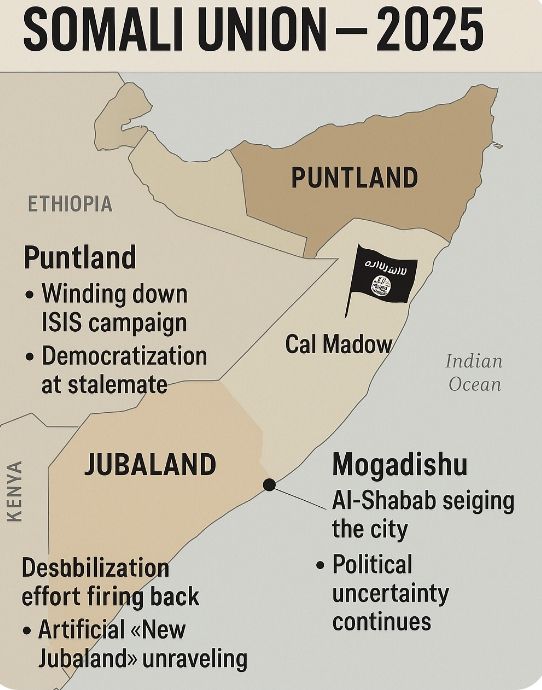
In the north, Puntland State—the federation’s last functioning polity—is concluding a grueling campaign against ISIS in the Cal-Miskaad ranges. The black flags have been torn down, but the war drums echo from the Calmadoow Mountains, where Al-Shabab’s shadow government still levies taxes, enforces its rule, and harvests the disillusioned and gemstones alike. This is the next battle, looming and unwon, pending the whims of distant patrons.

Those patrons, the United Arab Emirates and the United States, are now uncertain allies in a world fractured by new wars and economic tremors. Their commitment wavers with the potential next Donald J. Trump’s tweet, a figure who could erase yesterday’s pledges with such unpredictability. Should American aid vanish, Puntland’s soldiers may find themselves standing against the storm in little more than sandals and sheer will.

At home, Puntland’ democratic momentum has frozen. President Said Abdullahi Deni, rather than securing the legacy of his governance reforms, is captivated by the siren call of Villa Somalia in 2026. The ballot boxes in Garowe lie silent; the project of democracy is on indefinite hold.

Meanwhile, Villa Somalia is reaping the whirlwind of its own political arson. The “smart politics” of President Hassan Sheikh Mohamud and his Damul-Jadiid cadre have proven to be a masterclass in miscalculation, exposing a dangerous cocktail of arrogance and ineptitude. The regime’s “stabilization mission” is now a bitter punchline in Mogadishu’s tea shops.

Its deliberate campaign to destabilize the federal member states has backfired spectacularly. The artificial “North East State,” concocted in Laascaanood, is unraveling like a cheap mat from Bakaaraha market. Its administrators issue decrees to extort local financial agencies to stay relevant. The parallel fantasy of a “New Jubaland” is another lit fuse—a scheme destined to fail, but only after further poisoning the well between Mogadishu and Kismayo.

As for Hirshabeelle, Galmudug, and Southwest, these are not states but subsidiaries, their leaders governing on borrowed legitimacy and donor stipends. The federal model has been hollowed out, mutated from a structure of governance into a network of patronage.

And through the cracks, Al-Shabab marches. They no longer infiltrate the capital; they operate with impunity. The city’s “most secure zones” like Godka Jilicoow, guarded by NISA and African Union forces, have become stages for public humiliation. Each blast is a stark reminder: Mogadishu is under a siege that its own government seems powerless to lift.

Inside the Halane compound, the diplomatic bubble where optimism is imported and reheated, the mood has curdled. The envoys who once championed the Damul-Jadiid “success story” now scramble to explain how their project became an obituary for functional federalism. Their talking points are exhausted; their credibility, bankrupt.

So, where do we go from here?

The answer will not be found in Mogadishu’s sterile conferences or the anodyne communiqués of donors. Somalia’s fate will be decided by its local realities, not imported slogans. Puntland and Jubaland now shoulder the crumbling pillars of the federation, even as the center collapses. Unless a surge of reason dispels the pyromania in Villa Somalia, the Union itself may not survive the next blaze.

This is the state of our union: fractured, fatigued, its future flickering faintly against the gathering dark. The ghosts of division are dancing, and the music is reaching a crescendo.

Welcome to the Somali paradox: a nation at war with its own reflection.

WDM Commentary:
This is not a prediction; it is a diagnosis. Somalia’s crisis is not an accident of fate, but the direct yield of calculated irresponsibility. Until a new ethos of leadership rises from the ashes of Mogadishu’s hubris, the next state of the union will read not as a warning, but as an autopsy.

© Warsame Digital Media (WDM)
Qardho,Puntland
“Talking Truth to Power— One Editorial at a Time.”

CLAN AND MARRIAGE — TWO BINDING TIES IN SOMALI CULTURE

By Ismail H. Warsame, WDM

In the glittering hall of white linen and bottled milk, men and women gather — not merely for a wedding, but for the continuation of an ancient Somali ritual: the binding of clans through marriage. Behind the laughter, the speeches, and the perfumed atmosphere lies a silent constitution — older than any written law — where kinship replaces contracts, and bloodlines define both politics and peace.

This was my second time in Qardho witnessing such a union — a spectacle that is part diplomacy, part social insurance, and part clan arithmetic. When a Somali marriage takes place, it is not simply two souls uniting. It is the quiet reshuffling of genealogical alliances; a recalibration of power between sub-clans that might tomorrow either share camels or fight over wells.

The event begins long before the guests arrive. It starts with negotiations, deliberations, and sometimes even historical reconciliations between elders who still remember who offended whose grandfather over a grazing patch or a political appointment. The bride’s hand, formally requested, becomes a symbol of truce — a peace pact in white fabric and henna, sealed not by written law, but by maternal lineage and whispered blessings.

In such ceremonies, men and women usually sit separately or attend in different sessions — men in formal daytime gatherings of speeches, blessings, and agreements; women in vibrant evening events of singing, dancing, and expressing the folklore prowess of Somali womanhood. The two sessions together complete the cultural circle: solemn diplomacy by day, joyful cultural continuity by night.

Yet beneath this noble gesture lies the irony of Somali society: the very ties that unite us are the same that divide us. The mothers whose names echo in every family tree are both peacemakers and progenitors of rivalry. Each birth is a celebration, but also a demographic declaration — another branch in the ever-expanding tree of sub-clans that fracture, multiply, and compete for prestige, land, and leadership.

At the ceremony, I looked around the hall — rows of men in white, seated in careful symmetry, exchanging blessings and political gossip between sips of milk. This is the Somali parliament in its truest form — not in Villa Somalia, but here, under chandeliers and tribal memory. Every marriage is an unwritten treaty, every smile a signal of alignment, every whispered prayer a continuation of a 1,000-year clan contract.

When historians search for the roots of Somali political resilience — and its endless cycles of reconciliation and rupture — they should start not in Mogadishu’s corridors, but at these wedding tables. Here, the future is negotiated over bottles of milk and lineage, and every bride becomes a bridge between clans — or a border line drawn in beauty.

WDM Conclusion:
Marriage in Somali culture is the most stable political institution — an unspoken parliament of kinship. It binds us in peace, births our rivalries, and keeps our nation spinning in its familiar orbit of clan and connection.

© Warsame Digital Media (WDM)
City of Qardho, Karkaar Region

WDM Editorial: Qardho — From Roaring Debates to Quiet Calculations

By Ismail H. Warsame, Qardho, Karkaar Region, Puntland

There was a time when Qardho’s air was thick with argument, debate, and political ferment — a city that never slept without a new controversy. From clan assemblies to student circles, from mosques to teashops, the voice of Qardho was the pulse of Puntland’s civic life. It was here that ideas clashed, policies were tested, and political currents were sensed before they reached Garowe. Qardho earned its reputation as the “City of Debates and Controversies,” where nothing passed unquestioned and no leader escaped scrutiny.

Today, something is changing. The once noisy crossroads of Puntland’s political thought is learning a new rhythm — that of quiet, cool calculation. The political tempest that once defined Qardho’s public squares has given way to reflective silence, economic pragmatism, and slow, deliberate planning. The city that once spoke loudly is now thinking deeply.

In recent years, Qardho has emerged as a learning hub — a city of affordable education, housing, and calm community life. Its universities, training centers, and private schools are drawing youth from across Puntland. This intellectual transformation is reshaping Qardho’s identity from a political battlefield to an academic haven. Yet, beneath this positive evolution lies a worrying trend: opportunity is slipping away faster than it is created.

Job scarcity has become the city’s quiet crisis. The very youth who animate Qardho’s new intellectual scene are also the ones boarding buses, flights, and ships — seeking work in Garowe, Bosaso, Mogadishu, and beyond. The irony is painful: a city known for nurturing brains now exports them. The debates have stopped not because the people have lost curiosity, but because they are too busy surviving.

Qardho’s streets, once echoing with political chants and intellectual arguments, now hum with the sound of construction — affordable housing projects, small shops, and the buzz of daily hustle. The city is learning to measure progress not in decibels of debate, but in bricks, books, and banknotes. It’s a quiet evolution, one that could either anchor its future or flatten its spirit.

The challenge now is to balance Qardho’s newfound calm with its old courage — to blend calculation with conviction. A city that stops talking risks becoming stagnant, but a city that only talks and never builds remains poor. Qardho must find the middle path: to build its economy without losing its voice, to nurture its youth without pushing them away, to remain the thinking heart of Puntland while securing a future for its sons and daughters.

The future of Qardho depends not on the silence of its streets, but on the smart, deliberate ideas that grow within them. The city that once led debates must now lead development — with the same passion, purpose, and courage that once made it the intellectual capital of Puntland.

WDM — Talking Truth to Power.