
By Ismail H. Warsame, WDM Founder
Introduction: The Echo of Old Wounds
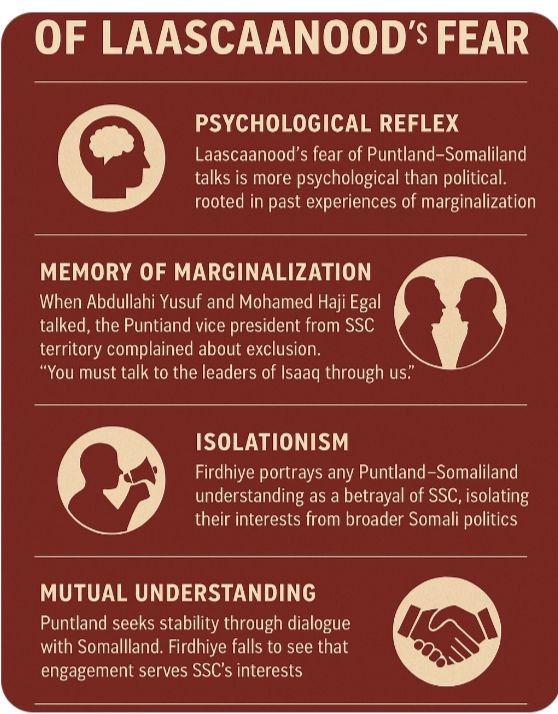
In the current uproar surrounding Puntland–Somaliland “security cooperation,” one hears not so much the clash of political logic as the tremor of old psychological fears. Laascaanood’s anxiety is not rooted in facts or tangible concessions but in the emotional residue of betrayal, marginalization, and historical trauma. The real problem is not that Garowe and Hargeisa talk—it’s that Laascaanood has never fully trusted anyone to talk on its behalf without suspicion of being sold out.
When history is weaponized by insecurity, perception becomes reality. The current leadership in Laascaanood, particularly figures like Firdhiye, mistake dialogue for compromise and cooperation for conspiracy. Yet the truth is far less dramatic and far more strategic: mutual understanding—no matter between whom—is always in the collective interest of the Somali people.
Historical Context: When Abdullahi Yusuf and Egal Talked
The unease we see today is not new. During the formative years of Puntland, when the late Abdullahi Yusuf engaged in discussions with Somaliland’s Mohamed Haji Ibrahim Egal, Puntland’s own vice president from SSC territory, Mohamed Abdi Hashi, objected. His words were striking:
“We don’t mind when you talk with leaders of Hawiye, but you must talk to the leaders of Isaaq through us.”
This wasn’t a political demand—it was a psychological reflex. It revealed a deep-seated insecurity that SSC’s agency could be bypassed, that others could determine its fate behind closed doors. It is an emotional scar from decades of marginalization—first under northern domination, then southern neglect.
Laascaanood’s fear, therefore, is a memory, not a policy. It’s the aftertaste of exclusion, not an objective assessment of current realities.
The Fallacy of Firdhiye’s Politics
Firdhiye’s rhetoric is historically shortsighted. His worldview is trapped in the narrow confines of clan sentiment rather than strategic foresight. By portraying every cross-border understanding as a “betrayal of SSC,” he inadvertently isolates his constituency from the broader currents of Somali politics.
He fails to understand that communication between Puntland and Somaliland is not about surrender; it’s about stability. It’s about preventing further bloodshed in a region where every gunshot echoes across multiple states and every misunderstanding can spiral into conflict.
The politics of paranoia is not leadership—it’s insecurity dressed in extremist clothing.
Puntland’s Strategic Rationality
Puntland’s leadership, past and present, has recognized one immutable fact: sustainable peace requires talking to everyone—including rivals. Abdullahi Yusuf understood this when he negotiated with both the Hawiye and the Isaaq leadership. Said Abdullahi Deni knows this when he maintains dialogue even with adversaries.
True leadership is not about pandering to fears but about managing them. Puntland’s talks with Somaliland—whether over security coordination, border stability, or trade routes—do not negate SSC interests; they safeguard them. Because a stable northern frontier is in Puntland’s interest, and therefore in SSC’s interest too.
The Bigger Picture: Dialogue as Security
Somalia’s tragedy is that every conversation is treated as conspiracy and every handshake as surrender. The country’s disintegration into clan fiefdoms has turned politics into psychological warfare. But dialogue—especially between Puntland and Somaliland—is not betrayal; it is the essence of statecraft.
If Laascaanood truly seeks autonomy, it must transcend its paranoia. It must learn that influence is not preserved by emotional veto but by strategic engagement. Real power lies in shaping conversations, not in silencing them.
Conclusion: Healing the Psychological Faultline
The Laascaanood dilemma is a symptom of a deeper Somali condition—the inability to separate emotion from interest, fear from strategy. What Abdullahi Yusuf understood, and what SSC leaders have yet to grasp, is that politics is not about perpetual grievance but about building bridges that outlast the emotions of the day.
Laascaanood’s fears are understandable, but they must not dictate policy. The wounds of history will not heal through isolation but through honest, mutual understanding. Puntland and Somaliland talking is not a threat—it is therapy for a fractured homeland.
WDM COMMENTARY:
Somalis must learn to replace suspicion with strategy. When Puntland and Somaliland engage, SSC should not retreat into psychological trenches—it should join the table with confidence, not fear.
 Warsame Policy & Media Network (WAPMEN)