A Reality Check for a Nation in Denial: An Open Letter to WDM Readers

Dear Esteemed WDM Readers,

At Warsame Digital Media (WDM), we don’t write to please. We write to awaken. Every essay, editorial, and academic paper published here is a mirror held to the Somali soul — reflecting the unfiltered reality of our politics, our personality, and our fractured national psyche. What you read on these pages is not fiction, not propaganda, but a reality check on where Somalia stands and where it is heading.

For students of Somali Studies, historians of our turbulent past, and analysts of our uncertain future, these writings are not mere commentaries — they are living documents of a nation still struggling to understand itself. Each article challenges the comfort of denial, exposing the deep contradictions within Somali leadership, society, and self-perception.

But truth-telling comes at a price. WDM survives not on advertisements or political patronage, but on your participation, your intellectual engagement, and your generosity. If you believe that independent Somali thought must be preserved, nurtured, and amplified — then join us.

Contribute your ideas. Comment with courage. Subscribe and share. Donate to sustain this Somali-led platform for truth and national reflection.

Let’s build together a culture where honesty replaces hypocrisy, and knowledge overcomes ignorance.

With appreciation and resolve,
Ismail H. Warsame
Founder & Chief Editor, Warsame Digital Media (WDM)
Talking Truth to Power — One Article at a Time

WDM EDITORIAL: HASSAN SHEIKH AND MADOOBE — COURAGE AMIDST CALCULATED CHAOS

By Ismail H. Warsame

In a rare moment of political sobriety, President Hassan Sheikh Mohamud and Jubaland leader Ahmed Mohamed Islam “Madoobe” sat across from each other in Kismayo yesterday — a meeting many in Somalia’s fractured political scene never thought possible. Yet, instead of welcoming this bold act of dialogue, much of the public chatter — the “political noise machine” of Mogadishu — has chosen to focus on what might have gone wrong, rather than what finally went right.

This meeting, however brief, represents something profoundly important in Somali politics: the courage to talk amidst mutual suspicion and political exhaustion. It is easy to wage wars of words from Mogadishu podiums or clan-based press briefings. It is far harder to sit down face-to-face in a region where power, loyalty, and geography are all contested. Whoever enabled this encounter deserves recognition — for in Somalia, dialogue itself is an act of defiance against the politics of perpetual stalemate.

But make no mistake: the test begins now.

President Hassan Sheikh Mohamud has often been accused — with justification — of treating federalism as an inconvenience rather than a constitutional reality. His administration’s flirtation with the idea of a so-called “New Jubaland,” or attempts to carve out a “North East State” to rival Puntland, would not only destroy the fragile trust earned in Kismayo but would ignite the very tensions he claims to be resolving.

Let it be clear: you cannot unify Somalia by dismantling the federal foundation upon which its fragile peace rests. Any attempt by Villa Somalia to engineer parallel administrations or divide existing federal states from within will backfire politically and strategically. It will not weaken regional leaders — it will strengthen their legitimacy, uniting their constituencies against what they will see as naked centralist aggression.

Moreover, such reckless political experiments — creating new Jubaland, new North East State, or any other artificial constructs — will not create peace or prosperity. Instead, they will turn Somalia into an ungovernable mosaic of fiefdoms, where every faction declares its own “statehood,” and where the authority of the federal government becomes nothing more than a hollow echo. This path leads not to unity, but to the unraveling of Somalia as we know it.

President Hassan Sheikh Mohamud must also understand that the issue at hand is far bigger than Ahmed Madoobe’s political legitimacy in Kismayo. It is not about who controls Jubaland’s port or commands local loyalty — it is about Somalia’s very survival as a state. Every move from Villa Somalia today echoes across the fragile federal system. A single miscalculated decision can either pave the way for a more cohesive federation — or accelerate Somalia’s descent into irreversible fragmentation.

The Kismayo meeting was therefore not just another handshake; it was a test of statesmanship. Hassan Sheikh Mohamud has been given an opportunity to rise above the politics of vengeance and vindication. If he chooses dialogue over division, and genuine federal partnership over administrative manipulation, history might finally remember him as the man who learned from his own mistakes.

But if he returns to Mogadishu with the old mindset of domination — hiding behind the rhetoric of “reform” while scheming to create a New Jubaland or North East State — then this fleeting moment of hope will turn into yet another episode of Somalia’s tragic political déjà vu.

In the end, the path forward is simple but steep: talk more, interfere less, and respect the federal equation. Somalia does not need another federal member state in crisis; it needs a federal president who understands the value of coexistence.

For once, let dialogue mean more than damage control.

——–

WDM Conclusion:
The Kismayo meeting should not be dismissed as political theater. It is a mirror showing the possibility of reconciliation — if only the actors involved resist the temptation to break it. Somalia’s survival depends not on creating new states, but on respecting the ones that already exist.

— Warsame Digital Media (WDM)
“Talking Truth to Power.”

WDM EDITORIAL: THE PSYCHOLOGY OF LAASCAANOOD’S FEAR

By Ismail H. Warsame, WDM Founder

Introduction: The Echo of Old Wounds

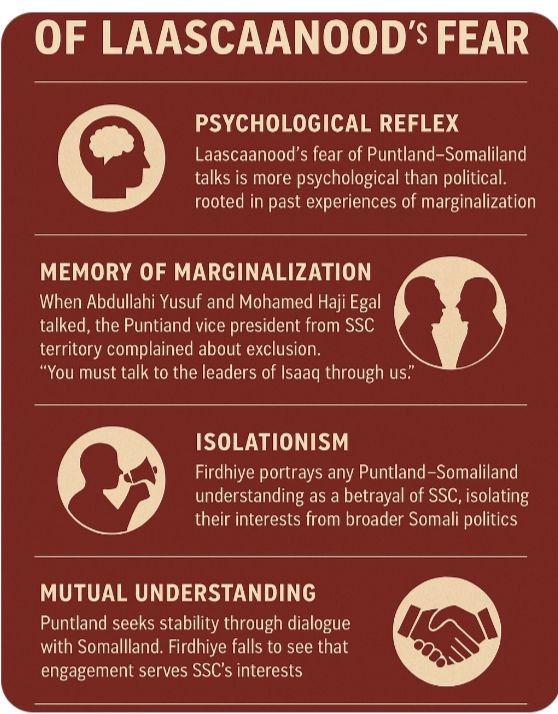
In the current uproar surrounding Puntland–Somaliland “security cooperation,” one hears not so much the clash of political logic as the tremor of old psychological fears. Laascaanood’s anxiety is not rooted in facts or tangible concessions but in the emotional residue of betrayal, marginalization, and historical trauma. The real problem is not that Garowe and Hargeisa talk—it’s that Laascaanood has never fully trusted anyone to talk on its behalf without suspicion of being sold out.

When history is weaponized by insecurity, perception becomes reality. The current leadership in Laascaanood, particularly figures like Firdhiye, mistake dialogue for compromise and cooperation for conspiracy. Yet the truth is far less dramatic and far more strategic: mutual understanding—no matter between whom—is always in the collective interest of the Somali people.

Historical Context: When Abdullahi Yusuf and Egal Talked

The unease we see today is not new. During the formative years of Puntland, when the late Abdullahi Yusuf engaged in discussions with Somaliland’s Mohamed Haji Ibrahim Egal, Puntland’s own vice president from SSC territory, Mohamed Abdi Hashi, objected. His words were striking:

“We don’t mind when you talk with leaders of Hawiye, but you must talk to the leaders of Isaaq through us.”

This wasn’t a political demand—it was a psychological reflex. It revealed a deep-seated insecurity that SSC’s agency could be bypassed, that others could determine its fate behind closed doors. It is an emotional scar from decades of marginalization—first under northern domination, then southern neglect.

Laascaanood’s fear, therefore, is a memory, not a policy. It’s the aftertaste of exclusion, not an objective assessment of current realities.

The Fallacy of Firdhiye’s Politics

Firdhiye’s rhetoric is historically shortsighted. His worldview is trapped in the narrow confines of clan sentiment rather than strategic foresight. By portraying every cross-border understanding as a “betrayal of SSC,” he inadvertently isolates his constituency from the broader currents of Somali politics.

He fails to understand that communication between Puntland and Somaliland is not about surrender; it’s about stability. It’s about preventing further bloodshed in a region where every gunshot echoes across multiple states and every misunderstanding can spiral into conflict.

The politics of paranoia is not leadership—it’s insecurity dressed in extremist clothing.

Puntland’s Strategic Rationality

Puntland’s leadership, past and present, has recognized one immutable fact: sustainable peace requires talking to everyone—including rivals. Abdullahi Yusuf understood this when he negotiated with both the Hawiye and the Isaaq leadership. Said Abdullahi Deni knows this when he maintains dialogue even with adversaries.

True leadership is not about pandering to fears but about managing them. Puntland’s talks with Somaliland—whether over security coordination, border stability, or trade routes—do not negate SSC interests; they safeguard them. Because a stable northern frontier is in Puntland’s interest, and therefore in SSC’s interest too.

The Bigger Picture: Dialogue as Security

Somalia’s tragedy is that every conversation is treated as conspiracy and every handshake as surrender. The country’s disintegration into clan fiefdoms has turned politics into psychological warfare. But dialogue—especially between Puntland and Somaliland—is not betrayal; it is the essence of statecraft.

If Laascaanood truly seeks autonomy, it must transcend its paranoia. It must learn that influence is not preserved by emotional veto but by strategic engagement. Real power lies in shaping conversations, not in silencing them.

Conclusion: Healing the Psychological Faultline

The Laascaanood dilemma is a symptom of a deeper Somali condition—the inability to separate emotion from interest, fear from strategy. What Abdullahi Yusuf understood, and what SSC leaders have yet to grasp, is that politics is not about perpetual grievance but about building bridges that outlast the emotions of the day.

Laascaanood’s fears are understandable, but they must not dictate policy. The wounds of history will not heal through isolation but through honest, mutual understanding. Puntland and Somaliland talking is not a threat—it is therapy for a fractured homeland.

WDM COMMENTARY:
Somalis must learn to replace suspicion with strategy. When Puntland and Somaliland engage, SSC should not retreat into psychological trenches—it should join the table with confidence, not fear.

Revisiting Somalia’s First Republic (1960–1969): Myths, Fallacies, and Historical Misreadings

By Ismail H. Warsame | WDM Analysis

1. Introduction: The Danger of Historical Simplification

The digital age has democratized history-telling but also weaponized misinformation. Social media platforms like X (formerly Twitter) have turned complex historical debates into viral narratives built on partial truths and populist outrage. One such case is the viral thread by @LtKhalifa, which purports to expose the “corruption and failures” of Somalia’s first civilian government under President Aden Abdulle Osman (Aden Adde) between 1960 and 1969. The thread, citing alleged “CIA declassified documents,” claims that the Somali Republic received over $330 million in foreign aid—equivalent to $3 billion today—yet achieved nothing tangible in national infrastructure or governance.

While emotionally compelling, this narrative commits several logical fallacies, relies on unverifiable evidence, and distorts the historical context of a newly independent African state navigating postcolonial chaos and Cold War geopolitics.

2. The Fallacy of the “CIA Declassified” Evidence

The most eye-catching claim in the thread is that “CIA declassified documents” show that Aden Adde’s civilian government “took $330 million in aid.” This statement raises immediate red flags:

1. No source citation or document link is provided. The CIA’s CREST archive contains thousands of declassified documents on Somalia, yet none confirm this figure. Without citation, the claim remains anecdotal hearsay masquerading as evidence.

2. The figure itself—$330 million in the 1960s—is implausibly high. At independence, Somalia’s annual GDP was under $100 million, and total U.S. and U.N. aid combined during that decade did not exceed $150 million. To allege that Aden Adde alone “took” this sum is historically inaccurate and economically illogical.

3. The inflation-adjusted conversion (“$330 million equals $3 billion today”) is also methodologically flawed. Using the U.S. Bureau of Labor Statistics CPI calculator, $330 million in 1965 equals roughly $3.3 billion today—but this assumes the original number was accurate, which it was not.

This misuse of “CIA” branding is a rhetorical trick often found in conspiracy or pseudo-academic narratives—invoking institutional authority to lend credibility to otherwise baseless assertions.

3. The Infrastructure Myth: “No Road Between Hargeisa and Berbera”

Another major claim is that “despite massive aid, Aden Adde failed to build a deep-water port for Mogadishu, and there wasn’t even a road between Hargeisa and Berbera.”

This too collapses under scrutiny:

Mogadishu already had a functioning port built and expanded during Italian administration in the 1950s. What Somalia lacked was a second deep-water port in the north—something that came later under Chinese-Somali cooperation during the 1970s.

The Hargeisa-Berbera road existed as a colonial-era route. It was unpaved but functional for livestock and trade. The later Chinese reconstruction (1972–1974) upgraded it—not built it from scratch.

The Aden Adde administration did prioritize education, civil service development, and agriculture, laying institutional groundwork rather than vanity infrastructure projects.

To claim “there wasn’t even a road” is a factual distortion typical of ahistorical social media narratives that equate “development” only with concrete and steel, ignoring institutional and administrative capacity-building.

4. The Corruption Narrative: Moralizing Without Evidence

The thread describes the Aden Adde era as “largely unpopular” and “rampantly corrupt.” Again, no documentation supports this sweeping indictment. In fact, comparative political studies (see: I.M. Lewis, A Modern History of the Somali, 2002; Abdi Ismail Samatar, The State and Rural Transformation in Northern Somalia, 1989) indicate the opposite:

Somalia’s first decade was remarkably democratic for its time. The 1967 peaceful transfer of power from Aden Adde to Abdirashid Ali Sharmarke was the first voluntary handover between civilian presidents in independent Africa.

The corruption that did exist—patronage, clan favoritism, and weak bureaucracy—was typical of postcolonial African states but not systemic looting. Somalia’s bureaucracy was small, donor-dependent, and largely transparent under international supervision.

The “unpopularity” claim ignores that Aden Adde lost a democratic election, not a coup. His defeat reflected political pluralism, not popular rebellion.

The moral absolutism of the thread—portraying Aden Adde’s government as a failed kleptocracy—collapses under historical evidence and scholarly consensus.

5. Misreading the Political Economy of the 1960s

The 1960s Somali economy was aid-dependent but not aid-wasteful. The problem was structural dependence, not theft. Key realities include:

Somalia inherited two incompatible colonial economies—British pastoralist north and Italian agrarian south—without fiscal or infrastructural integration.

Foreign aid was fragmented across Cold War lines: Italy, the U.S., the USSR, and China all funded competing projects, creating institutional incoherence, not enrichment.

The government had no sovereign control over customs, ports, or central banking until the late 1960s. Blaming Aden Adde for lack of modern infrastructure is akin to blaming a toddler for not running.

These nuances vanish in the thread’s simplistic cause-effect logic: “Aden Adde got aid → Aden Adde failed → therefore he was corrupt.” This is the post hoc fallacy—assuming correlation equals causation.

6. The Colonial Comparison Fallacy

The author also claims that “livestock and agricultural exports had to be shipped from the south to Berbera,” implying economic paralysis. This argument confuses colonial logistics with postcolonial neglect.

Berbera was historically the British export port for northern Somali livestock—its dominance persisted due to geography, not Aden Adde’s failure.

Somalia’s southern exports (bananas, sugar, hides) were shipped from Mogadishu and Kismayo, which were already operational ports.

The infrastructural imbalance between north and south was colonial inheritance, not corruption.

This reasoning exemplifies the anachronism fallacy—judging a 1960s African republic by 21st-century standards of infrastructure, and then concluding “failure” where structural constraints existed.

7. The Narrative of Neglect and the Myth of “Strongman Efficiency”

Threads like Lt. Khalifa’s often set up a contrast: Aden Adde’s “weak democracy” versus Siyad Barre’s “strong state.” This is an old fallacy that romanticizes authoritarian modernization while vilifying pluralist governance.

Yes, Barre built roads, ports, and factories—but through coercion, centralization, and Soviet funding, not national economic strength.

Aden Adde, in contrast, respected civil liberties, elections, and parliament, choosing institutional integrity over industrial showmanship.

To label him a failure because he didn’t “build a port” is to misunderstand governance itself. State legitimacy is built not just with cement, but with law, participation, and accountability—qualities Aden Adde’s administration embodied before being overthrown by militarism in 1969.

8. The Modern Impulse to Rewrite History

The popularity of such threads reveals more about contemporary Somali disillusionment than about 1960s reality. Young Somalis, alienated by current corruption and statelessness, project their anger backward, seeking villains in history to explain the present.

But revisionism without rigor is intellectual escapism. It replaces historical inquiry with digital tribalism—simplifying the past to validate current political or clan loyalties. The invocation of “CIA documents,” “billions lost,” and “failed leaders” without evidence is a form of historical populism: emotionally satisfying but empirically hollow.

9. Conclusion: History as a Discipline, Not a Battlefield

Somalia’s First Republic (1960–1969) was not perfect—it was messy, experimental, and constrained. Yet it remains the most democratic and law-abiding era in Somali history. Its leaders were flawed human beings, but not thieves of billions.

The Lt. Khalifa thread fails as history because it substitutes moral outrage for analysis and rumor for evidence. History cannot be rewritten through viral indignation; it must be reclaimed through documentation, context, and humility before facts.

As WDM has long argued: Without historical literacy, a nation becomes prisoner of its myths.

References

Lewis, I. M. A Modern History of the Somali: Nation and State in the Horn of Africa. 4th ed. Athens: Ohio University Press, 2002.

Samatar, Abdi Ismail. The State and Rural Transformation in Northern Somalia, 1884–1986. Madison: University of Wisconsin Press, 1989.

Laitin, David D., and Said S. Samatar. Somalia: Nation in Search of a State. Boulder: Westview Press, 1987.

CIA CREST Archives. “Somalia—Economic and Political Situation Reports, 1961–1968.” Accessed 2025.

United Nations Economic Commission for Africa. Annual Economic Report on Somalia, 1964–1968. Addis Ababa: UNECA.

THE CYCLE OF SOMALI POLITICAL STUPIDITY

By Ismail H. Warsame

In Somali politics, déjà vu is not a coincidence—it’s a governing principle. What you saw yesterday, you’ll see again tomorrow, only with a new set of tired faces pretending to be reformers. The script is older than the Somali Republic itself: clans quarrel, politicians pretend, donors pay, and the people pray.

Two constants define this endless political rerun: Clan and Conflict. Everything else is decorative chaos. Add in the chronic mistrust of politicians and public institutions—born in the ashes of civil war—and you get the perfect Somali cocktail: flattery, fraud, and failure served with a sprinkle of false hope.

Now comes Hassan Sheikh Mohamud, the self-appointed “smartest politician” Banadir ever exported. He thought he could charm Ahmed Madoobe with the same tired tricks he used on Sheikh Sharif and Abdul-Aziz “Laftegreen.” But Kismayo wasn’t fooled. Ahmed Madoobe, the survivor-in-chief of Somali power plays, smiled politely while keeping his political dagger under the table.

Hassan Sheikh had to cut short his trip—a premature evacuation of ego. It turns out that Jubaland’s political chessboard doesn’t play by Mogadishu’s recycled scripts. He discovered, perhaps too late, that his usual combination of clan manipulation and sweet talk only works north of Afgooye.

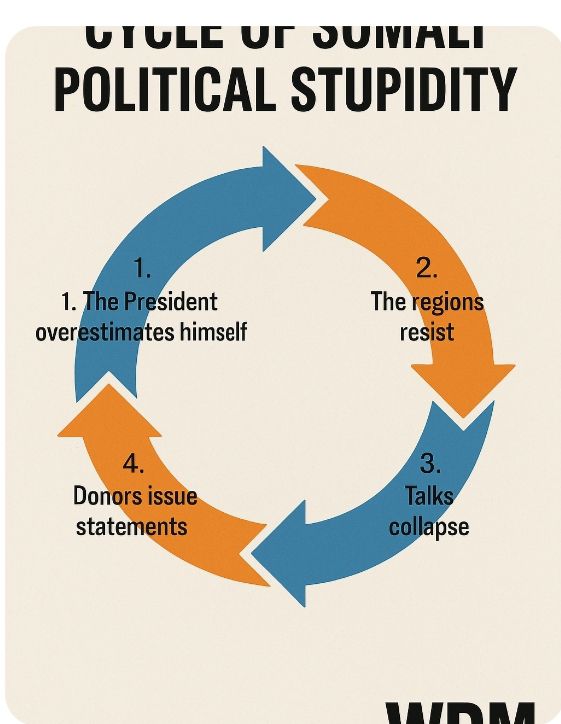
And so, the Cycle of Stupidity continues:

1. The President overestimates himself.

2. The regions resist.

3. Talks collapse.

4. Donors issue statements.

5. Everyone pretends progress was made.

No surprises. No lessons learned. Just the eternal Somali loop of power without purpose—where the past is never past, and the future is always yesterday.

WDM: Talking Truth to Power