
Breaking News: Names Behind the Secret Pact
WDM sources confirm that Prime Minister Hamse Abdi Barre, his Director General Jamaal Guutaale, and his close advisor Ahmed Dahir Hussein (Uleex) are reportedly involved in orchestrating Somalia’s end of the Sweden deportation-for-aid scheme. These names connect directly to the Somali executive office that demanded the aid redirection into their control.
On the Swedish side, the officials who greenlighted and executed this pact remain in the shadows—shielded by bureaucratic silence and political ambiguity. Their identities are not speculation; they exist. They signed. They moved money. They facilitated deportations. The fact that they remain unexposed is an indictment of Stockholm’s press and oversight institutions. The Swedish architects of this scheme should be named, scrutinized, and held to account with the same rigor.
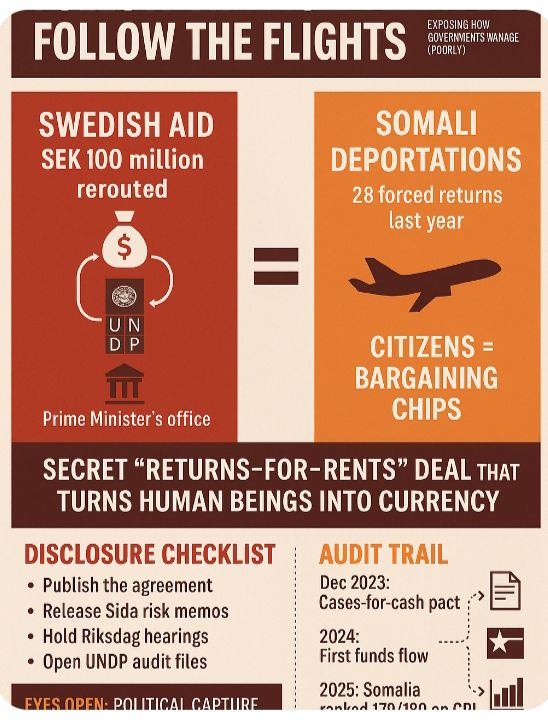
The scandal in one paragraph
Ekot has exposed a secret 100-million-kronor arrangement struck in December 2023: Sweden rerouted aid so that projects near Somalia’s Prime Minister’s Office gained greater influence, and in return Somalia agreed to accept forced deportations. Cash first landed in 2024 (SEK 40m), with a further SEK 60m disbursed this summer under a UNDP tie-in with the PM’s Office—while deportations spiked to 28 last year. Both sides sought secrecy; Sida staff raised alarms; and independent analysts called it a high-risk set-up with vague goals and weak indicators. That’s not cooperation; that’s calibrated political rent-seeking with human beings as the currency.
But here is the deeper problem: Ekot Report didn’t go far enough to expose the corrupt officials from both sides who engineered and benefited from this bargain. By focusing on the structures and not the names, the scandal remains half-covered. Accountability without naming names is accountability denied.
Why this is worse than Ekot’s framing
1. Conflict-of-interest by design
Routing state-to-state aid so the Prime Minister’s political circle has enlarged influence collapses the firewall between development funds and patronage. In a country ranked 179/180 on TI’s 2024 Corruption Index, that’s not naïveté—it’s foreseeable capture.
2. Policy swap that commodifies citizens
Tying returns to rents turns deportees into bargaining chips. Even Sweden’s own line—“we linked aid and migration to increase returns”—admits the quid-pro-quo logic while deflecting operational responsibility to Sida and embassies. Responsibility without control = impunity.
3. Vague objectives = audit-proof slush
Experts reviewing the project describe general goals and unclear indicators—code words auditors use when money is structurally untraceable to outcomes. When a project’s theory of change is fog, patronage becomes the de facto KPI.
4. Secrecy is the red flag, not a footnote
Ekot reports both governments wanted the deal secret. Secrecy in aid conditionality isn’t “sensitive diplomacy”; it’s pre-meditated opacity that disables parliaments, watchdogs, and press from doing their jobs.
5. Converging allegations demand urgent scrutiny
Somali political figures have publicly alleged pay-per-deportee kickbacks tied to European removals. These are accusations, not proven facts—but they raise the risk profile of this arrangement and increase the burden of proof on both governments and UNDP.
WDM verdict
This is not a one-off bureaucratic misstep; it is an architecture of plausible deniability: Stockholm claims policy wins (“returns up”), Mogadishu claims development wins (“funds in”), while citizens bear the hidden costs and political networks harvest the visible gains.
And yet—Ekot Report failed to name the corrupt officials on both the Somali and Swedish sides. Without names, without accountability, this “exposé” becomes another layer of cover for the guilty.
The fix isn’t spin. The fix is sunlight, documents, names, audits, and enforceable safeguards—now.
 Warsame Policy & Media Network (WAPMEN)