
From Eldoret to Villa Somalia
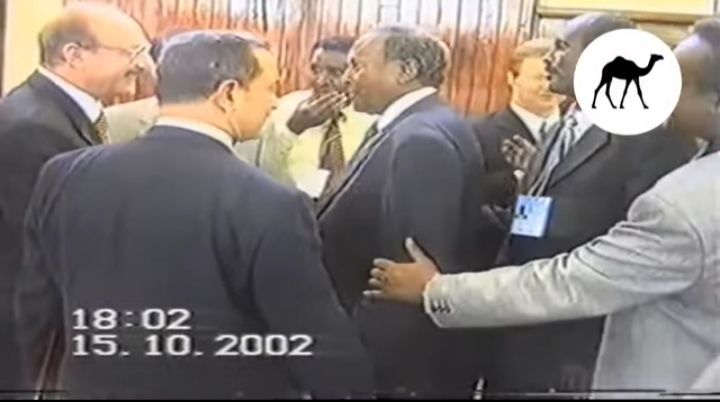
Take a watch this historic video:
https://www.facebook.com/share/v/16FnZEw4r4/
In the theater of statecraft, there are no accidents—only carefully crafted illusions of inevitability. The 2002 Somali Peace and National Reconciliation Conference, which began in Eldoret and concluded in Mbagathi, was presented as a forum of equals: a gathering of warlords, clan elders, and civil society under the auspices of IGAD. But for our circle within Abdullahi Yusuf’s camp—I served then as his Chief of Staff in the Puntland administration—the conference was not a dialogue. It was a stage. And we intended to ensure that when the curtain rose, Yusuf would be the lead actor.
The Stratagem: A Calculated Entrance
Our maneuver was elegant in its simplicity, devastating in its effect. We would orchestrate Abdullahi Yusuf’s entry into the main conference hall to occur moments before the arrival of the IGAD Heads of State. This was not left to chance; it was a precise operational detail.
The result was political theater at its most potent. As Yusuf entered, the room’s focus—the diplomats, the journalists, the collective anticipation—snapped to him. The energy shifted. Then, the IGAD leaders processed in, not as the main event, but as guests arriving at a reception already in full swing, hosted by the commanding figure of Abdullahi Yusuf. The intended hierarchy was instantly inverted.
The Payoff: A Narrative Seized
Diplomatic conferences run on rigid protocols, each handshake and introduction meant to reinforce a predetermined order. Our choreography shattered that order. Yusuf was not presented by others; he presented himself through the sheer force of timing and presence. The optics became an unassailable argument: here was a man who commanded the room not by force of arms, but by the authority of his bearing. Rival faction leaders watched, marginalized by a spectacle they had not anticipated. The international community witnessed a leader who looked the part.
The Strategic Imperative: Why Theater Matters
Eldoret was more than a peace talk; it was an attempt to conjure a state from the void of anarchy. IGAD and its international partners were not seeking the most powerful warlord; they were desperate for a credible head of state—a symbol of order. Legitimacy in a collapsed state is not merely about control; it is about perception. It is a performance that must be believed before it can be institutionalized. We understood that to win the presidency, Yusuf first had to perform the presidency. Eldoret was his audition, and he passed unequivocally.
The Legacy: From Stagecraft to Statecraft
The resonance of that single day in Eldoret defined the entire transition. As the talks moved to Mbagathi, Yusuf carried the aura of a frontrunner. Donors engaged him as the central player, IGAD mediators saw him as the anchor for stability, and Somali delegates, however reluctantly, began to orient their strategies around his perceived inevitability. His subsequent election as President of the Transitional Federal Government in Nairobi in 2004 was not a sudden victory but the logical culmination of a legitimacy narrative set in motion two years prior.
The Enduring Lesson
Cynics will call it manipulation. Strategists will recognize it as the essential art of political positioning. In moments of profound uncertainty, leadership is often decided not by who has the most compelling platform, but by who most effectively dramatizes their claim to power. We engineered that moment of drama. We understood that before a leader can govern a reality, he must first command the stage.
We wrote the script for Eldoret. And history played its part.
 Warsame Policy & Media Network (WAPMEN)