
The Onion: Global Affairs Edition
Dateline: Mogadishu / Washington D.C. / The Green Zone of Reality
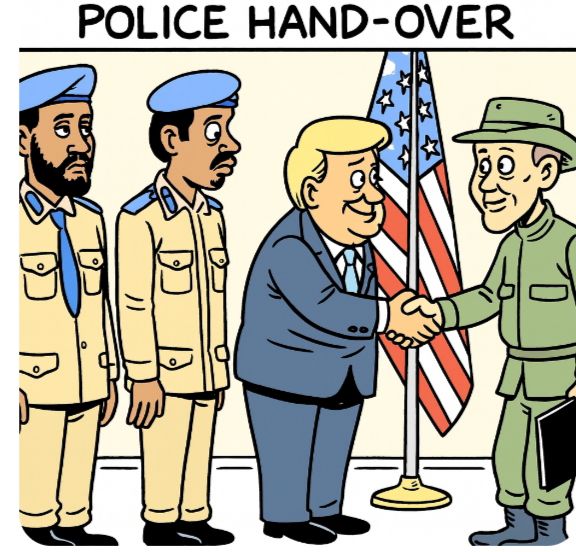
In a moving ceremony held securely within Mogadishu’s international airport—a bubble so secure most Somalis need a visa to enter their own capital—U.S. Ambassador Richard Riley stood before a handpicked group of Somali police officers and declared a resounding victory for… well, for something.
“I see before me a group of Somalis who are dedicated to the protection of their country and its people,” the Ambassador beamed, presumably reading from a teleprompter that carefully censored the words “unbalanced tribal militia,” “clan wars,” and “holistic approach”.
The new Crisis Response Team (CRT), a unit trained and equipped with a generous grant, is now officially certified to respond to terrorist attacks. This is a brilliant strategy, akin to funding an elite team of highly trained umbrella bearers to mop up water in a living room while politely ignoring the fact that the roof is on fire because you’re actively arming some of the residents to set fire to their neighbors’ sections.
The Clan-Tastic “National” Army
The cornerstone of this dazzling success is the international community’s unwavering commitment to building a “national” army. This involves a sophisticated, time-tested strategy: identify a few clans you can work with, give them guns, and call them the Somali National Army (SNA). What could possibly go wrong?
This approach is not without its critics. As recently as 2023, the Jubaland state government publicly accused federal actors of using the fight against Al-Shabaab as a pretext to arm clan militias for the purpose of destabilizing the regional state. A Jubaland minister warned that such a move was a “recipe for disaster,” hinting that “a more dangerous outfit was likely to emerge” from the attempt. But these concerns are clearly just the tedious complaints of local officials who don’t appreciate the elegant simplicity of international peacebuilding.
This policy brilliantly ignores the fact that Al-Shabaab itself, despite its claims to transcend clan politics, is deeply enmeshed in and manipulates these very dynamics. By adopting a similar strategy of co-opting some clans and alienating others, the internationally-backed government is essentially fighting fire with gasoline. The table below illustrates the chaotic genius of this approach.
Actor Stated Goal Satirical Reality (The “Clan-Blind” Strategy)
International Donors Build a unified, national security force. Fund and arm clan-based militias, creating parallel structures that undermine the very state they claim to build.
Federal Government of Somalia Extend its authority and defeat Al-Shabaab. Exploit clan rivalries for short-term military gains, risking long-term inter-clan conflict that could dwarf the current insurgency.
Al-Shabaab Establish an Islamic state that transcends clan. Masterfully exploit the grievances created by the government’s clan-based favoritism, using it as a powerful recruitment tool.
A Return to the Good Old Days (Of Civil War)
The ultimate satire is that this policy is not new; it’s a nostalgic revival of the conditions that led to the state’s collapse in 1991. By strengthening armed clan identities, the strategy expertly undermines the project of building a unified national identity. The fear among analysts is that a poorly managed campaign could simply plunge the country back into open clan-based fighting, but from the perspective of an arms dealer or a diplomat counting short-term “victories,” that’s a problem for a future funding cycle.
The real “Crisis Response Team” needed isn’t the one graduating in Mogadishu. It’s a team needed to respond to the crisis of a foreign policy that, in its desperate search for a simple solution, is actively reassembling the very bomb it claims to be defusing. But don’t worry, the diplomats are safe in their Green Zone, and the PowerPoint presentations showing declining Al-Shabaab attack statistics are absolutely stunning.
—
This satire is based on analysis and reporting from sources including the Security Council Report, the European Union Agency for Asylum, the European Union Institute for Security Studies, and news reports detailing internal Somali politics.
 Warsame Policy & Media Network (WAPMEN)