
By Ismail H. Warsame
© 2025 WDM
Donald J. Trump’s understanding of history appears to extend only as far as his own reflection. His commentary on Russia suggests a nation that sprang, fully formed, from the will of Vladimir Putin—a geopolitical novelty act of hackers, missiles, and shirtless bravado. He mistakes the current regime for the ancient state.
History, however, is unforgiving to those who ignore it. Russia is not a recent invention. It is a civilization that has absorbed the Mongol yoke, turned Napoleon’s Grand Armée into a frozen monument to hubris, and ground Hitler’s war machine into the snows of Stalingrad. It has built and lost empires, ignited revolutions that reshaped the global order, and consistently defied every Western prophecy of its collapse—from the Tsars to the Soviets to the so-called “post-Soviet chaos.”
A Millennium of Statehood vs. A Quarter-Millennium of Experiment
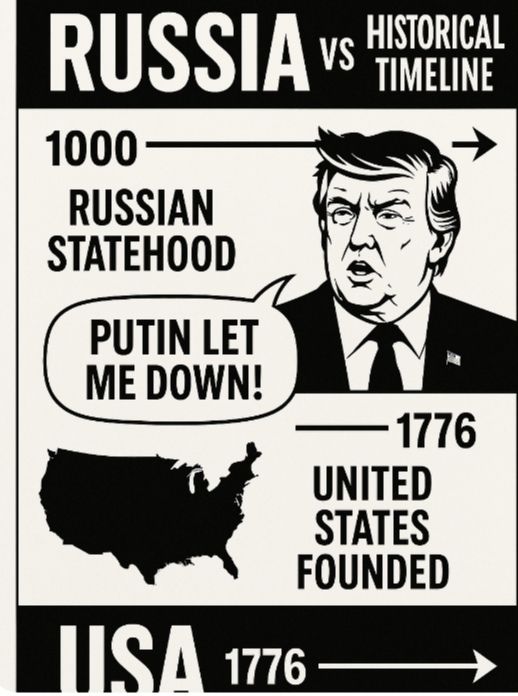
To compare the timelines of Russia and the United States is to compare a deep, slow-moving river to a powerful but youthful stream. As George Washington crossed the Delaware, Russia’s empire already spanned continents, stretching from the Baltic Sea to the Pacific Ocean. While American founders penned Enlightenment ideals, Empress Catherine the Great was practicing them—and simultaneously annexing Crimea—proving that Russian statecraft has always blended philosophy with realpolitik.
Consider its enduring assets: Russia commands a treasure trove of oil, gas, uranium, and wheat that keeps Europe dependent, America anxious, and China engaged. Its scientists launched Sputnik into the cosmos while America was perfecting the television commercial. Its literary giants—Dostoevsky, Tolstoy, Chekhov—were probing the depths of the human soul before the United States had a distinct literary voice. This is not merely a nation; it is a civilization with a long memory and profound cultural reserves.
The “Putin Let Me Down” Fallacy
This context makes Trump’s recent lament—“Putin let me down!”—so profoundly naive. He framed a geopolitical rift as a personal betrayal, as if a business partner had reneged on a handshake deal in Atlantic City. The error is fundamental: Vladimir Putin is not a contestant on The Apprentice: Geopolitics Edition. He is the calculated steward of a thousand-year tradition of Russian statecraft, for whom strategy is measured in centuries, not news cycles.
Trump evaluates world leaders as he does Yelp reviews: bestowing five stars for flattery, one star for defiance. Putin, by contrast, plays chess on a board where the pieces are history, energy, and power. He understands that a single-term American president is a temporary variable in Russia’s long equation.
The West’s Convenient Amnesia
Yet, this myopia is not Trump’s alone; it is a recurring Western affliction. We sanction, moralize, and tweet, treating Russia as a petulant child to be disciplined. Russia responds by having its bombers probe NATO airspace over Poland, Estonia, and Romania—not to start a war, but to remind the alliance of its reach and its resolve. It endures these punishments like a veteran boxer who knows how to absorb a punch. From Napoleon to Hitler to NATO expansion, it has been declared finished by its adversaries, only to remain—bruised, resilient, and eternally relevant. It is not a fleeting problem to be solved but a permanent fixture to be understood. Its strategy extends into culture and information, launching its own “Intervision” song contest not merely to troll Eurovision, but to build a parallel sphere of influence, dividing the West with a catchy melody.
WDM Verdict
Donald Trump’s failure is not merely a misunderstanding of Russia, but a rejection of history itself. America is still drafting its story; Russia is on its second or third draft, each written in the blood and ink of centuries. The Kremlin will not lose sleep over a former president’s bruised ego. Russia has outlived tyrants, invaders, and ideologues far more formidable than Trump. It will assuredly outlast his indignation.
 Warsame Policy & Media Network (WAPMEN)