
Publisher: Warsame Digital Media (WDM) September 2025 © 2025 WDM – All Rights Reserved
—
Copyright Page
This white paper is published by Warsame Digital Media (WDM). The findings, interpretations, and conclusions expressed herein are those of the authors and do not necessarily reflect the views of any affiliated institutions. Unauthorized reproduction or distribution is prohibited. For queries, please contact: ismailwarsame@gmail.com; Tel/WhatsApp: +252 90 703 4081.
Table of Contents
1. Executive Summary
2. Introduction: A Dispute of Principle, Not Just Revenue
3. Constitutional Jurisdiction and the Ambiguities of Federalism
4. The FGS Revenue-Sharing Proposal: A Rejected Offer
5. Puntland’s Position: Sovereignty and the Precedent of Overreach
6. Analysis: Governance Deficits and the Failure of Cooperative Federalism
7. Implications: Economic Costs and Political Risks
8. Policy Recommendations: A Pathway to Resolution
9. Conclusion: A Critical Juncture for Somali Federalism
1. Executive Summary
The launch of the Somali E-VISA system by the Federal Government of Somalia (FGS) has ignited a significant constitutional and political dispute with Puntland State. This paper argues that the core of the conflict extends beyond superficial accusations of corruption to a fundamental breakdown in Somalia’s federal model. It is a crisis of constitutional interpretation, fiscal federalism, and intergovernmental cooperation.
While the FGS holds clear constitutional authority over immigration, its proposal of an 18/42 revenue split—offering Puntland the majority share ($42 of every $60 fee)—was rejected. Puntland’s refusal stems from concerns over federal overreach and the erosion of its fiscal autonomy, not the specific financial terms. With monthly revenues from Puntland airports exceeding $200,000, this impasse has become a major flashpoint.
This paper analyzes the legal underpinnings of the dispute, the governance failures it exposes, and its grave economic and political consequences. It concludes with concrete policy recommendations to resolve the immediate crisis and establish durable mechanisms for cooperative federalism in Somalia. Failure to do so risks deepening fragmentation, undermining public trust, and stifling economic recovery.
2. Introduction: A Dispute of Principle, Not Just Revenue
In Somalia’s nascent federal architecture, disputes over resource allocation and jurisdictional boundaries are inevitable. The E-VISA conflict, however, represents a critical test of the system’s viability. Public discourse has often simplified the issue, but this paper contends that the standoff between Mogadishu and Garowe is primarily a conflict of principle. It is a manifestation of unresolved tensions inherent in Somalia’s Provisional Constitution, pitting federal authority against state rights and highlighting the absence of a trusted framework for sharing power—and revenue.
3. Constitutional Jurisdiction and the Ambiguities of Federalism
The Provisional Constitution (2012) explicitly grants the Federal Government exclusive jurisdiction over four key areas:
1. Foreign Affairs
2. National Defense
3. Citizenship and Immigration
4. Monetary Policy
Visa issuance is unequivocally a function of foreign affairs and immigration, placing the E-VISA system within the FGS’s constitutional mandate. However, the constitution is silent on the practical implementation of these exclusive powers, particularly when their exercise generates revenue within a federal state’s territory and relies on its infrastructure (e.g., airports) and administrative support (e.g., border control).
Puntland’s argument is not a direct denial of federal authority but a demand for a cooperative implementation model that recognizes its operational role and fiscal rights.
4. The FGS Revenue-Sharing Proposal: A Rejected Offer
In an attempt to address these concerns, the FGS presented a revenue-sharing proposal. According to Puntland finance sources, the terms were:
· Fee: $60 per E-VISA
· Proposed Split: $42 to Puntland, $18 retained by FGS
· Estimated Revenue: >$200,000/month from Puntland airports
This arrangement would have transferred an estimated $2.4 million annually to Puntland’s treasury, representing a significant potential investment in local infrastructure and services. The rejection of this ostensibly favorable financial deal underscores that the dispute is fundamentally about governance and sovereignty, not mere revenue.
5. Puntland’s Position: Sovereignty and the Precedent of Overreach
Puntland’s refusal of the 18/42 split is rooted in three core concerns:
1. Unilateral Federal Action: Puntland contends that the FGS overstepped by implementing a revenue-collection system at Puntland airports without prior agreement on a jointly administered mechanism.
2. Dangerous Precedent: Accepting a share of federally collected revenue, even a majority one, is viewed as legitimizing federal encroachment into state jurisdiction and setting a precedent that could be applied to other areas like natural resources or port revenues.
3. Political Leverage: There is a deep-seated fear that control over the revenue stream provides the FGS with a political tool to pressure or punish federal states, thereby eroding their hard-won autonomy.
6. Analysis: Governance Deficits and the Failure of Cooperative Federalism
This dispute reveals systemic weaknesses in Somalia’s governance structure:
· Absence of a Fiscal Federalism Framework: There is no legal framework to define revenue sources, sharing formulas, and responsibilities for jointly administered functions.
· Institutional Vacuum: No standing, empowered intergovernmental body exists to mediate such disputes, forcing ad-hoc negotiations that are vulnerable to political volatility.
· Profound Trust Deficit: A history of centralized rule and unmet agreements fuels a zero-sum mentality, where cooperation is perceived as concession.
7. Implications: Economic Costs and Political Risks
7.1 Economic Impact
· Lost Revenue: Puntland forgoes a stable revenue stream critical for local service delivery.
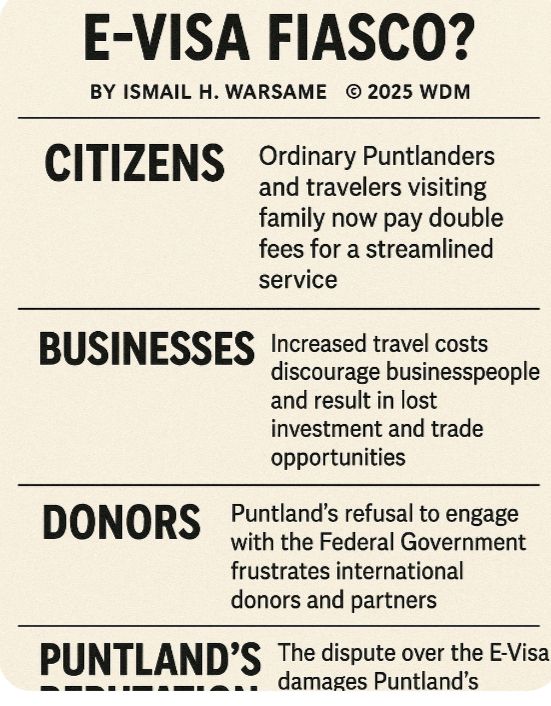
· Double Taxation: Travelers are now subject to both the federal E-VISA fee and a separate Puntland visa fee, increasing costs and creating bureaucratic redundancy.
· Investment Deterrence: The uncertainty and added expense undermine confidence among the diaspora and international investors, hindering economic recovery.
7.2 Political Fallout
· Escalating Tensions: The dispute exacerbates existing conflicts over security, elections, and resource management.
· Erosion of Legitimacy: The public perceives both governments as engaged in counterproductive turf wars, undermining their legitimacy.
· Fragmentation Risk: Prolonged impasse could lead Puntland to establish parallel systems, fracturing national policy and weakening integration.
8. Policy Recommendations: A Pathway to Resolution
To resolve this dispute and fortify Somali federalism, we recommend:
1. Immediate Establishment of a Joint Technical Committee: Composed of technical experts from the FGS Ministry of Finance and Puntland’s Treasury, this committee should work to implement a temporary revenue-sharing agreement with full transparency.
2. Enact a National Fiscal Federalism Law: A priority for the federal parliament should be to legislate a clear framework for revenue-sharing from all federal competencies exercised within state territories, including visas, ports, and natural resources.
3. Formalize a Federal-State Council: Create a constitutionally-mandated intergovernmental council with the authority to negotiate and bindingly resolve disputes, moving beyond ad-hoc political dialogues.
4. Implement Transparent Reporting: Both governments should commit to publishing audited monthly reports on E-VISA revenue collection and distribution to build public trust and eliminate speculation.
5. Leverage International Technical Assistance: Engage neutral international partners (e.g., World Bank, IMF) to provide technical models for revenue-sharing and facilitate mediation, ensuring the solution is perceived as fair and evidence-based.
9. Conclusion: A Critical Juncture for Somali Federalism
The E-VISA dispute is a microcosm of the broader challenges facing Somalia’s federal project. It is a stress test that neither level of government can afford to fail. Resolving it requires moving beyond a winner-takes-all approach to embrace a philosophy of cooperative federalism. The choice is between forging a collaborative path that strengthens the union or descending into further fragmentation. The establishment of transparent, predictable, and legally sound mechanisms for sharing power and revenue is not just a solution to this crisis—it is the essential foundation for a stable and prosperous Somalia.
 Warsame Policy & Media Network (WAPMEN)
You must be logged in to post a comment.