
Ismail H. Warsame, Warsame Digital Media (WDM), September 12, 2025
Abstract
This paper examines the escalating public safety and urban management crisis in Garowe, Puntland, driven by the unregulated proliferation of auto-rickshaws (locally known as Bajaj). It argues that what is often presented as grassroots entrepreneurship is, in fact, a symptom of weaponized poverty, enabled by uncontrolled imports and governmental failure, leading to urban chaos and increased fatalities. The analysis concludes with an urgent call for a multi-pronged strategy, including curtailing imports, comprehensive regulation, and investment in sustainable public transport.
1. Introduction: A City Under Siege
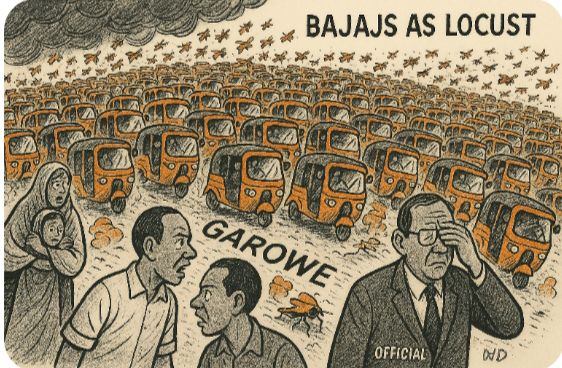
Garowe, the administrative capital of Puntland, is experiencing a crisis that threatens its social fabric and public safety. This crisis is not born from traditional conflict but from an unchecked invasion of mechanical chaos: the overwhelming and unregulated influx of Bajaj three-wheeled vehicles. Imported en masse without any restrictive policy and operated without oversight, these vehicles have transformed Garowe’s streets from orderly pathways into hazardous zones, representing a critical failure in urban planning and regulatory enforcement.
2. The Anatomy of the Crisis: A Flood of Metal and Desperation
The problem is threefold: the source of the machines, their mechanical impact, and the system that deploys them.
· The Unchecked Flood: The primary catalyst for the crisis is the uncontrolled importation of Bajaj vehicles from international markets. This constant stream of new three-wheelers has saturated the city’s limited infrastructure, making congestion and conflict inevitable.
· The Mechanical Menace: The Bajajs on Garowe’s streets are typically low-quality, smoke-belching vehicles. Their sheer numbers create unbearable noise pollution, traffic congestion, and environmental degradation, diminishing the quality of life for all residents.
· The Human Factor: The industry is built on the exploitation of a desperate workforce. The drivers are predominantly unemployed youth, often minors with no formal training, licensing, or insurance. Hired by profit-seeking operators, these young men are incentivized to drive aggressively to maximize daily fares, turning the city into a real-life racetrack with deadly consequences.
3. The Root Cause: The Economy of Desperation
The Bajaj epidemic cannot be understood outside the context of Puntland’s socio-economic challenges and policy failures.
· Unregulated Trade: The lack of a policy to curtail the import of Bajajs has directly led to market oversaturation, making the crisis a problem of scale as much as conduct.
· Youth Unemployment: A significant “youth bulge” with limited formal employment opportunities makes driving a Bajaj one of the few available sources of income.
· Exploitative Entrepreneurship: Small-time entrepreneurs capitalize on this desperation, creating a business model that externalizes all risk onto the drivers, passengers, and the general public.
· Government Negligence: The authorities have abdicated their responsibility at multiple levels, from controlling import flows to regulating operations. The absence of a regulated public transport system has created a vacuum filled by this anarchic private enterprise.
4. Consequences: Urban Dystopia and Social Breakdown
The impact of this neglect is severe and multifaceted:
· Public Safety Emergency: Traffic accidents, injuries, and fatalities have skyrocketed. Pedestrians, especially women and children, navigate streets at their own peril.
· Economic Damage: Shopfronts are plagued by noise and fumes. Motorists face constant risk of accidents with uninsured drivers, potentially leading to financial ruin.
· Normalization of Crisis: A dangerous public ennui has set in, where accidents are “shrugged off” and near-death experiences become routine.
· Erosion of Civic Trust: The government’s failure to protect its citizens and regulate both trade and traffic undermines its legitimacy.
5. Call to Action: A Path Toward Regulation and Order
Warsame Digital Media (WDM) calls for immediate and decisive action from the Puntland authorities to avert further catastrophe. We propose a multi-pronged strategy:
1. Curtail the Import of Bajajs: Impose an immediate moratorium on the importation of new Bajaj vehicles into Puntland. This is the essential first step to halt the flooding of the market and prevent the problem from escalating beyond control.
2. Licensing and Regulation:
· Mandate official driver’s licenses with verified age requirements (no minors).
· Require mandatory third-party insurance for all commercial Bajajs.
· Implement official registration and mechanical inspection for all vehicles.
3. Restoration of Law and Order:
· Empower and direct the traffic police to enforce traffic laws without exception. Reckless driving, overloading, and flouting of traffic rules must be met with fines and penalties.
4. Capping and Managing Numbers:
· Formalize a city-wide cap on the number of operating permits. The import moratorium will make this cap achievable and enforceable.
5. Investment in Sustainable Alternatives:
· Begin planning and investment in a safe, regulated, and reliable public bus system to provide a dignified alternative for citizens and create formal employment.
6. Conclusion
The Bajaj crisis in Garowe is a stark case study in what happens when uncontrolled imports, economic desperation, and governmental neglect converge. The streets of Garowe are on the brink of becoming “Somalia’s largest open-air casualty ward” not due to war, but due to a catastrophic failure of governance. The solution must begin at the source: the unchecked import of vehicles that fuels this chaos. The authority must act now to stem the tide, regulate the industry, protect its citizens, and reclaim the city for all who call it home. The future of Garowe’s civic life depends on it.
—
Warsame Digital Media (WDM) is an independent media organization dedicated to analytical journalism and commentary on issues affecting Somalia, the Horn of Africa, and beyond.
 Warsame Policy & Media Network (WAPMEN)