
September 10, 2025
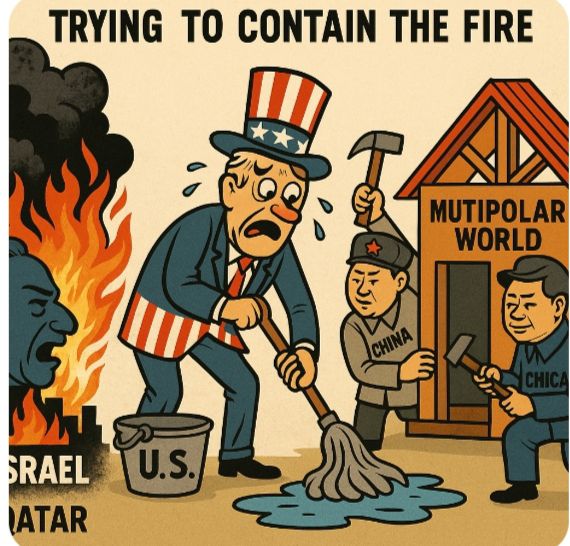
The scenes from Doha are more than a tragic headline; they are a geopolitical watershed. Israel’s bombardment of the Qatari capital—a hub regarded as a neutral forum for global diplomacy—has triggered not just outrage, but a fundamental realignment. As the world condemns the assault, the United States stands alone, performing a familiar yet increasingly futile role: the diplomatic shield for its ally. Washington’s efforts at damage control now resemble a patron making excuses for a partner that has spiraled out of control.
This time, however, the world is no longer listening.
The Abraham Accords: A Mirage Exposed
The “Abraham Accords,” once touted as a masterstroke of regional diplomacy, now lie in ruins. Even Saudi Arabia, the anticipated crown jewel of normalization, has publicly suspended talks. Riyadh understands that association with an Israel that acts with such impunity is political suicide. The Doha attack has achieved what years of diplomacy could not undo: it has poisoned the well of Arab-Israeli rapprochement for a generation. Netanyahu’s government hasn’t merely disrupted a process; it has incinerated its very foundation.
A Region Gripped by a New Reality
A palpable sense of vulnerability grips the Middle East. If Qatar’s diplomatic immunity can be so violently breached, no capital feels safe. This despair is compounded by the realization that the “rules-based international order” offers no protection. With the U.S. providing unwavering diplomatic cover—vetoing resolutions, justifying escalations—a dangerous consensus forms: Israel operates above international law. Arab regimes now face dual pressures: the fury of their own streets and the terrifying precedent set by Doha.
The region has become a tinderbox. The attack itself may be the spark that ignites a wider conflagration.
The Illusion of Impunity Shattered
For decades, the U.S. and Israel cultivated an aura of untouchable authority, often controlling narratives and leveraging international institutions to their ends. That era is over. The global spotlight is no longer fixed on designated “rogue states” or extremist groups, but is now trained directly on Washington and Tel Aviv. They are no longer perceived as guarantors of stability, but as primary sources of chaos and instability.
The Multipolar World Seizes the Initiative
In Beijing and Moscow, analysts are not just watching—they are recalibrating. The U.S.’s failure to restrain its ally is seen as a strategic failure of the highest order, confirming the overreach of American power. This crisis accelerates a shift that is economic as much as it is political. The conversation is now centered on de-dollarization, alternative financial systems, and economic sovereignty.
China advances the petroyuan, Russia builds sanctions-proof trade corridors, and an expanded BRICS incorporates energy giants. The Global South, long weary of Western double standards, sees in Doha a potent symbol and an opportunity to break from economic and political subservience. The message is clear: if the United States will not uphold the rules, the world will forge a new system without it.
The Unraveling of a 75-Year Order
The international architecture built after World War II—the UN system, Bretton Woods institutions, American security guarantees—is fracturing. In its place, a defiantly multipolar world is emerging, where power is contested and dispersed. Netanyahu’s bombs over Doha may be remembered as the catalyst that made the world’s long-simmering skepticism untenable.
The collapse is comprehensive: it is moral, strategic, and financial. The United States is hemorrhaging credibility. Israel is sacrificing its legitimacy. And the world is moving on.
Conclusion: The Turning Point
Modern conflict is waged with currencies, alliances, and information as much as with munitions. In Doha, Israel dropped bombs, but it also detonated the last remnants of American hegemony. The “rules-based order” has been exposed as a vehicle for power politics. What emerges next remains uncertain, but one fact is undeniable: the multipolar age is no longer a forecast. It is our present reality, being built in real time amid the rubble of yesterday’s assumptions.
Doha is not an ending. It is a brutal and decisive beginning.
 Warsame Policy & Media Network (WAPMEN)