
From Begging Bowl to Breadbasket: A Skills-First Path for Somalia’s Economy
September 2025
Executive Summary
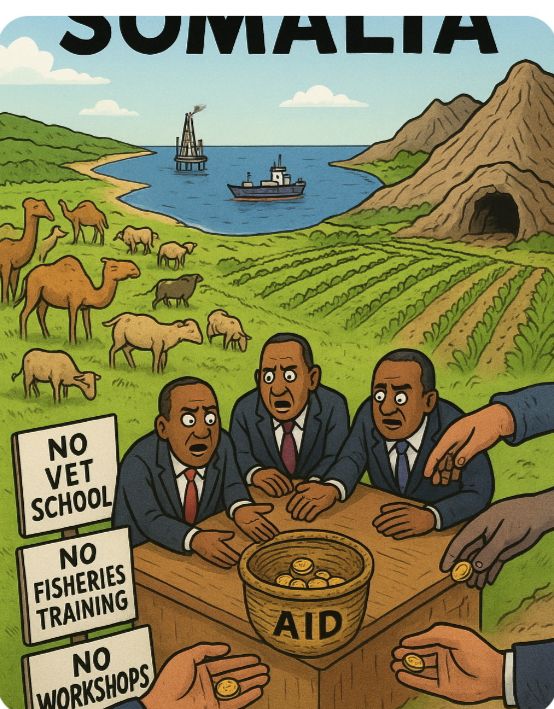
Somalia is a nation rich in resources but poor in applied skills. With Africa’s largest livestock herd, the continent’s longest coastline, significant mineral potential, fertile land, and emerging hydrocarbons, Somalia should be a regional breadbasket. Instead, it relies heavily on aid and remittances, with limited productive skills to leverage its wealth.
This brief outlines a five-year skills-first agenda targeting livestock, fisheries, construction, and extractives services. By prioritizing vocational training, employer-led standards, and outcome-based financing, Somalia can transition from aid dependence to a skills-driven economy.
The Challenge: A Wealthy Nation Behaving Poor
- Livestock: ~7 million camels, 5 million cattle, 30 million goats, 14 million sheep—Somalia’s greatest export asset.
- Fisheries: A 3,330 km coastline with underexploited tuna and pelagic stocks.
- Minerals & Hydrocarbons: Uranium, iron ore, gypsum, and offshore oil exploration agreements underway.
- Land: 70% classified as agricultural/pastoral land.
Yet Somalia imports food, suffers recurring famines, and remains donor-dependent. Vocational and technical education is almost absent:
- Few accredited veterinary para-professional programs.
- Little structured fisheries or marine training.
- Construction trades lack certification, lowering safety and productivity.
- Young people overwhelmingly seek NGO or office jobs instead of skilled work.
Bottom line: Somalia is rich in natural assets, but lacks the workforce to turn them into wealth.
Aid, Remittances, and the “Office Economy”
- Remittances (20–25% of GDP) sustain families but reinforce consumption.
- Foreign aid dominates the fiscal framework, but donor fatigue and cuts threaten stability.
- NGO employment absorbs educated youth but distorts skills away from productive sectors.
Without vocational pathways, the economy orients toward aid-funded clerical jobs rather than livestock markets, fishery exports, or construction trades.
A Five-Year Skills-First Agenda (2026–2030)
1. Build a Skills Governance System
- Establish a Somalia Skills Commission with employer-led sector skills councils.
- Create a National Qualifications Framework (NQF) for trades and certifications.
2. Invest in Livestock Competitiveness
- Train thousands of veterinary para-professionals, abattoir technicians, and cold-chain workers.
- Modernize quarantine stations and introduce animal ID systems.
- Promote HACCP/ISO standards in meat exports to Gulf markets.
3. Develop Fisheries Training Hubs
- Establish 3 coastal training hubs (Bosaso, Mogadishu, Kismayo).
- Train skippers, marine engineers, refrigeration technicians, and HACCP specialists.
- Upgrade landing sites with ice, water, and hygiene facilities.
4. Professionalize Construction Trades
- Require apprenticeships on all donor-funded and public works.
- Certify masons, electricians, plumbers, HVAC technicians, and surveyors.
- Enforce safety standards to lower accidents.
5. Prepare for Hydrocarbons & Minerals Responsibly
- Focus first on transferable skills: HSE officers, welders, environmental technicians, logistics.
- Publish contracts and data to ensure transparency and avoid “boom-bust” training.
Financing the Transition
- Domestic revenue growth: allocate a fixed share to vocational training and labs.
- Donor alignment: shift funding from clerical/NGO-heavy projects to TVET and applied skills.
- Remittance leverage: offer matching schemes for apprentices to buy toolkits and equipment.
- Results-based financing: pay training providers only for certifications, job placements, and retention.
Risks and Mitigation
- Aid volatility: modular programs allow scaling up/down with available funds.
- Security & climate shocks: mobile training units and drought-resilient fodder systems.
- Elite capture: employer councils oversee standards and outcomes, not politicians.
- Hype in extractives: skills focused on services useful across sectors.
Headline Targets by 2030
- 50,000 new certified workers in livestock, fisheries, construction, and maintenance.
- 30% increase in export livestock meeting international standards.
- Tripled fish landings through Somali-managed vessels and certified landing sites.
- 25,000 apprentices trained in construction trades, reducing site accidents.
Conclusion
Somalia’s paradox is clear: immense wealth in resources, yet chronic dependence on aid. The answer is not more conferences or more clerks, but practical skills, vocational pathways, and employer-led standards.
A five-year, skills-first agenda—anchored in livestock, fisheries, construction, and extractives services—can turn Somalia’s begging bowl into a breadbasket.
Somalia must shift from “aid-fed” to “skills-led.”
 Warsame Policy & Media Network (WAPMEN)