Ismail Warsame, the Quiet Architect of Somali Political Narrative 

Long before the echoes of Civil War faded from the Somali landscape, there was a man who had already begun to sketch a different future—not with guns, but with policy papers and quiet resolve.

His name was Ismail.

In 1998, Puntland State had just been born, a fledgling experiment in governance amidst the ruins of national collapse. At the heart of this fragile beginning, working behind the scenes, was a man entrusted with extraordinary responsibility: Ismail Warsame, the very first Chief of State—also known then as the Chief of Cabinet. His role was not symbolic. It was foundational.

While others scrambled for power or sought foreign patronage, Ismail operated with an eye on legacy, not limelight. He kept the wheels of state turning during those formative years, often the last one to leave the compound at night, cigarette burning low and papers strewn across his desk.

Ismail Warsame is one of the key founders of Puntland. Many believe he is the man who made the idea of Puntland State work and take root. Through tireless planning, relentless diplomacy, and a deep understanding of Somali political dynamics, he laid down the administrative and ideological foundation that allowed Puntland to emerge as a relatively stable region. He was not just managing a presidency—he was shaping a vision.

More importantly, he is one of the original architects of federalism in Somalia, a system designed to reconstitute the failed Somali state by restoring people’s trust in public institutions through shared governance and decentralization. While many doubted the idea, Ismail stood firm in his belief that federalism could knit the country back together—region by region, voice by voice.

But his journey did not end when his term in Puntland’s state house concluded in 2004. The mission simply expanded.

By 2005, as the world turned its cautious attention back to Somalia, Ismail joined a fragile effort—the UN and World Bank’s Reconstruction and Development Program.  The Somali New Deal (The Somali Compact) approved in Brussels in 2013 between Somalia, its regions, civil society and the international donor community was based on these studies to promote peace, security and development. Appointed as Zonal Technical Coordinator for Puntland, and later as the National Authorizing Officer (NAO), he became the vital bridge between international donors and local realities. In the harsh corridors of Galkayo and the makeshift offices of Garowe, he translated development jargon into tangible progress—water wells, roads, clinics. When the Transitional Federal Government beckoned, he moved south, stepping into the role of National Aid Technical Coordinator, this time liaising with the European Union. Still no headlines, just heavy responsibilities.

But politics, like history, has a strange rhythm. With time, Somalia’s dreams were hijacked by new factions, foreign meddling, and cynical calculations. Ismail, disillusioned by what politics had become, quietly relocated to Toronto. It was not an escape, but a vantage point. From his modest home, lined with books and dusty Somali flags, he began to write.

Not to reminisce, but to warn.
Not to mourn, but to awaken.
Not to flatter, but to challenge.

Through Warsame Digital Media, his blog, he became an elder voice in a digital age—surgical with his analysis, unafraid to speak truth to clan, state, or superpower. While others pursued social media fame, he pursued intellectual integrity. Occasionally, he would write pieces on modern Somali politics with an embedded memory of its historical origins—reminding young activists and foreign observers alike that Somalia’s problems weren’t born yesterday, and neither was its resilience.

Ismail is also the author of four books, including the Amazon bestseller “Talking Truth to Power in Undemocratic Tribal Context.” His writings cut through propaganda, offering insights rooted in experience, clarity, and conviction.

What many don’t know is that he’s also a PhD candidate in Thermal Power Engineering by profession—a rare blend of technical expertise and political wisdom. A writer, journalist, administrator, political strategist, and analyst—Ismail is a man of many callings who has walked in many shoes but never wavered in his mission: to serve truth, reform governance, and inspire change.

In every line he publishes, there is the weight of someone who has sat at the center of power—and walked away when it mattered most.

And though few may know his face, many know his words.

He is the quiet architect of a Somali Political narrative still unfolding.

And he can still be reached at: ismailwarsame@gmail.com.

Read more posts by Warsame Digital Media →
https://ismailwarsame.blog

By WDM EDITORIAL TEAM
WDM EDITORIAL: A Reckoning in Somalia’s Telecom Industry — Starlink is Here

http://www.starlink.com/Somalia

“Starlink now available in Somalia!” With those simple words, Elon Musk may have just sparked the most disruptive technological reckoning Somalia has seen in decades.

For years, Somali telecommunications companies have operated in a fragmented, monopolistic fashion, profiting from the very dysfunction they refused to fix. Despite Somalia’s brilliant entrepreneurial potential and the rise of mobile money and digital tools, Somali Telcos have shamefully failed to do the one thing people needed most: connect with one another.

It is a known fact across Somalia’s towns and cities that families, friends, and businesses were forced to carry multiple SIM cards — Hormuud, Somtel, Golis, Nationlink — just to call different networks. Why? Because these telecom giants refused to interconnect. It was not a technical problem. It was greed, negligence, and hostage-style capitalism.

Poor Somalis, displaced families, rural traders, and even civil servants were paying the price: disconnected, digitally excluded, and forced to navigate a deliberately fragmented system. For far too long, Somali telecom monopolies were accountable to no one — not to government regulators, not to consumer needs, not to national interest.

But now, Starlink has arrived.

Elon Musk’s satellite-powered internet service offers more than just fast broadband. It offers freedom — freedom from the monopolistic control of local telecoms, freedom from patchy coverage, and freedom from overpriced, overcontrolled services.

With Starlink, a Somali villager, student, business owner, or journalist can now bypass the local Telcos completely and beam their signal from space. No SIM card battles. No interconnectivity chaos. No political manipulation through telecom blackout. It’s a true technological revolution — one that couldn’t come at a better time.

What Happens Next?

Now that Somalia is lit up on the Starlink coverage map, Telcos must reckon with three hard truths:

1. Your Monopoly is Over – The era of exploiting Somali citizens through exclusive SIM networks and refusing interconnection is coming to an end. The people now have another way.

2. You Must Evolve or Die – Compete with real services, real prices, and real innovation. No more hiding behind clan loyalties or political deals. The market is being liberated.

3. Connectivity is a Human Right – For years, Somali Telcos acted like gatekeepers of communication. Starlink shifts that power directly to the people.

A Wake-Up Call

To Somali regulatory authorities, if they exist at all: this is your moment. Stop being bystanders. Enforce mandatory interconnectivity, consumer protections, and fair competition laws. The private sector must no longer operate like rogue cartels.

To Somali entrepreneurs and tech minds: leverage this shift. With Starlink, build the next wave of apps, services, education platforms, and fintech that truly connect Somalia — not divide it by SIM card.

To the people of Somalia: demand better. The days of being forced to carry 3 SIM cards to speak to your cousin are over.

Starlink may have come from the sky, but it has delivered a very earthly message: the future belongs to those who connect.

Further Reading:

Telecom companies in Somalia are prime examples of Somali disunity and disharmony

WDM Editorial Team
http://www.ismailwarsame.blog

Make a one-time donation

Your contribution is appreciated.Donate


Make a monthly donation

Your contribution is appreciated.Donate monthly


Make a yearly donation

Your contribution is appreciated.Donate yearly

WDM YEARLY SUBSCRIPTION

Annual fee

$37.00

Click here to purchase.

BREAKING

WDM NEEDS YOUR SUPPORT — SUBSCRIBE & DONATE NOW

Unbiased & Fearless Media

Fearless. Independent. Uncompromising. Support Somalia’s Boldest Voice.

Dear WDM Readers Across the Globe,

We at Warsame Digital Media (WDM) are not just another news outlet. We are a volunteer-run, fiercely independent digital platform dedicated to truth-telling, hard-hitting analysis, and exposing the uncomfortable realities others fear to touch — especially in Somalia, the Horn of Africa, and beyond.

We refuse funding from governments and political actors, and we proudly operate without corporate sponsors, because we believe media should serve the people, not power.

WDM exists because we believe in something bigger:
1.  Fearless reporting on corruption, conflict, and misrule.
2.  Unfiltered voices and grassroots perspectives.
3.  A platform for truth, even when it’s inconvenient.
4.  Freedom of expression, protected at all costs.

But the truth has costs.

Despite our growing international readership, WDM remains critically under-resourced. We have no budget for field equipment, transportation, or investigative tools. Our dedicated team of volunteer writers and analysts work with passion, but we urgently need your help to keep going.

We are now making this urgent appeal to YOU — our trusted readers and supporters:

HELP US GROW WDM’S IMPACT:

1.  Make a donation — however small, it makes a big difference.

2.  Subscribe to support our long-term sustainability.

3. Share this appeal widely with your networks.

We don’t beg. We stand tall. But this time, we’re asking those who believe in fearless journalism to stand with us. If you believe in independent Somali voices, in truth before politics, in shining light where others fear to go — then WDM is your media. And now, we need you.

Support WDM Today:

Tel/Sahal/WhatsApp: +252 90 703 4081
EVCPLUS: +252 61 588 388
MyCash: +252 71 681 4371
PayPal: ismail.warsame@yahoo.ca

Visit us: Warsame Digital Media (WDM); https://ismailwarsame.blog

With gratitude and determination,
The WDM Editorial Team
Unbought. Unbossed. Uncompromising.

WDM EDITORIAL on Diplomatic Scandal in Mogadishu: Incompetence, Treason—or Both?

Diplomat’s past social media campaign against Somali unity

A scandal of staggering proportions has erupted in Mogadishu, exposing either criminal negligence or outright treachery at the highest level of the Somali presidency. An Ethiopian social media activist—well-known and documented for his relentless online campaign against Somali unity, federalism, and territorial integrity—has been officially accepted as the new Ethiopian Ambassador to Somalia.

Let us not mince words. This is not a clerical oversight. This is either willful betrayal or catastrophic incompetence. The Somali presidency has once again proven to be a revolving door of humiliation, allowing foreign-backed agents of chaos to walk freely into the State House—this time with diplomatic immunity. A man who, for years, advocated the recognition of Somaliland, cheered Egyptian interference, and mocked Somalia’s unity was handed an official diplomatic role on Somali soil.

Was due diligence ignored or intentionally suppressed? Either way, the consequences are damning.

Thanks to the viral social media posts of Suleiman Dedefo, a former Ethiopian diplomat and vocal proponent of Somali fragmentation, the Somali people now have irrefutable evidence of the political schizophrenia afflicting Villa Somalia. Dedefo’s tweets make it abundantly clear: Ethiopia’s policy has never been about supporting Somali peace or sovereignty. From harboring terrorists, to weaponizing diplomacy, to manipulating AMISOM, Ethiopia’s record is crystal clear—they thrive on Somali division. And now, they’ve been handed the keys to the capital.

Where was Somalia’s National Intelligence and Security Agency (NISA)? Where was the Ministry of Foreign Affairs? Where was the President’s own political judgement?

This is not merely a diplomatic embarrassment—it is a national security breach. It is the equivalent of accepting an ambassador from a foreign power who publicly celebrated the dismemberment of your nation, only to later see them attend your cabinet meetings and diplomatic receptions. It is madness, plain and simple.

To make matters worse, this scandal comes at a time when regional powers like Egypt and Ethiopia are using Somalia as a chessboard for their geopolitical rivalry, as Dedefo has himself described. These are not neutral players. They are invested in Somali instability, in a weak central government, in the permanent balkanization of Somalia.

This incident also reveals something far more sinister—a deliberate normalization of Somalia’s fragmentation from within Mogadishu itself. How else do we explain why someone advocating for the recognition of Somaliland, the secession of SSC-Khatumo, and regional disintegration was embraced by the very state he has been trying to dismember?

Enough is enough.

We call for the immediate revocation of the ambassador’s credentials. We call for a parliamentary inquiry into the vetting process. We demand full accountability from those in Villa Somalia who enabled this farce to take place. And we call on all patriotic Somalis—regardless of clan or region—to reject the slow-motion betrayal of our national sovereignty.

Somalia does not need foreign stooges in ambassadorial robes. Somalia needs defenders, not enablers of disintegration.

The time for silence is over. The time for reckoning is now.

— WARSAME DIGITAL MEDIA (WDM)

WDM EDITORIAL ON MV SEA WORLD SCANDAL: PUNTLAND GOVERNMENT’S SILENCE IS DEAFENING

What has happened to the promised investigation by the Puntland Government regarding the MV Sea World—the mysterious ship intercepted off the coast of Bareda carrying heavy weapons? The public was told there would be a full disclosure. There was supposed to be accountability. Yet weeks have passed, and the silence is deafening.

When the vessel was captured, it sparked national concern. A ship loaded with military-grade arms docking quietly on the Somali coast is not just a security matter—it is a national emergency. Who sent it? Who was it meant for? Was it linked to terrorists, local militias, foreign actors, or worse—a shadow operation by a state entity? These are not questions we can afford to ignore.

But ignore them we did. Or rather, the Puntland authorities decided the public didn’t deserve answers.

A Government That Deals in Shadows

Instead of transparency, what we are witnessing appears to be another backroom deal—the kind of shady maneuvering that has come to define President Said Abdullahi Deni’s administration. The MV Sea World case, once heralded as a breakthrough for Puntland’s maritime security efforts, has instead turned into a symbol of state-level complicity or, at best, cowardice in the face of international pressure.

Reports are now circulating that the Turkish Ambassador to Mogadishu flew to Bosaso, and in what can only be described as a cloak-and-dagger operation, the MV Sea World was handed over to Turkish custody. No adequate explanation. No meaningful public statement. No accountability. What gives the Turkish government the authority to interfere in Puntland’s security jurisdiction without going through proper diplomatic or legal channels?

And what happened to the UN Arms Monitoring Group, supposedly tasked with tracking all such suspicious shipments in the region? Their silence is equally troubling. Are we witnessing a coordinated cover-up, involving international powers, meant to avoid scrutiny into who was behind the weapons and their intended destination?

A Pattern of Betrayal

This is not an isolated case. Puntland’s leadership has increasingly shown a disturbing willingness to sacrifice public trust and national sovereignty for secretive deals and foreign appeasement. Whether it is the rise of ISIS in the Cal-Miskaad Mountains, the surrender of Bari Region’s maritime integrity, or now this arms shipment, President Deni’s administration appears incapable—or unwilling—to put the people’s security first.

The people of Puntland are not blind. They have been demanding answers, only to be met with silence. Is the MV Sea World incident being buried to protect foreign interests? Was Puntland’s coast being used as an arms transit corridor? Was the Turkish government involved directly, or simply cleaning up a mess created by others?

Demand for Accountability

This editorial is a call for full disclosure. The Puntland Government must release:

The official findings of the MV Sea World investigation (if it ever took place).

The identities of those behind the weapons.

The exact circumstances under which the Turkish ambassador was allowed to assume control of the vessel.

The communications between Puntland officials and the Federal Government or foreign diplomats regarding the ship.

Furthermore, we call on the UN Panel of Experts on Somalia to explain their silence and disclose any intelligence they have on the MV Sea World arms shipment. The international community cannot claim to support peace in Somalia while looking the other way when blatant arms smuggling takes place under their noses.

If Puntland’s leaders think they can brush this incident under the rug, they are mistaken. The people deserve the truth. Anything less is a betrayal not just of Puntland’s sovereignty, but of its very future.

WDM – Warsame Digital Media
Where Truth Matters.

SSC-KHAATUMO: THE FAILURE OF PUNTLAND POLICY

WDM EDITORIAL

The political mishandling of SSC-KHAATUMO by the Puntland Government marks one of the most reckless and shortsighted decisions in Puntland’s recent history. After the heroic liberation of Laas Caanood—a victory made possible by the blood and determination of Puntlanders—the region stood at a historic crossroads. Two clear and strategic options were available for Puntland leadership. Both could have solidified Puntland’s legacy, protected its interests, and maintained unity in the northeast.

The first option was to reassert Puntland’s rightful claim over SSC territories with a nuanced approach—granting SSC a special self-governing administrative status under the Puntland constitutional framework. Such an approach would have honored the shared history, acknowledged SSC’s autonomy aspirations, and preserved Puntland’s sphere of influence in the region.

The second option was to embrace the newly declared SSC-KHAATUMO administration as a brotherly regional partner. By recognizing and working with SSC-KHAATUMO, Puntland could have created a stronger federalist bloc—one capable of resisting Villa Somalia’s creeping centralism, while deepening cultural, political, and economic cooperation with the Sool, Sanaag, and Cayn communities.

But instead of decisive leadership, President Said Abdullahi Deni and his administration chose paralysis and political cowardice. They abandoned the moment to Mogadishu, allowing Villa Somalia to hijack SSC-KHAATUMO for its own ends. This betrayal of opportunity has only emboldened federal actors—especially the Damul Jadiid network, now tightening its grip on Laas Caanood with a vision of centralized control dressed as “self-rule.”

This is not just a blunder. It is a total collapse of Puntland’s policy doctrine, a self-inflicted wound that weakens Puntland’s strategic depth and federalist standing.

The consequences are now visible:

Anti-Puntland elements are regrouping, forming a new alliance of convenience in Laas Caanood, emboldened by Puntland’s absence.

Opponents of President Deni—from political veterans to marginalized communities—have found a unifying cause: the betrayal of SSC and the mismanagement of regional leadership.

Deni’s one-man governance model, much like that of Hassan Sheikh Mohamud in Villa Somalia, has alienated allies and suppressed open dialogue, reducing government to a club of cronies and loyalists with no strategic vision.

For over one and a half terms, President Said Abdullahi Deni presided over a growing security catastrophe in the Cal Miskaad Mountains—a catastrophe that flourished not in secrecy, but in full view of the Puntland government. While the international community kept a watchful eye, ISIS quietly entrenched itself in the rugged terrain of Bari Region, building infrastructure, intimidating local communities, and extorting the Puntland business sector in a campaign of mafia-style taxation.

The question is not how ISIS gained a foothold in Bari—but why the Puntland government under Deni allowed this to happen.

Instead of mounting a comprehensive and strategic counter-terrorism campaign, President Deni turned a blind eye. For years, no serious ground or intelligence operations were launched, and Puntland’s security apparatus became a shell of its former self—underfunded, politicized, and paralyzed by crony appointments and neglect. Local elders and business owners cried out for help. The administration responded with silence, denial, or empty rhetoric.

It wasn’t until Washington, Abu Dhabi, and Tel Aviv—yes, three foreign capitals—sounded the alarm that any meaningful action was taken. These powers recognized the global implications of an ISIS stronghold in Puntland’s mountains. They understood that the Bari Region had become a geopolitical security risk, not just to Somalia or the Horn of Africa, but to global shipping, intelligence interests, and counterterrorism priorities in the region.

Under foreign pressure, and only then, did Deni’s government reluctantly join the campaign to dismantle the threat. Even then, the coordination and leadership came not from Garowe, but from foreign intelligence and drone warfare, with Puntland playing a junior role in its own backyard.

This is more than an embarrassing lapse. This is a grave betrayal of Puntland’s people and its foundational duty to protect the region. When a president watches international terrorists build a network in his territory—and does nothing until the United States and UAE air forces and intelligence forced his hand—he has failed.

President Deni’s two-term legacy will be remembered not just for political mismanagement—but for allowing Puntland’s sovereignty and internal security to be compromised under his watch. His failure has cost Puntland dearly in credibility, security, and independence.

The time has come for a reckoning in Puntland governance. A leadership that waits for foreign powers to secure its territory is not a leadership—it is a liability. The fight against terrorism must begin with local responsibility, not outsourced urgency.

The people of Puntland must now ask themselves: who really governs this state? A president concerned with long-term stability and unity? Or a political operator obsessed with controlling power at any cost—even if it means forfeiting core territories and allies?

The writing is on the wall. Puntland must either course-correct immediately and re-engage with SSC-KHAATUMO in good faith, or it will become an increasingly isolated and irrelevant actor in the rapidly evolving federal map of Somalia.

History will not be kind to leaders who chose silence when bold leadership was required. And Puntland will not survive another term of miscalculation and detachment. The people deserve clarity, vision, and action—not abdication.

Warsame Digital Media Editorial Board
WDM Editorials | August 2025

[Article has been updated since posting.]

WDM EDITORIAL ON A COUNTRY HELD HOSTAGE: WHY ALL CURRENT SOMALI LEADERSHIP MUST BE SWEPT ASIDE

It is no longer a matter of debate or diplomatic restraint—it is a national imperative. The entire current crop of Somali leadership, at all levels of government—federal, regional, and local—must be discarded. Not reformed. Not reshuffled. Removed wholesale. They have failed the Somali people. Worse, they have betrayed them.

These so-called leaders, parading around as statesmen, are nothing but hollow vessels of ambition. They lack vision. They offer no roadmap, no measurable goals, no meaningful development agenda. Somalia, a nation blessed with immense resilience, cultural strength, and strategic potential, is instead shackled by mediocrity, corruption, and criminal negligence. These men and women sit atop crumbling institutions and collapsing infrastructure, utterly clueless—or entirely indifferent—about how to fix it.

Let us be blunt. Somalia is not suffering from a lack of talent or resources. It is suffering from bad leadership—incurably bad leadership. Every tier of Somali government is infected by cronyism and patronage networks that enrich the few while dooming the many. Public offices have become family estates. State contracts are bartered in backroom deals. Qualified individuals are sidelined in favor of loyal sycophants, incompetent allies, and tribal enforcers. No merit. No ethics. No accountability.

Worse still, these so-called “leaders” do not serve the Somali people—they serve foreign interests. Some are the lapdogs of regional powers, others the darlings of donor agencies. But they all have one thing in common: they are puppets. Their strings are pulled from Nairobi, Doha, Ankara, London, Abu Dhabi, and Washington. Their loyalty lies not with Somalia but with the foreign paymasters that fund their corruption. They will sell national sovereignty, constitutional integrity, and the dignity of their people for a briefcase and a podium.

This is not just incompetence—it is treason masquerading as governance.

They speak the language of unity while stoking division. They hold peace conferences while buying weapons. They smile for donors while looting the budget. Every move they make is a performance, staged for foreign backers, and broadcast to an exhausted public that no longer believes the lies.

The truth is stark and unavoidable: There will be no national recovery, no federal revival, no peace, and no meaningful development under the current leadership. Somalia cannot be rebuilt by those who ruined it. We cannot entrust our future to those who are prisoners of the past.

This is a call—not for cosmetic changes, not for another cycle of empty dialogue—but for a total political overhaul. A clean slate. A generational shift. A new, accountable, and people-centered leadership must emerge from the ashes of this dysfunctional system.

Somalia deserves leaders who care. Leaders who plan. Leaders who protect. The current leadership class has proven time and again that it does none of these. It must go.

And the Somali people must make that happen. The future of this nation demands it.

—Warsame Digital Media (WDM)
August 3, 2025

THE CRITICAL NEED FOR AN ACCOUNTING FIRM TO MANAGE DONATED FUNDS IN MUDUGH

“If money meant for the people is wasted, the people will waste away.”

A Call for Transparency and Accountability in Mudugh’s Mega Construction Projects

Mudugh, a region with immense potential yet burdened by decades of marginalization, insecurity, and crumbling infrastructure, now finds itself at a turning point. For the first time in years, there is renewed energy around development—fueled by the community’s resolve and increasing attention from the diaspora and international donors. Schools need rebuilding, roads remain unpaved, hospitals operate under candlelight, and cities like Gaalkacayo struggle to survive even moderate rainfalls.

Yet in a poverty-stricken region like Mudugh, where every dollar matters, the question is no longer if funds will be donated, but how they will be managed.

The Risk: Mismanagement, Erosion of Trust, and Donor Fatigue

The single greatest threat to sustainable development in Mudugh is not war or drought—it is mismanagement. In many regions of Somalia, too often we have seen donated funds disappear into black holes of corruption, nepotism, and bureaucratic inefficiency. The result? Donor fatigue. Projects stall. Trust evaporates. Communities are left betrayed and in worse conditions than before.

We cannot afford to let Mudugh go down this path.

Every penny donated must be tracked, managed, and distributed with laser-focused accountability. To do that, Mudugh needs more than good intentions; it needs systems.

The Solution: Establishing an Independent Accounting Firm

It is imperative that Mudugh immediately establishes an independent accounting firm—a transparent, apolitical, and professional institution dedicated solely to the safe-keeping and management of funds designated for mega construction projects and humanitarian development.

This firm must:

Be staffed by qualified professionals: Only experienced accountants, auditors, and financial controllers with proven integrity should be considered. Community connections alone are not qualifications.

Operate independently: It must not be beholden to political actors, clans, or government offices. Independence is the foundation of trust.

Be compensated fairly: We must abandon the outdated notion that “volunteers” will do serious work for free. If we want results, we must pay professionals what they’re worth.

Work hand-in-hand with the Mudugh Development Committee: Coordination is essential. The accounting firm must be in constant consultation with a representative community committee to ensure funds align with development priorities and reflect the actual needs on the ground.

Adopt international standards of financial reporting: Let audits be public. Let budgets be transparent. Let there be no mystery where the money went.

Use digital tools: In today’s world, there is no excuse for opaque ledgers. Every transaction, every disbursement, every contract should be digitized and accessible to stakeholders.

A Preventative Strategy, Not a Reactionary One

Critics may ask, “Isn’t this premature? We haven’t even received the funds yet.” That’s exactly the point. You don’t install a smoke detector after the fire. The accounting structure must be in place before a single dollar is received. Waiting until money arrives before putting safeguards in place is like building a dam after the flood.

A Message to the Diaspora and Donors

To the generous Mudugh diaspora who tirelessly raise funds for roads, hospitals, schools, and water wells: your efforts are not in vain—but your donations need protection.

To international partners and development organizations watching from afar: Mudugh’s people are ready to work. What they need is a system that ensures your contributions create change, not chaos.

Don’t just send the funds—demand the structure.

Building Trust: The First Brick in Any Project

Before cement is poured, before a road is leveled, before a school is rebuilt—the first and most important structure we must construct is trust. And that trust is built with accountability, transparency, and proper financial governance.

Let us not waste this critical moment. Mudugh has been waiting too long for progress. But progress without systems is failure in disguise.

Let us choose wisely. Let us build responsibly. Let us be the region that not only receives funds but honors them with results.

#MudughRising
#AccountabilityFirst
#TransparentDevelopment
#FromDonationsToDevelopment

Authored by Warsame Digital Media (WDM)
August 2, 2025

DISTRESSING REPORT FROM GALKAYO: A CITY BETRAYED, A PEOPLE BROKEN AND FORGOTTEN

A Grim Discovery After the Conclusion of the Galkayo Community Conference

The much-anticipated Galkayo Community Conference has come to a close. What should have been a launchpad for meaningful change, recovery, and governance reawakening has instead revealed an ugly, unbearable truth: Galkayo is a broken, bleeding city—betrayed by the very institutions and leaders who claim to represent it.

The façade of progress and development carefully erected by government mouthpieces has collapsed under the weight of undeniable reality. Conference deliberations and post-event assessments have unearthed a deeply distressing picture of Galkayo—a city drowning, literally and metaphorically, in abandonment, dysfunction, and despair.

1. A City Sinking Under the Sky

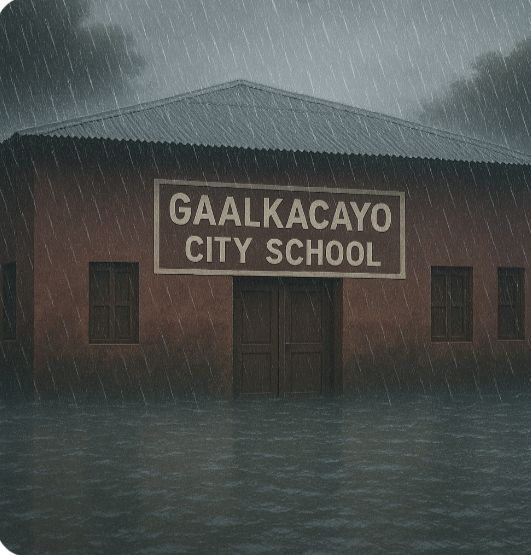
Every rainfall now brings catastrophe. The city’s drainage systems are either nonexistent or choked with years of neglect. School buildings—once iconic centers of learning like Bardacad School, now stand shuttered, flooded, and crumbling. The collapse of landmark educational institutions after repeated submersion in rainwater is more than a failure of infrastructure; it is a direct assault on the future of the next generation.

The government’s excuse? “This is no different from the rest of the country.”
Let that sink in.

This dismissive, lazy, and grossly irresponsible statement encapsulates the rot that has infected governance. Galkayo is not a victim of nature—it is a victim of state and community negligence.

2. Lawlessness Reigns as the Police Stand Powerless

The city’s police force is a shell of its former self—under-equipped, underpaid, and overwhelmed. Banditry, inter-clan killings, and revenge crimes go unpunished. Police morale is nonexistent. There is no civilian trust. Galkayo’s law enforcement institutions have been systematically weakened to the point of irrelevance.

Security is now in the hands of whoever holds a gun. Justice is bought or executed on the streets.
Is this what the state calls governance?

3. Financial Drain: Galkayo’s Wealth Transferred, Not Invested

It is no secret anymore: Galkayo’s monthly revenue is siphoned off to Garowe under the pretext of state revenue. This is outright theft disguised as administrative routine. What the people of Galkayo pay in taxes never comes back to them in services, investment, or development. Instead, their money builds office towers, guest houses, and highways in far-off cities—while Galkayo remains a mud pit of broken streets and shattered hopes.

This is not federalism.
This is exploitation.

4. Infrastructure in Ruins—No Road, No Airport, No Dignity

What remains of Galkayo’s roads are barely passable trails. Its airport is a decaying relic. Economic infrastructure that once connected the city to the rest of the Horn of Africa has deteriorated beyond repair. In other cities, the government builds. In Galkayo, it demolishes by omission. The private sector has fled. Investors avoid it. The youth emigrate en masse.

There is no mobility, no trade, no future.

5. A Social Fabric Torn by Tribal Hatred and State Failure

Tribal hatred and mistrust have taken deep root in Galkayo. Traditional elders once respected for wisdom and reconciliation now openly hate one another—fuelled by manipulation, power struggles, and the absence of a neutral state apparatus to mediate. The government has not only failed to address social fragmentation—it has profited from it, turning clans into tools of political control.

Today, Galkayo’s strongest export is its people—fleeing poverty, insecurity, and hopelessness. Its most educated sons and daughters are now in Nairobi, Addis Ababa, or Istanbul. Its youth fight wars that aren’t theirs. Its women endure famine, fear, and silence.

6. The Government’s Excuses Are an Insult

The claim that Galkayo’s disaster is “just like the rest of the country” is not only untrue—it is cruel. Galkayo has borne the brunt of every conflict, every betrayal, and every failed promise. The deliberate underdevelopment, marginalization, and mistreatment of the city cannot be glossed over by lazy comparisons.

This is not normal.
This is not acceptable.
This is deliberate destruction through neglect.

Call to Action: Enough is Enough

The Galkayo Community Conference was supposed to ignite a movement. Now it must fuel a revolution of civic resistance and demand for justice. The people of Galkayo cannot afford to wait for Garowe, or Mogadishu, or foreign donors to rescue them.

We demand:

1. Immediate restoration of basic infrastructure—roads, schools, drainage, and healthcare.

2. Autonomous control over local revenue, with transparent budgeting and public oversight.

3. Reconstruction and reequipping of the Galkayo Police Force, free from political interference.

4. An independent inter-clan reconciliation initiative, protected from state co-optation.

5. Accountability mechanisms for the state institutions that have siphoned public funds from Galkayo for over a decade.

Conclusion: Galkayo Will Not Be Silent

This post-conference report is not a lament—it is a warning. The people of Galkayo will not accept second-class citizenship in their own homeland. Those who have allowed this crisis to fester must know: silence has ended.

The rain may drown the streets, but it will not drown our voices.

Galkayo lives. Galkayo resists. Galkayo will rise again—with or without you.

By WDM Editorial Team
August 2, 2025

WDM EDITORIAL: BREAKTHROUGH IN GALKAYO: A DEFIANT COMMUNITY MOVES THE NEEDLE IN PUNTLAND POLITICS

Strong Message to Garowe: You Can’t Muzzle the People Forever

Galkayo City sinking in rainfall

In a powerful display of grassroots determination, the Galkayo Community Conference—deliberately obstructed and politically sabotaged by the Said Abdullahi Deni administration—has finally convened and concluded successfully, sending shockwaves through Puntland’s fragile political structure.

A Historic Moment the Deni Administration Tried to Bury

Let’s be clear: this conference was not welcomed by the current Puntland leadership. In fact, every trick in the book was deployed to prevent this gathering—from intimidation and administrative sabotage to propaganda campaigns painting the conference as anti-government or “chaos-driven.” President Deni’s administration had hoped to suppress it entirely under the false narrative that it would serve as a platform for hostile actors. But they were wrong—badly wrong.

What emerged instead was a genuine people-driven dialogue, a shining example of what constitutional participatory governance is meant to look like. Representatives from across Mudug—from professionals and youth leaders to elders and civil society advocates—showed up and made their voices heard.

The Real Fear: Accountability

Why would a government fear a community conference?

Because this administration is allergic to accountability. For far too long, the Deni regime has ruled with top-down arrogance, believing that the people of Puntland—particularly in strategically important cities like Galkayo—are passive subjects to be managed, not citizens to be consulted. That illusion has now been shattered.

Galkayo is not Garowe’s backyard. It is a city of resilience, a community tired of crumbling infrastructure, environmental neglect, and stalled development projects. The people have real questions:

Where are the long-promised roads, airports and city-sanitation networks?

Why is Galkayo—a city that has historically stood at the crossroads of Somali unity—treated like a neglected outpost?

Why has the regional government turned a blind eye to the deteriorating security and rising youth unemployment?

The Conference Outcome: Message Delivered, Loud and Clear

The Galkayo Community Conference became more than just a meeting—it was a political awakening.

1. It reaffirmed the community’s right to convene, debate, and organize.
The Constitution of Puntland—and of Somalia at large—protects civic assembly. Today’s conference was not an act of rebellion but of responsibility. The community has every right to organize and demand what the government has failed to deliver.

2. It exposed the paranoia of the Deni administration.
The groundless fears of “agents of chaos” or “anti-government movements” were exposed for what they were: a desperate excuse to justify authoritarian overreach. This was not an opposition rally; it was a civic dialogue. That it was feared speaks volumes.

3. It set a precedent for all other Puntland regions.
If Galkayo can do it, so can Bossaso, Qardho, Buuhoodle, and beyond. The era of muffling community voices under the guise of state security is ending. Puntland citizens are waking up to their constitutional role in governance.

A Warning to Garowe: The Tide Has Turned

President Deni and his advisors must understand that this is no longer the Puntland of One-man show, where leadership controlled both the narrative and the people. The people of Galkayo have spoken: you will not be allowed to rule in silence or with impunity.

The message is clear: the days of unilateral rule are numbered. Any future administration in Puntland must engage the people, listen to the ground, and allow bottom-up development.

This conference was a warning shot, not a declaration of war. But if the current leadership continues to stifle legitimate civic expression and refuses to course-correct, they will soon find themselves politically obsolete.

Final Word: From Galkayo, A New Chapter Begins

Let the record reflect:
The Galkayo Community Conference was held.
It was peaceful.
It was powerful.
It was necessary.

Let Puntland’s people across all districts take courage from this. Your voice matters. Your city matters. Your future must not be decided behind closed doors in Garowe.

The silence is broken.
The people are speaking.
And they will not be silenced again.

#GalkayoConference #PuntlandPeopleFirst #CivicPower #CommunityMatters #EndPoliticalArrogance