
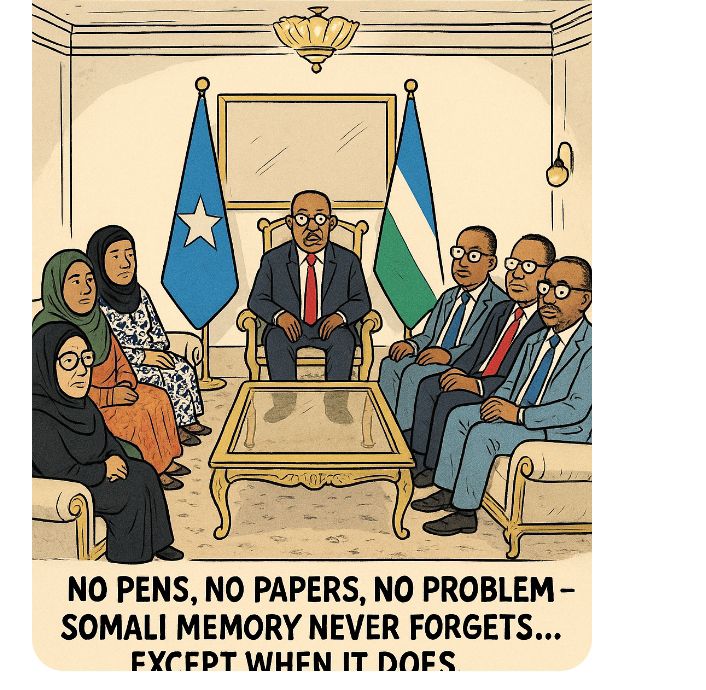
In the gilded salons of Garowe, where the curtains are heavier than the policy papers, the Puntland administration has discovered a new form of governance: sitting still, looking serious, and ensuring that not a single note is ever written down.
Look carefully at the photo. Not a pen. Not a notebook. Not even the humble biro stolen from a hotel reception desk. Instead, the honorable gentlemen and ladies of Puntland State sit like wax statues in a Somali Madame Tussauds, staring ahead as though waiting for Allah Himself to record the minutes.
The governorate of Puntland has apparently abolished the primitive practice of “note-taking” in favor of a new model called Memory Governance™. The theory is simple: if you remember the meeting later, it was important; if you forget, it probably wasn’t.
But here lies the tragicomedy: the man in the blue suit with the tie patterned like Mogadishu pavements nods sagely, while the one in the red tie leans back as if calculating how much of his stomach tax revenue could cover. Yet no one dares break the sacred silence by pulling out a notebook. For in Puntland, the first person to take notes becomes the secretary, and nobody wants that cursed job.
Even the women on the other side of the room, draped in colorful hijabs, sit calmly, clutching their handbags like they might contain the lost archives of Puntland State—hidden there since 1998. If only one brave soul would unzip and pull out a pen!
In the middle, His Excellency sits between the Somali flag and the Puntland flag, two cloth witnesses to this administrative theatre, presiding over what might be the most unrecorded meeting in Somali political history. Generations from now, scholars will debate what was said here—because nobody wrote it down.
Until then, Puntland continues to govern through the oral tradition of nodding heads and folded hands, while the minutes of every meeting evaporate.

 Warsame Policy & Media Network (WAPMEN)
You must be logged in to post a comment.