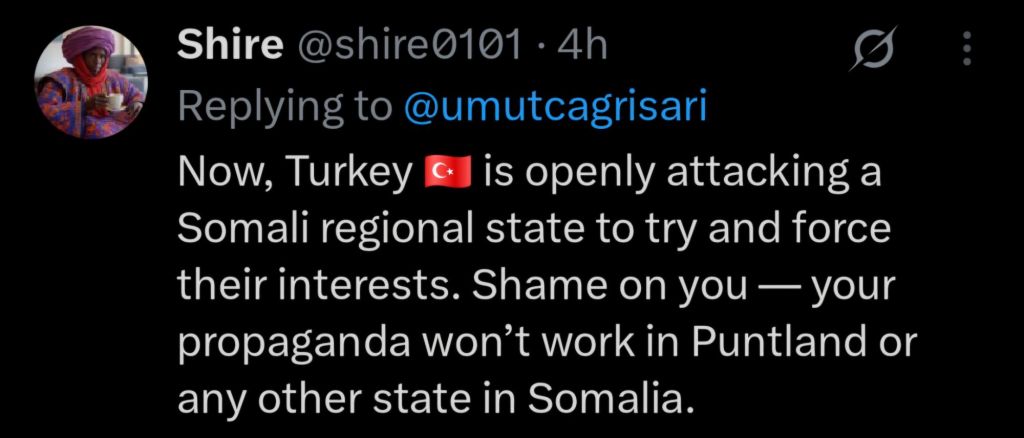
Turkey’s Meddling in Somalia: A Dangerous Campaign Against Puntland’s Stability

By: WDM

In a disturbing display of neocolonial arrogance, Turkey has escalated a media and diplomatic campaign targeting Puntland State — one of Somalia’s most stable and functional federal member states. The target of Ankara’s ire? A legal, transparent, and well-documented partnership between Puntland and the United Arab Emirates focused on trade, security, and infrastructure. This campaign is not only baseless; it is dangerous and exposes Turkey’s increasingly aggressive posture in the Horn of Africa.

Let us be unequivocal: Puntland is not a sovereign actor conducting rogue foreign policy. It is a constitutionally recognized federal state within Somalia, operating well within the bounds of its decentralized governance powers. Its cooperation with the UAE — dating back over decades — has helped combat piracy, ISIS, build ports, and inject real economic value into a region long neglected by Mogadishu.

Contrast this with Turkey’s own role in Somalia. Ankara’s deepening ties with the Somali federal government have increasingly taken the form of secretive deals, including a murky hydrocarbon agreement signed without parliamentary scrutiny, stakeholder consultation, or environmental assessment. These opaque arrangements suggest that Turkey’s growing presence is not about development or partnership — but extraction, control, and influence.

Turkey’s latest provocation — using pundits and proxies to vilify Puntland — is an unacceptable interference in Somalia’s fragile federal system. It is a brazen attempt to intimidate a peaceful region into submission, to punish Puntland for choosing practical partnerships over political allegiance, and to delegitimize any actor that does not tow Ankara’s preferred line.

This campaign also undermines the very stability that Turkey claims to support. Puntland is not a rebel territory or a breakaway enclave; it is a functioning federal member state with its own institutions, security forces, and governance structures. By attacking Puntland’s legitimacy, Turkey is not just meddling — it is fueling division and weakening Somalia’s already fragile federalism.

For a country that presents itself as a benevolent partner in Africa, Turkey is increasingly behaving like a 21st-century empire-builder — silencing dissent, pressuring local authorities, and cutting deals behind closed doors. This is not development. This is not diplomacy. It is coercion.

The international community must not stand by while a foreign power bullies a peaceful region for engaging in legal, beneficial partnerships. Turkey must be held to account for its destabilizing rhetoric and backroom dealings. Somalia needs genuine allies — not overlords.

If Turkey wants to be a partner in Somalia’s future, it must start by respecting the country’s federal structure, ceasing its propaganda against Puntland, and submitting its own dealings to the same transparency it demands of others. Until then, its influence in Somalia will be viewed not as a partnership but as provocation.

A Call for Accountability: Donor Complicity in Undermining Puntland’s Federal Rights

By: Warsame Digital Media (WDM)

To the international donor community,

The people of Puntland State of Somalia have watched with growing alarm as international aid, pledged in the name of unity, development, and federalism, is increasingly weaponized to serve narrow political interests. Aid intended to improve lives and strengthen governance is instead being manipulated to impose authoritarian control from Mogadishu—at the expense of equity, trust, and federalism.

This is not an accusation made lightly. Puntland, a founding pillar of the Somali Federal Republic and a model of self-governance, has been deliberately sidelined in development programming, budgetary allocations, and donor-led initiatives. Resources acquired in the name of “Somalia” are disproportionately channeled through federal institutions that lack the will—or in some cases, the constitutional authority—to represent or deliver on behalf of all federal member states.

Donors cannot claim ignorance. Repeated warnings have been issued by Puntland and other federal entities, urging a more balanced and transparent mechanism for aid delivery. Yet little has changed. Development partners continue to funnel assistance through a centralized bureaucracy that has shown open hostility toward Puntland’s autonomy and governance model.

Let us be clear: aid that undermines local ownership, disregards constitutional mandates, and serves as a lever for political compliance is not aid—it is coercion. It empowers autocracy, stifles regional initiative, and erodes the very foundations of the federal system donors once helped to craft.

Puntland has thrived not because of external largesse but because of internal resilience. We built functioning institutions while others crumbled. We maintained peace and democratic transitions while others turned to conflict. We earnesly fight extremists where others abysmally fail. We are not seeking special treatment—only our fair share, delivered through mechanisms that respect our identity, governance, and constitutional rights.

This is an urgent call for course correction. The donor community must:

1. End the monopolization of aid through Mogadishu and adopt a dual-track system that directly engages capable federal member states like Puntland.

2. Uphold constitutional principles in all aid agreements and programming.

3. Insist on transparency and accountability in the distribution of donor funds, not just at the federal level, but across all tiers of government.

4. Respect regional autonomy and avoid becoming complicit in centralization schemes that threaten peace and stability.

Donor silence is no longer neutral—it is enabling. If the international community truly values democratic governance, federalism, and sustainable development, then it must act now. Puntland will continue on the path of self-reliance and determination. But we will not remain silent as our people are denied the resources, respect, and representation they rightfully deserve.

The time for quiet diplomacy has passed. The donor community must choose between enabling authoritarian consolidation—or supporting a pluralistic and balanced federal Somalia.

Puntland has chosen its path. Will you stand with us?

Puntland Will Not Bow to Donor-Driven Authoritarianism

https://ismailwarsame.substack.com/p/puntland-will-not-bow-to-donor-driven

Puntland Will Not Bow to Donor-Driven Authoritarianism

WDM EDITORIAL

In a troubling and deeply consequential trend, the politicization of donor assistance by the federal authorities in Mogadishu has reached a critical point—weaponizing aid to enforce authoritarian control over the autonomous Puntland State. What was once a mechanism to uplift Somali communities has now become a tool of coercion, deployed not for development, but for domination.

Millions of dollars earmarked for Puntland—resources secured in the name of the Somali people—are either diverted, delayed, or deliberately politicized by a federal administration bent on centralizing power at the expense of regional autonomy. The donor community, whether by willful ignorance or silent complicity, enables this injustice. By funneling aid through Mogadishu without enforcing equitable distribution, international partners are empowering a centralized elite and undermining the very federal system they claim to support.

Let it be stated clearly: Puntland will not be strong-armed into submission through manipulated aid schemes or bureaucratic blackmail. Our people have endured decades of adversity—not through handouts or appeasement—but through self-reliance, governance, and sheer determination. We built institutions when others faltered, and we maintained stability while others dissolved into chaos. To now be treated as a subordinate entity, expected to beg for what is rightfully ours, is not only unacceptable—it is an affront to our dignity and legacy.

This conspiracy to starve Puntland into political obedience will fail. No amount of donor deception or Mogadishu maneuvering will erase the will of a people determined to chart their own course. Puntland does not reject aid—it rejects manipulation. We will welcome partnership, but only one that respects our autonomy, our rights, and our people.

The international community must choose: continue propping up authoritarianism cloaked in federal rhetoric, or stand with regions like Puntland that actually embody the democratic and developmental aspirations they so often preach. Time is running out for neutrality. Silence, at this juncture, is nothing less than endorsement of tyranny.

Puntland is not for sale. We will weather this storm, as we have others—by standing firm, standing free, and standing together.

Independent Media Matters. So, Does Your Support

At Warsame Digital Media (WDM), we don’t answer to pressure groups.
We answer to you — our readers.

Here’s why your support is critical:

1. It protects our independence.
No outside agendas. No censorship. We tell the truth — even when it’s inconvenient for those in power.

2. It keeps us focused on real journalism, not empty clicks.
We don’t chase trends or viral nonsense. We cover stories that matter — for our communities, our future, and our freedom.

3. It keeps WDM open for everyone.
We believe everyone deserves access to honest, fearless reporting.

Right now, most of our readers enjoy WDM without paying — and that is not good enough. If you believe independent journalism is worth fighting for, we need you to step up.

A small monthly contribution or an annual fee of $37 only make the biggest difference.
It powers deep investigations, amplifies unheard voices, and shields us from outside control.

If you can, please support WDM today.
We’ll make it quick, easy — and you’ll be part of something truly powerful.

Join us at iwarsame@ismailwarsame.blog/ismailwarsame@gmail.com. +252 90 703 4081.

Protect independent media. Power the future.

Somalia’s War Within: Why Al-Shabaab Cannot Be Defeated from a Compromised Government

https://ismailwarsame.substack.com/p/somalias-war-within-why-al-shabaab